
Ever wonder what actually happens when you send a crypto transaction? It doesn't just vanish into the digital ether. It gets packaged, hashed, and locked into a rigid container known as a block, which is the fundamental structural unit of a blockchain that records and stores transaction data in a secure, immutable format. Think of it like a page in a ledger book, but one that’s cryptographically sealed so no one can erase or alter the entries without breaking the whole chain. Understanding how these blocks are built is the key to grasping why cryptocurrencies work the way they do.
The Core Anatomy: Header vs. Body
Every block in a cryptocurrency network is split into two main sections: the block header, which acts as the metadata and security lock, and the transaction body, which holds the actual data. The header is small and fixed in size, while the body is variable and contains the bulk of the information. In Bitcoin, for example, the header is strictly 80 bytes long, whereas the body can hold up to 1 megabyte of transaction data. This separation allows nodes to verify the integrity of a block quickly by checking the header first, before processing the heavier transaction list.
Deep Dive: The 80-Byte Block Header
The header is where the magic of cryptographic linking happens. It contains six specific fields that define the block's place in history and its validity. If you change even a single bit in the body, the header becomes invalid because it relies on hashes to stay connected to the rest of the chain.
- Version (4 bytes): Indicates the protocol version, usually set to "1" for standard Bitcoin blocks.
- HashPrevBlock (32 bytes): The cryptographic hash of the previous block's header. This is the link that turns a stack of blocks into a chain.
- HashMerkleRoot (32 bytes): A summary hash of all transactions in the block, derived from a Merkle tree. It ensures every transaction inside is accounted for.
- Timestamp (4 bytes): The Unix time when the block was created, placing it chronologically in the ledger.
- Difficulty Bits (4 bytes): A compressed representation of the target difficulty, determining how hard it is to find a valid hash.
- Nonce (4 bytes): A random number miners adjust repeatedly until they solve the computational puzzle.
Beyond these core fields, the raw binary data of a block also includes a magic number (always 0xD9B4BEF9 in Bitcoin) to identify the file format, a block size field, and a transaction counter that tells the node how many transactions to expect next.
Inside the Transaction Body
The body is where the actual money moves. It’s a variable-size section filled with individual transaction records. Each transaction within this body has its own internal structure, including inputs, outputs, and signatures. The most critical component here is the coinbase transaction, which is always the first entry in any new block. This special transaction generates new coins as a reward for the miner who solved the block, effectively creating new supply out of thin air according to the network's rules.
Following the coinbase transaction, you’ll find standard transfers. Each one specifies:
- Txin_count: How many inputs (previous unspent outputs) are being consumed.
- Txins: The list of those inputs, referencing previous transactions.
- Txout_count: How many new outputs (receivers) are created.
- Txouts: The list of receivers and amounts.
- Script_witnesses: Data for Segregated Witness (SegWit) signatures, which helps optimize space.
- Lock_time: Usually zero, meaning the transaction is valid immediately upon inclusion in a block.
How Blocks Link Together: The Chain Effect
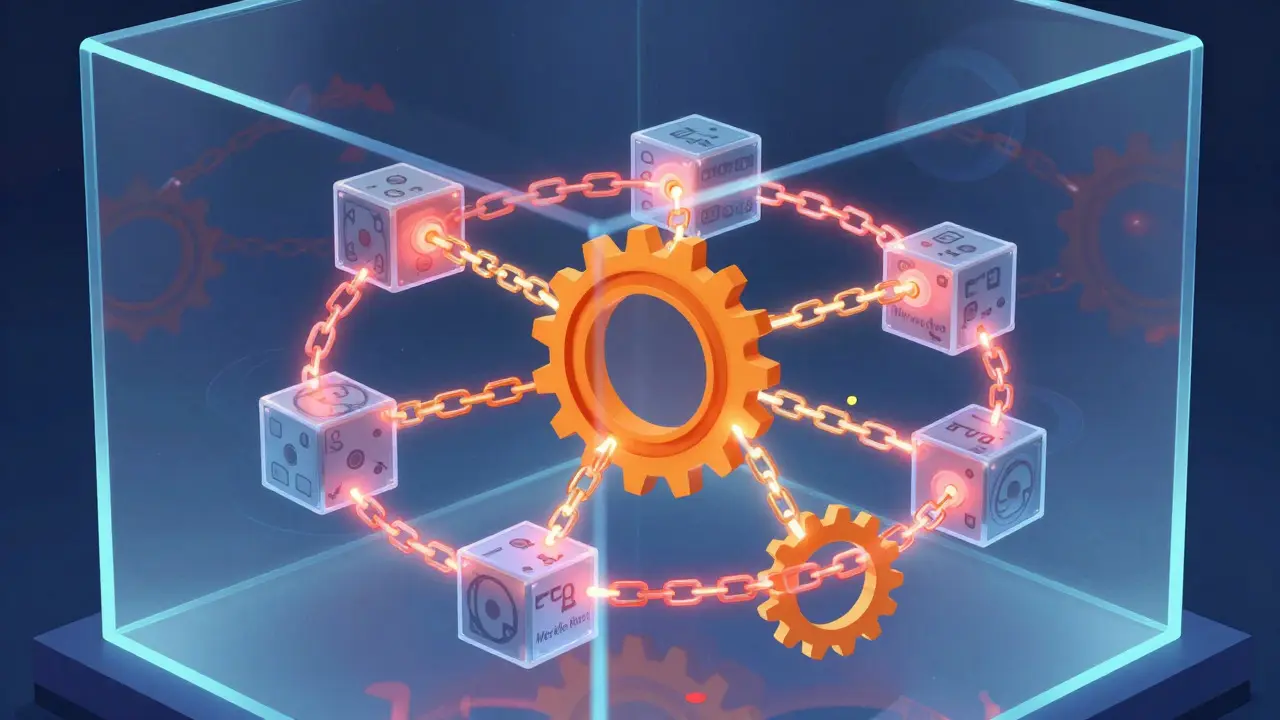
Blocks don't exist in isolation. They are strung together linearly through the hashPrevBlock field in the header. When a miner creates a new block, they must include the exact hash of the current last block in the network. This creates a dependency: if you try to tamper with an old block, its hash changes, which breaks the link to the next block, which breaks the link to the one after that, and so on. To fix the chain, you’d have to re-mine every subsequent block, which is computationally impossible for large networks like Bitcoin. This iterative verification process confirms integrity all the way back to the genesis block, the very first block ever created.
The Role of the Merkle Tree
Why not just list the transactions and hash them directly? Because efficiency matters. Instead, transactions are organized into a Merkle tree, a hierarchical data structure. Transactions are paired and hashed, then those hashes are paired and hashed again, continuing until a single root hash remains. This root hash goes into the block header. This structure allows light clients to verify if a specific transaction is in a block without downloading the entire block, significantly reducing storage requirements and speeding up proofs.

From Creation to Consensus
Creating a block isn't just about packing data; it's about solving a math problem. In Proof of Work systems, miners constantly change the nonce value in the header, hashing the result each time. They keep going until the resulting hash starts with a certain number of zeros, matching the current difficulty bits. Once found, the block is broadcast to the network. Other nodes validate the work and the transactions. If valid, the block is added to their local copy of the ledger. In Proof of Stake networks, validators are chosen based on their stake rather than computing power, but the block structure itself remains remarkably similar, ensuring compatibility across different consensus mechanisms.
| Component | Size (Bytes) | Function | Key Attribute |
|---|---|---|---|
| Block Header | 80 | Identifies block, links to previous, sets difficulty | Fixed size, cryptographically verified |
| Transaction Body | Variable (up to ~1MB) | Stores actual transaction data and rewards | Contains coinbase tx and user transfers |
| Merkle Root | 32 | Summarizes all transactions for quick verification | Enables efficient proof-of-inclusion |
| Nonce | 4 | Random number adjusted during mining | Critical for Proof of Work solution |
Why Structure Matters for Security
The rigid structure of a block is what makes it immutable. Because the header depends on the body via the Merkle root, and the current header depends on the previous header via the prev-hash, any alteration requires recalculating massive amounts of data. This design ensures transparency, as all transactions are publicly visible, and prevents double-spending by maintaining a strict chronological order. Whether you’re running a full node or just checking your balance, you’re relying on this precise architectural blueprint to trust that your assets are safe and recorded correctly.
What is the difference between a block and a transaction?
A transaction is a single transfer of value between parties. A block is a container that holds many transactions, along with metadata (the header) that secures and orders them. You can think of a transaction as a line item and a block as the page containing that line item.
Why is the block header only 80 bytes in Bitcoin?
The 80-byte limit is a design choice to keep the header lightweight. Nodes need to download headers frequently to sync with the network. A smaller header means faster synchronization and less bandwidth usage, while the heavy transaction data is downloaded separately or pruned depending on node type.
What happens if a miner finds a valid block?
The miner broadcasts the new block to the network. Other nodes verify the proof of work and the validity of the transactions. If everything checks out, the block is appended to the longest valid chain, and the miner receives the block reward plus transaction fees.
Do all cryptocurrencies use the same block structure?
Most follow the Bitcoin model closely, especially those using Proof of Work. However, some networks modify the structure to support smart contracts, larger block sizes, or different consensus mechanisms like Proof of Stake. The core concept of linking headers via hashes remains universal, though the specific fields may vary.
What is a coinbase transaction?
It is the first transaction in every block. Unlike normal transactions, it doesn't reference previous inputs. Instead, it creates new coins from nothing, paying the miner their reward for securing the network. It is essential for the issuance of new cryptocurrency supply.
