
Imagine waking up to find your salary worth half of what it was yesterday. That is the daily reality for millions in Venezuela, a nation where the bolívar has lost over 70% of its value since late 2023. In this environment, Bitcoin and stablecoins are not speculative assets; they are survival tools. For many Venezuelans, digital currency has become the only reliable way to buy food, pay rent, and save money without watching their wealth evaporate due to hyperinflation.
This article breaks down how cryptocurrency functions as a parallel banking system in one of the world's most volatile economies. We will look at the specific restrictions that drive this adoption, the technical hurdles users face, and why stablecoins like Tether have outpaced Bitcoin in daily use. You will understand the real-world mechanics of how people navigate U.S. sanctions, poor internet connectivity, and a collapsing national currency to keep their finances intact.
The Core Problem: Why Traditional Finance Failed
To understand why cryptocurrency took off in Venezuela, you first need to see what went wrong with the traditional system. The primary driver is not tech enthusiasm but economic desperation. Since the government stopped defending the bolívar in October 2023, inflation has skyrocketed. According to the Venezuelan Finance Observatory (OVF), annual inflation hit 229% by May 2024. When prices change daily, holding cash becomes a losing game.
Compounding this issue are severe restrictions on accessing foreign currency. U.S. sanctions, particularly under Executive Order 13850, have made it difficult for Venezuelan banks to maintain international relationships. This means ordinary citizens struggle to open accounts abroad or transfer money easily. As economist Aarón Olmos noted, Venezuelans turned to crypto out of necessity due to "inflation, low wages, foreign currency shortages, and difficulty opening bank accounts." It is a classic case of supply and demand: when the local currency fails and global options are blocked, people create their own market.
Stablecoins vs. Bitcoin: What People Actually Use
While Bitcoin gets the headlines, it is rarely the tool used for buying groceries. The dominant asset in Venezuela is the Tether (USDT) stablecoin. Local users often refer to USDT as "Binance dollars" because of its stability and ease of access. Unlike Bitcoin, which can swing 5% in an hour, USDT is pegged to the U.S. dollar, providing the price certainty merchants need to set menus and invoices.
Why does USDT win? Speed and cost. Bitcoin transactions can take 10 to 60 minutes to confirm during network congestion. In contrast, USDT transactions on the Tron network typically confirm in under two minutes. For a street vendor selling coffee, waiting an hour for payment is impossible. Here is a quick comparison of the two assets in the Venezuelan context:
| Feature | Bitcoin (BTC) | Tether (USDT) |
|---|---|---|
| Primary Use Case | Long-term savings / Store of value | Daily commerce / Payments |
| Price Volatility | High (can drop/rise significantly) | Low (pegged to USD) |
| Transaction Speed | 10-60 minutes | Under 2 minutes (Tron network) |
| Merchant Acceptance | Moderate | Very High (over 65% in Caracas) |
| Risk Factor | Market price fluctuation | Centralization risk (Tether Ltd.) |
Most Venezuelans hold a mix. They might receive a salary in bolívars, immediately convert it to USDT for spending, and move larger savings into Bitcoin for long-term protection against any future devaluation. This dual strategy maximizes both liquidity and security.
Navigating the Restrictions: Sanctions and Infrastructure
You cannot talk about crypto in Venezuela without addressing the heavy hand of regulation and infrastructure gaps. The biggest external restriction comes from U.S. sanctions. These rules block certain financial channels, making it hard for Venezuelan users to trade directly with major global exchanges using traditional bank wires. To bypass this, the market relies heavily on Peer-to-Peer (P2P) trading platforms like Binance P2P and LocalBitcoins. These platforms allow users to trade directly with each other, often using informal cash deposits or local bank transfers, effectively creating a shadow banking system.
However, internal restrictions pose just as big a challenge: internet connectivity. Venezuela ranks 153rd globally for internet speed, averaging just 14.79 Mbps download speed. In rural areas, connectivity is even worse. This leads to frequent transaction failures or delays. About 37% of users report connectivity issues affecting their ability to transact. Furthermore, the Venezuelan government’s stance has been inconsistent. While they launched their own state-backed coin, Petro, in 2018 (which largely failed), they also cracked down on private exchanges at times. Yet, in practice, the government has tolerated the crypto ecosystem because it helps citizens survive. The Central Bank acknowledged crypto’s role in 2024 but offered no clear regulatory framework, leaving the market in a gray zone.
How Venezuelans Buy and Sell Crypto
So, how does a regular person actually get started? The process is steeper than in developed countries, but doable. Most new users master basic transactions within two to three weeks, according to a University of Carabobo study. Here is the typical workflow for someone trying to enter the market:
- Create a Wallet: Users start with a mobile wallet like Binance Wallet or Airtm. These apps are user-friendly and support Spanish, which is crucial for widespread adoption.
- On-Ramp via P2P: Since direct bank transfers are restricted, users go to a P2P platform. They list an offer to buy USDT or BTC using local bolívars or cash. Another user accepts, sends the funds via a local method (like a bank deposit to a friend or cash meeting), and releases the crypto once confirmed.
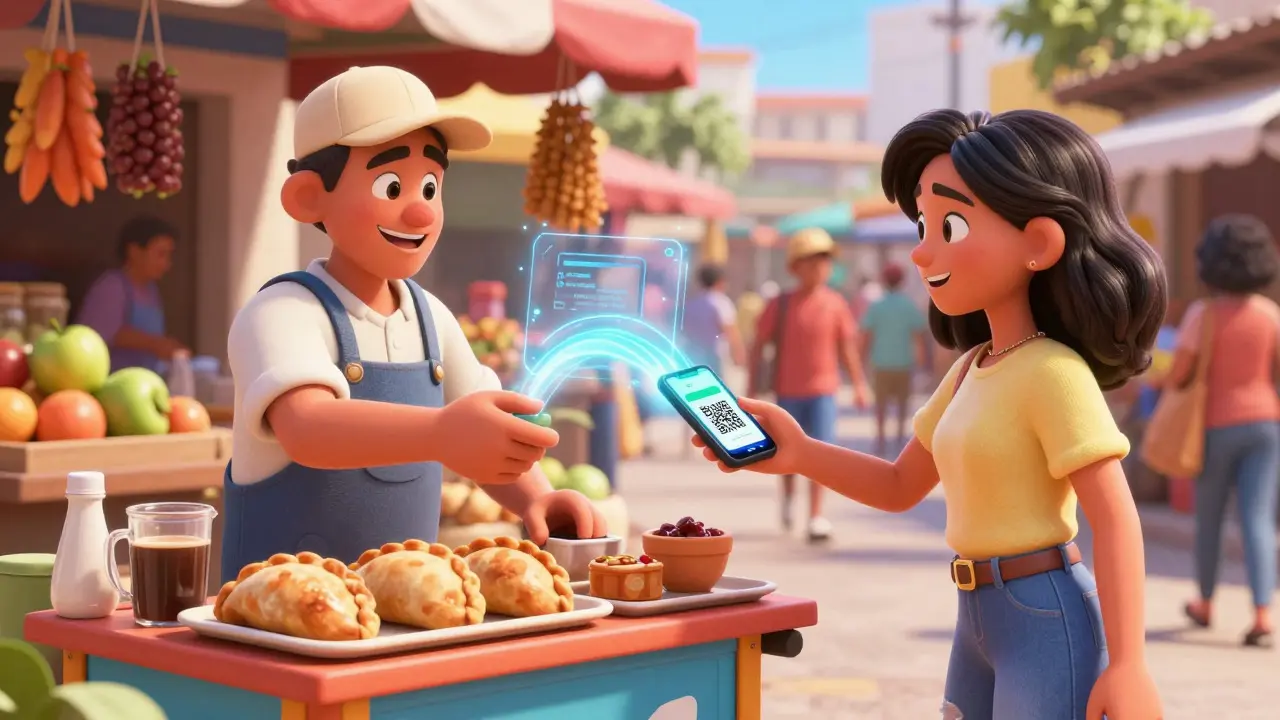
- Verify and Hold: Once the crypto arrives in their wallet, the user can hold it or spend it immediately. Many merchants accept QR code payments from these wallets, making checkout fast.
- Off-Ramp if Needed: If a user needs physical cash, they reverse the process, selling their crypto back through P2P. This step often incurs a spread cost of around 3.7% during high-demand periods, which is a significant hidden fee.
Education plays a huge role here. With formal banking education lacking, community resources fill the gap. YouTube channels like 'Cripto Para Todos' and university courses launched in 2025 have become essential training grounds. Without this grassroots education, the learning curve would be too steep for the average citizen.

Real-World Impact: Stories from the Ground
Statistics tell part of the story, but personal experiences reveal the true impact. Victor Sousa, a resident of Caracas, described buying phone accessories with USDT: "There's lots of places accepting it now... The plan is to one day have my savings in crypto." For him, crypto is not a gamble; it is a practical choice. Carlos, another resident, put it more bluntly: "I use USDT for everything-buying food, paying rent. It is much more reliable than the bolivar." His experience highlights the shift from viewing crypto as a tech novelty to seeing it as a utility. On Reddit, in the r/BitcoinVenezuela community, users share similar sentiments. One user, 'CryptoSurvivorVE,' posted in June 2025: "Without USDT, I couldn't feed my family after my bolivar salary became worthless overnight." These stories illustrate a key point: crypto adoption in Venezuela is driven by pain. It solves immediate problems. However, it also introduces new risks. The Venezuelan Finance Observatory documented 1,247 consumer complaints in Q1 2025, mostly related to price volatility during conversion and platform glitches. If the internet goes down, or if a P2P counterparty defaults, there is little recourse. It is a fragile system built on trust and technology rather than legal guarantee.
The Future: Will Crypto Stay or Go?
Will this trend continue? Most experts say yes, at least until the bolívar stabilizes. IMF economists suggest that inflation might not drop below 50% annually before 2027. As long as the local currency is unstable, the demand for dollar-pegged assets will remain high. Currently, 91% of Venezuela's crypto transactions involve stablecoins, showing that the market prefers safety over speculation. However, long-term viability faces challenges. Relying on centralized issuers like Tether creates dependency. If Tether changes its policies or if U.S. sanctions tighten further, the system could disrupt. Some economists warn that if the bolívar ever achieves moderate stability, crypto adoption might drop rapidly, leaving users exposed to the risks they previously avoided. Others, like Diego Morales from Binance, argue that digital assets have become a permanent part of Venezuela's financial landscape, processing transactions that traditional finance simply cannot handle. For now, the outlook is mixed but active. With $119 million in monthly transaction volume as of July 2025, the ecosystem is growing. Integration with regional systems like BRICS payment initiatives could provide alternative infrastructure less vulnerable to U.S. restrictions. But for the everyday Venezuelan, the question isn't about the future of blockchain technology; it's about whether they can afford dinner today. And for that, crypto is currently the best answer available.
Is Bitcoin widely accepted in Venezuela?
Yes, but stablecoins like USDT are more common for daily purchases. Over 65% of surveyed merchants in Caracas accept some form of cryptocurrency, with USDT being the preferred option due to its price stability compared to Bitcoin's volatility.
What are the main restrictions on using crypto in Venezuela?
The main restrictions come from U.S. sanctions, which limit direct banking relationships, and poor internet infrastructure. Additionally, the lack of a clear local regulatory framework creates uncertainty, though the government has largely tolerated private crypto usage.
Why do Venezuelans prefer USDT over Bitcoin?
USDT is pegged to the U.S. dollar, providing price stability needed for daily commerce. It also processes transactions faster (under 2 minutes on Tron) compared to Bitcoin (10-60 minutes), making it more practical for merchants and consumers alike.
How do people buy crypto in Venezuela without easy bank access?
Most users rely on Peer-to-Peer (P2P) platforms like Binance P2P or LocalBitcoins. These allow them to trade directly with other individuals using local payment methods, bypassing the need for traditional international bank transfers.
Is the Venezuelan government supportive of cryptocurrency?
The government's stance is mixed. While they launched their own failing token, Petro, and have occasionally cracked down on exchanges, they have generally tolerated private crypto usage because it helps citizens cope with hyperinflation. There is currently no strict regulatory framework banning it.

Laine Van Sickle
August 25, 2026 AT 20:17ok so basically they are just using a digital dollar because their own money is trash right? feels like we should be more worried about our own economy but nah we just complain about gas prices while they are literally surviving on code. its kinda sad tbh
Jarnail Singh
August 27, 2026 AT 18:38It is truly fascinating to observe how the human spirit, when pushed to the absolute brink of economic despair by the incompetence of local governance, inevitably turns to decentralized financial instruments as a last resort for survival, much like how our own nation navigated the complexities of global trade during the post-independence era, though admittedly with far fewer hyperinflationary hurdles and a stronger institutional framework that provided a safety net for the common citizen, which is why one must always appreciate the stability that comes from strong central banking and national pride in currency management :)
Ashwini Chaskar
August 28, 2026 AT 18:53its not just about the tech its about the pain people are in you see. they dont care if it is bitcoin or tether they just want to eat without losing half their salary before lunch time. i think we underestimate how desperate people get when the system fails them completely. it makes you feel guilty living in a place where your savings dont evaporate overnight
Sam Ariafar
August 29, 2026 AT 03:05The moral imperative here is clear: when a government allows its currency to become meaningless, the people have every right to seek alternative stores of value. It is not rebellion; it is self-preservation. We often judge these communities for their lack of trust in state institutions, but who can blame them when the state itself has broken the social contract regarding monetary stability?
Jane yuan
August 30, 2026 AT 08:20Sanctions are the real villain here. The US creates the problem, then acts surprised when people find workarounds. It’s a paradox of control.
Ian Munro
August 31, 2026 AT 00:14USDT dominance makes sense. Volatility kills daily commerce. If your coffee price changes every hour, you stop buying coffee. Stablecoins solve the medium-of-exchange problem better than BTC does in this context.
Trista Dennis
August 31, 2026 AT 20:53Ah, yes, the classic 'crypto saves the day' narrative. Let's ignore the fact that 37% of users struggle with internet connectivity. Because clearly, relying on a network that goes down whenever the power grid sneezes is the ultimate financial freedom. Truly a beacon of progress.
nic c
September 1, 2026 AT 01:24You guys are missing the massive, gaping hole in this whole setup which is that it’s all built on sand! I mean really think about it for a second, the entire ecosystem is hanging by a thread of P2P trust and some centralized issuer in the Cayman Islands who could pull the rug out from under everyone at any moment. It’s like building a skyscraper on a cloud and wondering why it doesn’t fall over when the wind picks up. The drama of it all is almost poetic in its fragility, isn't it? One bad day on the exchange or a slight tightening of sanctions and boom, back to square one with nothing but air in your pockets and a headache that won't quit. It’s a high-stakes game of musical chairs where the music is the internet connection and the chair is your dinner money.
Kevin Payette
September 1, 2026 AT 06:45Tether is a trap. Centralization risk is the only risk that matters long-term. Bitcoin is the only true answer. Stop being sheep.
Rebecca Springer
September 3, 2026 AT 04:13It is important to remember that for many of these individuals, this is not a speculative bet but a necessary adaptation to survive. While we debate the merits of decentralization versus centralization, they are simply trying to keep their families fed. Their resilience deserves respect, regardless of the tools they choose to use.
J Shepherd
September 4, 2026 AT 13:01From an infra perspective, the P2P spread of 3.7% is brutal. That's higher than most credit card fees. But when the alternative is holding cash that loses 2% a day, the math works out. The liquidity premium is just the cost of doing business in a sanctioned zone. Nice breakdown of the workflow steps, very helpful for understanding the friction points.
Alan Hawkins
September 5, 2026 AT 10:53I agree with the point about education. Without community support, the learning curve would be impossible for most people. Great job highlighting those resources.
Steve Sulley
September 5, 2026 AT 22:01actually im not sure this is such a good thing. maybe they need to learn to live with their own currency? also the govt might just crush it eventually. crypto is always temporary until the next big crash or regulation hits. dont get too excited about it. its just a bubble waiting to pop. plus the internet is bad so its all a mess anyway. lol
Linda Jevne
September 7, 2026 AT 11:22There is something profoundly poetic about a nation turning to the most volatile technology of our age to find stability. It highlights the absurdity of modern finance: that the safest harbor for a Venezuelan family is not their own bank, but a token issued by a private company. It forces us to reconsider what 'value' actually means when the state ceases to be the guarantor of that value. Is it the code? The consensus? Or simply the collective belief that today is better than yesterday?
Carey Thornton
September 7, 2026 AT 20:41Let's be honest, this is just another example of the Global South being forced to innovate because the West failed to provide basic economic stability. They are pioneering the future of finance while we sit around debating whether Bitcoin is a rock or a store of value. Pathetic, really. The Venezuelans are the true innovators here, dragging us all into the 21st century whether we like it or not.
David Powell
September 9, 2026 AT 15:09How naive. You think the US will let a parallel banking system flourish under their nose? It's a matter of time before the SEC or Treasury steps in and shuts it all down. Enjoy the ride while it lasts.
Ellie Brooks
September 10, 2026 AT 12:49This is such an inspiring story of resilience! It really shows how technology can empower people when traditional systems fail. I love seeing how communities come together to create solutions, like those YouTube channels mentioned. It gives me hope that no matter how tough things get, there is always a way forward if people are willing to adapt and learn from each other. Keep sharing these stories!
Dave Worth
September 11, 2026 AT 13:06👀 Tether is just the Fed with extra steps. The US gov knows exactly what's happening and lets it happen because it keeps the population docile and dependent on the dollar (even if it's digital). 🧠💡 Wake up sheeple. It's all controlled. 😎
Sean Dalton
September 12, 2026 AT 07:33Oh, brilliant. So now the Irish taxpayer's hard-earned wealth is indirectly propping up a black market in Caracas via some obscure blockchain link? Absolutely not. Let them sort out their own mess with their own failing currency. Why should we subsidize their incompetence through global financial interconnectivity? Typical.