
Remember the last time you had to prove who you were online? Maybe you uploaded a blurry photo of your driver's license to a bank, or you waited three days for a background check to clear before starting a new job. It’s tedious, invasive, and frankly, broken. We hand over our most sensitive personal data to hundreds of different companies, trusting them to keep it safe. But do they? The 2017 Equifax breach exposed the personal details of 147 million people, proving that centralized databases are just big targets with big vulnerabilities. Blockchain identity authentication is a decentralized method of verifying identity that gives users control over their own data rather than relying on central authorities. It shifts the power dynamic from "trust us" to "verify me," offering speed, security, and privacy in one package.
The End of the Single Point of Failure
Traditional identity management works like a library card catalog. If the catalog burns down-or gets hacked-everyone loses access to their records. Centralized systems create single points of failure. When a company stores your password, date of birth, and social security number in one server, they become a honeypot for hackers. Blockchain flips this model on its head. Instead of storing your identity in one place, it distributes the verification logic across a network of nodes. This means there is no central server to hack. Even if one node goes offline, the system keeps running.
This isn't just theoretical. In traditional Know Your Customer (KYC) processes, banks spend hours manually checking documents. J.P. Morgan’s Kinexys division reported that blockchain-based verification can process 98% of checks in under two seconds. Compare that to the standard 24 to 72-hour wait times for manual reviews, and the efficiency gain is obvious. You aren't just saving time; you're reducing the attack surface. Since your raw data doesn't sit in a vulnerable database, hackers have nothing to steal but cryptographic hashes, which mean nothing without your private key.
Self-Sovereign Identity: You Own Your Data
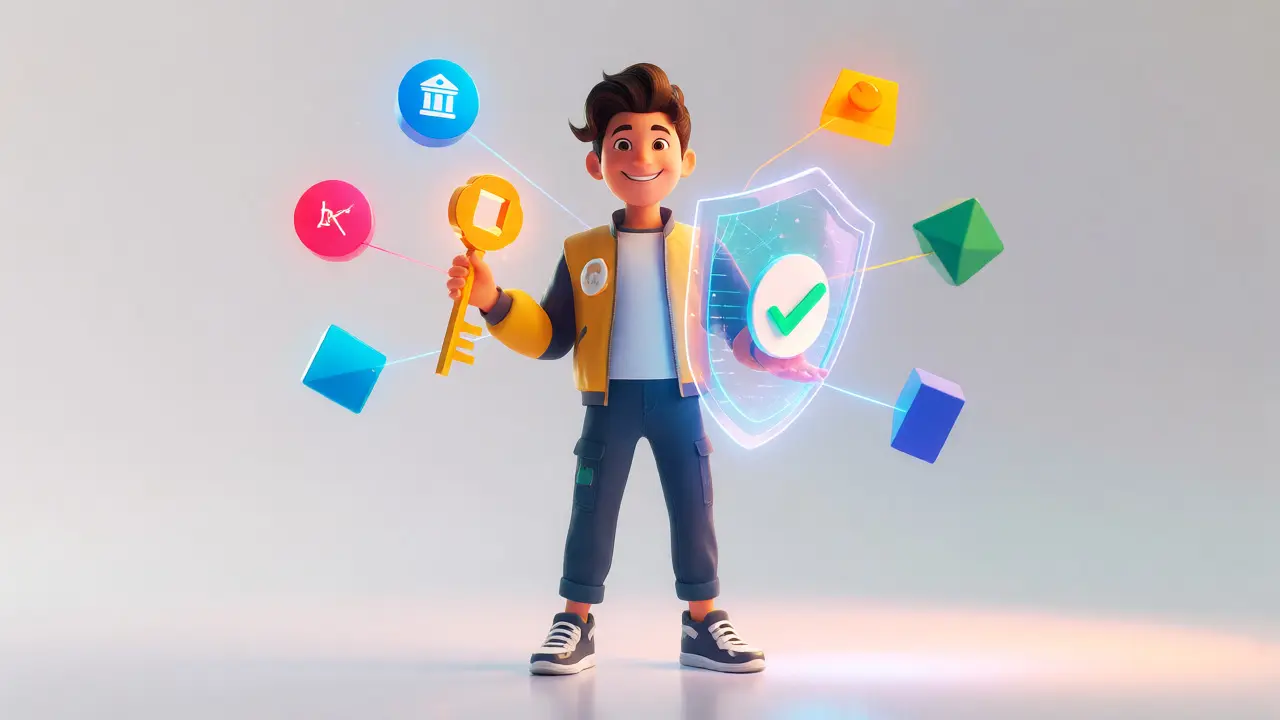
The core benefit here is something called Self-Sovereign Identity (SSI). SSI is a framework where individuals maintain full control over their identity data, choosing exactly what to share and with whom. Think of it like a digital wallet. Right now, when you sign up for a service, you give them your email, phone number, and sometimes your address. They store it forever. With SSI, you hold the keys. If you want to buy alcohol at a store, you don't need to show your entire driver's license with your home address and height. You just need to prove you're over 21. A blockchain credential can verify that age attribute without revealing any other part of your identity.
This concept relies on Zero-Knowledge Proofs (ZKPs), a cryptographic method that allows one party to prove to another that a statement is true without revealing any information beyond the validity of the statement itself. For example, you can prove you have enough funds for a transaction without showing your total balance. This level of privacy is impossible with traditional logins, where every login event creates a data trail that corporations track and monetize. By using ZKPs, blockchain identity ensures that verification happens without surveillance.
Interoperability Across Platforms
One of the biggest headaches in the current digital landscape is fragmentation. You have a separate login for Amazon, a different one for Facebook, and yet another for your bank. These silos don't talk to each other. If you change your name after marriage, you have to update it with dozens of providers individually. Blockchain identity aims to solve this through interoperability standards like Decentralized Identifiers (DIDs). DIDs are new type of identifier for verifiable, decentralized digital identity standardized by the W3C in 2022.
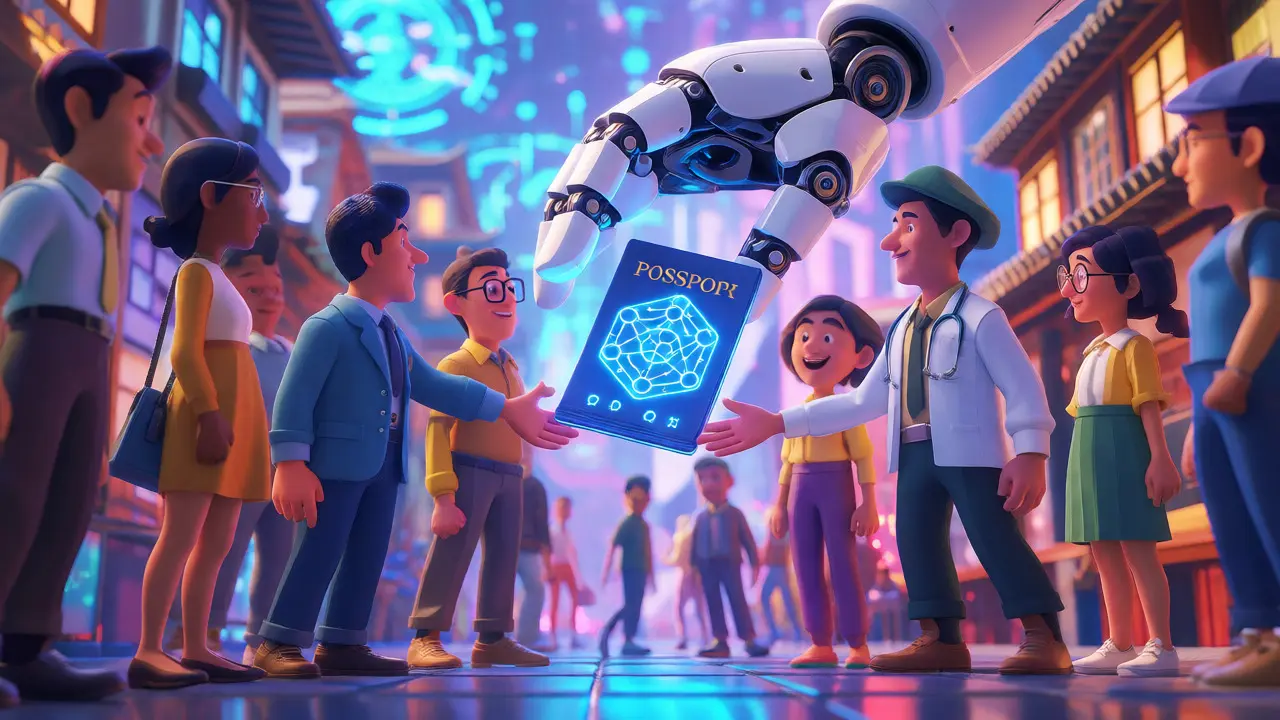
Imagine having one verified digital passport that works everywhere. You get your degree verified once by your university on the blockchain. Later, when you apply for a job, you present that same credential. The employer doesn't need to call the registrar; they just check the blockchain ledger. This eliminates redundant paperwork and reduces costs. Dock Labs estimates that such systems can reduce verification costs by 65% compared to traditional methods. While we aren't quite at the stage where one ID works for everything globally, the infrastructure is being built. The European Union’s eIDAS 2.0 regulation, effective in 2026, explicitly recognizes these blockchain-based identities as legally valid, pushing the rest of the world toward adoption.
Real-World Performance and User Experience
Skeptics often argue that blockchain is too slow or complex for everyday users. Ten years ago, they would have been right. Today, the technology has matured significantly. Modern solutions integrate with existing Identity and Access Management (IAM) systems via APIs, meaning users don't even know they're interacting with a blockchain. They just see a faster login screen.
User feedback shows mixed but improving results. On platforms like Reddit, early adopters report seamless experiences, such as using a digital wallet to enter a concert in 15 seconds instead of waiting in line. However, challenges remain. Key management is still a hurdle. If you lose your private key, you lose your identity. Unlike a password reset email, there is no "forgot password" button in a truly decentralized system unless you use recovery mechanisms provided by newer wallets. Solutions like 1Kosmos BlockID offer multi-factor recovery to mitigate this risk, blending the security of crypto with the convenience of traditional auth.
| Feature | Traditional Centralized ID | Blockchain Identity |
|---|---|---|
| Data Storage | Central servers (single point of failure) | Distributed ledger (no single target) |
| Verification Time | Hours to Days (manual review) | Seconds (automated cryptographic proof) |
| Privacy Control | Low (companies store all data) | High (user shares only specific attributes) |
| Portability | Low (tied to specific provider) | High (usable across multiple platforms) |
| Breach Risk | High (large datasets stolen) | Low (data not stored centrally) |
Market Growth and Industry Adoption
If you think this is just a niche tech trend, look at the numbers. The market for blockchain identity management is projected to grow from $1.23 billion in 2023 to $8.64 billion by 2028. That’s a compound annual growth rate of nearly 47%. Who is driving this? Financial services lead the pack, accounting for 42% of implementations because they face the strictest compliance regulations. Healthcare follows closely, needing secure ways to share patient records between hospitals without violating HIPAA laws.
Major players are already betting big. Microsoft holds about 35% of the enterprise market share with its Entra Verified ID solution. IBM and Sovrin Foundation are also key contributors. The momentum suggests that blockchain identity isn't replacing passwords overnight, but it is becoming the backbone for high-stakes verifications. Gartner predicts that by 2027, 30% of consumer digital identities will be blockchain-based. That’s a massive shift from the 5% seen in 2023.
Challenges You Need to Know
It’s not all sunshine and cryptographic signatures. There are real barriers to entry. First, the "chicken-and-egg" problem: blockchain networks need widespread adoption to be useful, but people won’t adopt them until they’re widely accepted. Second, regulatory uncertainty persists outside the EU. While 22 U.S. states have enacted some form of blockchain identity legislation, there is no unified federal framework yet. This makes multinational companies hesitant to fully commit.
There’s also the issue of user experience complexity. For non-technical users, managing private keys can be intimidating. A failed implementation by a major European bank in 2023 saw 40% user abandonment simply because the onboarding process was too confusing. Developers must prioritize intuitive design. If a grandmother can’t figure out how to approve a login request, the technology fails regardless of how secure it is.
Next Steps for Implementation
If you’re looking to integrate blockchain identity into your business or life, start small. Don’t try to replace your entire login system at once. Use it for specific high-value transactions first, like account openings or age verification. Ensure you choose a solution that supports W3C DID standards to guarantee future compatibility. Look for providers that offer robust key recovery options so users don’t feel locked out if they lose a device.
For individuals, keeping an eye on emerging digital wallets is wise. As more services accept verifiable credentials, having a trusted wallet will become as essential as having a physical ID. The transition is happening now, driven by privacy concerns and the sheer inefficiency of current systems. The benefits are clear: faster verification, better security, and true ownership of your digital self.
Is blockchain identity completely anonymous?
No, it is pseudonymous. Your public address is visible on the ledger, but your real-world identity is linked through verifiable credentials issued by trusted entities. Zero-knowledge proofs allow you to reveal only necessary attributes, enhancing privacy without requiring total anonymity.
What happens if I lose my private key?
In a strictly decentralized system, losing your private key means losing access to your identity. However, modern solutions incorporate recovery mechanisms, such as social recovery or custodial backups, allowing users to regain access through predefined trusted contacts or institutions.
How does blockchain identity improve KYC processes?
It automates verification using cryptographic proofs, reducing manual document checks. This cuts processing time from days to seconds and lowers costs by eliminating redundant data collection across different financial institutions.
Are blockchain identities legally recognized?
Recognition varies by region. The EU’s eIDAS 2.0 regulation explicitly validates them as of 2026. In the US, recognition depends on state laws, though federal frameworks are evolving. Many countries now accept digital credentials for government services.
Can hackers steal my identity from the blockchain?
Hackers cannot alter recorded data due to immutability. However, they can attempt to compromise your private key or the device storing it. Securing your digital wallet and using multi-factor authentication are critical defenses against unauthorized access.

Jennifer Phipps
September 20, 2026 AT 09:31Oh my gosh, this is exactly what I've been screaming about for years!! 🙌 The Equifax breach was such a wake-up call. I still get spam calls from random numbers because some shady company sold my data. Blockchain ID feels like the only way to actually take back control. It’s not just tech hype; it’s basic human dignity! We deserve to own our digital selves without begging corporations for permission. The idea of zero-knowledge proofs is mind-blowing in the best way possible. Imagine proving you're over 21 without handing over your address, height, and eye color. That is freedom right there. We need to push for this everywhere, not just in crypto circles. Banks, hospitals, schools... everyone needs to get on board. Let's make passwords extinct before they cause another massive disaster. 💪✨
clarence bustos
September 21, 2026 AT 17:41Finally someone acknowledges that centralization is morally bankrupt. 😤 We have been forced to trust institutions that have proven time and again they cannot be trusted. It is not just about convenience; it is about ethical responsibility. When you hand your SSN to a bank, you are making yourself vulnerable to their negligence. Blockchain restores the moral high ground by giving power back to the individual. No more single points of failure where one hack ruins millions of lives. This is the right path forward. 👍🔒
Wanda Terral
September 23, 2026 AT 05:36The juxtaposition between centralized fragility and distributed resilience is indeed striking. One must consider the ontological shift here: we are moving from identity as a stored commodity to identity as a verifiable claim. The utilization of Zero-Knowledge Proofs represents a paradigmatic leap in privacy preservation, allowing for authentication without surveillance capitalism's prying eyes. However, the interoperability standards remain nascent. Without robust W3C DID adoption across disparate ecosystems, we risk creating new silos rather than dissolving old ones. The technical elegance is undeniable, yet the sociotechnical implementation lags behind the theoretical promise. 🧐
Sean Patterson
September 24, 2026 AT 02:03yeah but who actually manages the keys?? lol if i lose my phone im screwed. also "decentralized" usually means no support when things break. its all fun and games until u cant access ur bank accnt bc u forgot the seed phrase. typical tech bro solution ignoring real ppl problems. 🙄💀
Samantha Dalton
September 24, 2026 AT 08:19totally get the fear about losing keys samantha here tho thinks recovery methods like social recovery are getting way better. its not all or nothing anymore. plus most wallets now have biometric backups so its less scary than it sounds. we gotta meet people where they are at with ux improvements. 🤝✨
Theresa Flores
September 24, 2026 AT 15:16It is fascinating to think about identity as something fluid and self-owned rather than fixed and external. 🌱 There is a deep philosophical beauty in the idea that we can prove our truth without exposing our whole being. This technology might help us reclaim our inner sovereignty in a digital world that often feels invasive. Hope springs eternal that we can build systems that respect the human spirit. 🌟
dillon wright
September 26, 2026 AT 00:49honestly though the user experience part is key. if my grandma can't use it then it's useless. the article mentions the eIDAS 2.0 stuff which is huge for europe but us folks in the states are still waiting on clear laws. it's a slow burn but the direction seems right. just hope the big tech companies don't mess it up by trying to control the nodes themselves. 🤷♂️
Alan Farley
September 27, 2026 AT 23:14This aligns perfectly with global trends towards data sovereignty. In many parts of Asia and Europe, the demand for portable digital identities is already reshaping how we interact with services. It is great to see US-centric articles acknowledging the international momentum like eIDAS. Collaboration across borders will be essential for true interoperability. We are building a bridge between different legal and cultural frameworks here. 🌏🤝
Newman Thurairatnam
September 28, 2026 AT 17:59One must remain vigilant regarding the underlying infrastructure. Who controls the node operators? Is this truly decentralized or merely a consortium of corporate interests masquerading as blockchain? The potential for subtle censorship through smart contract logic is non-trivial. Furthermore, the energy consumption metrics often cited by critics may underestimate the long-term efficiency gains, yet the initial carbon footprint remains a concern. We should not blindly accept 'decentralization' as an inherent good without scrutinizing the governance models employed. ⚖️📉
Sagan Bogda
September 30, 2026 AT 08:25actually you guys are missing the point. the real issue isn't security it's scalability. ethereum gas fees alone make this impossible for mass adoption right now unless you use layer 2s which introduce their own centralization risks. also nobody talks about the oracle problem. how do you verify off-chain data like a diploma without trusting the issuer completely? it's a solved problem in theory but messy in practice. stop hyping it up before it's ready. 🛑
Janine John
October 1, 2026 AT 11:34I appreciate the nuanced discussion on regulatory frameworks. The distinction between pseudonymity and anonymity is crucial for legal compliance. As we move toward broader adoption, ensuring that these systems adhere to GDPR and other privacy laws will be paramount. Grammatically and legally precise definitions will help avoid future litigation. It is promising to see industry leaders like Microsoft taking concrete steps. ✅
Taylor Szalaiy
October 1, 2026 AT 17:47Love seeing the mix of optimism and caution here. It really highlights that while the tech is solid, the human element-trust, UX, regulation-is the actual hurdle. If we can nail the 'grandma test' mentioned earlier, we're golden. Excited to see how the next few years unfold with eIDAS pushing things forward. Let's keep the conversation going and share those success stories as they pop up! 🚀🌈