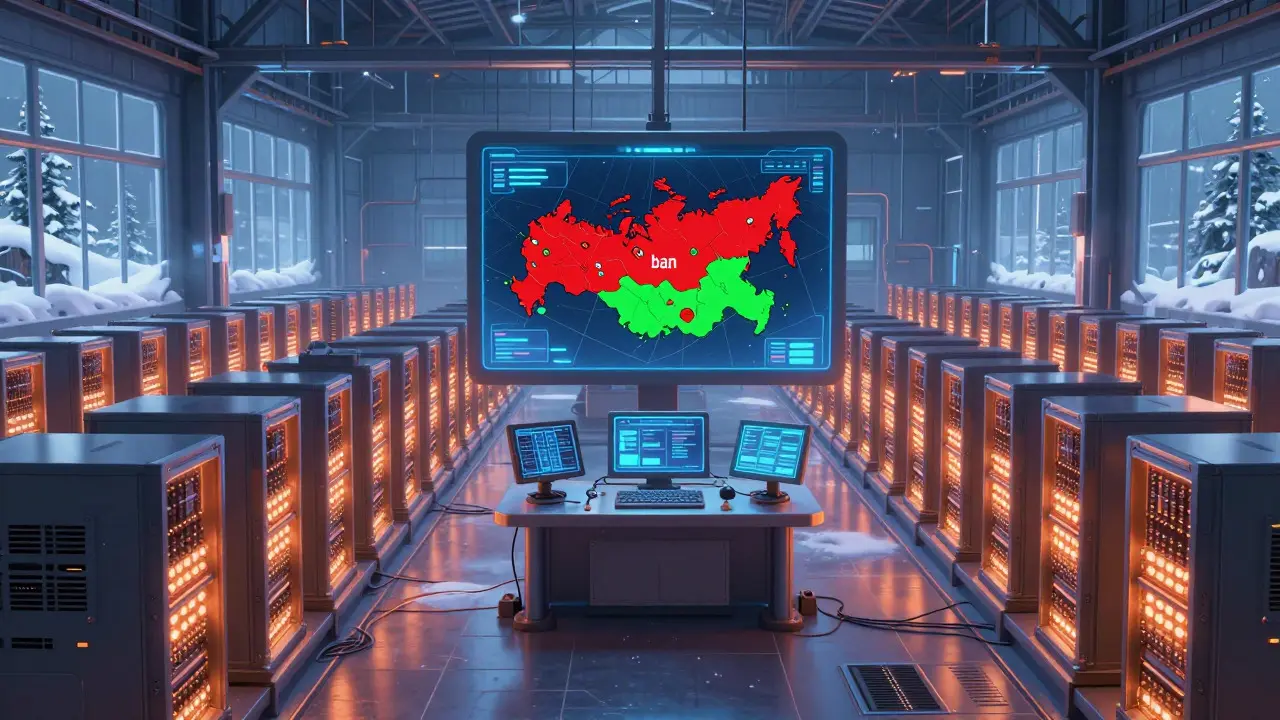
For years, Russia was the wild west of cryptocurrency mining. Cheap electricity, lax enforcement, and a vast geography made it a haven for hash rate operations. But if you are looking to set up rigs or invest in Russian mining farms today, that era is over. The landscape has shifted dramatically since late 2024, with a new regulatory framework taking full effect on January 1, 2025. The government no longer ignores mining; it controls it.
The core message from Moscow is clear: mining is legal, but only if you play by strict rules. If you operate in the shadows, you face massive fines, equipment confiscation, and immediate power cuts. This guide breaks down exactly what changed, where you can mine, how much you’ll pay in taxes, and whether it’s still worth the risk in 2026.
The New Legal Framework: Controlled Legalization
In August and October 2024, President Vladimir Putin signed comprehensive laws that transformed Cryptocurrency Mining is the process of validating transactions and adding them to a blockchain ledger using computational power, now strictly regulated in Russia. These laws moved the sector from a gray area into a highly controlled environment. The goal wasn’t to ban mining entirely, but to harness its economic potential while protecting the national energy grid.
The cornerstone of this new system is the classification of miners as "fourth category" consumers. In practical terms, this means your electricity supply is the lowest priority in the country. When demand spikes-whether due to a cold snap in Siberia or industrial needs elsewhere-the state can remotely disconnect your equipment. You don’t get a warning call. The power just stops. This mechanism ensures that hospitals, homes, and critical industries always have power before your ASICs do.
To enforce this, all imported mining hardware must be labeled and certified in a mandatory state registry. This allows authorities to track exactly where equipment is located and how much power it draws. It’s a surveillance tool designed to make illegal operations nearly impossible to hide.
Geographic Restrictions: Where You Can and Cannot Mine
You cannot simply plug in a rig anywhere in Russia anymore. The government has implemented a two-tiered geographic restriction system affecting 13 regions. Understanding these zones is critical before buying any hardware.
| Region Type | Regions Affected | Restriction Details | Duration |
|---|---|---|---|
| Complete Ban | Dagestan, Ingushetia, Kabardino-Balkaria, Karachay-Cherkessia, North Ossetia, Chechnya, Donetsk, Lugansk, Zaporizhzhia, Kherson | No mining allowed under any circumstances | Jan 1, 2025 - Mar 15, 2031 |
| Seasonal Restriction | Irkutsk, Buryatia, Zabaikalsky | Banned during winter peak demand | Nov 15 - Mar 15 (annually) |
The complete bans cover ten regions, primarily in the North Caucasus and the newly integrated territories in the east. These areas suffer from chronic energy deficits, so the government has decided to eliminate the competition for power entirely. The seasonal restrictions in Siberia are equally harsh. During the winter months, when heating demands soar, mining is shut down. This means your operational window in Irkutsk might be less than half the year, drastically impacting profitability calculations.
Registration and Taxation: The Cost of Compliance
If you want to mine legally, you must register. The threshold for individual miners is relatively low: if you use under 6,000 kWh of energy per month, you are exempt from registration. However, most serious operations exceed this limit. Businesses and entrepreneurs above this threshold must enter the national miners' registry managed by the Federal Tax Service.
The tax structure is straightforward but significant. Russia introduced a 15% tax on Bitcoin mining profits in November 2024. This applies to the net profit after accounting for electricity costs and other expenses. While 15% seems moderate compared to some Western jurisdictions, remember that this is on top of the high cost of compliance and the risk of downtime.
As of mid-2025, compliance remains a major headache. According to Ivan Chebeskov, Deputy Minister of Finance, only about 30% of miners were registered at the time. He acknowledged that the process of bringing the remaining two-thirds into the fold is "far from complete." This suggests that enforcement is ramping up, and the window for operating illegally without consequence is closing fast.
Penalties for Illegal Mining
The consequences of ignoring these rules are severe. Fines for unauthorized mining activities range from 200,000 rubles to potentially 2 million rubles (approximately $25,500). Given that many small-to-medium operations run on thin margins, a single fine can wipe out months of profits.
Moreover, the digital development ministry is actively considering increasing these penalties further to enhance enforcement effectiveness. Beyond fines, illegal operators face equipment confiscation. Since all legal hardware is tracked via the state registry, unregistered rigs are easy to identify during audits or power inspections. The state doesn’t just want your money; it wants to remove the hardware from the grid entirely.
Market Dynamics and Growth Trends
Despite the heavy regulation, the market hasn’t collapsed-it has exploded. Demand for industrial mining equipment in Russia tripled in the fourth quarter of 2024 compared to the previous year. Why? Because the new laws provided clarity. Large-scale operators and institutional investors prefer regulated environments over the uncertainty of the past. They see mining as a viable diversification strategy, with some experts recommending allocating up to 5% of portfolios to crypto mining operations.
However, this rapid growth has triggered the very concerns the government sought to address: electricity shortages and price disparities. Subsidized regions are seeing their cheap power drained by miners, leading to higher bills for regular citizens. This political pressure is why the geographic bans and remote shutdown capabilities were implemented so aggressively. The state is trying to balance economic gain with social stability.
Broader Crypto Context: Trading vs. Mining
It’s important to distinguish between mining and general crypto usage in Russia. Owning and trading digital assets like Bitcoin or Ethereum is generally permitted. However, using cryptocurrencies to pay for goods and services remains illegal. The ruble retains its status as the sole legal tender.
Additionally, individuals and organizations must report any cryptocurrency transactions exceeding 600,000 rubles to tax authorities. Failure to do so results in significant penalties. This reporting requirement applies regardless of whether you are a miner or a trader. The government wants visibility into all crypto flows, ensuring that the digital asset boom doesn’t undermine traditional monetary policy.
Is Crypto Mining in Russia Still Worth It?
The answer depends on your scale and risk tolerance. For small hobbyists using under 6,000 kWh monthly, the barriers are lower, but the remote shutdown risk remains. You could lose power during a cold wave, stalling your operation for weeks. For large-scale operators, the 15% tax and registration requirements add administrative overhead, but the legal certainty is a plus.
The key challenge is energy reliability. Being a "fourth category" consumer means your business model is inherently unstable. You need to build redundancy into your operations, perhaps by diversifying across regions not subject to seasonal bans. You also need to factor in the potential for increased fines and stricter enforcement as the government continues to "clean up" the unregistered sector.
Ultimately, Russia offers one of the most detailed and restrictive regulatory frameworks in the world. It’s no longer a free-for-all. Success requires meticulous compliance, strategic location planning, and a healthy respect for the state’s control over the energy grid.
Is cryptocurrency mining legal in Russia in 2026?
Yes, cryptocurrency mining is legal in Russia, but it is heavily regulated. Operators must register with the state if they consume more than 6,000 kWh of electricity per month. They are also subject to a 15% tax on profits and must comply with geographic restrictions and remote shutdown protocols.
Which regions in Russia have banned crypto mining?
Ten regions have complete bans, including Dagestan, Chechnya, and the Donetsk and Lugansk People's Republics. Three Siberian regions-Irkutsk, Buryatia, and Zabaikalsky-have seasonal bans during winter months (November 15 to March 15) due to high energy demand.
What are the penalties for illegal crypto mining in Russia?
Fines for illegal mining range from 200,000 to 2 million rubles. Authorities may also confiscate equipment. The government is considering increasing these fines to improve enforcement, as only 30% of miners were registered as of mid-2025.
How does the remote shutdown system work?
Miners are classified as "fourth category" consumers, meaning they have the lowest priority for electricity. During periods of high demand, the state can remotely disconnect registered mining equipment to ensure power supply to homes, hospitals, and critical industries.
Do I need to register my mining equipment?
Individuals using less than 6,000 kWh of electricity per month are exempt from registration. However, businesses and larger operations must register their equipment in the national miners' registry to operate legally and avoid fines.
What is the tax rate for crypto mining profits in Russia?
Russia imposes a 15% tax on profits generated from Bitcoin and other cryptocurrency mining operations. This tax was introduced in November 2024 as part of the broader regulatory framework.
Can I use cryptocurrency to pay for goods in Russia?
No, using cryptocurrency to pay for goods and services is illegal in Russia. The ruble is the sole legal tender. However, owning and trading cryptocurrencies is permitted, provided transactions over 600,000 rubles are reported to tax authorities.
How long will the regional mining bans last?
The complete bans in ten regions are effective from January 1, 2025, through March 15, 2031. Seasonal restrictions in Siberian regions apply annually during winter peaks, extending to November 15 through March 15 in subsequent years.

Lance Jantz
August 8, 2026 AT 14:56The sheer audacity of a state to treat computational power as a secondary citizen is nothing short of Orwellian poetry in motion. We watch from the sidelines, sipping our artisanal coffee, while Siberian miners dance to the tune of a remote switch flipped by a bureaucrat in Moscow. It is a theater of control, grand and terrifyingly efficient. The 'fourth category' consumer label is not just a classification; it is a metaphor for the modern individual in the face of the leviathan. You exist only when the grid permits your existence.
One must wonder if this centralized grip on energy will eventually spill over into other aspects of digital life. If they can cut your hash rate with a thought, what stops them from cutting your voice? The infrastructure of surveillance is built one ASIC at a time. We are witnessing the birth of a new kind of feudalism, where the lord of the manor controls the very electrons that flow through your veins. It is beautiful in its horror. Truly.
Don Fizy
August 10, 2026 AT 04:34Hey folks! Just wanted to drop a quick tip for anyone thinking about diving into this :D Make sure you check the specific region rules before buying any hardware! It's super important to know if you're in a banned zone like Dagestan or Chechnya. Also, don't forget the 6,000 kWh limit for individuals! Good luck everyone! :)
Phil Babb
August 10, 2026 AT 08:16LISTEN UP!!! This is HUGE news for the crypto community!! The government is finally stepping up!! They are taking control!! No more wild west!! Order is being restored!!! You better register your rigs or else!!! The fines are REAL!!! Don't be stupid!!! Follow the rules!!! Russia is leading the way in regulation!!! Wake up people!!!
Dominic Greco
August 11, 2026 AT 08:48They think they can stop us 🤡👀 The registry is just a list for them to target later. Once they have all the locations mapped out, they won't just cut power, they'll seize everything. It's a trap. A glorious, shiny trap. The 30% registration rate proves everyone knows the game is rigged. They want your data, not your taxes. Keep your rigs off-grid if you value your freedom. The deep state fears decentralized power more than anything. Stay woke. 🔋⛔️
Sean Rowland
August 11, 2026 AT 15:47It is imperative to note that the semantic distinction between 'legalization' and 'regulation' is often lost on the layperson, yet critical here. The state has not legalized mining; it has monopolized the right to mine under duress. The term 'fourth category consumer' is a bureaucratic euphemism for 'disposable asset.' Furthermore, the assertion that this protects the national grid is disingenuous at best. It protects the state's ability to ration resources during crises, ensuring political stability over economic efficiency. The jargon-heavy obfuscation in the laws is deliberate, designed to confuse the average operator into compliance through fear rather than understanding. One must remain vigilant against such linguistic manipulation.
Sus Sawyer
August 13, 2026 AT 14:20Honestly, this looks like a mess but also kinda exciting? Like, if you can navigate the bureaucracy, maybe there's an opportunity? But seriously, dont get caught without registering. The fines are no joke. I heard some guys in Irkutsk got hit hard last winter. So yeah, do your homework first. Maybe look into those regions without seasonal bans? Just my two cents tho!
Aryan MISHRA
August 14, 2026 AT 09:17Fundamental flaw in logic. Regulation stifles innovation. Why does the state need to track every kilowatt? Inefficiency breeds corruption. Simple as that. Register or perish. Typical.
Ryan Robinson
August 15, 2026 AT 07:03i mean... seems pretty strict huh. but hey, thats how it goes i guess. just gotta adapt right? hope everyone stays safe out there.
Earl Kott65
August 15, 2026 AT 13:06Oh wow, talk about a plot twist! 😱 Who would've thought the Russian government would actually care about electricity grids? I suppose we should all be trembling in our boots now! 🙄 But seriously, if you're gonna play the game, play it smart. Or don't. Watch the world burn. Either way, it's entertainment for the rest of us! 🎭🔥
Ethan Yuwono
August 16, 2026 AT 20:25the balance between order and chaos is delicate. perhaps this regulation is necessary. perhaps it is tyranny. who can say. i just hope the people suffer less.
Jack Delasquez
August 17, 2026 AT 00:41man this is crazy. so much red tape. why cant they just let us mine in peace? its getting harder every day. hope things change soon.
Harman Singh
August 18, 2026 AT 07:02why does nobody listen to me? i told you this was coming. now look at us. stuck in the middle of nowhere waiting for power cuts. pathetic really.
Qolbina Islami
August 19, 2026 AT 11:08RUSSIA IS STRONG!!! WE CONTROL OUR RESOURCES!!! NO FOREIGN INFLUENCE!!! THE MINERS MUST OBEY THE STATE!!! THIS IS HOW WE BUILD A NATION!!! PROUD TO BE RUSSIAN!!! STAND TALL!!!
SUBHAM CHOUDHURY
August 19, 2026 AT 12:34Just keep going guys. It's tough but we can make it work. Don't let the regulations scare you too much. There's always a way around. Stay positive and keep hashing!
Joy Kwant
August 20, 2026 AT 02:13It's disgusting how much energy these machines waste while the planet burns. And now the government is profiting from it? Shameful. They should ban it entirely instead of regulating it. Morality has left the building.
amy miranda
August 21, 2026 AT 09:55This article is completely lacking in nuance. It presents the government's perspective as fact without questioning the underlying motives. It is lazy journalism at its finest. I am appalled by the lack of critical analysis. How dare they simplify such a complex issue?
Pernelia Wahkan
August 21, 2026 AT 12:16Interesting read. The distinction between trading and mining is crucial. Many people confuse the two. Remember, paying for goods with crypto is still illegal. Keep that in mind. Also, the tax implications are significant. Do your math carefully.
Subhash Kashyap Dm
August 22, 2026 AT 19:11Globalist agenda exposed. They want to centralize control over digital assets. The registry is step one. Step two is total surveillance. Wake up sheeple. The matrix is tightening its grip. Resistance is futile unless you go dark.