
Have you ever looked at your trading history and realized that fees are quietly eating away at your profits? You aren't alone. For many traders, especially those who move money frequently, transaction costs can add up to a surprising amount over time. But there is a built-in mechanism in the cryptocurrency world designed specifically to lower these costs: exchange token fee discounts.
These discounts work by encouraging you to hold the native token of a specific exchange platform. In return for holding this asset, the exchange gives you a percentage off your trading fees. It sounds simple enough, but the mechanics behind it involve tiered systems, maker-taker structures, and significant risk-reward calculations. Understanding how this works can mean the difference between paying standard rates and keeping more of your hard-earned gains.
What Are Exchange Tokens and Why Do They Exist?
To understand the discount, you first need to understand the token itself. An exchange token is a digital asset issued by a cryptocurrency trading platform. Unlike Bitcoin or Ethereum, which operate independently on their own blockchains, these tokens live within the ecosystem of the exchange that created them.
Binance Coin (BNB) is the native utility token of the Binance exchange, used primarily for fee discounts and participating in token sales. Also known as BNB Token, it was launched in 2017 and has since become one of the largest cryptocurrencies by market capitalization. The token's primary function remains reducing trading fees, though its utility has expanded to include payments, travel bookings, and entertainment services through the Binance ecosystem. Companies like Binance use these tokens to create loyalty among users. When you hold their token, you are less likely to leave for a competitor because you would lose your fee benefits.
From an economic perspective, these tokens serve two main purposes. First, they provide the exchange with a massive source of funding during initial coin offerings (ICOs) or launchpad events. Second, they lock users into the platform’s ecosystem. The Bank for International Settlements has noted that exchange tokens have historically represented a major funding source for crypto platforms, with combined values often exceeding $100 billion. This creates a symbiotic relationship: the exchange gets stability and liquidity, while you get cheaper trades.
How Fee Discount Structures Actually Work
The way discounts are applied varies significantly from one platform to another. Most exchanges use a base fee structure, typically ranging between 0.1% and 0.5% per trade. On top of this, they layer additional reductions based on your holdings and activity level.
Consider the model used by Gate.io as a concrete example. At the entry-level VIP status, standard maker and taker fees might sit at 0.200%. However, if you advance to higher VIP levels based on your 30-day trading volume, those fees drop. At VIP level 14, fees could reduce to 0.055% for makers and 0.065% for takers. If you then choose to pay those already-reduced fees using the platform’s native GT token, the cost drops further to approximately 0.030% and 0.036% respectively.
This tiered approach means that high-frequency traders benefit the most. A casual trader who makes one purchase a month might save only a few dollars. But an active day trader executing dozens of orders daily can save hundreds or even thousands of dollars annually. The key is understanding whether your trading volume justifies the effort and capital required to maintain the necessary token balance.
| Exchange | Native Token | Standard Fee Range | Max Discount with Token | Key Requirement |
|---|---|---|---|---|
| Binance | BNB | 0.1% - 0.5% | Up to 25% | Hold BNB in Spot Wallet |
| KuCoin | KCS | 0.1% - 0.2% | Up to 20% | Hold KCS + Volume Tier |
| OKX | OKB | 0.08% - 0.1% | Up to 20-25% | Hold OKB + VIP Level |
| WazirX | WRX | Variable | Up to 50% | Pay Fees in WRX |
The Risk-Reward Calculation: Is It Worth It?
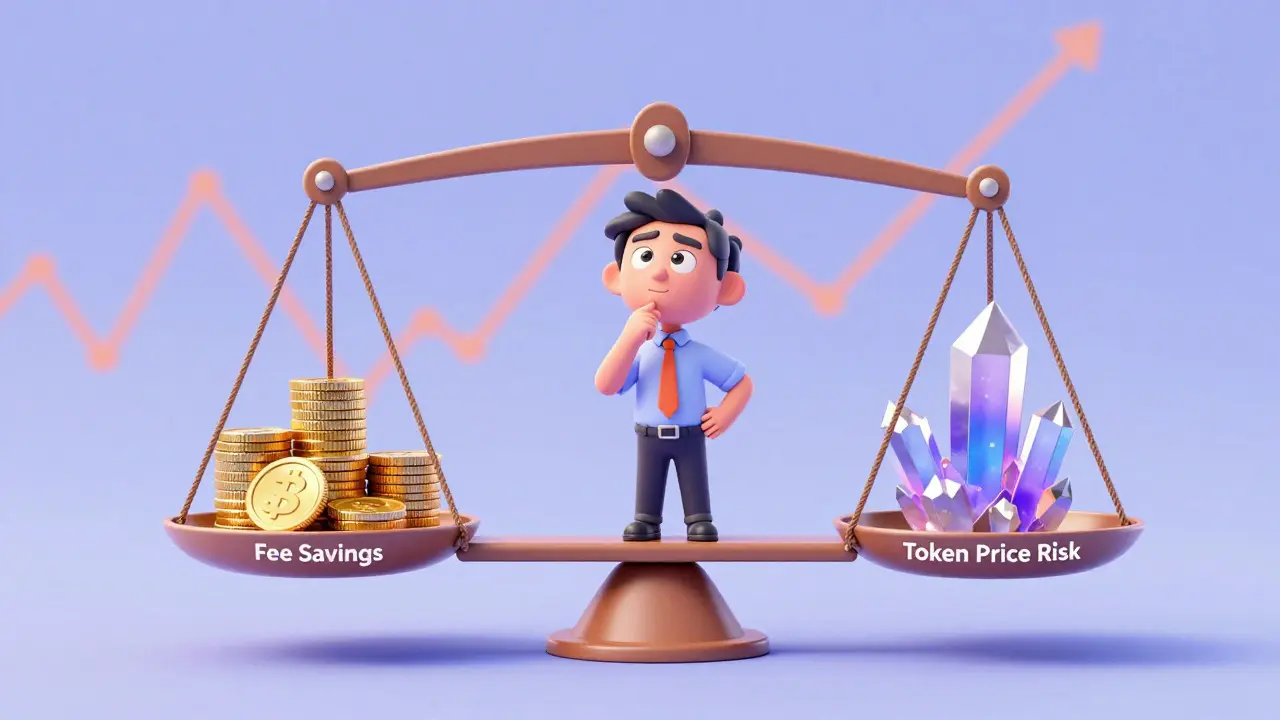
Here is where things get tricky. While saving on fees sounds great, you are not just buying a coupon; you are buying a volatile asset. The price of an exchange token fluctuates just like any other cryptocurrency. If the token’s value drops significantly, the loss in your portfolio could outweigh the savings you gained from lower fees.
Professional traders recommend calculating a break-even point before committing capital. Let’s say you expect to save $500 in fees over the next year by holding a specific token. You should only buy enough of that token to cover your expected fee usage, plus a small buffer. Buying far more than you need exposes you to unnecessary market risk.
For instance, if you hold $1,000 worth of an exchange token solely for discounts, and that token crashes by 30%, you have lost $300 in principal value. Even if you saved $200 in fees, you are still down $100 overall. The goal is to treat the token as a tool for efficiency, not necessarily as a long-term investment, unless you believe in the underlying success of the exchange itself.
Setting Up Your Account for Maximum Savings
Getting started with fee discounts is usually straightforward, but each platform has its own quirks. Generally, the process involves three steps:
- Purchase the Native Token: Use your fiat currency or stablecoins (like USDT or USDC) to buy the exchange’s token on the spot market.
- Enable Fee Payment: Go to your account settings, find the "Trading" or "Fees" section, and toggle the option to "Use [Token Name] for fees." This step is crucial; simply holding the token isn't always enough. Some platforms require explicit activation.
- Maintain Holdings: Ensure the token remains in your spot wallet. Moving it to a cold wallet or transferring it to another exchange will disqualify you from the discount.
Some platforms, like KuCoin, also offer staking programs where you lock up tokens for longer periods to earn additional rewards alongside fee discounts. This adds another layer of complexity but can increase your overall return if the token price appreciates. Always read the fine print regarding vesting periods and withdrawal penalties.
Navigating Common Pitfalls and User Complaints
User experiences with these programs are mixed. On forums like Reddit and Trustpilot, common complaints revolve around opacity. Many users feel frustrated when fee calculation methods change without clear notice. One day, your discount might be 20%; the next, after a policy update, it could be 15% due to new volume requirements.
Another pitfall is the "complexity trap." Some exchanges combine fee discounts with referral bonuses, cashback campaigns, and VIP tiers. Trying to optimize all of these simultaneously can lead to confusion. Users often report spending more time monitoring their dashboard than actually trading. To avoid this, stick to the simplest path: enable the token discount and ignore peripheral promotions unless they directly impact your bottom line.
Additionally, be wary of regulatory risks. The collapse of FTX in 2022 highlighted the dangers of concentrating too much wealth in a single exchange’s ecosystem. The FTT token played a central role in the platform’s financial difficulties, and holders saw their assets freeze or vanish. Diversification remains key. Don’t put all your trading capital and fee-discount tokens on one platform if you can help it.

Advanced Strategies for Active Traders
If you are serious about minimizing costs, you can go beyond basic token holdings. Advanced users implement strategies that combine multiple levers:
- Batch Order Placement: Instead of making ten small trades, consolidate them into fewer larger orders to reduce the total number of fee transactions.
- Layer 2 Utilization: When depositing funds to the exchange, use Layer 2 networks (like Arbitrum or Polygon) or sidechains to avoid high gas fees on Ethereum mainnet. This ensures that your deposit costs don’t erase your trading fee savings.
- Stablecoin Profit-Taking: Regularly convert profits into stablecoins rather than leaving them in volatile assets. This protects your capital from market downturns while keeping you ready for the next opportunity.
Timing also matters. Transaction costs on blockchain networks vary by time of day. For example, Ethereum gas fees tend to be lower during weekends and off-peak hours in the U.S. By scheduling large deposits or withdrawals during these windows, you can reduce overall friction costs by 30-50%.
Future Trends in Exchange Token Utility
The landscape of exchange tokens is evolving. We are seeing a shift from simple fee discounts to broader utility models. Platforms are integrating tokens into decentralized finance (DeFi) protocols, offering governance rights, and providing access to exclusive investment opportunities like Launchpads.
Regulatory scrutiny is also increasing. Exchanges are working harder to classify their tokens as utilities rather than securities to comply with global regulations. This may lead to more transparency in how discounts are calculated and distributed. In the long term, we expect consolidation among smaller exchange tokens, with major players strengthening their ecosystems through burn mechanisms-where the exchange buys back and destroys tokens to reduce supply and potentially support price stability.
As the market matures, the focus will likely shift from aggressive discount percentages to sustainable business models. For users, this means looking for platforms that offer consistent, transparent benefits rather than chasing the highest possible discount from a risky or lesser-known exchange.
Do I have to hold the exchange token permanently to get discounts?
No, you do not need to hold it forever. You only need to have the token in your spot wallet at the moment you execute a trade. If you sell your tokens, you will immediately lose the fee discount for subsequent trades until you buy them back.
Can I use the fee discount on futures trading?
It depends on the exchange. Some platforms, like Binance, allow you to use BNB for both spot and futures trading fees. Others may restrict discounts to spot markets only. Check the specific terms of service for the derivative products on your chosen platform.
What happens if the exchange token price goes to zero?
If the token loses all value, you lose the capital you invested in buying it. However, you would have already benefited from the fee discounts during the period you held it. The net result depends on whether your fee savings exceeded the loss in token value.
Are exchange tokens safe investments?
They carry higher risk than major cryptocurrencies like Bitcoin because their value is tied directly to the success and reputation of a single company. Regulatory actions or operational failures at the exchange can cause drastic price drops. Treat them primarily as utility tools rather than safe-haven investments.
How do I calculate my break-even point for buying exchange tokens?
Estimate your annual trading volume and multiply it by your current fee rate to find your total expected fees. Then, calculate how much you would save with the discount. Only buy enough tokens to cover that savings amount. For example, if you expect to save $200 a year, buying $200 worth of tokens is a logical starting point.
