
Imagine stealing $1.5 billion in a single afternoon. Now imagine trying to spend it without anyone noticing where it came from. That is the daily reality for DPRK hackers, state-sponsored cyber actors working for North Korea's Reconnaissance General Bureau. In February 2025, the Bybit exchange suffered a historic breach, losing over $1.4 billion to these operatives. But the heist was just the beginning. The real challenge for Pyongyang isn't grabbing the coins; it's cleaning them up fast enough to fund weapons programs before global watchdogs freeze their assets.
You might think cryptocurrency is anonymous. It’s not. Every transaction lives on a public ledger forever. So how do North Korean operatives move billions across Bitcoin, Ethereum, and Tron without getting caught? They don’t hide in one place. They hop. This strategy, known as cross-chain laundering, exploits the bridges that connect different blockchains. By rapidly swapping assets between networks, they break the digital trail, turning transparent ledgers into a maze of obfuscation. If you are tracking crypto crime or just want to understand why your favorite exchange keeps getting hacked, here is how the game actually works.
The Evolution From Mixers to Bridges
A few years ago, if you wanted to dirty up some stolen Bitcoin, you sent it through a mixer like Tornado Cash or Sinbad. These services pooled users' funds and spat them out randomly, making it hard to link inputs to outputs. For a while, this worked great for the Lazarus Group, the umbrella term for North Korea’s elite hacking units. But regulators got wise. Sanctions hit Tornado Cash. Exchanges started blocking addresses linked to mixers. Suddenly, the old playbook was risky.
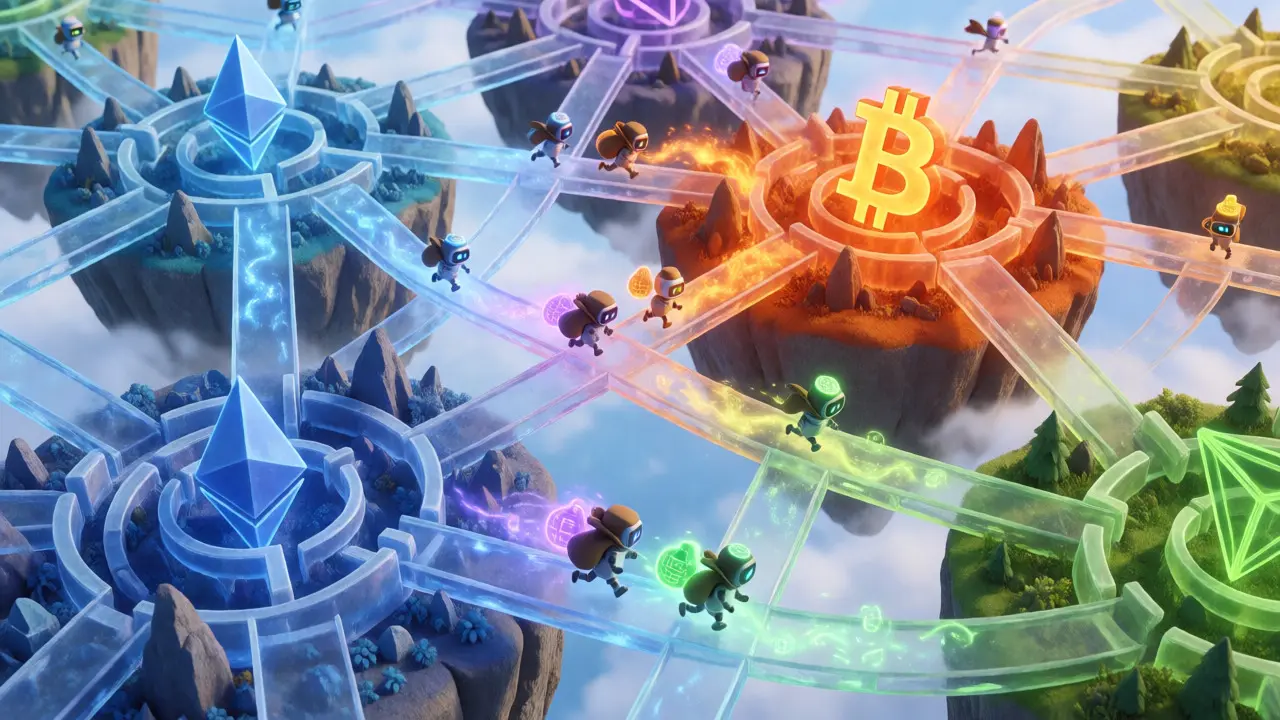
Enter the cross-chain bridge. Instead of mixing coins within one network, hackers now move value between entirely different blockchains. TRM Labs data shows that since 2023, the use of cross-chain conversion services by North Korea surged by 111%. Why? Because moving from Ethereum to Avalanche, then to Bitcoin, creates gaps in visibility. Most analytics tools track one chain well but struggle when funds jump across five different ecosystems in minutes. The hackers exploit this fragmentation. They aren't just hiding money; they are drowning analysts in noise.
Anatomy of the "Flood the Zone" Technique
When the Bybit hack happened, compliance teams didn't just see one large transfer. They saw thousands of tiny, rapid-fire transactions hitting multiple platforms simultaneously. Nick Carlsen, a former FBI expert now at TRM Labs, calls this "flood the zone." The goal isn't subtlety. It's volume. By overwhelming monitoring systems with high-frequency swaps, the hackers create chaos. While analysts scramble to tag one address, the bulk of the funds has already moved through three other chains.
Here is the typical flow observed in recent attacks:
- Initial Theft: Funds are drained from a centralized exchange or DeFi protocol (e.g., Ethereum mainnet).
- Rapid Conversion: Stolen ERC-20 tokens are swapped for native ETH via decentralized exchanges (DEXs) to avoid smart contract scrutiny.
- Cross-Chain Hop: Assets are bridged to less-analyzed networks like BitTorrent Chain (BTTC), Tron, or Solana using services like Ren Bridge or Avalanche Bridge.
- Obfuscation Layer: On the new chain, funds are split into smaller amounts and mixed again or converted into stablecoins.
- Final Destination: Eventually, most funds return to Bitcoin, often held in fresh wallets awaiting Over-The-Counter (OTC) liquidation.
This method relies on speed. Automation scripts execute these trades in seconds. Human traders can't keep up. By the time a human analyst flags a suspicious pattern, the money is already halfway around the world, technically speaking.
| Feature | Traditional Mixer Era (Pre-2023) | Cross-Chain Bridge Era (2024-2026) |
|---|---|---|
| Primary Tool | Tornado Cash, Sinbad, Wasabi Wallet | Ren Bridge, Avalanche Bridge, Thorchain |
| Visibility Risk | High (Sanctioned entities) | Medium (Fragmented data sources) |
| Speed | Moderate (Batch processing) | Extremely High (Automated scripts) |
| Target Asset | Ethereum (ERC-20) | Multi-chain (BTC, ETH, TRX, SOL) |
| Analyst Challenge | Linking input/output clusters | Tracing hops across disparate ledgers |
Why Centralized Exchanges Are Still Vulnerable
You might ask: If the tech is so good, why do they still steal from big exchanges? Because humans are weak links. Elliptic notes that the "weak point in cryptocurrency security is now human, not technological." Recent campaigns show a pivot toward social engineering. Hackers send fake job offers to executives. They compromise social media accounts. They trick individual high-net-worth holders into signing malicious transactions.
Once the funds are in the hacker's wallet, the technical laundering begins. But the initial breach often stems from simple phishing or compromised keys. This shift means that even if your exchange uses top-tier cold storage, an employee clicking a bad link can cost billions. The Bybit incident wasn't just a code failure; it was a complex web of operational security lapses that allowed TraderTraitor-a specific subunit of the RGB 3rd Bureau-to execute the drain.
The Role of Blockchain Analytics Firms
Tools like TRM Forensics and Chainalysis have had to evolve rapidly. Five years ago, tracing Bitcoin was straightforward. Today, investigators need cross-chain visualization. TRM introduced "Phoenix," a tool designed specifically to trace flows across bridges. Without such tools, the data is siloed. An analyst looking at Ethereum sees funds leave. An analyst looking at Tron sees funds arrive. Connecting the two requires sophisticated matching algorithms.
These firms work closely with law enforcement. In August 2023, the FBI released a list of Bitcoin addresses linked to the Lazarus Group, urging exchanges to halt transactions. This collaboration is critical. However, the arms race continues. As analytics improve, hackers use obscure blockchains-networks with fewer nodes and less coverage-to hide in the dark corners of the crypto ecosystem. They also issue their own tokens, creating synthetic layers that further confuse automated trackers.

Geopolitical Stakes: More Than Just Money
Why does this matter to you if you don't live in Seoul or Washington? Because this money buys missiles. A UN report indicates that up to 50% of North Korea's foreign currency earnings come from cybercrime. The Wilson Center estimates that North Korean hackers stole $660.5 million in 2023, jumping to $1.34 billion in 2024, and exceeding $2 billion in 2025 alone. The Bybit heist alone surpassed all of 2023's combined thefts.
This revenue directly funds the regime's nuclear and ballistic missile programs. When you hear about sanctions being ineffective, look at the blockchain. The ability to launder billions through cross-chain swaps allows the DPRK to bypass traditional banking restrictions. It turns digital theft into geopolitical leverage. If the West wants to curb proliferation, it must crack down on the OTC desks and exchanges that facilitate the final off-ramp for these laundered assets.
What You Can Do as an Investor
If you hold crypto, you aren't immune to this wave. Here are practical steps to protect yourself from the fallout of DPRK-style operations:
- Check Your Exchange's Compliance: Does your platform use real-time cross-chain monitoring? Ask them. Smaller exchanges may lack the tools to flag rapid bridge hops.
- Beware of Job Scams: If a recruiter contacts you on LinkedIn offering a remote crypto role, verify their company independently. Don't click links in unsolicited messages.
- Use Hardware Wallets: Keep private keys offline. Even if a website is compromised, your hardware device won't sign a malicious transaction unless you physically approve it.
- Monitor Large Transfers: Use free explorers like Etherscan or Blockchair to watch for unusual activity in your wallet. Set alerts for large outbound transactions.
The landscape is shifting. We are no longer dealing with script kiddies testing passwords. We are facing nation-state actors with military-grade resources and a desperate need for cash. Understanding their methods helps you anticipate risks. Stay skeptical of easy opportunities, and always assume that every digital footstep is being watched-and possibly laundered.
What is the Lazarus Group?
The Lazarus Group is a computer-based attack organization sponsored by the government of North Korea. It operates under the Reconnaissance General Bureau (RGB), the country's primary intelligence agency. The group is responsible for major cyberattacks, including the Sony Pictures hack and numerous cryptocurrency thefts.
How do cross-chain bridges help launder money?
Cross-chain bridges allow assets to move between different blockchains (e.g., Ethereum to Bitcoin). By rapidly converting and moving funds across multiple chains, hackers break the direct transaction history. This makes it difficult for analytics firms to trace the full path of stolen funds in real-time, providing a layer of obfuscation.
Why did North Korea stop using mixers like Tornado Cash?
Regulatory pressure increased significantly after 2022. Tornado Cash and similar services were sanctioned by the US Treasury. Many exchanges began blocking deposits from addresses associated with these mixers. To avoid frozen assets, North Korean hackers shifted to cross-chain bridges, which were initially less regulated and harder to monitor comprehensively.
How much crypto has North Korea stolen recently?
According to Elliptic and TRM Labs, North Korea-linked groups stole over $2 billion in 2025 alone. This includes the record-breaking $1.4 billion Bybit hack in February 2025. In 2024, they stole approximately $1.34 billion across 47 incidents. These figures highlight a steady escalation in both frequency and scale of attacks.
What is the "flood the zone" technique?
"Flood the zone" is a tactic where hackers execute a massive number of small, rapid transactions across multiple platforms simultaneously. This overwhelms compliance teams and automated monitoring systems, making it difficult to identify the primary flow of funds amidst the noise. It prioritizes speed and volume over stealth.

liam & the bees
September 2, 2026 AT 03:16Great breakdown of the technical side! It's fascinating how they've moved from simple mixers to complex cross-chain hops. For anyone in Ireland or Europe, keep an eye on your exchange compliance settings, as many EU platforms are still catching up with real-time bridge monitoring. Stay safe out there!
Edward Ogunfolaju
September 2, 2026 AT 21:41This is exactly what I’ve been saying for months. The market ignores these risks until it’s too late. We need to stop treating crypto like a casino and start treating it like a geopolitical battlefield. Wake up people!
Liam Grimes
September 3, 2026 AT 07:46Yeah the bridge hopping thing is def tricky to track. I used to think Tornado Cash was the end all be all but yeah regs killed that vibe pretty quick. Now its all about speed and volume which is wild. Good read though, helped me understand why my wallet alerts go crazy sometimes.
Matthew O'Neill
September 4, 2026 AT 21:36The article fundamentally misunderstands the nature of state-sponsored obfuscation. By focusing solely on the 'how' of laundering, we ignore the 'why' of systemic regulatory failure. The reliance on fragmented data sources by analytics firms is not just a technical hurdle; it is a moral failing of the industry to prioritize user privacy over transparent accountability. Until we enforce strict KYC/AML protocols at the bridge layer itself, rather than just at the off-ramp, we are merely delaying the inevitable collapse of trust in decentralized finance. The 'flood the zone' tactic is not chaos; it is a calculated exploitation of jurisdictional arbitrage.
Steve Sulley
September 6, 2026 AT 01:31actually i think u guys are missing the point entirely. its not about hiding money its about velocity. if you move fast enough does it even matter where it came from? society constructs value based on perception not origin. so technically its already clean once it hits the OTC desk. deep thoughts right there.
Linda Jevne
September 7, 2026 AT 22:51I find the metaphor of the 'digital maze' quite poetic, yet terrifying. It makes one wonder if anonymity was ever truly possible, or if we were simply comfortable with the illusion of privacy. The way these hackers navigate the chains reminds me of dancers moving through a crowded room-fluid, unseen, yet leaving ripples everywhere. It challenges our very definition of ownership in a digital age.
Carey Thornton
September 9, 2026 AT 04:00Oh please. Another breathless take on crypto crime. As if North Korea invented theft. The sheer audacity of calling this 'laundering' when it's essentially just rapid-fire gambling with stolen goods is laughable. But sure, let's pretend blockchain analytics firms aren't just selling snake oil to frightened investors who don't understand basic cryptography.
David Powell
September 9, 2026 AT 12:24Sarcasm aside, the human element is the only part that actually matters here. Tech doesn't fail; people do. Clicking a link isn't a 'weakness,' it's a feature of being human. Blaming the victim for getting phished while ignoring the lack of universal hardware key adoption is peak corporate cowardice.
Ellie Brooks
September 10, 2026 AT 15:11I loved reading this because it really highlights how interconnected everything is now. It’s not just about losing money; it’s about how that money fuels global tensions. I always worry about the security of my own holdings, especially since I’m not super tech-savvy. The tip about hardware wallets was super helpful, and I’m definitely going to look into checking my exchange’s compliance tools more often. It feels good to know there are steps we can take, even if the bad guys are super sophisticated!
Dave Worth
September 10, 2026 AT 21:32👀 Look closely at who owns those analytics firms. 🕵️♂️ They are not neutral observers. They are gatekeepers. If they want to freeze your assets, they will. If they want to let DPRK slide, they might. It’s all controlled opposition. The bridges are backdoors. 🚪💸
Kevin Payette
September 12, 2026 AT 06:57You're all naive. This isn't about safety. It's about control. Every transaction tracked is a leash. You trade freedom for convenience and then cry when the dog bites. Pathetic.
Rebecca Springer
September 14, 2026 AT 04:33I appreciate the detailed explanation. It helps to have clear information without too much sensationalism. I will share this with my community group who are interested in financial literacy.
J Shepherd
September 15, 2026 AT 06:52Good post. To add to the OP, make sure you understand the difference between custodial and non-custodial risk. When you use a bridge, you are often trusting a smart contract AND a relayer network. That double trust vector is where the exploit lives. Keep your keys cold and your eyes open.
Alan Hawkins
September 17, 2026 AT 04:20Agreed with the points on social engineering. We had a close call last week with a fake support ticket that looked legit. Always verify URLs manually.
Rajni Mathur
September 18, 2026 AT 23:45It is extremely alarming that such vast sums can be moved with impunity. 🤯 The fact that up to 50% of their foreign currency comes from this is staggering. 😱 One must question the efficacy of current sanctions regimes. 📉 It seems we are merely rearranging deck chairs on the Titanic. 🚢
Bill Patterson
September 20, 2026 AT 23:21tl;dr: north korea steals coins moves them around buys missiles we pay taxes
Ashwin Bhandurge
September 21, 2026 AT 22:58This is a powerful reminder that technology is neutral, but intent defines its impact. Let's stay vigilant and educate ourselves. Knowledge is the best defense against manipulation. Keep learning everyone!
jeffry jones
September 22, 2026 AT 01:18Nice overview. Remember that bridge security varies wildly. Some are audited well, some are rug-pull waiting to happen. DYOR before bridging large amounts.
Aaliyah Simpson
September 23, 2026 AT 23:10Honestly I bet the exchanges knew and did nothing. Why fix it if you can charge fees on the recovery process? Smells fishy. 🐟
Kelechi Precious Nwachukwu
September 25, 2026 AT 15:27The drama of it all... billions gone in seconds. It feels like a movie script written by madmen. Yet here we are, watching the numbers tick down. It is both tragic and absurd. How do we sleep knowing this happens daily?