
Imagine making a ₹100,000 profit on one Bitcoin trade and losing ₹80,000 on another Ethereum trade. Your net gain is only ₹20,000. In most investment markets, you’d pay tax on that ₹20,000. But if you are a crypto trader in India under the current Virtual Digital Asset (VDA) regulations, you pay 30% tax on the full ₹100,000 gain. That comes to ₹30,000. You end up with a net loss after taxes, yet you still owe the government money. This is the reality of the No Loss Offset Rule in India.
This rule isn’t just an inconvenience; it fundamentally changes how traders approach risk, strategy, and even whether to stay in the market at all. Since its implementation in 2022 and reinforced through 2025 and into 2026, this regulation has created what experts call an "asymmetric tax burden." You get taxed on every win, but you get zero relief for every loss. For anyone holding or trading Virtual Digital Assets (VDAs) like Bitcoin, Ethereum, NFTs, understanding this landscape is critical to avoiding financial pitfalls.
What Exactly Is the No Loss Offset Rule?
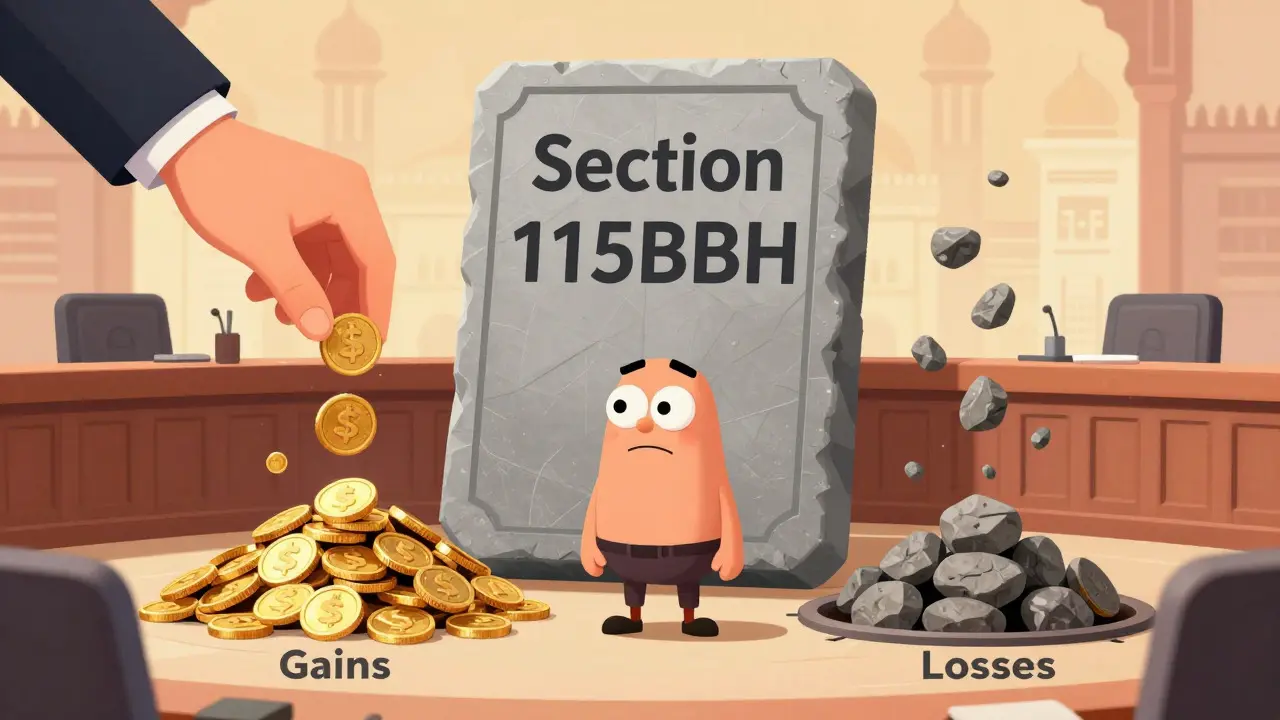
The core of this issue lies in Section 115BBH(2)(b) of the Indian Income Tax Act. This specific clause explicitly prohibits cryptocurrency losses from being used to offset gains from other crypto transactions. To break it down simply: if you lose money on Crypto A, that loss stays trapped. It cannot reduce the taxable income generated by profits from Crypto B.
This applies to all VDAs. Whether you are trading major coins like Bitcoin or smaller altcoins, the rule treats them all the same. The law does not distinguish between short-term speculation and long-term holding when it comes to this specific restriction. Unlike traditional equity markets where losses can often be carried forward or set off against other gains, crypto losses in India essentially vanish for tax purposes.
Here is why this matters so much:
- No Carry Forward: You cannot take this year’s crypto losses and use them to lower your tax bill next year.
- No Cross-Asset Offset: You cannot use crypto losses to reduce tax on salary, business income, or stock market gains.
- No Internal Offset: Even within the crypto space, a loss on one token doesn’t help you save on tax from a profit on another.
This creates a scenario where active traders, who naturally experience both wins and losses, face a significantly higher effective tax rate than passive holders who only sell when profitable.
The 30% Flat Tax and Hidden Costs
The no loss offset rule doesn’t operate in isolation. It sits on top of a rigid 30% flat tax rate on all crypto gains. This rate applies regardless of your personal income bracket. Whether you earn ₹5 lakh a year or ₹5 crore, the tax on your crypto profit is always 30%. On top of that, you must add applicable surcharges and health cess, which can push the effective rate closer to 33% or higher depending on your total income slab.
But the cost doesn’t stop there. There is also a 1% Tax Deducted at Source (TDS) on crypto transfers exceeding ₹10,000 annually. This TDS is deducted immediately by Indian exchanges whenever you transfer crypto worth more than this threshold. While this amount can be claimed back during filing, it ties up your capital instantly. For high-frequency traders, this creates significant cash flow issues.
Consider the deduction limits. Under this framework, the only expense you can deduct from your gains is the acquisition cost-the price you paid to buy the asset. You cannot deduct operational costs. This means gas fees on Ethereum, transaction fees paid to exchanges, or wallet maintenance costs are all ignored by the taxman. If you spent ₹5,000 in gas fees to execute a trade, that money is gone, and it doesn’t lower your taxable income.
| Feature | Equity/Stock Market | Crypto (VDAs) |
|---|---|---|
| Tax Rate | 10-20% (based on holding period) | 30% flat + surcharge/cess |
| Loss Offset | Allowed within same category | Not Allowed |
| Carry Forward Losses | Up to 8 years | Not Allowed |
| Deductible Expenses | Brokerage, STT, GST | Only Acquisition Cost |
| TDS/TCS | Variable based on transaction type | 1% TDS on transfers >₹10k |
Real-World Impact on Trader Psychology
How does this affect actual behavior? Data from platforms like CoinSwitch and feedback from tax advisory firms like Dinesh Aarjav & Associates show a clear shift. Traders are becoming more conservative. The fear of paying tax on gross gains while absorbing net losses discourages frequent trading.
Many experienced traders report reducing their activity levels. Some have migrated to crypto futures trading. Why? Because futures are derivatives, and currently, they do not fall strictly under the VDA category in the same way spot trades do. This loophole allows some traders to avoid the 1% TDS and potentially navigate different tax treatments, though this area remains legally gray and risky.
Others are looking offshore. Using international platforms seems attractive because it bypasses domestic exchange TDS mechanisms. However, this introduces new risks. Any remittance above ₹7 lakh per year triggers a 20% Tax Collected at Source (TCS) under the Liberalised Remittance Scheme (LRS). So, moving funds abroad to trade might save you 1% TDS here, but could cost you 20% TCS there, plus potential scrutiny from authorities regarding undisclosed assets.
Compliance Nightmares: Record Keeping
If the tax rates weren’t enough, the compliance requirements are exhaustive. You cannot file your crypto taxes using the simple ITR-1 form. You must use ITR-2 or ITR-3, and specifically fill out Schedule VDA.
This means you need a detailed record of every single transaction. Not just buys and sells, but also:
- Staking Rewards: Taxed as "Income from Other Sources" when received, then subject to capital gains tax when sold.
- Airdrops and Hard Forks: Treated as income upon crediting to your wallet.
- Mining Activities: Subject to income tax on the value mined, plus capital gains when those coins are later sold.
- P2P Trades: Both buyer and seller may have TDS obligations, requiring meticulous tracking of counterparty details.
Tax experts warn that failure to maintain these records is costly. Budget 2025 introduced stricter penalties for undisclosed holdings. Authorities can now tax unreported crypto at a steep 60% rate under Section 158B, applied retrospectively from February 1, 2025. This is not a suggestion; it is a punitive measure designed to force compliance.

Global Context: How India Compares
India’s approach is among the strictest globally. Compare it to the United States, where crypto losses can offset gains within the same asset class, and excess losses can sometimes offset ordinary income up to $3,000 per year, with the rest carried forward indefinitely. Or look at Germany, where crypto gains are entirely tax-free if held for more than one year.
In contrast, India offers no holding-period benefit for the 30% rate (though indexation was briefly discussed, the flat rate remains dominant). The combination of high tax, no loss relief, and heavy TDS creates an environment where innovation is stifled. Industry associations argue that this drives talent and capital away, forcing traders into underground channels where tax collection is actually harder, not easier.
Strategies for Navigating the Current Landscape
So, what can you do? First, accept that the rules are unlikely to change soon. Experts predict continued enforcement rather than relaxation. Therefore, adaptation is key.
- Track Everything: Use specialized crypto tax software. Manual spreadsheets will likely lead to errors given the complexity of Schedule VDA. Ensure you capture acquisition costs accurately, as this is your only deductible expense.
- Review Trading Frequency: Ask yourself if high-frequency trading makes sense when you lose the benefit of loss averaging. Consider longer holding periods if possible, even though the tax rate doesn't drop, the volatility risk decreases.
- Understand Derivatives: If you are an advanced trader, consult a CA about the implications of futures trading versus spot trading. Understand the legal boundaries clearly.
- Beware of Offshore Loopholes: Before moving funds abroad, calculate the TCS impact. Often, the convenience of an offshore exchange is negated by the 20% TCS on large remittances.
- Consult a Specialist: General CAs may not fully grasp the nuances of VDA taxation. Seek advisors who specialize in crypto to avoid costly mistakes during assessment.
The no loss offset rule is a structural hurdle. It turns crypto trading from a standard investment activity into a high-compliance, high-cost endeavor. By understanding the mechanics of Section 115BBH and the broader VDA framework, you can protect your capital and ensure you remain compliant in one of the world's most regulated crypto environments.
Can I carry forward crypto losses to the next financial year in India?
No. Under the current VDA regulations, crypto losses cannot be carried forward to future financial years. They are effectively lost for tax purposes once the financial year ends.
Does the 30% tax rate apply to staking rewards?
Staking rewards are first taxed as "Income from Other Sources" at your applicable income slab rate when received. When you subsequently sell those staked tokens, any gain over the fair market value at receipt is subject to the 30% VDA tax rate.
Can I deduct gas fees and exchange transaction fees from my crypto gains?
No. The law currently allows deductions only for the acquisition cost of the asset. Operational expenses like gas fees, network fees, and exchange transaction charges are not deductible.
What happens if I fail to report my crypto holdings?
Authorities can impose a penalty tax of 60% on undisclosed crypto holdings under Section 158B, along with interest and potential prosecution for willful evasion. This applies retrospectively from February 1, 2025.
Is there a difference in tax treatment for spot trading vs. futures trading?
Yes. Spot trading falls directly under VDA rules with 30% tax and 1% TDS. Futures trading involves derivatives, which may have different regulatory classifications, potentially avoiding immediate VDA TDS, but this area is complex and requires professional advice.
Which ITR form should I use for crypto income?
You must use ITR-2 or ITR-3 and fill out Schedule VDA. The simpler ITR-1 form does not accommodate crypto income reporting.
Can crypto losses offset salary or business income?
No. Crypto losses are ring-fenced. They cannot be set off against salary, business income, house property income, or any other source of income.
