Blockchain Explained: How It Powers Crypto, DeFi, and Real-World Applications
When you hear blockchain, a distributed digital ledger that records transactions across many computers so that records can’t be altered retroactively. Also known as distributed ledger technology, it’s the foundation that makes Bitcoin, DeFi, and even NFTs possible without needing banks or middlemen. It’s not magic—it’s math, code, and incentives working together to keep things honest.
At its core, blockchain, a distributed digital ledger that records transactions across many computers so that records can’t be altered retroactively. Also known as distributed ledger technology, it’s the foundation that makes Bitcoin, DeFi, and even NFTs possible without needing banks or middlemen. It’s not magic—it’s math, code, and incentives working together to keep things honest.
Most people think blockchain = Bitcoin, but that’s like saying internet = email. Ethereum, a programmable blockchain that lets developers build decentralized apps and smart contracts changed everything by letting code run on the network. That’s how DeFi, a system of financial services built on blockchain without banks or brokers emerged—lending, trading, and earning interest all happen automatically through code. And now, scaling solutions like ZK-rollups, a Layer 2 technology that bundles hundreds of transactions into one secure proof to cut fees and speed up Ethereum are making these apps fast and cheap enough for everyday use.
Blockchains don’t just move money. They track travel rewards like CANDY tokens, power virtual worlds with MANA and SAND, and even help verify who owns digital art or music NFTs like HUSL. Some chains, like Binance Smart Chain, were built to be faster and cheaper—others, like the Sonic blockchain behind Shadow Exchange v2, are designed for traders who want sub-second trades and near-zero fees. Meanwhile, Bitcoin’s blockchain stays secure through mining difficulty and block rewards, while Ethereum shifted to proof-of-stake to cut energy use and improve scalability.
But blockchain isn’t flawless. It’s only as good as the rules it follows. That’s why regulations like MiCA in the EU now require crypto platforms to get official licenses. It’s why some tokens—like SPEED or GROKGIRL—vanish overnight with no real use. And it’s why understanding the difference between hashing and encryption matters: one keeps data intact, the other proves you own it.
What you’ll find below isn’t theory. It’s real-world breakdowns of how blockchain actually works in practice—whether you’re trying to avoid scams, understand why fees spike, figure out how DeFi lending rates change, or spot which projects have real utility versus hype. No fluff. No jargon. Just what you need to know to use blockchain without getting burned.
Understanding Cryptocurrency vs Traditional Money: Key Differences in 2025
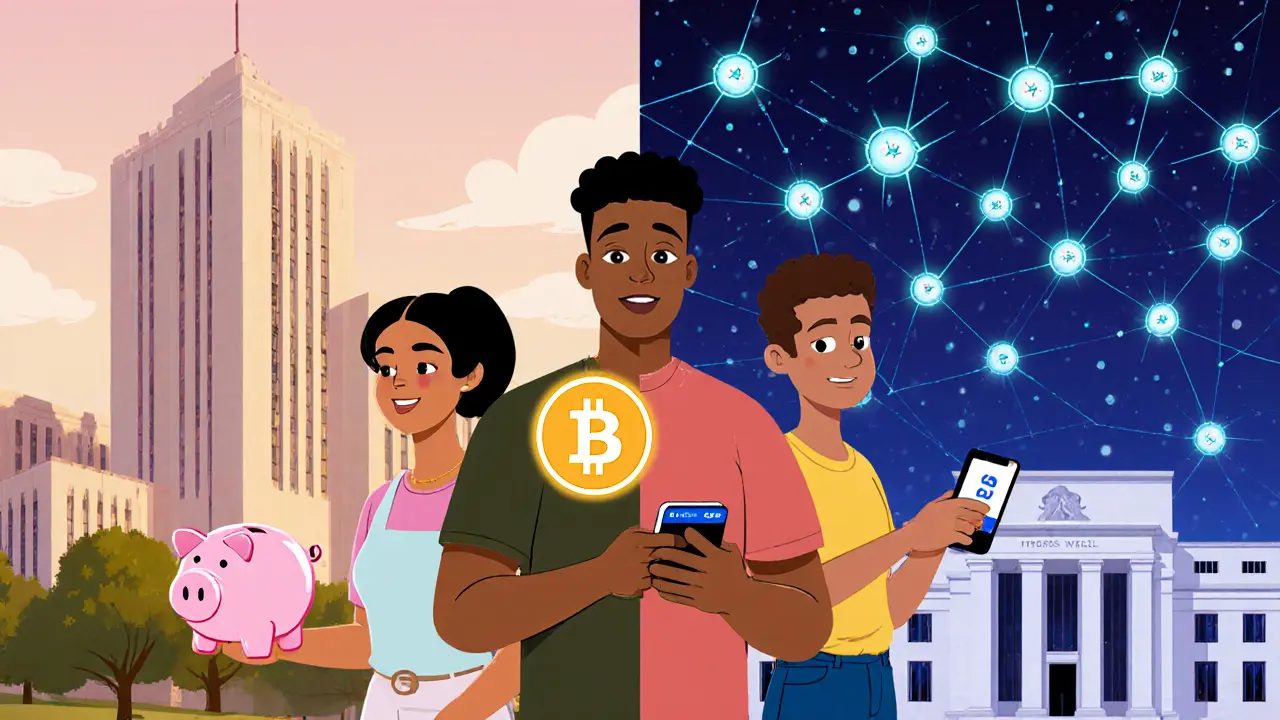
Cryptocurrency and traditional money work differently in 2025. One is government-backed and regulated. The other runs on code and decentralization. Learn how they compare in speed, cost, security, and real-world use.
- July 14 2025
- Terri DeLange
- 12 Comments