Byzantine Fault Tolerance: How Blockchains Stay Secure Without Trust
When you send Bitcoin or swap tokens on a decentralized exchange, you’re trusting a network of computers that don’t know or like each other. That’s where Byzantine fault tolerance, a system design that allows distributed networks to reach agreement even when some participants are faulty or malicious. Also known as BFT, it’s the reason your crypto doesn’t vanish because one node lies. Without it, blockchains would collapse the moment someone tried to cheat—like double-spending coins or faking transaction history.
Think of it like a group of generals trying to attack a city. If one general is a traitor and sends conflicting orders, how do the others agree on when to strike? In the real world, that’s the Byzantine Generals Problem, a theoretical puzzle about achieving consensus in unreliable systems. Blockchains solve it using consensus algorithms, rules that let nodes agree on the state of the ledger without a central authority. Bitcoin uses Proof of Work, which is slow but tough. Newer chains like Cosmos or Tendermint use Practical Byzantine Fault Tolerance (PBFT), which is faster and energy-efficient. Both are built on the same core idea: trust the math, not the people.
It’s not just about security—it’s about survival. If a network can’t handle bad actors, no one will use it. That’s why every major blockchain, from Ethereum’s shift to PoS to new Layer 2s like zkSync, has to answer this question: can it stay honest when half the nodes go rogue? The answer isn’t perfect, but it’s good enough. And that’s why you can send crypto across the world without a bank in the middle.
Below, you’ll find real-world examples of how this concept shows up in crypto—whether it’s in how a token gets distributed, how an exchange handles transactions, or why some networks die while others keep running. These aren’t theory papers. They’re the gritty details of what keeps crypto alive when the odds are against it.
How Many Faulty Nodes Can BFT Systems Tolerate? The Math Behind Blockchain Consensus
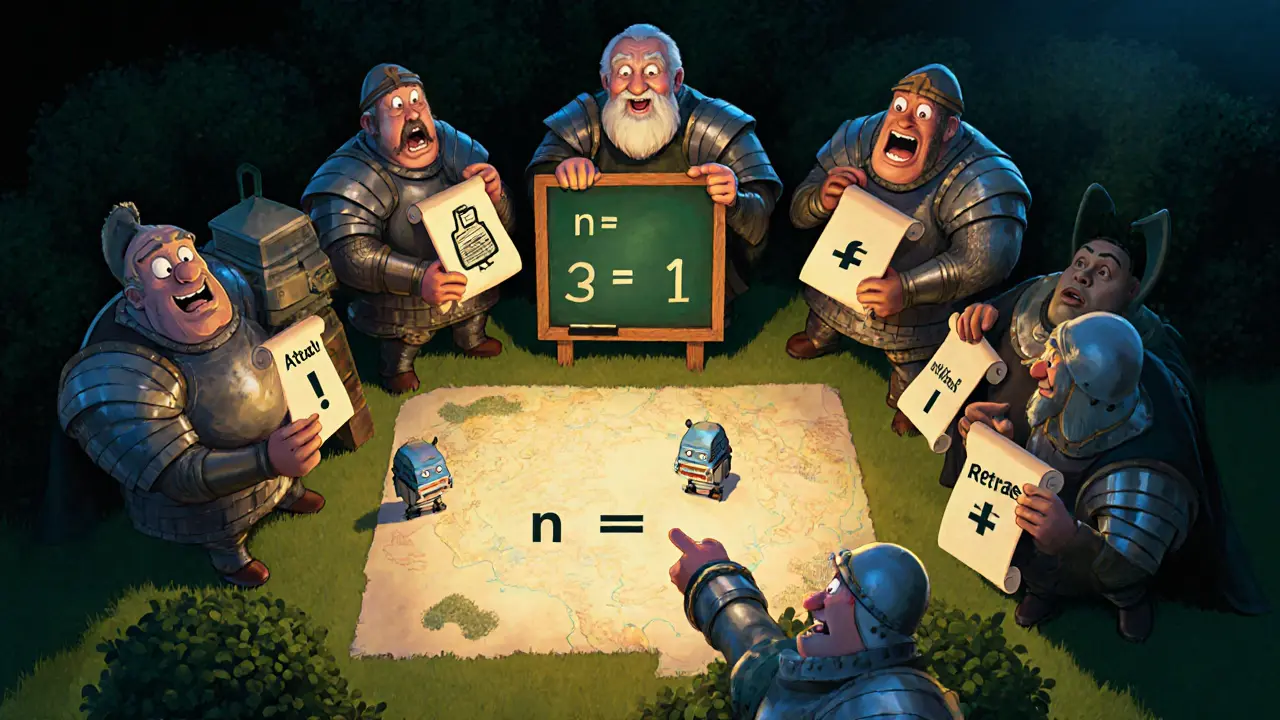
BFT systems can tolerate up to one-third of nodes being faulty, governed by the formula n ≥ 3f + 1. Learn how many nodes you need to handle 1, 2, or 3 faults - and why running the minimum is often a dangerous mistake.
- October 20 2025
- Terri DeLange
- 10 Comments