Crypto Exchange Geo-Blocks: Why Location Limits Your Trading Options
When you try to sign up for a crypto exchange and get blocked, it’s not a glitch—it’s a geo-block, a restriction that prevents users from accessing services based on their physical location. Also known as geofencing, this is how exchanges comply with local laws, avoid fines, or simply choose not to operate in certain countries. It’s not about your wallet or your knowledge—it’s about where you live.
Geo-blocks aren’t random. They’re tied to regional crypto regulation, laws that force exchanges to verify users by country and restrict services where compliance is too risky or costly. For example, in India, exchanges like WazirX and CoinDCX had to adapt to strict tax rules and UPI limits, so they built systems that only allow Indian residents to trade with INR. Meanwhile, the EU’s MiCA regulation, a unified framework that requires crypto firms to get a single license to operate across all 27 member states means some exchanges now serve the whole bloc, while others avoid it entirely because the paperwork is too heavy. If you’re in the U.S., you might see Coinbase but not Binance—because Binance chose not to register with U.S. regulators. It’s not about security. It’s about legal risk.
These blocks affect more than just access. They shape what you can trade, how you fund your account, and even what tokens are available. Some exchanges only list stablecoins in countries with strict capital controls. Others disable margin trading in regions where it’s banned. You might think you’re choosing an exchange—but the exchange is choosing you, based on your IP address or bank details. That’s why you’ll find posts here about exchanges that work in India, why some platforms vanished from the EU, and how users in restricted countries still find ways to trade—sometimes safely, sometimes not.
Below, you’ll find real reviews and breakdowns of exchanges that either allow or block users by location. You’ll see what happens when a platform ignores geo-blocks—and gets shut down. You’ll also find guides on how to legally access services where you live, and why trying to bypass restrictions can cost you more than just access.
Coinbase Geographic Crypto Restrictions by Country: What’s Allowed and What’s Blocked
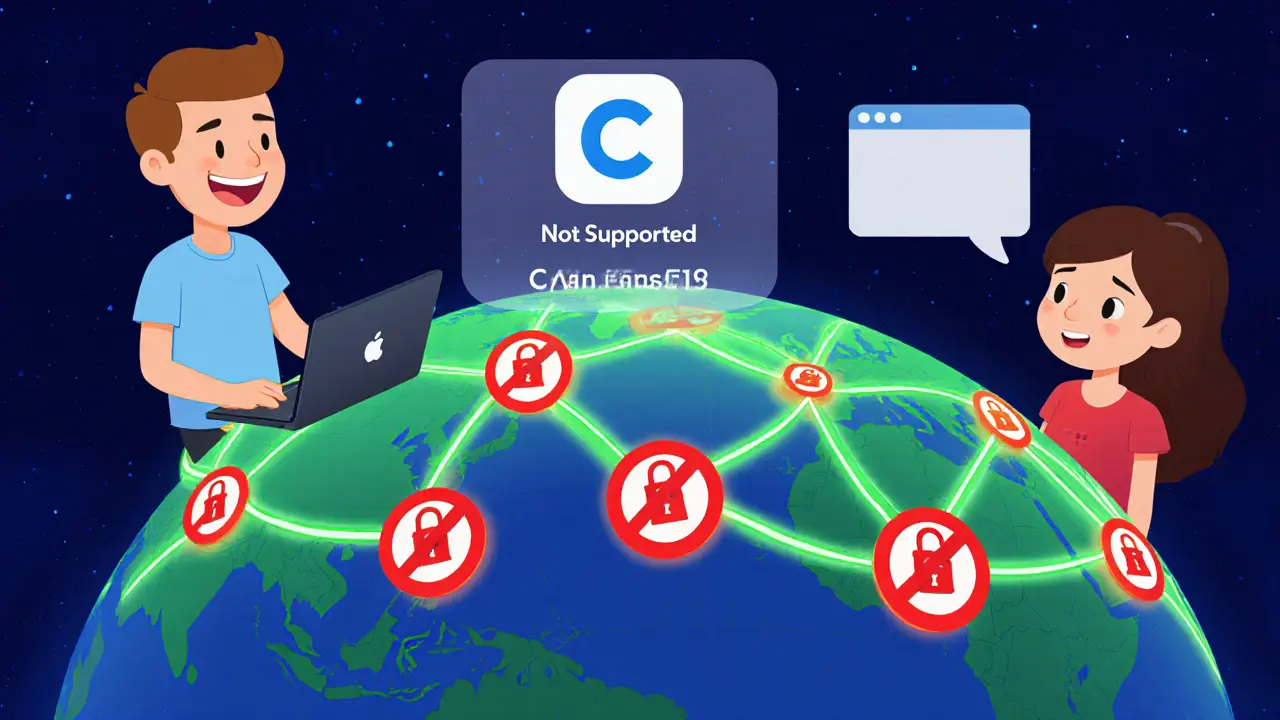
Coinbase restricts fiat services in 63 countries due to legal compliance. Learn where you can buy crypto, where you can't, and how to use Coinbase Wallet safely if you're blocked.
- August 21 2025
- Terri DeLange
- 11 Comments