n ≥ 3f + 1: What It Means for Blockchain Consensus and Network Security
When you hear n ≥ 3f + 1, a mathematical condition that defines the minimum number of nodes needed to tolerate malicious actors in a distributed system. Also known as the Byzantine fault tolerance threshold, it's the invisible rule that keeps blockchains from collapsing when some participants lie, cheat, or go offline. This isn't theory—it's the foundation of every secure blockchain that doesn't rely on a central authority. If your network has 10 nodes and 4 of them are compromised, the system fails. But if you have 13 nodes and only 4 are bad? It still works. That’s n ≥ 3f + 1 in action: n is total nodes, f is faulty or malicious ones, and the math says you need at least three times as many honest nodes as bad ones to stay safe.
This rule connects directly to how real systems like Bitcoin, Ethereum, and enterprise blockchains make decisions. Bitcoin uses proof-of-work to approximate this condition—miners compete to add blocks, and the longest chain wins. It doesn’t count nodes directly, but the cost of attacking the network makes it practically impossible to control 51% of the hash power. Ethereum’s proof-of-stake is more explicit: validators are chosen by stake, and the protocol requires 2/3 of validators to agree on a block. That’s a variation of n ≥ 3f + 1, where f is the number of slashed or offline validators. Without this threshold, a single bad actor could rewrite history, double-spend coins, or freeze transactions. The whole idea of decentralization falls apart if you can’t guarantee safety under attack.
It’s not just about Bitcoin or Ethereum. Protocols like Tendermint, HotStuff, and PBFT all rely on this exact math. Even if you’re not running a node, you’re still using systems built on this principle every time you send crypto, stake tokens, or trade on a DEX. If a network claims to be "decentralized" but doesn’t meet n ≥ 3f + 1, it’s just a database with a blockchain label. The posts below show you how this rule plays out in real projects—from how ZK-rollups secure Layer 2 networks to why some exchanges fail when they ignore distributed consensus. You’ll see how QBT and CANDY tokens depend on underlying protocols that must satisfy this condition, why Whale Alerts track node behavior, and how mining difficulty and nonce ranges are part of the same security ecosystem. This isn’t abstract math. It’s the reason your crypto still exists after a hack, a crash, or a bad actor’s attempt to break it all.
How Many Faulty Nodes Can BFT Systems Tolerate? The Math Behind Blockchain Consensus
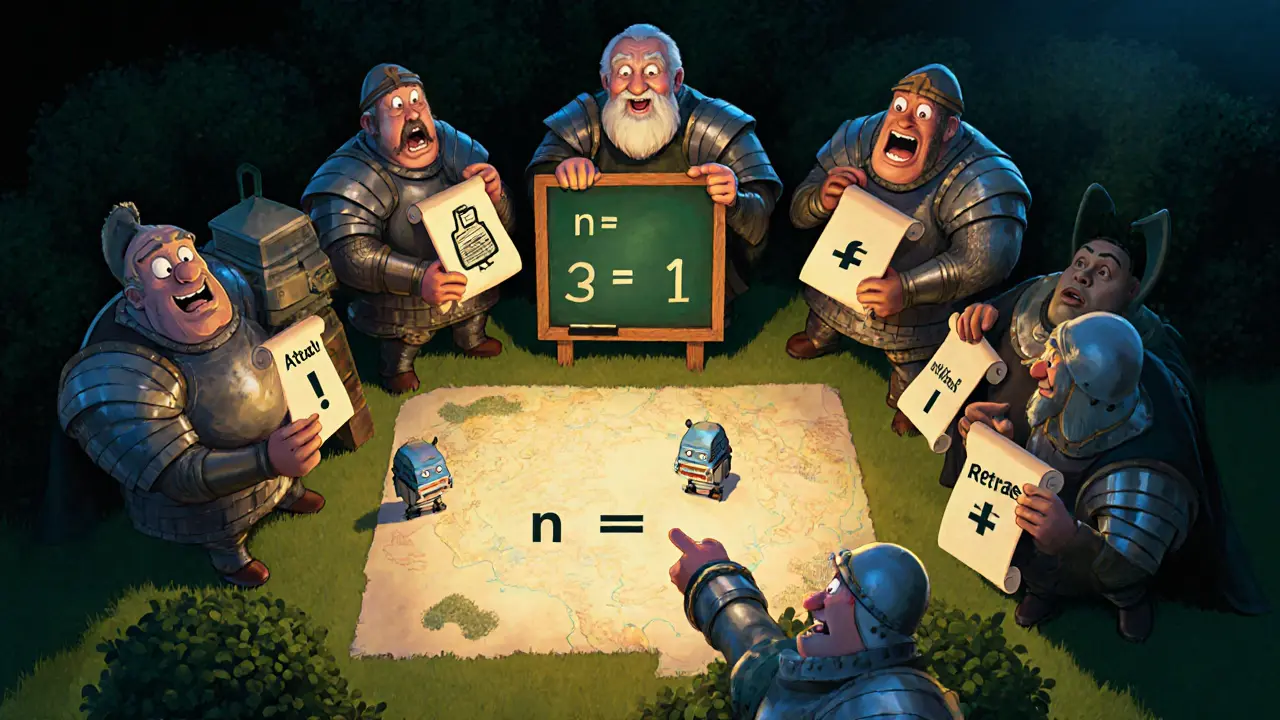
BFT systems can tolerate up to one-third of nodes being faulty, governed by the formula n ≥ 3f + 1. Learn how many nodes you need to handle 1, 2, or 3 faults - and why running the minimum is often a dangerous mistake.
- October 20 2025
- Terri DeLange
- 10 Comments