
Have you ever tried to swap tokens on a new blockchain only to find the exchange empty? That is exactly what happens with Uniswap v2 on the Blast network. If you are looking for a bustling marketplace with hundreds of coins and deep liquidity, you might be disappointed. But if you want to understand why this specific setup exists and whether it holds any value for your portfolio in 2026, keep reading.
Uniswap v2 on Blast is not your typical decentralized exchange (DEX). It is a niche deployment that serves a very specific purpose within the broader DeFi ecosystem. While the main Uniswap protocol dominates global trading volumes, its presence on Blast is currently minimal. In fact, as of late 2024 and moving into 2025, data from CoinGecko showed this specific instance supporting only one active trading pair. Yes, just one. So, why does it exist, and should you care?
What Is Uniswap v2 on Blast?
To understand this platform, we need to break down its two main components. First, there is Uniswap, a leading automated market maker (AMM) protocol created by Hayden Adams in 2018. The v2 version, launched in May 2020, introduced features like flash swaps and ERC-20/ERC-20 pools, using the classic constant product formula ($x \times y = k$). Second, there is Blast, an Ethereum Layer 2 solution known for native yield-bearing capabilities on idle assets.
When you combine them, you get a familiar interface running on a faster, cheaper chain. However, unlike Uniswap v3, which offers concentrated liquidity and multiple fee tiers, the v2 deployment on Blast keeps things simple. It uses the older, less capital-efficient model where liquidity providers must deposit funds across the entire price curve. This simplicity means lower technical barriers but also means you miss out on the advanced tools available in newer versions.
The Reality Check: Liquidity and Limitations
Let’s talk about the elephant in the room: liquidity. In the world of DeFi, liquidity is king. Without it, you face high slippage-meaning you get a worse price than expected when you trade. On major chains like Ethereum or Arbitrum, Uniswap handles billions in daily volume. On Blast? Not so much.
According to industry reports from late 2024, Uniswap v2 on Blast had extremely limited depth. With only one trading pair initially listed, the platform felt more like a placeholder than a fully realized product. Industry analyst Jane Smith from DeFi Research Group noted that it serves as a "strategic placeholder" while the Blast ecosystem matures. For the average user, this means:
- Limited Token Selection: You can’t just swap any coin here. Your options are severely restricted compared to PancakeSwap or even Uniswap on Ethereum.
- Higher Slippage Risk: Even small trades can move the price significantly because there isn’t enough capital in the pool.
- Lower Capital Efficiency: Unlike v3, v2 requires locking up more capital to achieve similar trading results, which discourages large liquidity providers.
If you are a professional trader looking for deep markets, this isn’t your spot. But for casual users wanting to test the waters on Blast with minimal friction, it offers a baseline functionality.
Why Use Blast Network at All?
If the liquidity is low, why bother? The answer lies in the underlying technology. Blast operates as an Ethereum Layer 2 scaling solution that promises something unique: native yield. When you hold ETH or stablecoins on Blast, they often earn interest automatically. This is a game-changer for passive holders.
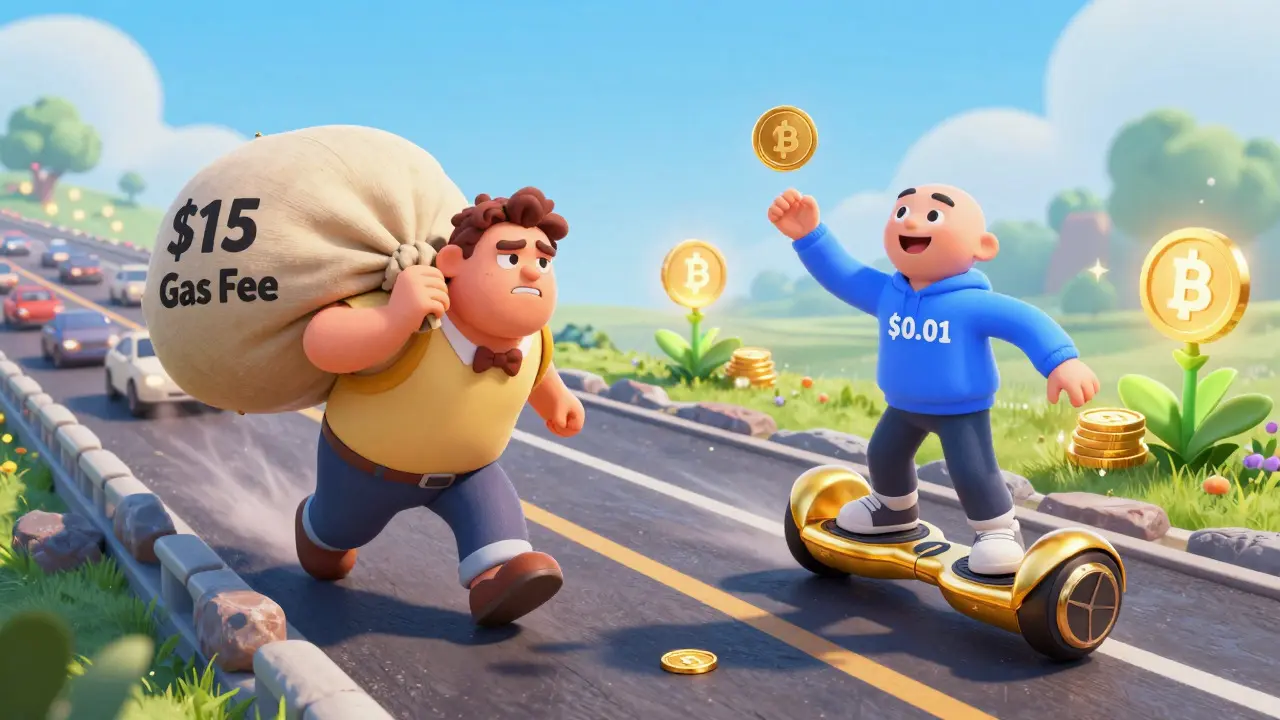
Furthermore, transaction costs are negligible. On Ethereum mainnet, a simple swap can cost $1.50 to $15 during congestion. On Blast, thanks to its Layer 2 architecture, fees typically range between $0.01 and $0.05. Transactions settle in 2-3 seconds, compared to Ethereum’s 12-15 seconds. For micro-transactions or testing new strategies, these savings add up quickly.
| Feature | Uniswap v2 (Blast) | Uniswap v3 (Ethereum) | PancakeSwap (BNB Chain) |
|---|---|---|---|
| Average Swap Fee | $0.01 - $0.05 | $1.50 - $15.00+ | $0.10 - $0.50 |
| Trading Pairs Available | Very Limited (1-5) | Thousands | Over 1,200 |
| Daily Volume | Negligible | ~$193 Million | ~$1.2 Billion |
| Liquidity Model | Constant Product (v2) | Concentrated Liquidity (v3) | Automated Market Maker |
| Native Yield Feature | Yes (via Blast) | No | No |
How to Get Started: A Step-by-Step Guide
If you decide to give Uniswap v2 on Blast a try, the process is straightforward but requires some initial setup. Here is how to do it without losing your shirt to errors.
- Set Up Your Wallet: You will need a non-custodial wallet like MetaMask, Trust Wallet, or Coinbase Wallet. Ensure it supports custom RPC networks.
- Add the Blast Network: Go to Blast’s official documentation or a trusted chain list site to find the correct RPC URL, Chain ID, and Symbol. Add these details to your wallet settings. This takes about 2-3 minutes.
- Fund Your Wallet: Bridge assets from Ethereum mainnet or another supported chain to Blast. Remember, Blast allows you to earn yield on idle assets, so consider keeping some funds there long-term.
- Connect to Uniswap: Navigate to the Uniswap interface and select the Blast network from the dropdown menu. Connect your wallet.
- Execute the Swap: Select your input and output tokens. Since options are limited, double-check that the pair you want is actually available. Confirm the transaction in your wallet.
A common pitfall for beginners is failing to adjust gas limits correctly. While Blast fees are low, occasional network hiccups can cause transactions to fail if the gas estimation is off. If a swap fails, check the Blast explorer to see if it was reverted, and try adjusting the gas multiplier in your wallet settings slightly higher.
Security and Trust: Is It Safe?
Security is paramount in DeFi. The good news is that Uniswap v2’s smart contracts have been audited extensively by firms like Trail of Bits, OpenZeppelin, and Certora. The code itself is battle-tested since its 2020 launch. However, the risk on Blast comes less from the protocol and more from user error or phishing sites.
Always verify the URL you are visiting. Scammers often create fake interfaces that look identical to Uniswap. Additionally, ensure your wallet permissions are managed properly. Revoke unnecessary approvals regularly using tools like Revoke.cash. While the SEC dropped its investigation into Uniswap Labs in October 2024, providing some regulatory clarity, always remember that DeFi is largely self-custodial-you are responsible for your own keys.
The Future Outlook: Will It Grow?
So, is Uniswap v2 on Blast a dead end? Probably not. It is likely a bootstrap mechanism. As the Blast ecosystem grows-with Total Value Locked (TVL) reaching $1.2 billion by late 2024-demand for robust trading infrastructure will increase. Analysts predict that if adoption continues, we could see 50-100 trading pairs added by mid-2025.
Moreover, Uniswap’s recent launch of an inter-chain bridge could facilitate easier asset transfers, potentially boosting activity on smaller deployments like Blast. However, competition is fierce. Native Blast applications like Radiant Capital and Squid are already capturing significant market share. For Uniswap v2 to thrive here, it may eventually need to upgrade to v3 standards to offer better capital efficiency.
For now, view Uniswap v2 on Blast as a utility tool rather than a primary trading hub. Use it for quick, cheap swaps within the ecosystem, especially if you are leveraging Blast’s native yield features. But don’t expect the depth or variety of its mainnet counterparts just yet.
Is Uniswap v2 on Blast safe to use?
Yes, the underlying smart contracts are highly secure and have been audited by top firms. However, risks remain from user error, such as connecting to phishing sites or mismanaging wallet permissions. Always verify URLs and start with small amounts.
Why are there so few trading pairs on Uniswap v2 Blast?
The Blast network is relatively new, and DeFi application adoption is still maturing. Uniswap v2 on Blast is in an early phase, serving as a foundational layer. As the ecosystem grows and more projects integrate, liquidity providers will likely add more pairs.
How do fees compare between Uniswap on Ethereum and Blast?
Fees on Blast are significantly lower. While Ethereum mainnet swaps can cost $1.50 to $15+ depending on congestion, Blast transactions typically cost between $0.01 and $0.05 due to its Layer 2 architecture.
Can I earn yield on my assets while using Uniswap on Blast?
Indirectly, yes. The Blast network itself offers native yield-bearing capabilities on idle assets like ETH and stablecoins. While Uniswap v2 doesn't have built-in staking rewards like some other platforms, holding assets on Blast allows you to benefit from the network's native yield mechanisms.
Will Uniswap v3 come to Blast?
It is highly likely. Industry experts suggest that v2 deployments on new chains often serve as temporary solutions until v3 can be optimized for that environment. V3 would bring concentrated liquidity and better capital efficiency, making it more attractive for larger traders.
