Trading cryptocurrency on Ethereum mainnet often feels like paying a premium for the privilege of moving money. You want to swap tokens, but gas fees eat into your profits before the trade even settles. This is exactly why Uniswap v3 on World Chain has become a hot topic in decentralized finance (DeFi). It combines one of the most advanced automated market maker protocols with a high-performance layer-1 blockchain designed for speed and low costs.
If you are looking for a way to trade without breaking the bank on transaction fees, or if you want to provide liquidity with higher capital efficiency than traditional pools allow, this setup might be what you need. But it isn't just about cheap fees; it’s about how the technology works under the hood. Let’s look at what makes Uniswap v3 on World Chain different, who it is actually good for, and what risks you should watch out for.
What Is Uniswap v3 on World Chain?
To understand this platform, we need to break it down into two parts: the protocol and the chain. Uniswap v3 is the third major version of the Uniswap protocol, launched in May 2021 by Hayden Adams. It revolutionized decentralized exchanges by introducing concentrated liquidity, allowing providers to allocate capital within specific price ranges rather than across the entire curve. This feature alone can increase capital efficiency by up to 4,000 times compared to previous versions.
World Chain is a layer-1 blockchain launched in early 2024 focused on scalability, offering sub-second finality and near-zero transaction costs. When you combine these two, you get a trading environment where swaps happen almost instantly, and the cost to execute them is fractions of a cent. As of mid-2025, Uniswap v3 on World Chain processes around $6.44 million in daily volume, making it a significant player despite being newer than its Ethereum counterpart.
The core value proposition here is simple: permissionless, non-custodial token swaps using an Automated Market Maker (AMM) model, but stripped of the bottlenecks that plague older networks. You keep control of your funds, and the code handles the rest.
Key Features That Set It Apart
Uniswap v3 brings several technical innovations to the table, and World Chain amplifies their benefits due to its infrastructure. Here is what you get when you use this platform:
- Concentrated Liquidity: Instead of spreading your funds thin across all possible prices, you choose a range. If ETH trades between $3,000 and $3,200, you only provide liquidity in that band. This means your money works harder, earning more fees per dollar invested.
- Range Orders: Think of this as placing a limit order on a centralized exchange, but while earning swap fees. You can deposit single tokens at a target price above or below the current market rate. Data from Evacodes shows that 22% of liquidity positions on World Chain use this feature.
- Flexible Fee Tiers: Pools offer three fee options: 0.05%, 0.30%, and 1.00%. Stablecoin pairs like USDC/DAI usually sit at 0.05% because they have low volatility, while riskier assets might use 1.00% to compensate providers for higher impermanent loss risk.
- NFT-Based Positions: Each liquidity position is represented as a unique ERC-721 NFT. This allows for precise tracking and management of your assets, though it adds a layer of complexity for beginners.
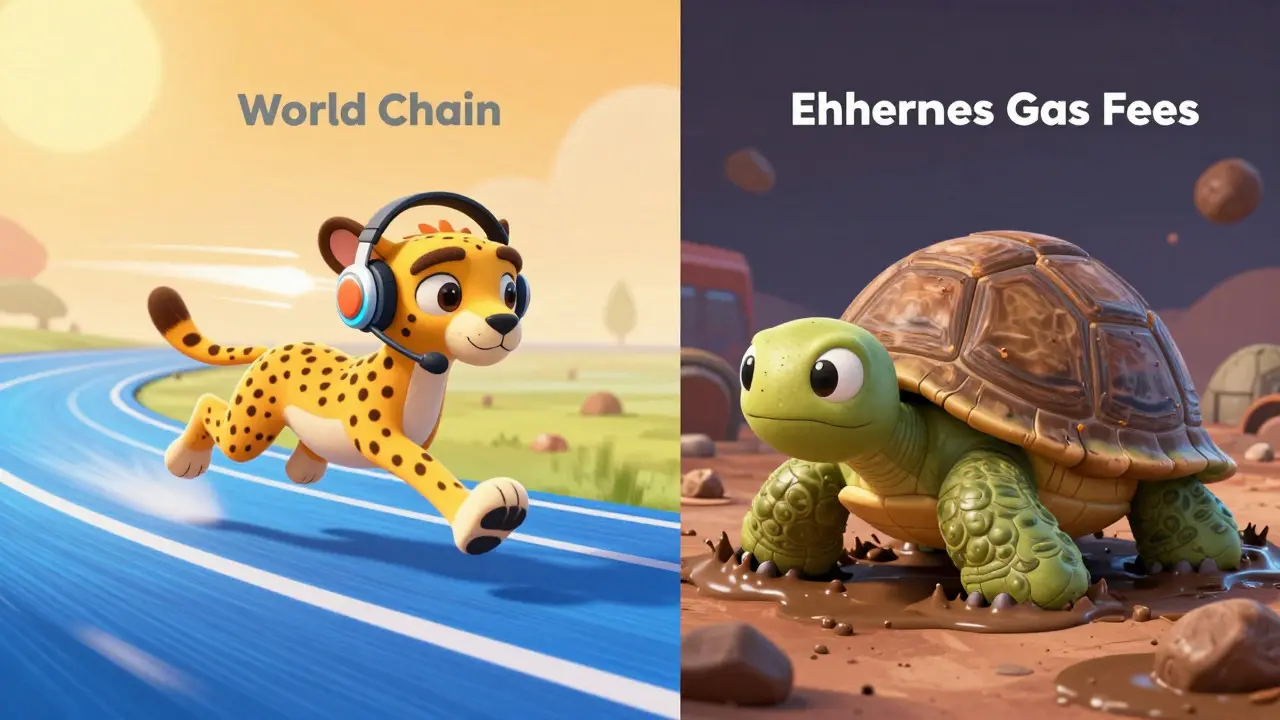
On World Chain specifically, these features shine because of the network's performance. With block times of roughly 100 milliseconds and average transaction costs of $0.0003, you can adjust your liquidity ranges frequently without worrying about eating into your returns with gas fees. In contrast, doing the same on Ethereum mainnet could cost over $1.00 per transaction during normal conditions.
Performance Comparison: How Does It Stack Up?
You might be wondering how this compares to other options. Is it better than Uniswap on Ethereum? What about PancakeSwap or Curve? Let’s look at the data.
| Feature | Uniswap v3 (World Chain) | Uniswap v3 (Ethereum) | PancakeSwap (BNB Chain) |
|---|---|---|---|
| Avg. Gas Fee | $0.0003 | $1.27 | $0.10 - $0.50 |
| Transaction Speed | ~100ms | 12-15 seconds | ~3 seconds |
| Liquidity Concentration | High (Custom Ranges) | High (Custom Ranges) | Medium (Standard Pools) |
| Total Value Locked (TVL) | ~$36M (0.8% of Uniswap Total) | ~$1.9B (42.3% of Uniswap Total) | ~$842M |
| Best For | Low-cost active trading & LPs | Institutional depth & security | Token farming incentives |
As you can see, World Chain wins on speed and cost. However, Ethereum still holds the crown for total liquidity depth. If you are trying to move millions of dollars, Ethereum’s deeper pools mean less slippage. But for retail traders moving hundreds or thousands of dollars, World Chain offers a smoother experience with negligible fees.
Compared to PancakeSwap, Uniswap v3 on World Chain lacks native token farming incentives, which drive a lot of activity on BNB Chain. However, it offers superior tools for professional liquidity providers who care more about capital efficiency than yield farming rewards.

User Experience and Interface
Getting started is straightforward if you already use MetaMask. You don’t need to download a new app; Uniswap’s interface works directly in your browser. The first step is adding World Chain to your wallet. Here are the parameters you’ll need:
- Chain ID: 4328
- RPC URL: https://worldchain.drpc.org
- Currency Symbol: ETH (or WORLD, depending on the specific bridge implementation)
Once connected, the interface looks familiar to anyone who has used Uniswap before. The price range selector is intuitive, showing you visual graphs of where liquidity sits. However, users have noted that while swapping is easy, providing liquidity requires learning. A survey by Milk Road found that 61% of novice users made suboptimal decisions because they didn’t fully understand how price ranges work.
For example, if you set a narrow range for a volatile asset like ETH, you might earn high fees initially, but if the price moves out of your range, your position stops earning until you rebalance. On Ethereum, rebalancing is expensive. On World Chain, it costs pennies, so you can adjust frequently. This is a huge advantage for active managers.
Risks and Considerations
No investment tool is perfect, and Uniswap v3 on World Chain has its own set of challenges. First, there is the issue of impermanent loss. This is a risk inherent to all AMMs, not just Uniswap. If the price of the asset you deposited changes significantly compared to when you deposited it, you might end up with less value than if you had just held the tokens in your wallet. One Trustpilot reviewer reported a 22% decline in portfolio value during a single ETH swing, despite following guides.
Second, regulatory uncertainty looms. While Uniswap on Ethereum has faced SEC scrutiny since 2022, World Chain’s status as a newer layer-1 creates additional ambiguity. CoinLaw’s 2025 report highlights that 67% of professional users are concerned about potential compliance risks. If regulations tighten, newer chains might face stricter hurdles than established ones.
Third, security audits. Uniswap Labs is reputable, but deploying on a new chain introduces variables. Cybersecurity expert Alex Thorn noted that rapid deployment sometimes outpaces comprehensive security testing. Always ensure you are connecting to the official Uniswap interface and double-check contract addresses.
Who Should Use This Platform?
This setup isn’t for everyone. If you are a passive investor who wants to "set it and forget it," standard Uniswap v2 pools or centralized exchanges might be easier. But if you fall into one of these categories, Uniswap v3 on World Chain is worth exploring:
- Active Traders: Those who make multiple swaps a day will save significant money on gas fees.
- Sophisticated Liquidity Providers: Users who understand price ranges and are willing to monitor their positions can achieve much higher returns than in standard pools.
- Arbitrageurs: The low latency and cost make it ideal for capturing small price differences between markets.
For beginners, start small. Deposit a modest amount into a stablecoin pair (like USDC/USDT) with a wide price range to learn how the mechanics work without exposing yourself to high volatility.
Future Outlook
The landscape is evolving quickly. Uniswap v4 is scheduled to launch on World Chain in Q1 2026, bringing even more advanced features like hooks and singleton deployments. Early estimates suggest this could boost capital efficiency by another 300%. Additionally, Uniswap governance recently approved $2.5 million to incentivize liquidity on World Chain through Q3 2025, aiming to triple the Total Value Locked (TVL).
If World Chain continues to grow and reaches the top 10 blockchains by network value, analysts predict Uniswap v3’s implementation could process over $50 million in daily volume by the end of 2026. However, if adoption stalls, it may remain a niche platform for power users.
Is Uniswap v3 on World Chain safe to use?
It is generally considered safe as it uses the battle-tested Uniswap v3 smart contracts. However, like all DeFi platforms, it carries risks such as smart contract bugs, impermanent loss, and regulatory uncertainty. Always do your own research and never invest more than you can afford to lose.
How much does it cost to swap on World Chain?
Transaction fees on World Chain are extremely low, averaging around $0.0003 per transaction. This is significantly cheaper than Ethereum mainnet, where fees can exceed $1.00 or more depending on network congestion.
What is concentrated liquidity?
Concentrated liquidity allows providers to allocate their capital within a specific price range instead of across the entire price spectrum. This increases capital efficiency, meaning your money earns more fees because it is actively working within the range where trades are happening.
Do I need World Chain tokens to use Uniswap?
You need ETH (or the native gas token of World Chain) to pay for transaction fees. Recently, Uniswap integrated WORLD as a payment option, which can reduce swap fees by 15% for holders, but ETH remains the primary requirement for gas.
How do I add World Chain to MetaMask?
Go to Settings > Networks > Add Network. Enter the Chain ID 4328 and RPC URL https://worldchain.drpc.org. You can find the full details in World Chain’s official documentation. Once added, switch to World Chain in your wallet before connecting to Uniswap.
