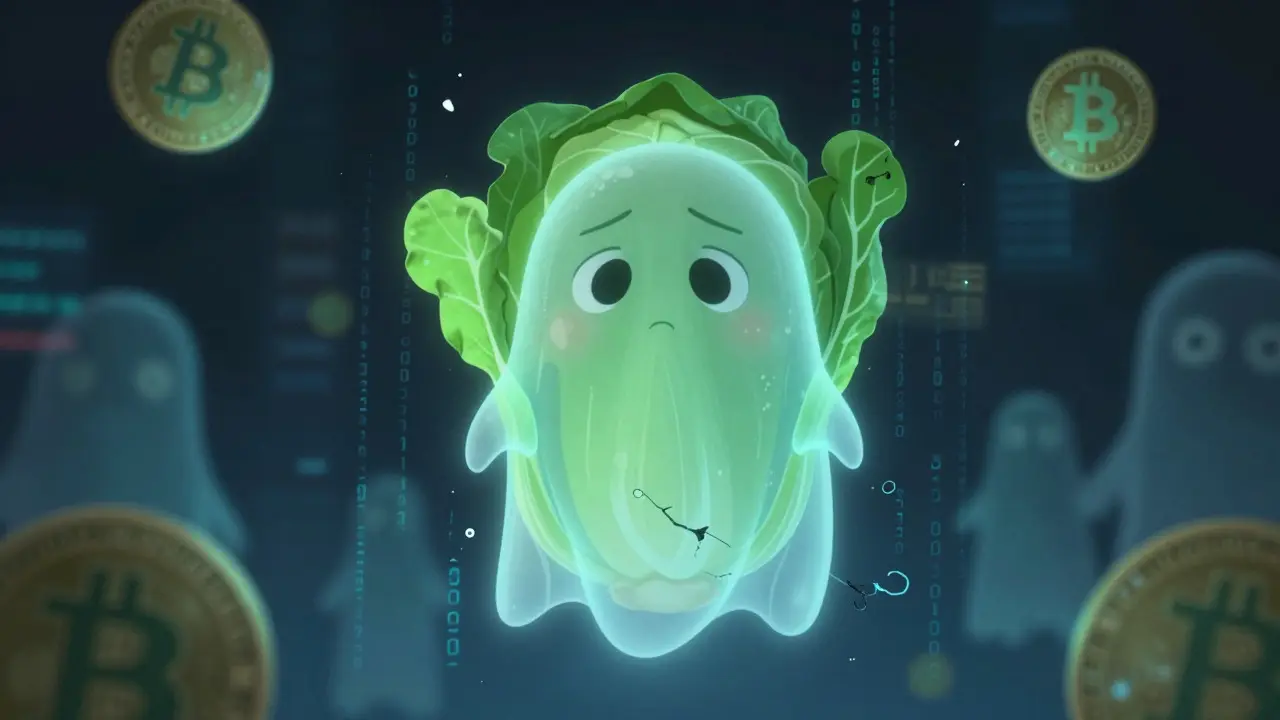
You’ve probably heard of Bitcoin, Ethereum, or even the latest meme coin taking over social media. But have you ever stumbled across Cabbage (CAB) is a virtually defunct cryptocurrency that exists primarily as a warning sign for investors? It’s one of those projects that appears on tracking sites but seems to live in a digital void. No news, no updates, and barely any trading activity. If you’re wondering what this token actually is, why it still shows up on lists, and whether it holds any value, you’re not alone. Many curious traders dig into obscure coins hoping to find hidden gems, only to uncover something far less exciting-or worse.
In this guide, we’ll break down exactly what Cabbage (CAB) is, where it came from, and why experts consider it a "ghost token." We’ll also look at the red flags that signal a project has been abandoned, so you can spot similar traps before they cost you money. By the end, you’ll know precisely how to evaluate low-cap cryptocurrencies and avoid dead ends like CAB.
The Origin Story: What Is Cabbage (CAB)?
To understand Cabbage (CAB), we first need to look at its history. The token emerged around 2016, during the early boom of altcoin creation. Back then, launching a new cryptocurrency was relatively easy, leading to thousands of projects popping up overnight. Most failed quickly, but their data often lingers on tracking platforms.
Cabbage (CAB) has a fixed total supply of approximately 10.5 million tokens. However, here’s the strange part: despite having millions of tokens created, reports indicate there are effectively zero tokens in actual circulation. This discrepancy is a major red flag. In healthy ecosystems, circulating supply represents the coins available for public trading. When that number hits zero while the total supply remains high, it usually means the creators held onto all the tokens and never released them to the market.
The official website, http://www.cabbage.tech, appears inactive. Attempts to access it often result in errors or empty pages. Without a functioning site, whitepaper, or active development team, CAB lacks the foundational elements required for a legitimate cryptocurrency project. There is no verifiable information about its founders, original purpose, or technological innovation. It simply exists as a static entry on several data aggregators.
Market Performance: Why CAB Has No Value
If you check current prices for Cabbage (CAB), you might see numbers ranging from $0.000073 to $0.0012 depending on the source. These figures are misleading because they don’t reflect real market activity. Here’s why:
- Zero Trading Volume: Major exchanges report $0 in 24-hour trading volume for CAB. This means no one is buying or selling the token actively.
- Inconsistent Data: Different platforms show wildly different rankings and values. One site might list it at rank #6,300, while another places it below #18,000. This inconsistency stems from automated scraping rather than real-time market data.
- No Liquidity: Even if you found someone willing to buy CAB, you’d likely struggle to sell it due to the lack of order books on reputable exchanges.
For context, Bitcoin’s market cap exceeds $11 trillion. Cabbage (CAB)’s estimated market cap hovers around $11,000-barely a rounding error in the grand scheme of things. To put that perspective into reality, imagine trying to trade a penny stock with no buyers. That’s the state of CAB today.
| Feature | Cabbage (CAB) | Typical Active Altcoin |
|---|---|---|
| Circulating Supply | ~0 (anomalous) | Transparent & Audited |
| 24h Volume | $0 | $10K - $1M+ |
| Exchange Listings | None Major | Binance, Coinbase, Kraken |
| Developer Activity | None Since ~2019 | Regular GitHub Commits |
| Community Engagement | Non-existent | Active Discord/Twitter |
Ghost Tokens Explained: The Category CAB Belongs To
Cabbage (CAB) isn’t just an old coin; it’s classified by analysts as a Ghost Token is a cryptocurrency that retains a listing on trackers but has no active trading, development, or community support. According to Messari’s Q4 2025 report, these tokens make up roughly 8.3% of all listed cryptocurrencies. They linger in databases because automated systems haven’t yet purged them, not because they offer any utility.
Why do ghost tokens exist? Often, they are remnants of failed Initial Coin Offerings (ICOs) from 2017-2018. Projects raised funds, promised revolutionary tech, and then vanished when interest waned. Others were outright scams designed to drain investor capital before disappearing. In either case, the result is the same: a token with no future.
Security firms like CertiK have flagged CAB for exhibiting multiple scam indicators. These include the anomalous supply structure, lack of blockchain transactions, and absence of smart contract audits. While CAB may not be actively stealing money right now, its characteristics align closely with historical fraud patterns.
Red Flags: How to Spot Abandoned Projects Like CAB
Avoiding tokens like Cabbage (CAB) requires vigilance. Here are the key warning signs every investor should watch for:
- Missing Whitepaper: Legitimate projects publish detailed documents explaining their technology, roadmap, and team. If you can’t find a whitepaper, proceed with extreme caution.
- Inactive Social Media: Check Twitter, Telegram, and Discord. Are posts recent? Do developers respond to questions? Silence is a bad omen.
- Low Liquidity: Use tools like CoinGecko or CoinMarketCap to check 24-hour volume. Consistently low or zero volume indicates a dead market.
- Anomalous Supply Metrics: Discrepancies between total and circulating supply suggest manipulation or abandonment.
- No Exchange Listings: Top-tier exchanges vet projects rigorously. If a token isn’t on Binance, Coinbase, or Kraken, it hasn’t passed basic security checks.
When evaluating any obscure coin, ask yourself: Who benefits if I buy this? If the answer isn’t clear, walk away. The crypto space is full of opportunities, but it’s also littered with traps like CAB.

Is There Any Future for Cabbage (CAB)?
Realistically, the chances of Cabbage (CAB) making a comeback are near zero. For a dead token to revive, three things must happen simultaneously:
- The original team returns and releases locked tokens.
- A major exchange agrees to relist it after years of inactivity.
- A community forms organically to drive demand.
History shows this rarely happens. Most ghost tokens are eventually delisted entirely. CoinGecko, for instance, removed over 3,200 inactive tokens in their Q3 2025 cleanup initiative. CAB is likely next in line for deletion from most reputable trackers.
Investors looking for high-risk, high-reward plays should focus on newer projects with transparent teams and active communities. Speculating on zombie assets like CAB offers little upside and significant downside risk.
Practical Steps: Protecting Yourself From Dead Coins
So, how do you stay safe? Start by using trusted resources. Always verify project details through multiple sources. Don’t rely solely on price charts; dig deeper into fundamentals. Join relevant communities to gauge sentiment. And remember, if something looks too good to be true-or too quiet to be real-it probably is.
Consider using portfolio management tools that filter out low-volume assets automatically. This helps prevent accidental exposure to tokens like CAB. Education is your best defense. The more you learn about blockchain mechanics and market dynamics, the harder it becomes for scams to trick you.
Is Cabbage (CAB) a scam?
While not definitively proven as a malicious scam, Cabbage (CAB) exhibits all the hallmarks of an abandoned or fraudulent project. With zero circulating supply, no developer activity, and no trading volume, it fits the profile of a "ghost token" that poses minimal threat beyond wasting time and potentially confusing new investors.
Can I still buy Cabbage (CAB)?
Technically, you might find small amounts on decentralized exchanges, but liquidity is virtually non-existent. Buying CAB is highly discouraged due to the inability to sell later. Most major centralized exchanges do not list it.
Why does Cabbage (CAB) still appear on tracking sites?
Tracking platforms like CoinMarketCap use automated crawlers to collect data. Until a manual review removes inactive tokens, they remain listed. This creates a false impression of legitimacy for dead projects.
What is the difference between a ghost token and a regular altcoin?
A regular altcoin has active development, community engagement, and trading volume. A ghost token like CAB has none of these. It exists only as data entries without real-world utility or market participation.
Should I hold my Cabbage (CAB) tokens?
If you already own CAB, holding them carries little financial risk since the investment is likely negligible. However, there is also no potential for gain. Consider it a lesson learned rather than an asset worth preserving.
