
You’ve probably seen the ticker HOODOG, a community-driven cryptocurrency token marketed as an 'Organic Community Token' for those who have 'started from nothing' pop up on social media or a price tracker. It promises a ride "to the moon" and speaks directly to retail investors who feel left behind by traditional finance. But before you swap your stablecoins for this meme-inspired asset, you need to know exactly what you are holding. Is it the next big community success story, or just another high-risk speculative bet with thin liquidity?
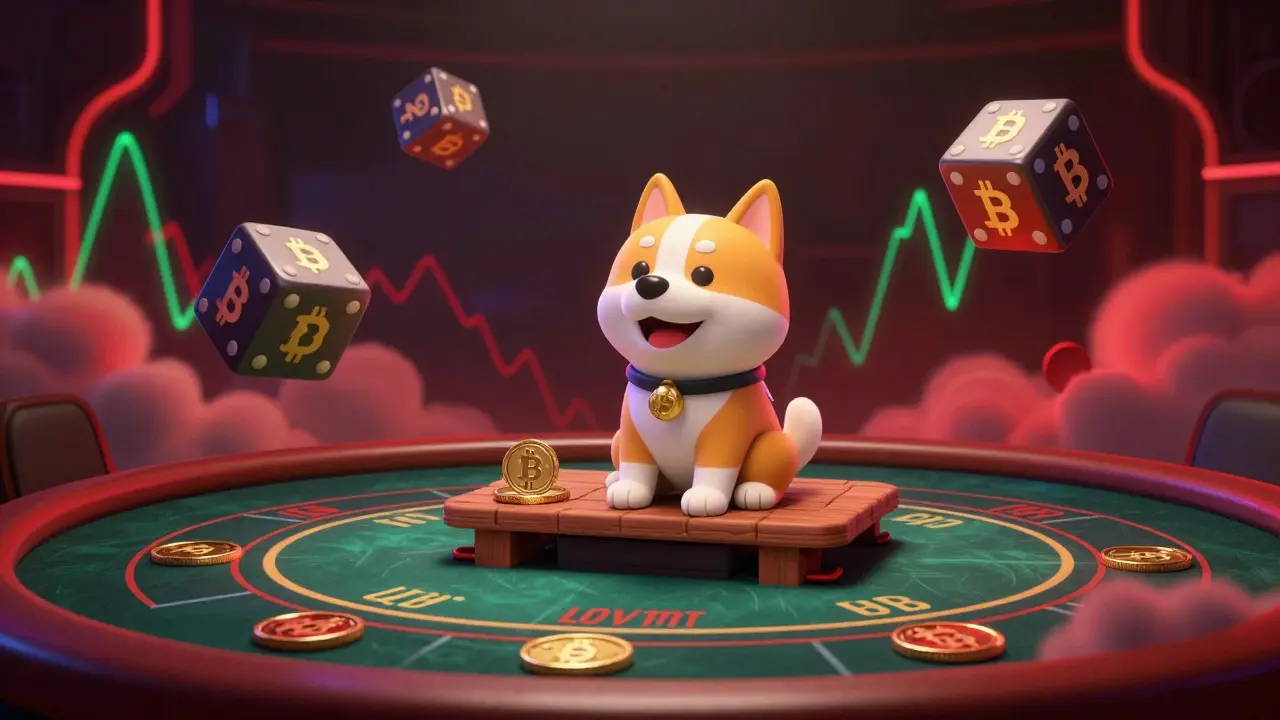
Hoodog (HOODOG) is not a utility token with a complex protocol, nor is it a governance token for a decentralized exchange. It is a narrative-driven asset built on the back of internet culture, specifically targeting the "hood dog" persona-a character that has seen both the lowest lows and highest highs of crypto cycles. If you are looking for technical innovation, you won’t find it here. If you are looking for community hype and extreme volatility, you might be in the right place. Let’s break down the reality behind the hype.
The Core Identity: What Makes HOODOG Tick?
To understand HOODOG, you have to look past the code and look at the culture. The project positions itself as an "Organic Community Token." This means its value isn't derived from revenue, user growth, or technological breakthroughs. Instead, its value comes entirely from collective belief and social momentum.
The official narrative revolves around a "hood dog" character. This mascot represents the everyday crypto trader who started with zero capital and survived multiple market crashes. The website hoodog.net invites users who relate to this struggle to join the movement. The messaging is blunt: "If you ever started from nothing then you can feel the energy of this community."
- Community Rituals: The project encourages members to "come to the block every Friday" to perform coordinated actions, aiming to show "what a million dogs can do in a day."
- Mindset Strategy: Developers explicitly advise holders to "Hold and don't sell," acknowledging that while easier said than done, this strategy is central to their long-term vision.
- Tone: The branding avoids corporate jargon. It uses colloquialisms like "see you on the moon" and warns against trying to "kiss him in the mouth," reinforcing the rough-and-tumble, grassroots identity.
This approach works well for building a loyal, albeit small, following. However, it also means the token’s fate is tied directly to social media trends rather than fundamental metrics.
Technical Reality Check: Solana or Ethereum?
Here is where things get messy. One of the biggest red flags for new investors is the confusion surrounding which blockchain HOODOG actually lives on. Different data aggregators tell different stories, and this discrepancy matters significantly for your transaction costs and security.
| Source | Reported Chain | Key Details |
|---|---|---|
| CoinSwitch.co | Solana | Described as a Web3 coin on Solana, citing high speed and low fees. |
| Blockspot.io / CoinMarketCap | Ethereum | Listed as a token on Ethereum; contract address starts with 0x9bf8...8df4B8. |
Why does this matter? If you are buying the Ethereum version, you will pay gas fees that can range from $1 to $50 depending on network congestion. If you are buying the Solana version, fees are fractions of a cent. The presence of an Ethereum contract address on major trackers like CoinMarketCap suggests the primary tradable asset is likely the ERC-20 token. However, the mention of Solana could indicate a bridge event, a separate launch, or simply inaccurate data entry by aggregators.
For now, assume the Ethereum version is the main one unless you verify the specific contract address on a wallet scanner. Always double-check the contract address before sending funds. Sending ETH to a Solana address (or vice versa) will result in permanent loss of assets.

Price Action and Market Performance
Let’s talk numbers. As of mid-2026, HOODOG is a micro-cap asset. This means it has a very small market capitalization, typically under $100,000. While this offers high leverage for gains, it also exposes you to massive downside risk.
Recent data points paint a picture of extreme volatility:
- All-Time High (ATH): Reached approximately $0.096 in July 2025.
- All-Time Low (ATL): Dropped to roughly $0.011 just one day later.
- Current Status: Trading near $0.000000000063 USD (scientific notation: $6.31e-11).
- Market Cap: Approximately $91,810 USD.
- Total Supply: 1 Quadrillion (1P) tokens.
The drop from its ATH to current levels represents an over 85% decline. However, from its ATL, it has recovered more than 1,300%. This whipsaw pattern is classic for meme coins with low liquidity. A single large buy order can spike the price by 20%, while a single large sell can crash it by just as much.
The volume-to-market cap ratio sits around 11%, indicating moderate activity relative to its size. Daily trading volumes hover between $1,100 and $10,300. In the world of Bitcoin or Ethereum, this is noise. For HOODOG, this is all the liquidity there is.
Where Can You Trade HOODOG?
Liquidity is king in crypto, and HOODOG suffers from severe liquidity constraints. According to recent tracking data, there is only one significant venue for trading this token: Uniswap V2, a decentralized exchange protocol that allows peer-to-peer trading of cryptocurrencies without intermediaries.
On Uniswap, HOODOG is paired with WETH (Wrapped Ethereum). This means you cannot buy HOODOG with USDT or USDC directly; you must first swap your stablecoin for ETH, wrap it into WETH, and then trade for HOODOG. Each step incurs a fee.
Because the pool is small, you face two major risks when trading:
- Slippage: If you try to buy $100 worth of HOODOG, the price might jump by 5-10% because there aren't enough tokens in the pool at the current price. You end up paying more than expected.
- Impermanent Loss for Liquidity Providers: If you provide liquidity, the volatile nature of the pair can lead to significant losses compared to just holding the assets separately.
There are no listings on centralized exchanges like Binance, Coinbase, or Kraken. This lack of institutional access keeps the token in the "wild west" phase of crypto development. It relies entirely on decentralized trading, which requires users to manage their own private keys and security.
Roadmap and Future Viability
The HOODOG team has outlined a three-phase roadmap on their official site. Evaluating this roadmap helps determine if the project is moving forward or stagnating.
- Phase 1 (Completed): Setup community, update socials/branding, Twitter verification.
- Phase 2 (In Progress/Partial): Begin marketing, Moonshot listing, Jupiter verification.
- Phase 3 (Target): CoinMarketCap/CoinGecko listing, RWR (Real World Rewards), Community Rewards Program.
Interestingly, HOODOG already appears on CoinMarketCap and CoinGecko, suggesting Phase 3 objectives have been partially met. However, the absence of "Real World Rewards" or a concrete "Community Rewards Program" leaves the token’s utility ambiguous. Without a clear use case-such as staking rewards, NFT integration, or merchant acceptance-the token remains purely speculative.
The future viability of HOODOG depends less on technology and more on community retention. Can they keep the "Friday block" rituals engaging? Can they expand beyond Uniswap to other decentralized exchanges or eventually secure a spot on a smaller centralized exchange? These are the milestones that would signal genuine growth.
Key Risks Every Investor Must Know
If you decide to allocate even 1% of your portfolio to HOODOG, you need to accept these risks:
- Liquidity Trap: With daily volumes under $10k, selling a large position can drain the pool, causing your exit price to collapse.
- Contract Risk: There is no public information regarding smart contract audits. On Ethereum, unaudited contracts carry the risk of hidden functions that allow developers to halt trading or mint unlimited tokens.
- Regulatory Gray Area: Meme coins often operate without clear regulatory compliance. Future regulations on unregistered securities could impact trading availability.
- Data Inconsistency: The confusion between Solana and Ethereum versions creates operational risk. Buying the wrong chain means you hold an illiquid asset with no easy way to swap.
Always remember the golden rule of meme investing: Only invest what you are willing to lose entirely. HOODOG is not an investment in the traditional sense; it is a bet on community sentiment.
Is HOODOG a scam?
There is no definitive proof that HOODOG is a scam, but it carries high risk. It lacks smart contract audits and has conflicting blockchain data. The term "scam" usually implies intentional fraud, whereas HOODOG appears to be a high-volatility meme coin with limited utility. Treat it as a speculative gamble rather than a secure investment.
Which blockchain is HOODOG on?
Data is conflicting. CoinMarketCap and Blockspot list it on Ethereum (ERC-20), while CoinSwitch mentions Solana. The most active trading pair is on Uniswap V2 (Ethereum). Always verify the contract address before purchasing to ensure you are on the correct chain.
How do I buy HOODOG?
You can buy HOODOG on Uniswap V2. You will need an Ethereum wallet (like MetaMask), some ETH for gas fees, and Wrapped ETH (WETH) to swap for HOODOG. Connect your wallet to Uniswap, paste the correct HOODOG contract address, and approve the transaction.
What is the total supply of HOODOG?
The total supply of HOODOG is 1 Quadrillion (1,000,000,000,000,000) tokens. This massive supply is typical for meme coins, allowing for micro-penny pricing and psychological appeal for retail buyers.
Is HOODOG listed on Coinbase or Binance?
No. HOODOG is currently only available on decentralized exchanges like Uniswap V2. It is not listed on any major centralized exchanges such as Coinbase, Binance, or Kraken.
