
You type "ORC" into a search bar or a crypto tracker, and you get a headache. You see a price chart for a mortgage company. You see another chart for a blockchain bridge. And then you see a third one for a meme coin featuring fantasy creatures. It is confusing because the ticker symbol ORC belongs to three completely different assets that share nothing in common except those three letters.
If you are looking to buy, trade, or simply understand what is happening with this asset, you need to separate these instruments immediately. Mixing them up could lead you to buy a stock instead of a token, or worse, invest in a high-risk meme coin thinking it is a serious infrastructure project. This guide breaks down exactly what each "ORC" is, how they work, and where you can actually find them in the market as of mid-2026.
The Real Confusion: Three Assets, One Ticker
Before we look at the blockchain tech, let's clear the biggest trap first. When you see "ORC" on financial news sites like Yahoo Finance or Bloomberg, you are likely looking at Orchid Island Capital, which is a real estate investment trust (REIT) focused on residential mortgages. This company trades on the New York Stock Exchange under the symbol ORC. In June 2026, its stock price hovers around $6.90 per share, with a market cap of roughly $1.2 billion and a dividend yield near 18.8%.
This is a traditional equity security. It pays dividends. It has earnings reports. It has absolutely nothing to do with cryptocurrency, blockchain, or digital wallets. If you try to send Orchid Island Capital stock to your MetaMask wallet, it will fail. Always check the exchange name. If it says NYSE, stay away if you are looking for crypto.
Orbit Chain ORC: The Utility Token
Now we move to the actual cryptocurrencies. The first one is the native token of Orbit Chain, which is a multi-asset blockchain network designed for cross-chain interoperability. Developed by Ozys, a South Korean blockchain firm, Orbit Chain aims to connect fragmented blockchain communities. Think of it as a hub that allows different blockchains to talk to each other and move assets seamlessly.
The ORC token here serves a specific job. It is not just a store of value; it is fuel. You use ORC to pay transaction fees on the Orbit network. You use it to vote on governance proposals that decide how the network evolves. Validators who secure the ledger receive ORC as compensation. Because it powers the infrastructure, its value is tied to the usage of the Orbit Bridge and the decentralized applications built on top of it.
Here is the hard data on this token as of late 2025 and early 2026:
- Max Supply: 1,000,000,000 ORC
- Circulating Supply: Approximately 685 million ORC (about 69% of max supply)
- Market Cap: Roughly $2.1 million USD
- Price Range: Sub-penny, often trading between $0.0005 and $0.002 USD
- Blockchain Standard: ERC-20 on Ethereum (for representation), but operates on its own chain logic
The holder base is modest but active. On-chain data from Ethplorer shows over 8,000 holders and more than 84,000 transactions recorded by October 2025. This suggests real engagement from developers and niche users, rather than just bots. However, the liquidity is thin. On Uniswap V3, daily trading volume has been reported as low as $59. This means if you try to sell a large amount of ORC quickly, you will face significant slippage-the price will drop before your order fills.
ORC Coin: The Meme Token
The second crypto asset is simply called ORC Coin, which is a speculative meme token inspired by legendary orc characters. Unlike Orbit Chain, this token has no underlying technology, no bridge infrastructure, and no governance utility. Its entire value proposition rests on community interest, internet culture, and short-term trading momentum.
ORC Coin launched with a fixed supply of 1 billion tokens, all of which are currently in circulation. There are no future emissions or vesting schedules to worry about, but there is also no mechanism to burn tokens or create scarcity through utility. As of June 2026, it trades primarily on decentralized exchanges like Raydium on the Solana network.
The metrics paint a picture of extreme volatility and micro-cap status:
- Total Supply: 1,000,000,000 ORC (100% circulating)
- Market Cap: Fluctuates between $112,000 and $1.3 million USD depending on the data source
- Trading Volume: Often below $250 per day on major DEX pairs
- Primary Venue: Raydium (Solana ecosystem)
Because the market cap is so small, even tiny amounts of money moving in or out can cause double-digit percentage swings in hours. A buy order of $5,000 might push the price up 5% instantly. This makes it a playground for degens and speculators, but a dangerous place for anyone seeking stable growth. There are no institutional analysts covering this token. No whitepaper details technical innovations. It exists purely as a social experiment in digital currency.
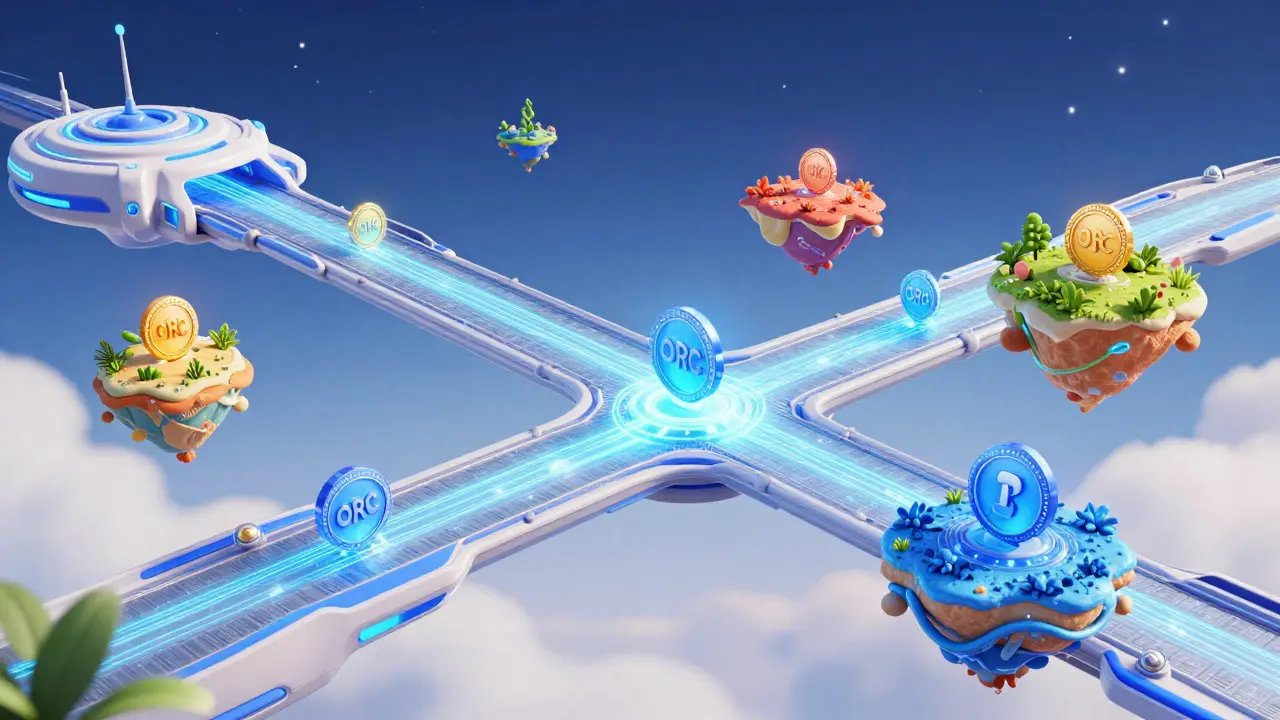
Comparing the Two Crypto ORCs
| Feature | Orbit Chain ORC | ORC Coin |
|---|---|---|
| Purpose | Cross-chain utility, fees, governance | Meme speculation, community fun |
| Underlying Tech | Orbit Chain Network (Interoperability) | None (Standard Token Contract) |
| Primary Chain | Ethereum (ERC-20 wrapper) / Native Orbit | Solana (SPL Token) |
| Supply Status | ~69% Circulating | 100% Circulating |
| Risk Profile | High (Low liquidity, niche adoption) | Extreme (Pure speculation, no utility) |
| Exchange Listings | Uniswap V3, Kraken (limited) | Raydium, Coinbase (listed but low vol) |
Notice the key difference in risk. Orbit Chain has a team, a product, and a roadmap. If the cross-chain narrative grows, ORC could benefit from increased network usage. ORC Coin has none of that. If the community loses interest, the price goes to zero. There is no floor based on utility.
How to Buy ORC Tokens Safely
Buying either of these tokens requires stepping outside the comfort zone of centralized exchanges like Binance or Coinbase Pro for direct spot trading. Here is why: Neither asset meets the listing criteria for major tier-1 exchanges due to low volume and compliance hurdles. Binance explicitly states that ORC is not listed for spot trading and directs users to their Web3 wallet for DEX interactions.
To acquire Orbit Chain ORC:
- Set up an Ethereum-compatible wallet. MetaMask or Trust Wallet works well. For better security, consider a hardware wallet like D’CENT, which supports Orbit Chain natively.
- Fund your wallet with ETH. You need ETH to pay for gas fees on the Ethereum network when interacting with the ERC-20 version of the token.
- Connect to Uniswap V3. Go to the Uniswap interface and connect your wallet.
- Swap ETH for ORC. Paste the correct contract address for Orbit Chain ORC. Double-check this address against official sources like CoinGecko or the Orbit Chain documentation. Never copy addresses from random Telegram messages.
- Adjust slippage. Due to low liquidity, you may need to set slippage tolerance higher than the default 0.5%, perhaps to 1% or 2%, to ensure the transaction goes through.
To acquire ORC Coin (the meme token):
- Use a Solana-compatible wallet. Phantom or Solflare are standard choices.
- Fund with SOL. You need Solana to pay for transaction fees.
- Go to Raydium. Connect your wallet to the Raydium decentralized exchange.
- Find the ORC/SOL pair. Again, verify the contract address carefully. Meme coins often have fake copies with similar names.
- Execute the swap. Be prepared for high volatility. The price might change significantly while your transaction is pending.
Key Risks and Red Flags
Investing in micro-cap tokens like these carries risks that do not exist with Bitcoin or Ethereum. First, there is the liquidity risk. With daily volumes sometimes under $100, you might buy easily but find yourself unable to sell without crashing the price. Second, there is the smart contract risk. While Orbit Chain uses established standards, any bug in the bridge code could freeze funds. Third, there is the information asymmetry. Most retail investors rely on aggregated data from CoinGecko or CoinMarketCap, which can lag behind real-time DEX prices by minutes or hours.
Another critical red flag is the ticker collision. Always verify the platform. If you are on a stock brokerage app, you are buying Orchid Island Capital. If you are on a crypto app, check the full name. Does it say "Orbit Chain" or just "ORC Coin"? The distinction changes your investment thesis entirely.
Future Outlook: Niche Utility vs. Pure Speculation
Looking ahead to the rest of 2026 and beyond, the paths for these two assets diverge sharply. Orbit Chain’s success depends on the broader adoption of cross-chain solutions. If more dApps choose to build on Orbit for its interoperability features, demand for ORC as a fee token will rise organically. However, it faces stiff competition from larger players in the interoperability space. It remains a niche project with limited mainstream awareness.
ORC Coin’s future is binary. It either gains a cult following and sees sporadic pumps driven by social media trends, or it fades into obscurity as attention shifts to newer memes. There is no middle ground. Without utility, it cannot sustain long-term value appreciation independent of hype cycles.
For most investors, these tokens represent high-risk allocations suitable only for capital you can afford to lose entirely. They offer exposure to specific narratives-interoperability and meme culture-but lack the stability and liquidity of blue-chip assets. Do your own research, verify contract addresses, and never confuse the REIT stock with the crypto tokens.
Is ORC crypto the same as Orchid Island Capital stock?
No. Orchid Island Capital (NYSE: ORC) is a traditional real estate investment trust (REIT) that trades on the New York Stock Exchange. It is a stock, not a cryptocurrency. The crypto assets named ORC are digital tokens traded on decentralized exchanges. They are completely unrelated entities that happen to share the same three-letter ticker symbol.
Which ORC token should I buy?
It depends on your goal. If you believe in the technology of cross-chain interoperability and want a token with utility for paying fees and governance, look at Orbit Chain ORC. If you are looking for high-risk, high-reward speculation based on internet culture and memes, look at ORC Coin. Both are highly volatile and illiquid, so neither is recommended for conservative investing.
Can I buy ORC on Binance?
No, ORC is not listed for spot trading on Binance. Binance explicitly directs users to use their Web3 wallet feature to interact with decentralized exchanges (DEXs) like Uniswap or Raydium to purchase ORC tokens. This means you must manage your own private keys and handle the swap process manually.
Why is the liquidity for ORC so low?
Both Orbit Chain ORC and ORC Coin are micro-cap assets with small market caps (under $3 million). Low market cap usually correlates with low trading volume. Fewer people are buying and selling, resulting in thin order books on decentralized exchanges. This leads to high slippage, meaning large trades can significantly impact the price.
What is the total supply of Orbit Chain ORC?
The maximum supply of Orbit Chain ORC is 1 billion tokens. As of late 2025, approximately 685 million tokens were in circulation, representing about 69% of the total supply. The remaining tokens are likely reserved for future development, team incentives, or ecosystem growth, subject to the project's tokenomics schedule.

Ryan Peters
June 29, 2026 AT 11:10Look, the whole crypto space is a massive scam designed to bleed dry anyone who doesn't understand basic economics. You're sitting there trying to figure out which ORC token is 'real' while the rest of us are just watching our savings evaporate into thin air. It's pathetic how people chase these micro-cap garbage coins thinking they're going to be the next big thing. The REIT stock is at least backed by actual real estate, even if it's a dying industry. But no, you want to gamble on a meme coin with zero utility because some internet troll told you it would moon. Wake up. This isn't investing; it's donating money to developers who are already cashing out.
ross harris
July 1, 2026 AT 06:40The ticker symbol collision is merely a reflection of the chaotic nature of human consciousness in the digital age. We seek order in symbols, yet the universe provides only noise. Orbit Chain attempts to bridge chains, but can it bridge the gap between hope and despair? Probably not. The meme coin represents the id-pure impulse, no superego to check it. It is fascinating, really, that we assign value to nothingness. I find myself contemplating the void of the liquidity pool, staring into the abyss of slippage, and realizing that the abyss stares back with a 90% fee structure. Beautiful, in a horrifying way.
Daniel J. Cox
July 2, 2026 AT 17:01I actually tried buying the Orbit Chain one last week. It was such a smooth process once I figured out the wallet setup 😊. The interface on Uniswap was a bit confusing at first, but hey, that's part of the adventure, right? I love how diverse the crypto ecosystem is becoming. It's like exploring a new country every time you switch chains. Keep learning, everyone! 🌍
Emma Rémond
July 2, 2026 AT 19:56Oh, darling, please. Do you honestly believe that 'cross-chain interoperability' is anything more than a buzzword invented to justify another failed venture capital bet? The notion that Orbit Chain will solve fragmentation is laughable when the foundational technology itself is riddled with security vulnerabilities. And let's not pretend that ORC Coin has any cultural merit; it's vulgar, derivative, and utterly devoid of intellectual substance. Only those with a profound lack of financial literacy would consider allocating capital to such instruments. It is simply embarrassing to witness this level of naivety.
ELNORA JEFFERSON
July 4, 2026 AT 01:51why do i always end up reading these articles about shitcoins i dont own and cant afford anyway its just so exhausting seeing all this hype around things that go to zero instantly i just want to sleep
Carol @minaszilda
July 4, 2026 AT 14:25It is important to remember that knowledge is power. Understanding the difference between these assets helps protect your financial well-being. Take your time to research. Do not rush into decisions. Every small step towards understanding is a victory. Stay safe and stay informed.
John Curry
July 4, 2026 AT 20:20There is something profoundly tragic about the human desire for quick riches in an era of algorithmic exploitation. We watch these charts rise and fall like tides, unaware that we are merely sandcastles being washed away. The meme coin is a mirror reflecting our collective desperation for meaning in a meaningless market. It is dramatic, yes, but also deeply sad. We are all just waiting for the other shoe to drop.
Trent Erman1
July 5, 2026 AT 16:07Hey everyone! Just wanted to share that I successfully swapped ETH for ORC on Uniswap yesterday. Make sure you double-check the contract address, folks! It’s super easy to make a mistake. Also, don’t forget to adjust your slippage tolerance if the trade fails. Happy trading! 🚀💪
Fiona Ellis
July 5, 2026 AT 20:46I must interject here, as I feel compelled to point out that your failure to verify the contract address is precisely why you lost money. Did you truly think that copying a link from a random Telegram group was sufficient due diligence? Absolutely not. You should have used a block explorer. You should have read the whitepaper. Instead, you acted with reckless abandon. How disappointing. 😒📉
Trent Erman1
July 7, 2026 AT 11:37Whoa, calm down! I didn't lose any money. I said I successfully swapped. Maybe you need to relax a bit. Not everyone makes mistakes. Some of us actually follow the instructions properly. Thanks for the unsolicited lecture though, really needed that energy today. 😅
Carl Hanzel
July 7, 2026 AT 12:07You are all missing the point entirely. The entire premise of this article is flawed because it assumes there is any intrinsic value in either asset. One is a hollow shell of corporate bureaucracy disguised as tech, and the other is a joke. I hate how people get excited about 'utility' when there is none. It is disgusting to see this optimism. There is no future here, only decay. Stop pretending otherwise.
Nicole Woessner
July 8, 2026 AT 14:16i think the comparison table is really helpful though it shows clearly how different they are. one is for fees one is for memes. simple as that. i just wish there was more volume on both so we could trade without losing half our money to slippage. maybe in the future things will improve
Jon Milton
July 10, 2026 AT 09:46Listen, whether you like it or not, cross-chain solutions are necessary. The fragmentation issue is real, and Orbit Chain is attempting to address it. That doesn't mean it's perfect, but dismissing it outright is ignorant. On the other hand, the meme coin is exactly what it says it is: a meme. If you buy it, you are gambling. Own that. Don't blame the market for your poor choices. Be aggressive in your research, not your spending.
Sajjad Ghorbani Moghaddam
July 10, 2026 AT 14:17If you're looking to get started, just take it slow. Set up your wallets carefully. Use hardware wallets if you can. It's not about getting rich quick; it's about learning the tools. Everyone starts somewhere. Don't let the noise distract you from the basics. Safe travels on the chain.