
Most people believe you have to choose between two evils when trading crypto: the speed and ease of a centralized exchange (CEX) or the security and ownership of a decentralized exchange (DEX). For years, if you wanted millisecond execution, you handed your keys to a third party. If you wanted to keep your assets in your own wallet, you dealt with slow confirmations, massive gas fees, and the nightmare of front-running bots. Brine Fi is a decentralized exchange designed to bridge this gap, offering institutional-grade speed and privacy without requiring users to surrender custody of their funds. Launched in September 2023, it aims to bring the "big money"-hedge funds and high-frequency traders-into the DeFi space by solving the technical bottlenecks that usually make DEXs impractical for professional use.
The Engine Under the Hood
To understand why Brine Fi feels different from a standard swap, you have to look at its architecture. While most popular DEXs use an Automated Market Maker (AMM) model-where you trade against a liquidity pool-Brine Fi uses an orderbook-based system. This is the same setup you'll find on platforms like Binance or Coinbase, allowing for precise limit orders and a clearer view of market depth.
The secret to its speed is the integration of StarkWare is a leading Layer 2 scaling solution that utilizes Zero-Knowledge Rollups to process transactions off-chain before anchoring them to the main blockchain. . By leveraging zkP (Zero Knowledge Proofs), Brine Fi achieves a massive 600,000 transactions per second (TPS). For a trader, this means sub-100 millisecond execution. You aren't waiting for a block to be mined to know if your trade hit; it happens almost instantly.
Privacy is another huge win here. In a traditional DEX, a "whale" placing a massive order is visible in the mempool, allowing bots to jump ahead and drive the price up (front-running). Because Brine Fi uses ZK-proofs, your trading positions remain private, effectively killing the front-running advantage that plagues the average DeFi user.
Fees and Cost Efficiency
One of the biggest deterrents for retail traders entering DeFi is the unpredictable cost of gas. Brine Fi handles this by offering gasless trading. They absorb the Layer 2 transaction costs, leaving the user with a transparent fee schedule. While some DEXs can cost you $20 just to move a small amount of capital, Brine Fi keeps it lean.
| User Tier | Brine Fi Trading Fee | Average DEX Cost |
|---|---|---|
| Retail/Beginner | 0.1% | $5 - $25 (Gas based) |
| Standard User | 0.05% | $5 - $25 (Gas based) |
| High-Volume Institutional | 0.01% | $5 - $25 (Gas based) |
Institutional Security in a Trustless World
For a hedge fund, the "wild west" nature of DeFi is a regulatory nightmare. They can't just trade with anonymous wallets. Brine Fi solves this by allowing a hybrid approach. While the exchange remains non-custodial (meaning you keep your assets), it allows institutions to execute orders exclusively with KYC is a Know Your Customer process that verifies the identity of users to prevent money laundering and fraud. -verified counterparties. This creates a "walled garden" of known, compliant entities within a decentralized framework.
To ensure this complexity doesn't lead to vulnerabilities, the platform was audited by PeckShield, a well-known security firm in the blockchain space. This audit confirms that the non-custodial promise holds true: your funds never leave your control, even while you're hitting those high-speed matching engines.

How Brine Fi Stacks Up Against the Giants
When you compare Brine Fi to a behemoth like Uniswap is the largest decentralized exchange by volume, primarily using an AMM model for token swaps. , the trade-off is clear. Uniswap offers an incredible variety of tokens-thousands of small-cap coins and experimental projects. Brine Fi, by contrast, focuses on a curated list of around 45 major pairs. If you are hunting for the next micro-cap gem, Brine Fi isn't the place.
However, if you are an algorithmic trader or someone moving millions of dollars, Uniswap's 15-second average execution time is an eternity. Brine Fi's sub-100ms speed makes it a direct competitor to centralized exchanges rather than other DEXs. Compared to dYdX, which often requires users to surrender custody of funds to a trading account, Brine Fi's commitment to remaining fully non-custodial throughout the session is a significant upgrade in risk management.
The User Experience: From Pros to Beginners
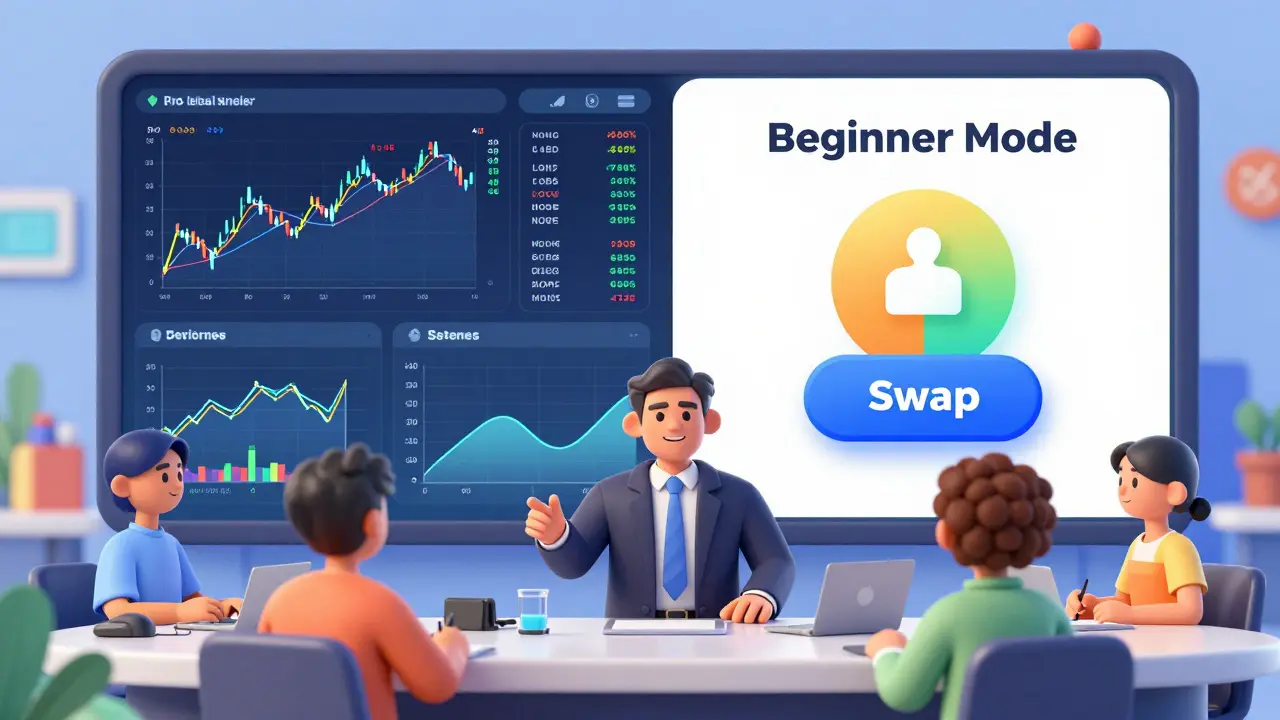
The interface is designed to feel like a professional trading terminal. For someone coming from a CEX, the order book, depth charts, and limit order functions will feel like home. For the DeFi-native user who is used to simple "Swap A for B" buttons, there is a slightly steeper learning curve.
To combat this, Brine Fi introduced a "Beginner Mode." This simplifies the interface, stripping away the complex charts and focusing on easy execution. They've also integrated with 0x is a protocol that aggregates liquidity from various sources to provide the best possible trade prices. to make onboarding as smooth as possible. If you're looking for extra incentives, they have a referral program that kicks back up to 50% of the fees from your referrals and a Trading Leaderboard that pays out rewards in USDC.
Potential Pitfalls and Risks
No platform is without its downsides. The most glaring issue is the token selection. Having only 45 pairs is a major limitation for retail users who want a one-stop shop. Furthermore, while the technology is impressive, the regulatory environment for DEXs is shifting. The U.S. Treasury and other global bodies are increasingly looking at how to apply AML (Anti-Money Laundering) rules to decentralized protocols. While Brine Fi's KYC options help institutions, the overall platform still operates in a grey area of global regulation.
Additionally, the ecosystem around Brine Fi is still small. It lacks the deep integration with other DeFi lending protocols or yield farms that you find in the Uniswap or PancakeSwap ecosystems. You are coming here to trade, not to build a complex web of yield-bearing assets.
The Bottom Line for Different Traders
Is Brine Fi right for you? It depends on what you're trying to achieve. If you are a retail hobbyist who likes exploring new coins and doesn't mind a 20-second wait for a transaction, stick with a traditional AMM. The lack of token variety will likely frustrate you.
But if you are a professional trader, a hedge fund, or someone who has been burned by CEX collapses and wants a secure, non-custodial alternative that doesn't sacrifice speed, Brine Fi is a game-changer. It effectively removes the "speed tax" associated with DeFi, making it possible to trade at high frequencies while keeping your private keys in your own pocket.
Is Brine Fi truly non-custodial?
Yes. Unlike many centralized exchanges or even some hybrid DEXs like dYdX, Brine Fi allows you to maintain full custody of your assets throughout the entire trading process. This has been validated through audits by security firms like PeckShield.
How does Brine Fi prevent front-running?
Brine Fi uses Zero Knowledge Proofs (zkP) powered by StarkWare. This technology ensures that trading positions and order details remain private, meaning bots cannot see large pending orders in the mempool and trade ahead of them.
What are the trading fees on Brine Fi?
Fees are transparent and gasless. The base rate is 0.1%, which can be reduced to 0.05% for standard users and as low as 0.01% for high-volume institutional traders.
Can I trade any coin on Brine Fi?
No. Brine Fi focuses on a curated selection of approximately 45 major trading pairs. It does not have the massive library of thousands of tokens found on AMMs like Uniswap.
How fast are the transactions?
The platform's matching engine supports up to 600,000 transactions per second, enabling execution times of under 100 milliseconds, which is comparable to centralized exchange speeds.

Aaron Zeiler
April 29, 2026 AT 04:24the orderbook model is definitely the way to go if you're tired of slippage on amms. most people don't realize how much they lose to impermanent loss or just bad pricing on standard swaps
Gabby Puche
April 30, 2026 AT 19:42This looks like such a win for the community! 🚀 Love seeing the gap between CEX and DEX finally closing. Keep grinding everyone! ✨
Carli Bates
May 2, 2026 AT 18:39oh great another walled garden for the big fish to swim in while we peasants enjoy our 45 precious pairs. truly the pinnacle of decentralization lol
Jimmy vasquez
May 4, 2026 AT 14:37If you're new to ZK-proofs, just think of it as a way to prove you have the funds and the right to trade without actually showing your whole hand to the public. It's a massive upgrade for privacy.
Tracy McBurney
May 6, 2026 AT 00:45The claim about 600,000 TPS is almost certainly a theoretical peak and not a real-world sustained rate. Anyone with a basic understanding of network latency knows that sub-100ms execution is dependent on the user's proximity to the sequencer, not just the L2's throughput. It is intellectually dishonest to market this as a universal speed increase without mentioning the infrastructure requirements.
Sri Astuti
May 6, 2026 AT 23:21Imagine actually believing that a "curated list" of 45 pairs is a feature and not a massive failure of liquidity provision, especially when you consider that the volatility of these specific pairs usually attracts high-frequency bots that will eat the retail traders alive anyway, and the irony of using KYC in a DEX is just too much to handle :/
Gabrielle Danis
May 8, 2026 AT 17:16The integration of StarkWare provides a robust framework for scalability. By moving the computation off-chain, Brine Fi successfully mitigates the congestion typically associated with Ethereum's mainnet, thereby ensuring a more seamless user experience for high-volume traders.
Harvey Alford
May 10, 2026 AT 10:20I've lost a ton on CEXs. Glad this exists.
Janis Naglis
May 12, 2026 AT 09:18The synergy between the ZK-rollup architecture and the non-custodial wallet integration is simply phenomenal!!! It really optimizes the throughput while maintaining the core ethos of DeFi... absolutely brilliant implementation of Layer 2 scaling!!!
Elle Kharitou
May 12, 2026 AT 12:54It is quite fascinating to contemplate how the evolution of these platforms reflects our broader societal shift toward trustless systems, where the code itself becomes the arbiter of truth rather than a corporate entity. By bridging the gap for institutional players, we are essentially witnessing the professionalization of the decentralized dream, which could either stabilize the market or introduce the same systemic risks we saw in 2008 🌿🙏✨
Rachel S
May 13, 2026 AT 21:47One must acknowledge the sheer audacity of attempting to implement a high-frequency matching engine within a non-custodial framework! It is a technical marvel that warrants the most rigorous scrutiny! 😲 The implications for market efficiency are staggering, provided the security audits remain current and comprehensive! 🧐
Lynne Teperman
May 15, 2026 AT 06:55fancy tech for the big wigs but still feels like a velvet rope operation no thanks
Andrew Todd
May 15, 2026 AT 20:21Only 45 pairs? Pathetic. Real traders need every asset available, not some tiny list picked by a few suits. This is just another way to keep the real money in the US while the rest of the world plays with scraps.
Kathleen Warren
May 17, 2026 AT 19:19I can see why some people might find the pro interface scary. If you're just starting out, definitely try the beginner mode first so you don't get overwhelmed by all the charts.