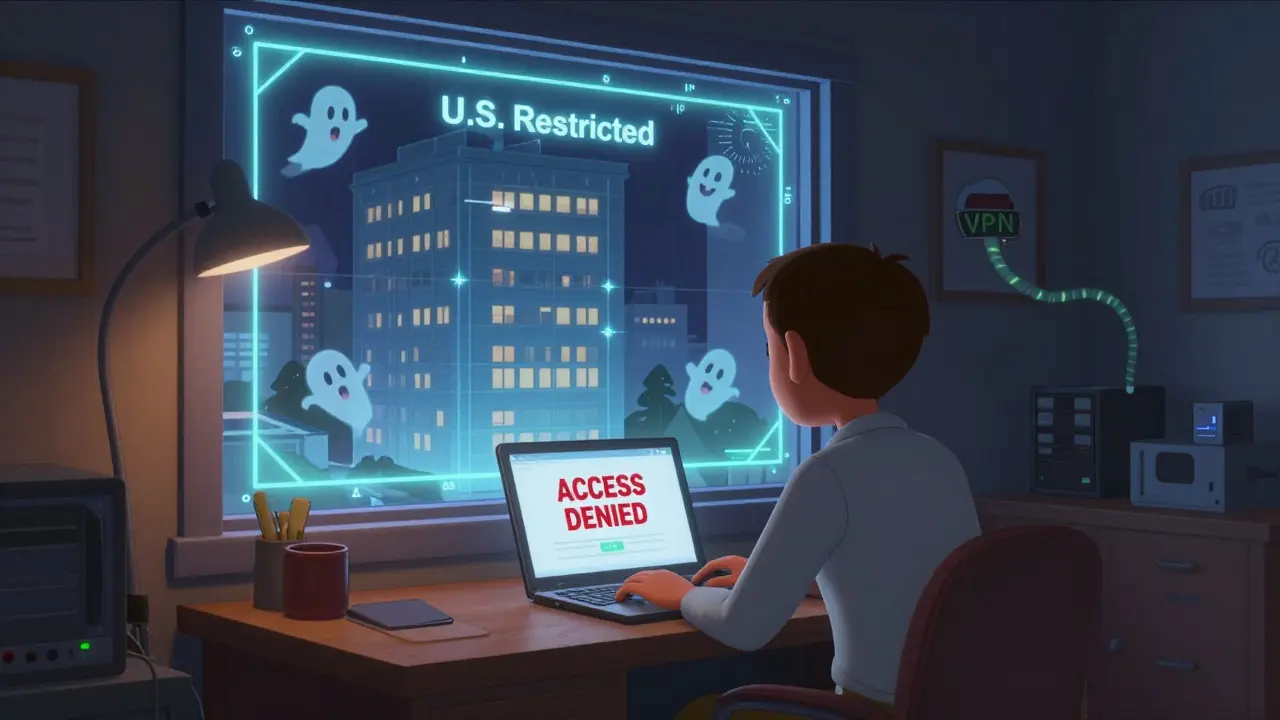
When you try to log into Bybit from the United States, you don’t just get a login error. You get blocked. Full stop. No warning. No grace period. That’s because Bybit uses geofencing to lock out users based on where their internet connection appears to come from. It’s not about trust-it’s about legal survival. In a world where regulators like the SEC and CFTC are cracking down hard, exchanges like Bybit have one tool left: virtual borders.
How Bybit’s Geofencing Works
Geofencing isn’t magic. It’s simple math. When you connect to Bybit, the system checks your IP address. That IP gets mapped to a physical location-say, Chicago, Illinois. If that location is on the banned list (which includes the U.S., Canada, Singapore, and a few others), you’re locked out before you even type your password.
It’s not just one check, either. The system runs multiple layers:
- IP geolocation at login
- IP geolocation during KYC document upload
- IP monitoring during active trading sessions
That means even if you slip through the front door, Bybit keeps watching. If your IP suddenly shifts from London to New York while you’re holding a $50,000 position, your account gets flagged. Sometimes it’s a freeze. Sometimes it’s a full closure. No notice. No appeal.
Why the U.S. Is Blocked
Bybit doesn’t hate American traders. It’s scared. After Binance paid $4.3 billion to settle with U.S. regulators, every offshore exchange had to choose: comply fully, or get crushed. Bybit picked the latter. Instead of building a U.S.-licensed version like Coinbase or Kraken, it chose to cut the U.S. market entirely. It’s not ideal-but it’s cheaper than hiring lawyers, paying fines, and dealing with endless audits.
That decision forced traders to get creative. And that’s where VPNs come in.
Can You Beat Bybit’s VPN Detection?
Yes. And no.
Most commercial VPNs-NordVPN, ExpressVPN, Surfshark-work just fine to mask your U.S. IP. You connect to a server in the Philippines, Thailand, or Estonia, and suddenly Bybit thinks you’re in a permitted country. You then upload a passport from that country (yes, people do this), and complete KYC. Bybit doesn’t cross-check your document’s origin with your real identity. It just checks if the document looks real and matches the IP.
That’s the loophole.
According to a CoinDesk investigation in November 2024, American users have been successfully opening Bybit accounts this way for months. Some even use friends’ or relatives’ foreign IDs. It’s not hard. It’s not technical. It’s just dishonest.
But here’s the catch: Bybit’s detection system doesn’t look for VPN traffic patterns. It doesn’t analyze browser fingerprints. It doesn’t check device time zones or keyboard input rhythms. It only checks IP. That’s like locking your front door but leaving the back window wide open.
Compare that to exchanges like OKX or Bitget, which use advanced fingerprinting to detect VPNs. They look at:
- How fast your connection changes between servers
- Whether your browser has common VPN plugin signatures
- Whether your device clock is synced to a non-local timezone
Bybit? It doesn’t. And that’s why it’s so easy to bypass.

What Happens If You Get Caught
If Bybit detects you’re using a VPN or foreign ID from a banned region, the consequences are brutal:
- Account frozen with no warning
- Funds locked indefinitely
- KYC documents deleted
- Permanent ban with no appeal
There’s no customer service line to call. No email response. Just silence. Reddit threads are full of traders who lost six-figure positions overnight. One user posted: "I had $120k in BTC. One day, it vanished. No message. No explanation. Just gone."
And here’s the kicker: Bybit doesn’t even have to prove you violated their terms. Their ToS says: "Access from restricted jurisdictions is prohibited." That’s it. No proof needed. No due process. Just deletion.
The Bigger Problem: Security Risks
Geofencing isn’t just about compliance-it’s about security. And Bybit’s system has a dark side.
In early 2024, hackers from North Korea’s TraderTraitor group stole $1.4 billion by exploiting a flaw in Bybit’s SAFE Wallet interface. The attack didn’t come from outside. It came from inside. Hackers embedded malicious code into the frontend that made fraudulent transactions look like legitimate ones. CEO Ben Zhou signed off on them-because the system told him they were safe.
That breach showed something terrifying: if the system can be fooled into thinking fake transactions are real, how much trust can you put in its geofencing?
After the hack, Bybit hired Mandiant (Google’s security arm) to fix things. But they didn’t fix the geofencing. They just patched the wallet. The virtual fence is still just a cardboard wall.

What Traders Are Saying
On Reddit, r/Bybit has 200,000+ users. Half of them are from the U.S. The top thread? "How to use Bybit with VPN in 2026." The replies are all the same: "Use NordVPN + Thai ID. Works fine."
On Trustpilot, users rate Bybit 4.3/5-but the complaints are brutal: "Best platform, worst access policy." "I lost $40k because they froze my account for using a VPN. I didn’t even know it was against the rules."
Legal firms like d&a partners confirm this isn’t rare. Thousands of U.S. traders are doing this. And Bybit? They’re turning a blind eye. Why? Because they need the volume. They need the trading fees. They need the liquidity.
What’s Next?
Bybit won’t upgrade its detection anytime soon. Why? Because advanced detection costs money. And it creates friction. More checks = fewer users = less revenue.
Meanwhile, regulators are watching. The EU’s MiCA law, effective in 2025, requires exchanges to verify user locations with 99% accuracy. The U.S. is pushing for similar rules. If Bybit wants to expand into Europe or Asia, it’ll need better systems.
But for now? It’s a game of cat and mouse. And the cat is half-asleep.
For traders, the choice is clear: use a VPN and risk losing everything-or find an exchange that actually lets you trade from the U.S. There’s no middle ground.
Can I use Bybit if I live in the United States?
No, Bybit blocks all U.S.-based IP addresses by default. Even if you use a VPN, you’re violating their Terms of Service. While some users bypass this with foreign IDs and VPNs, doing so risks account freezing, fund loss, and permanent bans with no recourse.
Does Bybit detect all VPNs?
No. Bybit only checks your IP address for geographic location. It does not use browser fingerprinting, device behavior analysis, or connection pattern detection-tools that more advanced exchanges use to catch VPN users. This makes it easy to bypass with standard commercial VPNs like NordVPN or ExpressVPN.
What happens if Bybit catches me using a VPN?
Your account will likely be frozen immediately. Funds may be locked indefinitely. You won’t get a warning or explanation. Appeals are not accepted. Many users report losing six-figure positions overnight with no way to recover them.
Why doesn’t Bybit just get a U.S. license like Coinbase?
Getting a U.S. license requires millions in legal fees, ongoing audits, and strict compliance with federal and state regulations. For Bybit, which is headquartered in Dubai, it’s far cheaper and less risky to block the U.S. market entirely than to build a compliant U.S. entity. Many offshore exchanges take this same approach.
Is using a VPN with Bybit illegal?
Using a VPN to access Bybit isn’t illegal under U.S. law-but it violates Bybit’s Terms of Service. That means you have no legal protection if your account is frozen or funds seized. You’re essentially trading at your own risk, with no recourse if things go wrong.

Don B.
March 2, 2026 AT 20:54Arya Dev
March 3, 2026 AT 05:27Leslie Cox
March 4, 2026 AT 09:15Andrew Hadder
March 5, 2026 AT 14:00Derek Sasser
March 5, 2026 AT 22:31Neeti Sharma
March 7, 2026 AT 09:02Nadia Shalaby
March 7, 2026 AT 13:27Fiona Monroe
March 9, 2026 AT 01:56Molley Spencer
March 10, 2026 AT 17:32Daisy Boliaan
March 12, 2026 AT 00:54Alyssa Herndon
March 12, 2026 AT 06:34Ifeanyi Uche
March 13, 2026 AT 10:33Elana Vorspan
March 14, 2026 AT 11:14Kenneth Genodiala
March 14, 2026 AT 16:08Michael Rozputniy
March 15, 2026 AT 15:26Danny Kim
March 17, 2026 AT 13:19Cathy Sunshine
March 18, 2026 AT 16:04Shannon Black
March 19, 2026 AT 19:20Vishakha Singh
March 21, 2026 AT 02:31