
Crypto Tax Calculator
Calculate Your Tax Liability
Enter your purchase and sale details to see how much tax you owe under India's 2025 crypto regulations.
Your Tax Breakdown
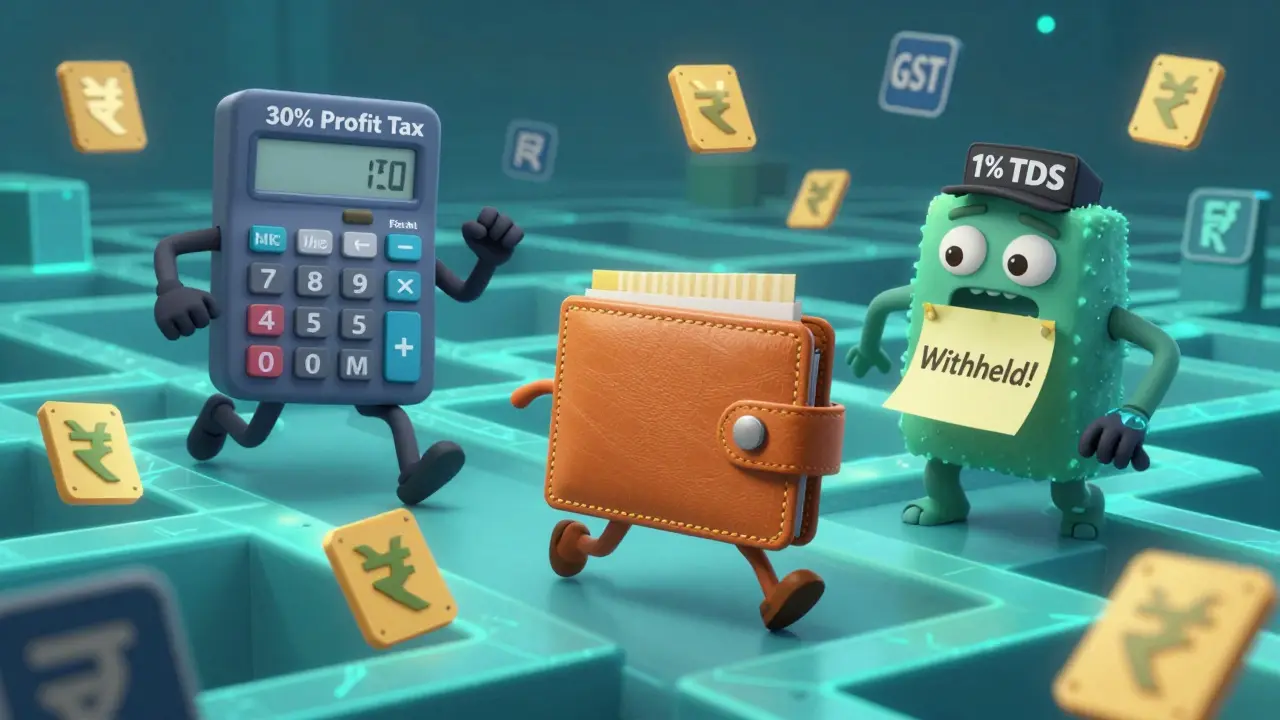
India’s crypto tax rules aren’t just complicated-they’re unique. If you’ve ever tried calculating your crypto gains here, you know it’s not like filing stocks or mutual funds. There’s no long-term vs short-term distinction. No deductions for fees. No indexation. Just a flat 30% tax on every profit, plus a 1% deduction at source before you even see your money. And now, exchanges are charging you 18% GST on every trade fee. This isn’t regulation with balance. It’s regulation with teeth.
How Crypto Is Taxed in India (2025 Rules)
Since April 1, 2022, all cryptocurrencies-Bitcoin, Ethereum, Solana, Dogecoin, even NFTs-are legally classified as Virtual Digital Assets (VDAs). That label changes everything. Under Section 2(47A) of the Income Tax Act, any profit from selling, trading, or swapping crypto is treated as income, not capital gain. And it’s taxed at 30%, no matter how long you held it.
Let’s say you bought 0.5 BTC for ₹15 lakh in January 2023 and sold it for ₹22 lakh in June 2025. Your profit? ₹7 lakh. You owe ₹2.1 lakh in tax (30% of ₹7 lakh). That’s it. No matter if you held it for 6 months or 2 years. No reduction. No discount. Just 30%.
On top of that, every time you transfer crypto-whether you sell it, trade it for another coin, or even gift it-you trigger a 1% TDS (Tax Deducted at Source). So if you sold that ₹22 lakh worth of BTC, ₹22,000 gets withheld by the exchange before you get paid. You can claim this back when you file your return, but only if your records match exactly what the exchange reports to the tax department. And that’s where most people get stuck.
What Counts as Income? Mining, Staking, Airdrops
It’s not just buying and selling. If you earn crypto without buying it, it’s still taxable. Staking rewards? Taxable. Mining rewards? Taxable. Airdrops? Taxable. Even if you didn’t pay for it, the moment you receive it, the Indian tax department treats it as income. And they value it at the fair market price in INR on the day you received it.
For example, if you got 10 SOL as a staking reward on March 10, 2025, and SOL was trading at ₹12,000 that day, you owe tax on ₹1.2 lakh as ordinary income. That amount gets added to your salary or other income and taxed at your slab rate-could be 5%, 20%, or 30%, depending on your total earnings. Then, if you later sell those SOL for more, you pay another 30% on the profit.
This double taxation hits stakers hard. You’re taxed when you earn the reward, then again when you cash out. No other asset in India works this way.
GST on Crypto Platforms: The Hidden Cost
Starting July 7, 2025, every fee you pay to a crypto exchange in India is subject to 18% GST. That includes trading fees, withdrawal charges, deposit fees, staking service fees-even if the exchange doesn’t charge you directly, they now have to add GST to their pricing structure.
Before this, exchanges operated under the old rule that digital services weren’t clearly taxed. Now, the Central Board of Indirect Taxes and Customs (CBIC) has classified them as “Online Service Providers” under GST law. That means even tiny platforms with under ₹20 lakh in revenue must register for GST, issue proper invoices, and collect tax. This isn’t optional.
For users, this adds 18% to every transaction cost. If you pay ₹100 in trading fees, you’re now paying ₹118. That’s money you can’t recover. And because exchanges have to absorb some of this cost to stay competitive, many have raised their base fees-making trading more expensive across the board.
Why This System Is Different From the Rest of the World
Compare India to the U.S. In America, if you hold crypto for over a year, you pay 0% to 20% in capital gains tax, depending on your income. In Portugal, crypto profits are tax-free for individuals. In Germany, if you hold for more than a year, you pay nothing. India? 30% no matter what.
And no other major country combines a 30% capital gains tax with a 1% TDS on every transaction. That’s a double hit. You’re taxed on the way out, and again when you try to claim back the TDS. The result? Many small traders say it’s not worth it.
A WazirX survey in December 2024 found that 68.7% of Indian crypto users think the tax system is “excessively punitive.” Over 40% have reduced their trading activity because of it. One Reddit user wrote: “I made ₹5 lakh in profit last year. After 30% tax and 1% TDS, I walked away with ₹3.1 lakh. My broker took ₹10,000 in fees. I ended up with less than I started with.”
What You Need to Track (And How to Do It)
To file your crypto taxes correctly, you need four things:
- Complete transaction history: Every buy, sell, swap, gift, airdrop, staking reward. Timestamps matter.
- INR value at time of each transaction: Use exchange rates from reputable sources like CoinGecko or CoinMarketCap.
- Wallet addresses: You must link transactions to specific wallets. Mixing wallets without clear records = audit risk.
- TDS certificates: Download Form 26AS from the income tax portal to verify how much was withheld.
Doing this manually takes 8-12 hours per quarter. Most people use tools like KoinX, CoinTracker, or ZenLedger. These tools connect to your exchanges and wallets, auto-import transactions, calculate gains/losses, and generate reports for ITR filing. They cut the time to 2-3 hours. But they’re not perfect. If your exchange doesn’t report to the tax department correctly, the software won’t fix that.
And here’s the kicker: the Income Tax Department’s Annual Information Statement (AIS) now pulls data from exchanges. If your records don’t match what the exchange reports, you’ll get a notice. In 2023-24, over 32% of filers had mismatches. That’s not a small error-it’s a red flag.

The Big Gaps: DeFi, Cross-Border, and Hard Forks
The rules are clear for simple buys and sells. But what if you’re using DeFi? Like lending ETH on Aave, providing liquidity on Uniswap, or swapping tokens through a smart contract? The government hasn’t said.
Same with cross-border trades. If you buy Bitcoin on Binance (Singapore) and sell it on WazirX (India), which country’s rules apply? The Indian tax department assumes all income from Indian residents is taxable, but they don’t have systems to track foreign exchange activity.
And hard forks? If Bitcoin splits and you get Bitcoin Cash, is that income? The CBDT said yes in Circular No. 22 of 2023. But they didn’t explain how to value it if the forked coin wasn’t listed anywhere on the day you received it.
These gray areas are where most compliance headaches happen. Tax professionals say: “When in doubt, declare it. Pay the tax. Then fight it later if needed.”
What’s Coming in 2026?
The government isn’t done. A Joint Committee on Virtual Digital Assets, formed in November 2024, is expected to submit recommendations by March 2026. Rumors suggest they might:
- Raise the TDS threshold from ₹10,000 to ₹50,000 for regular users
- Clarify DeFi taxation rules
- Allow deductions for exchange fees or wallet costs
But don’t expect a tax cut. Finance Minister Nirmala Sitharaman has been clear: India doesn’t encourage crypto. It doesn’t discourage it either. It just taxes it. And the goal isn’t to make crypto popular-it’s to make sure the government gets its cut.
Meanwhile, the e-Rupee, India’s central bank digital currency, is rolling out. It’s backed by the RBI. It’s regulated like cash. And it’s designed to compete with decentralized crypto. The message is clear: if you want digital money, use ours. If you want to use Bitcoin, fine-but pay up.
Is Crypto Still Worth It in India?
Despite the taxes, India still has the second-highest crypto adoption rate in the world-15.2% of the population owns some form of crypto, according to Chainalysis. But the user base has changed. In 2021, 82% of traders were retail. By 2024, that dropped to 57%. Institutional investors, hedge funds, and high-net-worth individuals now make up the majority of volume.
Why? Because they can afford the tax burden. They have accountants. They use tax software. They know how to file. Retail traders? Many have walked away.
But if you’re still in it, you’re not alone. Over 15,000 people are in the CryptoTaxIndia Telegram group, sharing tips on TDS reconciliation and cost basis tracking. The tools are better than they were in 2022. The process is still brutal, but it’s predictable.
So yes, crypto is still worth it-if you know the rules, track everything, and accept that you’re paying one of the highest tax rates in the world for the privilege.
Is crypto profit taxable in India even if I don’t withdraw it to my bank?
Yes. Any trade, swap, or sale of crypto triggers a taxable event in India-even if you don’t convert it to INR. Swapping Bitcoin for Ethereum counts as a sale of Bitcoin and a purchase of Ethereum. You owe 30% tax on the profit from Bitcoin, calculated in INR at the time of the swap.
Can I offset crypto losses against other income?
No. Crypto losses can only be offset against other crypto gains in the same financial year. You can’t use them to reduce your salary, business income, or capital gains from stocks or real estate. And you can’t carry forward losses to future years. This makes crypto riskier than traditional investments.
Do I need to pay tax on crypto I received as a gift?
Yes. If you receive crypto as a gift from someone who isn’t a relative (as defined under income tax law), its fair market value at the time of receipt is added to your income and taxed at your slab rate. Even if you didn’t pay for it, you owe tax on it. Relatives (spouse, parents, siblings, etc.) are exempt from this rule.
What happens if I don’t report my crypto income?
The Income Tax Department now receives transaction data directly from exchanges via AIS. If you don’t report, they’ll match your unreported gains with what exchanges report. You’ll get a notice. Penalties can be up to 200% of the tax evaded, plus interest. In severe cases, it could lead to prosecution under the Income Tax Act.
Are NFTs taxed the same as cryptocurrencies?
Yes. NFTs are classified as Virtual Digital Assets under Indian law. Any sale, trade, or transfer of an NFT is subject to the same 30% tax on gains and 1% TDS. Even if you mint an NFT and sell it later, the profit is taxable. The only exception is if you receive an NFT as a gift from a relative.
Can I claim TDS credit if my exchange doesn’t provide Form 16B?
Yes. You don’t need Form 16B to claim TDS credit. The TDS deducted on your crypto transactions will appear in your Form 26AS (Annual Information Statement) on the income tax portal. As long as the amount matches what you reported, you can claim the credit when filing your return. If there’s a mismatch, contact your exchange and file a correction request.

Lois Glavin
December 16, 2025 AT 10:25Wow, this is one of the clearest breakdowns I’ve seen on Indian crypto taxes. I’m from the US and even I learned a few things. The 30% flat rate is wild compared to our tiered system. It’s like they’re saying, ‘If you’re into this, you better be ready to pay.’
Abhishek Bansal
December 17, 2025 AT 01:48Typical Indian govt. Overtax everything then act surprised when people stop trading. I made ₹8L last year and walked away with ₹3.2L after tax, fees, and TDS drama. Worth it? Only if you like paying the state to play casino.
Bridget Suhr
December 17, 2025 AT 11:58so like… if i swap eth for sol and make a profit, i pay 30% on that? even if i never cash out to inr? bruh. that’s wild. and the 1% tds on every swap?? that adds up fast. i’m confused but also kinda impressed by how detailed this is.
Ike McMahon
December 19, 2025 AT 06:29If you’re trading crypto in India, get a tax tool like KoinX. Seriously. Manual tracking is a nightmare. I used to do it by hand and ended up with a notice. Now I spend 2 hours a quarter and sleep fine.
JoAnne Geigner
December 21, 2025 AT 05:14It’s fascinating how India treats crypto as income, not capital - it’s almost like they’re trying to discourage speculation while still allowing it. There’s a quiet wisdom in that, even if it feels harsh. The 1% TDS is like a gentle nudge to stay compliant, not a sledgehammer. And honestly? I respect that clarity, even if I wish the rate were lower.
Anselmo Buffet
December 22, 2025 AT 11:3430% tax on every trade no matter how long you hold? That’s brutal. But at least they’re transparent. No guessing. No loopholes. Just pay up or don’t play. Simple.
Joey Cacace
December 24, 2025 AT 07:32Wow. The 18% GST on trading fees is the real kicker. I didn’t even realize that was coming. So now every $10 fee becomes $11.80? That’s going to kill small traders. I hope they reconsider this soon.
Taylor Fallon
December 25, 2025 AT 07:12India’s approach feels… oddly thoughtful? Like, they didn’t ban crypto, they didn’t ignore it - they just said, ‘This is how it works, and here’s the cost.’ No romanticizing, no fearmongering. Just facts. And yeah, it’s steep… but at least you know exactly what you’re getting into. It’s like a tax with boundaries. That’s more than most countries do.
Sarah Luttrell
December 27, 2025 AT 03:36Of course India taxes crypto like it’s a luxury yacht. Meanwhile, the US lets people profit tax-free for years. And you wonder why the world laughs at our ‘regulation’? At least here, you know you’re paying for the privilege of living under a bureaucracy that thinks Bitcoin is a threat to the rupee. 🙄
Kathleen Sudborough
December 28, 2025 AT 08:31I used to think crypto was too risky in India. Then I started tracking everything. Now I see it’s not about the tax - it’s about the discipline. If you keep clean records, the system works. It’s not friendly, but it’s fair. And that’s more than I can say for most tax systems.
Vidhi Kotak
December 29, 2025 AT 19:09As someone who’s filed crypto taxes in India for three years - yes, it’s brutal. But the tools are better now. I use KoinX + manual checks on Form 26AS. If you’re a small trader, just declare everything. No drama. Save yourself the stress.
Kim Throne
December 30, 2025 AT 13:52Regarding the DeFi gray areas: the CBDT’s position, while not codified, is consistent with the broader interpretation of Section 2(47A). Any economic benefit derived from a smart contract interaction - including yield generation, liquidity provision, or token swaps - constitutes a taxable event under the VDA framework. The absence of explicit guidance does not equate to exemption. Prudent compliance requires declaration. Consult a chartered accountant specializing in digital assets for case-specific advice.