
When you see a crypto exchange promising 12.11% annual returns just for holding its own token, you should pause. Cryptonex isn’t just another exchange - it’s a red flag wrapped in a clean interface. Launched in 2017, it claims to offer low trading fees (0.10%), cloud mining, and easy access to its native CNX token. But beneath the surface, the risks are serious - and the evidence is stacking up.
What Cryptonex Actually Offers
Cryptonex is a centralized exchange that only allows crypto-to-crypto trades. No fiat deposits. No bank transfers. No credit cards. If you want to use it, you need to already own Bitcoin, Ethereum, or another cryptocurrency. That alone makes it useless for most new users.
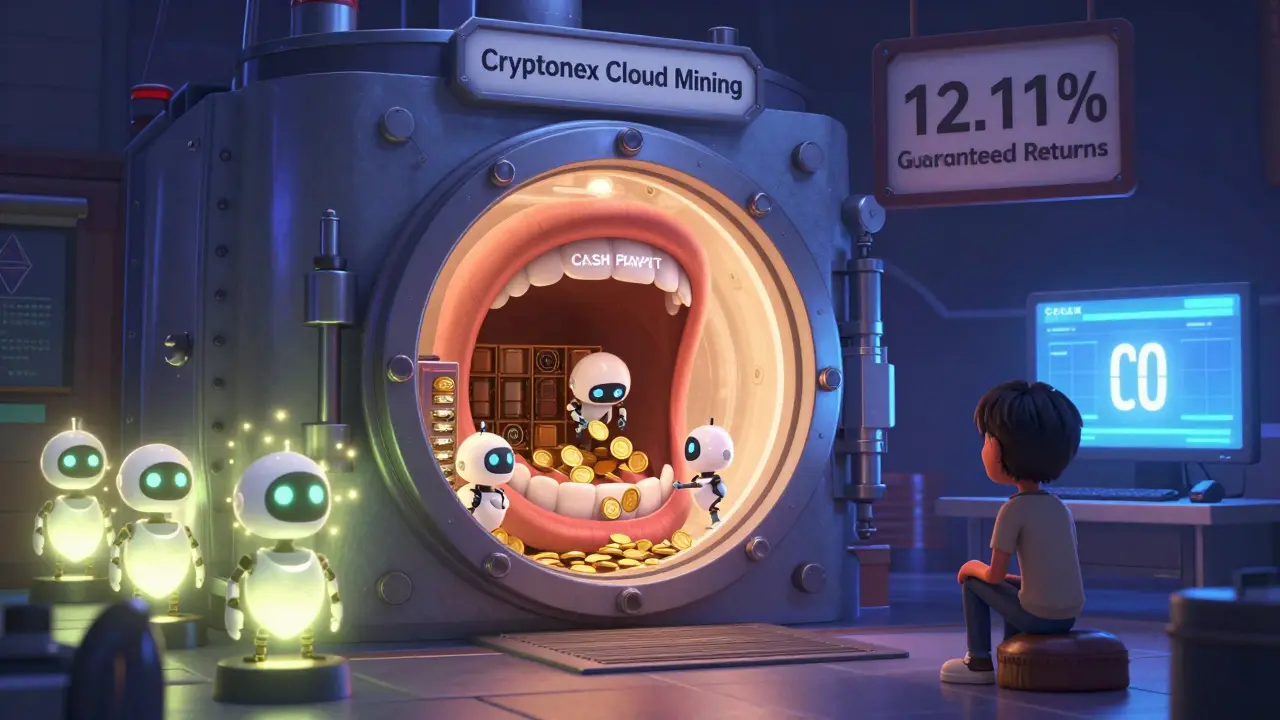
The platform’s main selling point? A fixed 12.11% return on CNX tokens. Here’s how it works: you buy CNX, lock it up for a full year, and it’s automatically funneled into something called "Proof-of-Stake mining." The platform claims this generates 11% in rewards, plus a 1% deposit bonus. Sounds too good to be true? It is.
Real Proof-of-Stake doesn’t work like this. In legitimate networks like Ethereum or Cardano, staking rewards depend on network activity, validator performance, and token supply. There’s no guarantee of fixed returns - especially not 12.11%. Cryptonex is essentially paying you with its own money, not from real mining activity. That’s a classic Ponzi-style setup.
The Fee Trap
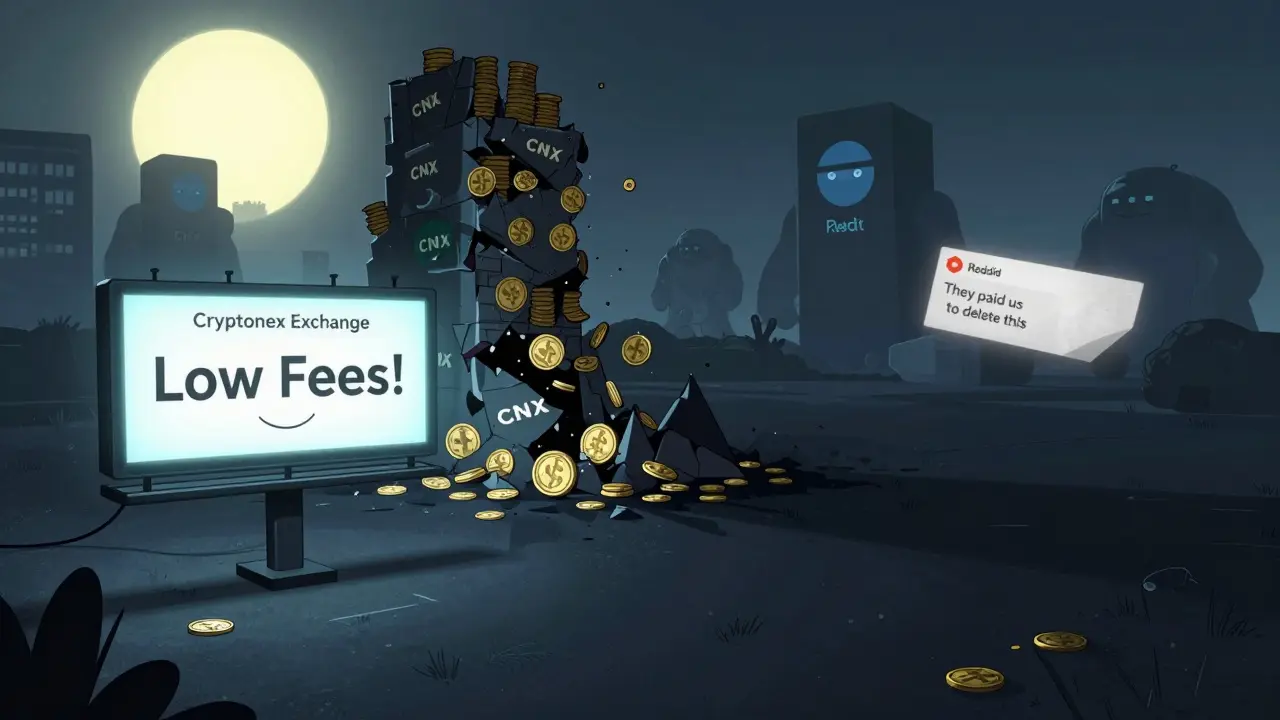
Cryptonex advertises a 0.10% trading fee - half the industry average. That sounds great, until you realize no one else charges 0.50% for crypto-to-crypto trades anymore. Binance, Kraken, and KuCoin all charge 0.10% or less. So Cryptonex isn’t saving you money - it’s just matching the market. And since you can’t deposit fiat, you’re forced to buy crypto elsewhere first, pay withdrawal fees, then move it over. You’re not saving. You’re adding steps.
Withdrawal fees? 0.001 BTC. That’s normal. But here’s the catch: if you’re locked into CNX for a year and the price drops 40%, you lose money. And if Cryptonex shuts down? Your tokens vanish. No one’s insured your holdings. No deposit protection. No recourse.
No Regulation. No Safety.
Cryptonex doesn’t have licenses from any major financial authority. Not the FCA in the UK. Not the SEC in the US. Not even a local regulator in the EU. TradersUnion’s 2025 review explicitly states: "The Cryptonex trading platform is not licensed by reputable financial regulators."
This isn’t a minor oversight. It’s a dealbreaker. Regulated exchanges follow strict rules: they keep user funds separate, run audits, report suspicious activity, and comply with KYC. Cryptonex does none of this. If your account gets hacked or the platform disappears, you have zero legal protection.
Compare that to Kraken, which has been licensed in the U.S., Canada, the EU, and Australia since 2011. Or Coinbase, which handles over $100 billion in assets under regulatory oversight. Cryptonex doesn’t even come close.
The CNX Token Problem
Cryptonex’s entire model revolves around its native token, CNX. But here’s the truth: CNX has almost no value outside of Cryptonex’s own exchange.
According to CoinGecko, CNX trades an average of just $147,000 per day in September 2025. Bitcoin? $32.7 billion. Ethereum? $18.9 billion. CNX is a ghost. No major wallet supports it. No decentralized exchange lists it. No institutional investor touches it.
And the tokenomics? Suspicious. Cryptonex claims CNX is "mined" through staking. But there’s no public blockchain explorer for CNX. No verified contract address. No transparency. That means the entire supply could be controlled by a single wallet - and that wallet could dump 10 million CNX tokens tomorrow, crashing the price.
User Reports and Warning Signs
The BitcoinTalk forum, a long-standing hub for crypto discussions, has threads dating back to 2017 with users warning others to stay away. One user, "802529er," posted detailed evidence in September 2018 that Cryptonex paid users to remove negative reviews and threatened to leak private messages if they didn’t comply.
Reddit discussions from 2018 - now deleted - reportedly contained screenshots of Cryptonex employees offering cash to delete posts. That’s not customer service. That’s reputation laundering.
And the cloud mining feature? It’s a smoke screen. Real cloud mining involves renting actual hardware. Cryptonex doesn’t own mining rigs. It doesn’t publish data on energy use, hash rates, or server locations. It just takes your CNX, locks it up, and promises a return. That’s not mining. That’s a savings account with no bank.
Who Should Avoid Cryptonex
- New crypto users - You can’t deposit fiat. You need to buy crypto elsewhere first.
- Anyone seeking security - No regulation, no insurance, no audit trail.
- Long-term holders - Your funds are locked for a year. If the market crashes, you can’t sell.
- Anyone who values transparency - No whitepaper, no team names, no public blockchain.
Who Might Use It (And Why They Shouldn’t)
Some traders with existing crypto might be tempted by the 0.10% fee. Maybe they’re trying to swap between altcoins and think Cryptonex is a shortcut. But here’s the reality: every major exchange now offers lower or equal fees. Binance, Bybit, and OKX all have 0.075% or less for VIP traders. You’re not gaining anything - you’re just risking everything.
The platform’s interface is clean. The mobile app works. The charts load fast. That’s why people get fooled. It looks professional. But looks don’t protect your money.
The Bigger Picture
The crypto exchange market is worth over $10 billion. The top three players - Binance, Coinbase, Kraken - control nearly 70% of trading volume. They’re regulated, audited, and backed by institutional investors.
Cryptonex? It’s a ghost in that landscape. No team. No licenses. No transparency. Just a promise of guaranteed returns on a token nobody else wants.
According to the 2025 Chainalysis Crypto Crime Report, 87% of exchanges that offer fixed returns on their own tokens are either scams or on the verge of collapse. Cryptonex ticks every box.
The Cambridge Centre for Alternative Finance found that unlicensed exchanges targeting Western users have an 83% failure rate within three years. Cryptonex has been around since 2017. That’s eight years. But it hasn’t grown. It hasn’t improved. It hasn’t added features. It’s still pushing the same 12.11% return - unchanged since 2018.
That’s not innovation. That’s stagnation. And in crypto, stagnation means death.
Final Verdict
Cryptonex isn’t a scam in the traditional sense - it’s still operating. But it’s built on deception. It hides behind low fees and a polished interface while avoiding regulation, transparency, and real utility.
If you’re looking to trade crypto, use a regulated exchange. If you want to earn rewards, stake on Ethereum, Solana, or Cardano. If you’re chasing high returns, understand the risk - don’t hand your coins to a platform that won’t tell you how it generates them.
Cryptonex offers nothing you can’t get elsewhere - and everything you can’t afford to lose.
Is Cryptonex a legitimate crypto exchange?
No, Cryptonex is not a legitimate exchange by any regulatory standard. It lacks licenses from any major financial authority, including the FCA, SEC, or EU regulators. It does not provide transparent documentation, public audits, or verifiable team information. Multiple independent reviews, including TradersUnion’s 2025 report, label it as unlicensed and high-risk.
Can I deposit fiat currency into Cryptonex?
No, Cryptonex does not accept fiat deposits. You cannot use bank transfers, credit cards, or PayPal to fund your account. You must first buy cryptocurrency on another exchange, withdraw it to your wallet, and then deposit it into Cryptonex. This makes it unusable for beginners and anyone without existing crypto holdings.
What is the CNX token, and is it worth buying?
CNX is Cryptonex’s native token, used for its cloud mining program and trading fees. It has no value outside Cryptonex’s own exchange, with daily trading volume averaging just $147,000 in 2025 - compared to Bitcoin’s $32.7 billion. There is no public blockchain explorer for CNX, no verified smart contract, and no third-party liquidity. Buying CNX means betting your money on a platform with no transparency and a history of questionable behavior.
Are the 12.11% returns from Cryptonex’s cloud mining real?
No, the 12.11% returns are not from real mining. Cryptonex claims the returns come from "Proof-of-Stake mining," but this is a misleading term. Real staking rewards fluctuate based on network conditions and are not guaranteed. Cryptonex pays out fixed returns using its own funds, which is unsustainable. This is a common tactic used by Ponzi schemes to lure users with unrealistic promises.
Why do some people say Cryptonex has a good interface and low fees?
Yes, the interface is clean and the 0.10% trading fee is low - but that’s not unique. Major exchanges like Binance and Kraken offer the same or better fees. The appeal is superficial. Users are attracted by the design and fee, but ignore the lack of regulation, fiat support, and transparency. Positive reviews often come from users who were paid to post them, as documented in 2018 forum posts where Cryptonex allegedly offered cash to remove negative feedback.
What happens if Cryptonex shuts down?
If Cryptonex shuts down, your funds are likely gone forever. There is no insurance, no regulatory protection, and no legal recourse. Your CNX tokens are locked on a private system with no public blockchain. Even if you hold other cryptocurrencies on the platform, there’s no guarantee they can be withdrawn. Many unlicensed exchanges disappear overnight - and users lose everything.
Is Cryptonex still operational in 2026?
As of March 2026, Cryptonex is still accessible and accepting deposits. However, it has shown no meaningful updates, new features, or regulatory progress since 2018. Its continued operation does not equal legitimacy. Many scam platforms remain active for years to extract funds before vanishing. Its lack of development and reliance on outdated marketing tactics suggest it is in a holding pattern, not growth.

Arlene Miles
March 15, 2026 AT 04:42Let me be clear: if you're even considering Cryptonex, you're already playing Russian roulette with your crypto. This isn't about fees or interface - it's about trust. No regulation? No transparency? No blockchain explorer for CNX? That's not innovation. That's a neon sign screaming "Ponzi" in Morse code. Real staking doesn't promise fixed returns. It adapts. It evolves. It's decentralized. Cryptonex is a centralized cash grab wrapped in a sleek UI. You're not investing. You're donating to a ghost company with no accountability.
And don't get me started on that "cloud mining" lie. You don't mine with tokens. You mine with hardware. If they're not showing you servers, energy logs, or hash rates - they're not mining. They're just printing CNX out of thin air and paying you with it. Eventually, the printer runs out of ink. And when it does? Your locked-up tokens become digital confetti.
Ricky Fairlamb
March 16, 2026 AT 04:18Exactly. And let’s not forget the 2018 BitcoinTalk thread where users were paid to delete negative posts. That’s not a business. That’s a cult. Cryptonex doesn’t want users - it wants hostages. Lock your CNX for a year? That’s not a feature. That’s a trapdoor. You think you’re earning 12.11%? You’re just the latest sucker funding the next guy’s payout. The math doesn’t add up - because it’s not math. It’s magic. And magic? It always vanishes.
Also, the fact that they’ve had the same pitch since 2017? No upgrades. No team reveal. No whitepaper revision. That’s not stagnation. That’s a death rattle disguised as a business model. If you’re still holding CNX, you’re not a trader. You’re a museum exhibit.
Konakuze Christopher
March 16, 2026 AT 18:41Zachary N
March 18, 2026 AT 05:12Let’s unpack this properly. Cryptonex operates in the blind spot of crypto regulation - the gray zone where unlicensed platforms prey on users who don’t understand the difference between decentralization and deception. The 0.10% fee? Misleading. You’re not saving money - you’re paying in friction. You have to buy BTC/ETH elsewhere, pay withdrawal fees, then deposit into a platform that can’t be audited, can’t be verified, and won’t return your funds if they vanish tomorrow.
Real staking networks like Ethereum or Cardano don’t guarantee returns. They incentivize participation through consensus. Cryptonex? It’s a bank that doesn’t exist. The CNX token? A closed-loop economy with zero external liquidity. Its $147k daily volume? That’s less than a single whale trade on Binance. There’s no market. Just a closed room with one exit - and the door is locked from the inside.
And the cloud mining claim? Pure theater. Real cloud mining requires infrastructure. Public IP logs. Hash rate disclosures. Energy consumption reports. Cryptonex offers none. Zero. That’s not a feature. That’s a confession. They’re not mining. They’re printing money. And when the printing stops? You’re left holding a token with no utility, no exchange, no future - and no recourse.
Compare this to Kraken or Coinbase. They’re regulated because they want to last. Cryptonex wants to disappear - quietly, after the last investor locks their coins. The 2025 Chainalysis report is clear: 87% of exchanges offering fixed returns on native tokens collapse within 24 months. Cryptonex has lasted eight years. That doesn’t mean it’s safe. It means it’s late.
Don’t be fooled by the clean UI. A polished interface doesn’t protect your assets. It hides them. And when the lights go out? You won’t even know the power was cut until it’s too late.
Brenda White
March 18, 2026 AT 07:13Jessica Beadle
March 19, 2026 AT 19:35The entire model is a liquidity trap masquerading as a yield platform. The CNX token’s nonexistence on any DEX, lack of blockchain explorer, and absence of verified contract addresses indicate a deliberately opaque structure. This is not a DeFi protocol - it’s a closed-system token economy with zero external validation. The 12.11% return is not a reward; it’s an interest payment funded by new entrants. The moment inflows slow, the entire mechanism implodes.
Moreover, the absence of regulatory licensing isn’t a technical oversight - it’s a strategic choice. Licensing requires audits, compliance, and accountability. Cryptonex avoids these because they cannot pass them. The platform’s continued operation since 2017 isn’t evidence of viability - it’s evidence of regulatory arbitrage. They’re exploiting jurisdictional gaps, targeting users who don’t know what a licensed exchange looks like.
The claim of "Proof-of-Stake mining" is a linguistic obfuscation. Proof-of-Stake is not mining. Mining implies PoW. This is a deliberate semantic distortion to sound technical while being fundamentally false. Users are being misled by terminology they don’t understand - and that’s not incompetence. That’s predatory design.
The fact that the CNX token’s daily volume is $147k while BTC is $32.7B isn’t just a statistic - it’s a death sentence. Liquidity is trust. No liquidity means no exit. If you lock your CNX for a year and the price drops 40%? You’re trapped. No one will buy. No one can buy. And if Cryptonex vanishes? Your entire portfolio evaporates with no audit trail, no recovery mechanism, and no legal recourse.
This isn’t a crypto exchange. It’s a time-delayed asset forfeiture system. The UI is polished. The fees are competitive. The returns are seductive. But the architecture? It’s a house of cards built on a foundation of lies.
Marc Morgan
March 21, 2026 AT 17:32Yikes. I read this whole thing and thought, ‘Wow, this guy’s either a regulator or a former Cryptonex employee who got fired.’
But honestly? The fact that this thing is still up and running in 2026 is the weirdest part. Like, if it’s such a scam, why hasn’t it collapsed yet? Maybe it’s just… really good at convincing people they’re not getting scammed? The interface is sleek. The math looks clean. The returns are tempting. It’s like a luxury car with no engine - looks amazing, goes nowhere, but you still want to sit in it.
And yeah, the 12.11%? That number’s been the same since 2018. That’s not a feature. That’s a fossil.
Derek Lynch
March 23, 2026 AT 03:15Look, I get it - people want easy money. But this isn’t finance. It’s psychology. Cryptonex doesn’t sell crypto. It sells hope. And hope is the most dangerous asset class because it’s not measurable. You can’t audit hope. You can’t regulate hope. You can’t insure hope.
The 0.10% fee? Irrelevant. The clean UI? A distraction. The 12.11% return? A trapdoor. The real question isn’t ‘Is this legit?’ - it’s ‘Why are you still here?’
If you’re holding CNX, you’re not investing. You’re volunteering to be the last one in the room when the music stops. And trust me - the music stopped years ago. You just haven’t noticed yet.
Stake on Ethereum. Use Kraken. Trade on Binance. These platforms have audits, licenses, and real teams. Cryptonex has a website, a promise, and a countdown clock. Don’t be the one who didn’t see it coming.
Prakash Patel
March 24, 2026 AT 14:15Tobias Wriedt
March 25, 2026 AT 02:1712.11%? That’s not a yield - it’s a confession. You don’t get guaranteed returns in crypto. Ever. If someone promises you fixed income on a token with no blockchain explorer, no liquidity, and zero regulation - you’re not investing. You’re handing your keys to a guy in a basement who’s counting down the days until he vanishes with your ETH.
And let’s be real: if this was legit, it’d be on CoinGecko’s top 100. It’s not. It’s on page 3,782. That’s not a bug. That’s a feature. They don’t want you to compare it. They want you to be dazzled by the UI and forget to ask questions.
Stay away. Seriously. Your future self will thank you.
Elizabeth Kurtz
March 25, 2026 AT 18:11I’ve lived in three countries and traded across five exchanges. Cryptonex is the only one that feels like a stage play - polished lights, perfect script, but no backstage. No crew. No props. Just a man in a suit saying, ‘Trust me.’
Regulation isn’t bureaucracy. It’s armor. It’s the difference between a bank vault and a locked suitcase. Cryptonex offers the suitcase. And we all know what happens to suitcases left unattended in airports.
The CNX token? It’s not a currency. It’s a loyalty card for a store that doesn’t exist. You can’t spend it anywhere. You can’t trade it meaningfully. You can’t even verify its supply. That’s not innovation. That’s isolation.
If you’re tempted by the 0.10% fee - ask yourself: why are you paying to move crypto to a platform you can’t trust? Why not just hold it? Or use a real exchange?
There’s no reward here worth the risk. Only illusion.
john peter
March 25, 2026 AT 18:52One cannot help but observe that the entire Cryptonex apparatus constitutes a profound epistemological failure - a systemic collapse of fiduciary integrity predicated upon the commodification of naïveté. The platform, in its ostensible provision of algorithmic yield, in fact functions as a neo-feudal instrument of capital extraction, wherein the user is simultaneously debtor, collateral, and victim.
The 12.11% figure is not an interest rate; it is a siren song of ontological dissonance - a numerically precise lie designed to exploit the cognitive dissonance between mathematical aesthetics and economic reality. The absence of a public blockchain explorer is not an oversight - it is the necessary condition for the perpetuation of the charade.
One must ask: in an age where decentralized ledgers are the very foundation of trustless exchange, how is it conceivable that a platform purporting to engage in ‘Proof-of-Stake mining’ refuses to publish its consensus parameters? The answer, of course, is that no such mining occurs. There is no staking. There is no blockchain. There is only a ledger of illusions.
The continued operation of this entity since 2017 is not evidence of longevity - it is evidence of the profound failure of regulatory oversight, the complicity of passive users, and the moral bankruptcy of a financial culture that confuses interface design with institutional legitimacy.
Do not invest. Do not engage. Do not even visit. The very act of loading the homepage is an act of complicity.
Carol Lueneburg
March 26, 2026 AT 18:30I get why people are scared - I really do. But let’s not forget: every big thing in crypto started as ‘too good to be true.’ Ethereum? Bitcoin? Even Coinbase? People thought they were scams too.
Maybe Cryptonex is just… ahead of its time? Maybe they’re building something quietly? I mean, the interface is gorgeous, the fee is low, and they’ve been around for years. That’s not nothing.
Yes, the CNX token is quiet. Yes, no one talks about it. But maybe that’s because they don’t need to? Maybe they’re just focused on building, not hype?
I’m not saying ‘go all in.’ But don’t dismiss it out of hand. Sometimes the quiet ones are the ones who change everything. 🤔
Arlene Miles
March 27, 2026 AT 02:32Carol, I love your optimism - but crypto isn’t a startup pitch deck. It’s digital property. And property doesn’t get protected by ‘quiet building.’ It gets protected by audits, licenses, and public ledgers.
Ethereum didn’t succeed because it was quiet. It succeeded because its code was open. Its blockchain was public. Its developers were accountable. Cryptonex? Zero public code. Zero team. Zero transparency. That’s not ‘quiet building.’ That’s hiding.
If they were building something real, they’d have a GitHub. A whitepaper. A Twitter account with updates. A press release. Instead, they have a 2017 landing page and a promise that hasn’t changed in eight years.
Hope is beautiful. But in crypto? Hope without proof is a liability.
Kira Dreamland
March 27, 2026 AT 20:22