When you need to swap USDC for DAI or sETH for wETH without losing 1% to slippage, most seasoned DeFi users head straight to Curve. And if you're on Arbitrum, you're not just getting a sidechain - you're getting one of the most efficient places to move stablecoins in crypto.
Curve Finance isn't another Uniswap clone. It doesn't try to be everything. It’s laser-focused: trading assets that are meant to have the same value. Think stablecoins, wrapped Bitcoin, or tokenized Ethereum. That’s it. And on Arbitrum, where gas fees are a fraction of Ethereum’s and transactions confirm in under a second, Curve becomes a powerhouse for traders who move large amounts daily.
How Curve Works (The Simple Version)
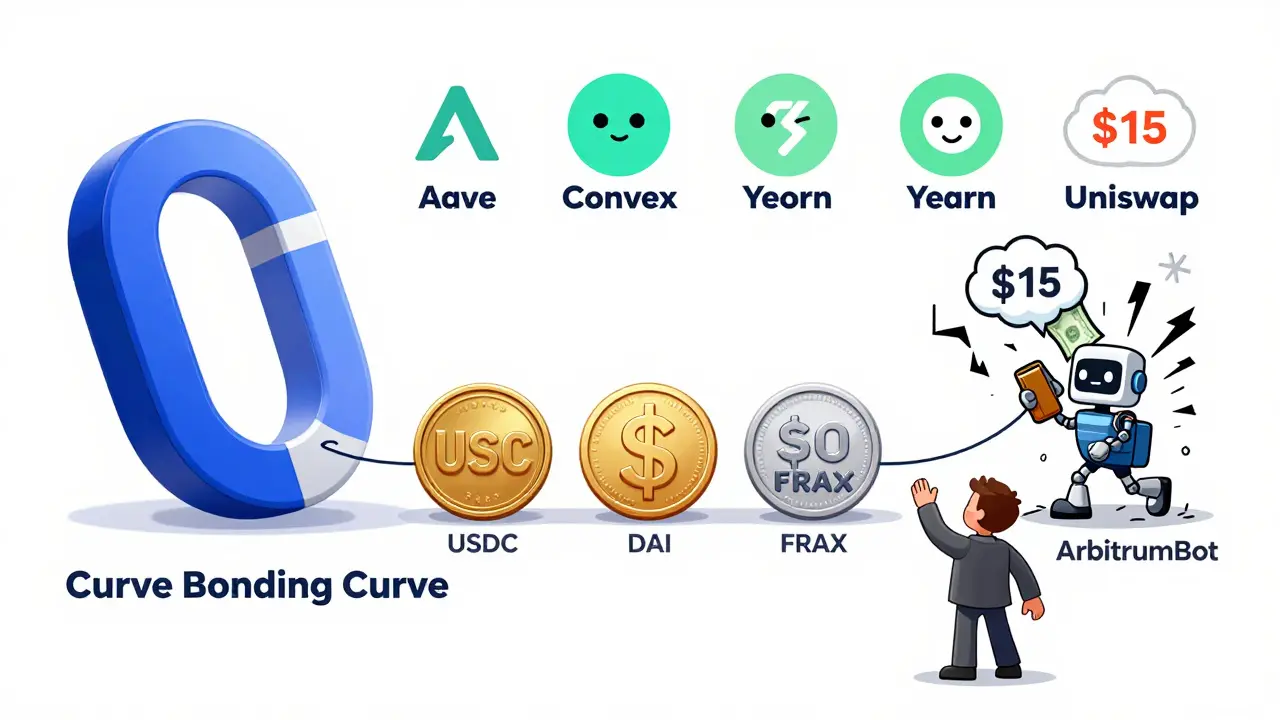
Most decentralized exchanges use a constant product formula - x * y = k - which works fine for Bitcoin and Ethereum, but falls apart when you try to swap $1.001 USDC for $0.999 DAI. The price jumps. Slippage spikes. That’s where Curve’s bonding curve changes everything.
Instead of a hyperbolic curve, Curve uses a flatter, more linear one. Think of it like a magnet pulling prices toward $1. If you’re trading between two stablecoins, the algorithm keeps the exchange rate dead-on. It’s not magic. It’s math designed for one thing: minimizing price impact on large trades.
On Arbitrum, this matters even more. With lower fees and faster blocks, you’re not just saving money - you’re avoiding delays that could ruin arbitrage opportunities. A trader moving $500,000 in USDT to FRAX can do it in one transaction without watching their price slip 0.3%.
Why Curve on Arbitrum?
Curve isn’t exclusive to Arbitrum. It runs on Ethereum, Polygon, Optimism, and 23 other chains. But Arbitrum is where it shines.
- Gas costs: A stablecoin swap on Ethereum might cost $5-$15. On Arbitrum? $0.05-$0.20.
- Speed: Confirmations take 1-2 seconds. On Ethereum, you wait 10-20.
- Liquidity depth: Arbitrum’s Curve pools hold over $1.2 billion in total value locked (TVL) as of early 2026 - making it the second-largest Curve deployment after Ethereum itself.
- Integration: Curve on Arbitrum connects directly to Aave, Lido, Convex, and Yearn. If you’re staking, farming, or borrowing, you’re likely using Curve under the hood.
For liquidity providers, this means higher yields with less risk. Because stablecoins rarely swing more than 0.5%, Curve’s pools don’t need massive capital buffers. That lets providers earn fees from high-volume trades without constant impermanent loss.
Trading Fees - What You Actually Pay
Curve doesn’t charge one flat fee. It varies by pool.
| Pool Type | Trading Fee | Best For |
|---|---|---|
| Stablecoin (e.g., USDC/DAI/USDT) | 0.04% | Large swaps, arbitrage |
| Wrapped BTC (e.g., WBTC/renBTC) | 0.04% | Bitcoin liquidity providers |
| ETH-like (e.g., wETH/renETH) | 0.04% | Staking derivatives |
| Volatility pools (e.g., CRV/ETH) | 0.50% | Speculative pairs |
Most users stick to the 0.04% pools. That’s 10x cheaper than Uniswap’s 0.3% on similar pairs. And because Curve’s algorithm minimizes slippage, your effective cost is even lower.
Where Curve Falls Short
Curve isn’t for everyone. If you’re trying to swap DOGE for SHIB, or Solana tokens for Ethereum, forget it. Curve doesn’t support those pairs. Period.
It also has a clunky interface. The website feels like a 2021 prototype. No guided onboarding. No price charts you can zoom. No mobile app. You need to know what pool you want before you even load the site.
And then there’s CRV. The native token isn’t just for governance - it’s a maze. To earn maximum rewards, you need to lock CRV for up to four years. That locks your voting power. It’s a great way to earn yield if you’re a long-term holder. But if you’re just swapping stablecoins? You’ll never touch it. And if you try, you’ll likely get lost.
Recent security issues haven’t helped. In late 2025, a DNS hijacking attack redirected users to a fake Curve site. Hundreds lost funds before the fix. Curve didn’t get hacked - their domain did. That’s a warning: always check the URL. Bookmark it. Never click a link from Discord or Twitter.
Curve vs. Other DEXs on Arbitrum
Arbitrum has other DEXs: Uniswap V3, Balancer, SushiSwap. So why Curve?
| Feature | Curve Finance | Uniswap V3 | Balancer |
|---|---|---|---|
| Best for | Stablecoins, wrapped assets | Volatility, custom pools | Multi-asset pools, weighted ratios |
| Typical fee | 0.04% | 0.05%-0.3% | 0.01%-0.5% |
| Slippage on $100k swap | <0.05% | 0.2%-0.8% | 0.1%-0.6% |
| Interface ease | Low | Moderate | Low |
| TVL on Arbitrum | $1.2B | $850M | $320M |
Curve wins on execution quality for stablecoin trades. Uniswap wins for variety and ease. Balancer is for advanced users who want to build custom pools. If you’re moving stablecoins at scale - Curve is the only real choice.

Who Should Use Curve on Arbitrum?
You should use Curve if:
- You trade stablecoins daily (DeFi yield farmer, market maker, trader)
- You’re moving $50k+ in a single swap
- You’re using Arbitrum for its low fees and speed
- You’re integrated into Convex, Yearn, or Lido - and need liquidity
You should avoid Curve if:
- You’re new to crypto and just swapping ETH for USDC
- You want to trade altcoins or meme tokens
- You’re scared of complex interfaces or domain risks
- You don’t want to learn how to use a wallet properly
The Bottom Line
Curve Finance on Arbitrum isn’t flashy. It doesn’t have gamified staking or NFTs. But it’s the quiet engine behind DeFi. If you’re doing anything serious with stablecoins, you’re already using it - even if you don’t realize it.
It’s the most efficient place to move money between dollar-pegged assets. The fees are low. The slippage is near zero. The liquidity is deep. And on Arbitrum, it’s faster and cheaper than anywhere else.
But it’s not for beginners. It’s not for altcoin traders. And it’s not without risk. The interface is outdated. The governance is confusing. And domain security is still a weak spot.
If you know what you’re doing - and you’re moving stablecoins - Curve on Arbitrum is still the gold standard. Skip the rest. Go straight to the source.
Is Curve Finance safe on Arbitrum?
Curve’s smart contracts have been audited multiple times by top firms like CertiK and SlowMist, and have handled over $100 billion in trades since 2020. The code itself is secure. But safety isn’t just about code - it’s about you. In late 2025, a DNS hijacking attack tricked users into visiting fake sites. Always type curve.fi manually. Never click links from social media. Use a bookmark. That’s how you stay safe.
Can I trade ETH for USDT on Curve?
No. Curve doesn’t support trading between assets with very different values - like ETH and USDT. It’s designed for pairs that should stay close in price: USDC/DAI, wETH/renETH, or WBTC/renBTC. If you want to swap ETH for USDT, use Uniswap or SushiSwap instead.
Why is Curve’s interface so hard to use?
Curve was built by and for DeFi insiders. It assumes you know what a stablecoin pool is, how to check TVL, and why you’d pick one fee tier over another. It doesn’t hold your hand. That’s why it’s efficient - but also intimidating. New users should start with Uniswap’s simple interface, then move to Curve once they understand the basics of stablecoin trading.
Do I need CRV tokens to use Curve?
No. You can swap, provide liquidity, or earn fees without ever touching CRV. The token is only needed if you want to vote on governance proposals or boost your yield through veCRV (vote-escrowed CRV). Most users never touch it - and that’s fine.
How does Curve make money?
Curve doesn’t take a cut from trades. Instead, it earns revenue through trading fees paid by users. These fees go directly to liquidity providers as rewards. Curve’s team also earns CRV emissions from the protocol’s governance system - but that’s separate from user fees. The platform operates as a non-profit infrastructure layer - not a business.

Anandaraj Br
February 18, 2026 AT 23:42yogesh negi
February 19, 2026 AT 01:36AJITH AERO
February 19, 2026 AT 15:50Lauren Brookes
February 21, 2026 AT 14:52Chris Thomas
February 23, 2026 AT 11:04Sarah Shergold
February 24, 2026 AT 00:42Dominica Anderson
February 24, 2026 AT 10:59Nova Meristiana
February 24, 2026 AT 16:59Nicole Stewart
February 24, 2026 AT 19:09Tarun Krishnakumar
February 26, 2026 AT 02:56Jenn Estes
February 27, 2026 AT 12:01Jeremy Fisher
February 28, 2026 AT 18:17JJ White
March 1, 2026 AT 20:55Alan Enfield
March 3, 2026 AT 10:26Jennifer Riddalls
March 3, 2026 AT 17:17Kyle Tully
March 4, 2026 AT 03:42kieron reid
March 6, 2026 AT 01:56Anandaraj Br
March 7, 2026 AT 23:23