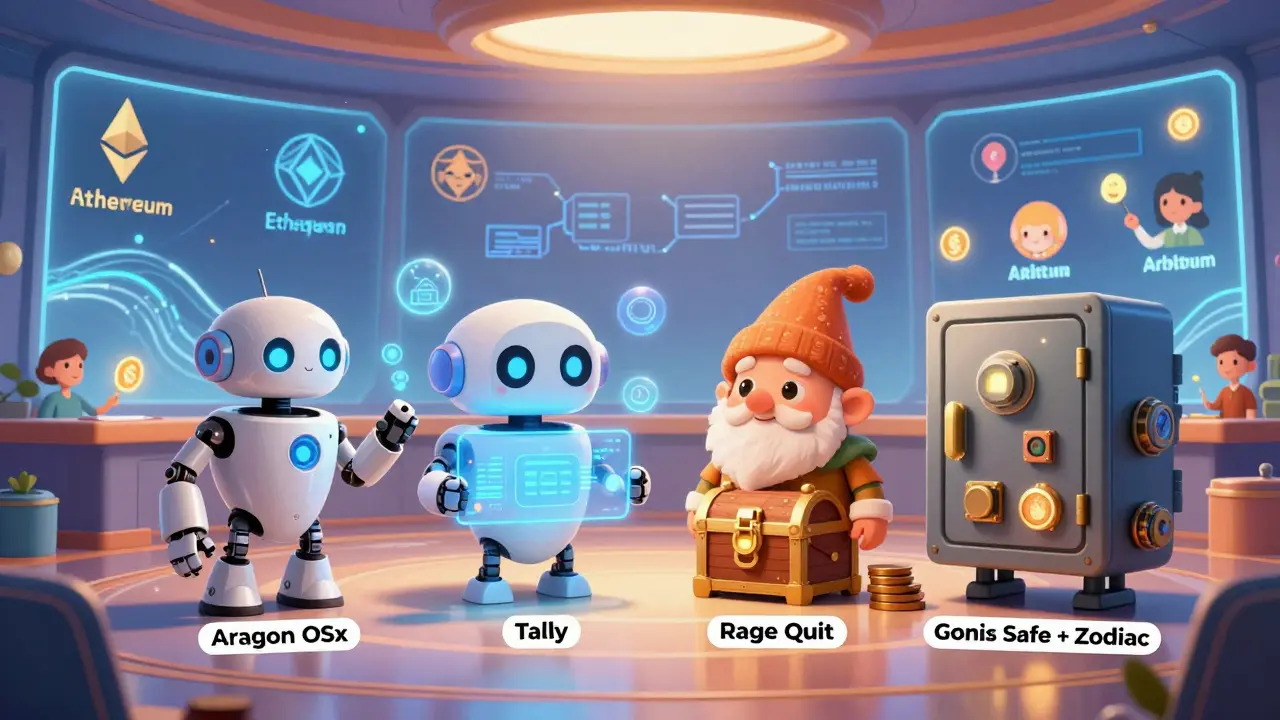
Choosing the right DAO governance tool isn’t just about picking software-it’s about matching the structure of your community to the way decisions actually get made. In 2026, there’s no single best platform. Instead, there are four major approaches, each built for a different kind of group, with different needs, technical skills, and goals.
What DAO Governance Really Means Today
A DAO isn’t just a smart contract. It’s a group of people trying to run something together without a boss. That sounds simple, but it gets messy fast. Who can propose changes? Who votes? How do you stop one person from taking over? How do you move money across different blockchains? The tools you use answer these questions before they become disasters.
Modern DAO governance tools handle four core jobs: letting members vote, managing the treasury, controlling who can do what, and letting proposals work across multiple blockchains. The best platforms don’t just offer features-they offer a way of thinking about how power flows.
Aragon OSx: For Protocols That Need to Evolve
If your DAO runs a DeFi protocol, a blockchain layer, or any system that needs to change often, Aragon OSx is built for you. It doesn’t lock you into one voting method. Instead, it lets you swap out governance rules like plugins. Need to switch from simple token voting to dual governance where one group approves proposals and another executes them? Just install the right plugin.
Aragon OSx gives you fine-grained control. You can set up allowlists that only let certain wallets propose votes. You can add time delays so big treasury moves can’t happen in a panic. It supports voting across Ethereum, Polygon, Arbitrum, and more-all in one system. This isn’t for beginners. You need developers or serious technical teams to set it up. But once running, it’s one of the most flexible systems out there. Teams like Aave and Uniswap use similar architectures because they can’t afford to be stuck with one way of governing forever.
Tally: The Power User’s Dashboard for Voting
Tally isn’t trying to reinvent governance. It’s trying to make it smooth. It’s the go-to interface for DAOs using OpenZeppelin’s Governor contracts-something you’ll find in most major token-based DAOs. If your DAO votes with tokens, Tally makes it easy to create proposals, track who voted, see delegation patterns, and monitor treasury balances-all in one clean dashboard.
What makes Tally stand out? It handles complexity at scale. Imagine a proposal that needs votes from Ethereum, Base, and zkSync. Tally aggregates them. It shows you who delegated their vote, how many votes are still pending, and even flags voters who haven’t participated in months. It also supports security council elections, where a small group is chosen to pause dangerous proposals. If your DAO has hundreds or thousands of voters, Tally reduces the noise. It’s hosted, so no self-hosting needed. You just connect your smart contracts and start. Most DAOs using Tally report a 40%+ increase in voter turnout because the interface is just easier to use.

DAOhaus: Simple for New Communities
Not every DAO needs a complex voting system. DAOhaus was built for early-stage groups that just want to get started without getting lost in code. It’s based on Moloch v3-a simple, battle-tested framework that uses shares and loot tokens instead of ERC-20 voting tokens. Shares give you voting power. Loot tokens let you claim a share of the treasury if you leave.
DAOhaus makes exit easy. If someone disagrees with a decision, they can ragequit and take back their share of funds. That’s not just a feature-it’s a trust builder. It stops people from feeling trapped. The platform connects directly to Gnosis Safe, so your treasury stays secure. You can even batch multiple actions in one proposal, like sending ETH to five different wallets at once. There’s no subscription fee. You pay only the gas to create and execute proposals. For communities under 100 members, DAOhaus is often the fastest path to real coordination.
Gnosis Safe + Zodiac: The Treasury-First Path
Many DAOs start with a simple multisig wallet-like Gnosis Safe-where 3 of 5 founders can approve transactions. That’s safe, but not decentralized. Zodiac changes that. It adds modular governance on top of Safe, so you can slowly move from a small group to full community control.
With Zodiac, you can add modules one at a time. Start with the Roles module to give different teams access to different funds. Add the Bridge module to move assets across chains. Then plug in the Governor module to let token holders vote on treasury moves. This isn’t a full governance platform like Aragon or Tally. It’s a stepping stone. Teams that began with Safe and later added Zodiac include the Gitcoin DAO and the Ethereum Foundation’s working groups. It’s perfect if you’re not ready to replace your treasury system but want to open it up over time.
How to Choose: A Quick Decision Guide
Here’s how to pick the right tool for your DAO:
- Need granular permissions and protocol-level control? → Aragon OSx
- Have lots of token holders and want rich analytics? → Tally
- Are you small, early, or want easy exits? → DAOhaus
- Already use Gnosis Safe and want to decentralize slowly? → Safe + Zodiac
Most DAOs start with one of these and evolve. DAOhaus can grow into Aragon. Safe can upgrade to Zodiac. Tally can be added to any contract. The key is not to overbuild early. Start simple, then add complexity as your community grows.
Other Tools in the Ecosystem
There are dozens of other platforms-Boardroom.io, Dework, Syndicate, Colony, and more. Many focus on specific use cases: Boardroom for community dashboards, Dework for task tracking inside DAOs, Syndicate for investment clubs. But the four platforms above cover 90% of real-world governance needs in 2026. The rest are either niche, outdated, or built on top of these core systems.
What’s Changing in 2026
The biggest shift isn’t new tools-it’s how they’re used. Modular design is now the standard. No one builds monolithic systems anymore. Everything connects: voting, treasury, delegation, and execution are separate components that plug together. Multichain governance is no longer optional. If your DAO operates on Ethereum, Solana, and Polygon, your tool must handle it. And security is no longer an add-on-it’s baked in. Time delays, role scoping, and multisig backups are now expected features, not luxuries.
The future of DAO governance isn’t more features. It’s better integration. Tools that let you vote, move funds, and assign roles without switching between five different apps are winning. The winners in 2026 aren’t the flashiest-they’re the most reliable.
Can I use multiple DAO governance tools at once?
Yes, and many do. A DAO might use DAOhaus for membership voting, connect to Gnosis Safe for treasury management, and use Tally to track voter participation across chains. The key is ensuring the underlying smart contracts can talk to each other. Most modern tools are designed to integrate-especially through Safe or Aragon’s plugin system. But mixing tools adds complexity. Only do it if you have technical support.
Do I need to be a developer to use these tools?
Not necessarily. Tally and DAOhaus offer no-code interfaces. You just connect your wallet and start. Aragon OSx and Safe + Zodiac require more setup-usually a developer or team to deploy contracts. But once set up, members can vote and interact without coding. The barrier is in setup, not daily use.
Are these tools safe from hacks?
They’re safer than most traditional systems, but not foolproof. Aragon and Tally use audited contracts. DAOhaus relies on Moloch v3, which has been battle-tested since 2021. Safe + Zodiac is built on Gnosis Safe, used by over 10 million wallets. Still, vulnerabilities can exist in custom plugins or misconfigurations. Always audit custom code, use time delays, and avoid single points of control.
How much do these tools cost?
Most platforms are open-source and free to use. You pay only blockchain gas fees-usually $1 to $20 per proposal, depending on network congestion. Tally and Boardroom offer optional paid tiers for analytics or support, but you don’t need them to run a DAO. DAOhaus and Aragon OSx have no subscription fees. The real cost is time: learning the system and setting it up correctly.
Can I migrate from one platform to another later?
Yes, but it’s not simple. Moving from DAOhaus to Aragon OSx means redeploying contracts and migrating votes. Tally doesn’t store data-it just displays what’s on-chain, so switching is easier if the new platform uses the same governance contract. Always design with migration in mind: use standard contracts, keep records of votes, and avoid locking funds in non-standard systems.

christopher luke
February 26, 2026 AT 20:53Also, love that you mentioned gas fees - so many people think these tools are $$$ when really it’s just time and a little patience.
Thanks for the clarity!
Mary Scott
February 27, 2026 AT 23:59And who’s auditing these plugins? Some guy on Discord? I’m not trusting my treasury to some "modular" system that changes every week. This is all just crypto theater.
Shannon Holliday
March 1, 2026 AT 09:54Also, Tally’s delegation tracker is so pretty 🌈 I stare at it like it’s a screensaver.
PS: Multichain voting is no longer optional - it’s life support.
Jeremy buttoncollector
March 1, 2026 AT 21:48But let’s be real: most DAOs are just VC-backed shell corporations with a token and a Discord. The real innovation isn’t in the tooling - it’s in the *absence* of centralized authority. Which, statistically, almost never happens.
Also, ‘gas fees’? More like ‘gas tax’ on the proletariat.
Michelle Xu
March 2, 2026 AT 23:23Aragon OSx is indeed the gold standard for protocol-level governance - but only if you have a dev team. For most grassroots groups, DAOhaus + Safe is the pragmatic sweet spot.
One note: Tally’s voter analytics are underrated. We saw a 52% increase in participation after implementing delegation tracking. It’s not magic - it’s UX.
Ryan Burk
March 3, 2026 AT 04:27Real DAOs don’t need apps. They need leaders. And if your DAO can’t make a decision without a 3-step dashboard, you’re already dead.
Also, ‘multichain governance’? That’s just another way to say ‘we’re too lazy to pick one chain’. Pathetic.
Sriharsha Majety
March 3, 2026 AT 17:57we had like 40 members and no one knew what they were doing but the ragequit thing made everyone chill out
also gas fees were like 2 bucks per vote lol
Tabitha Davis
March 3, 2026 AT 21:16Gitcoin used it? Yeah, because they’re owned by Consensys. Ethereum Foundation? Same.
This isn’t decentralization. It’s a Trojan horse with a cute logo. And Tally? They’re just a front for the same VC crowd.
Wake up. You’re being sold a fantasy.
Don B.
March 5, 2026 AT 08:31But honestly? I just wanted to send some ETH to a friend. Took me 3 days. 3. Days.
Now I just use a wallet. Simpler. Less drama.
Also, who even has a DAO anymore? It’s just a bunch of guys in Discord arguing about NFTs.
Why are we pretending this is governance?
Arya Dev
March 6, 2026 AT 06:19Also, 'gas fees'? In India, that's a week's wages for most people. So who really gets to vote? The rich. The tech bros. The Americans.
This isn't democracy. It's a digital caste system.
Leslie Cox
March 7, 2026 AT 00:22Tools don’t fix bad culture. A DAO with toxic members using Tally is still toxic. A DAO with empathy using DAOhaus is still functional.
And let’s not pretend ‘modular’ means ‘decentralized’. Modular is just another word for ‘controlled by a few devs who know how to deploy plugins’.
Stop fetishizing interfaces. Focus on trust.
Andrew Hadder
March 7, 2026 AT 23:04Otherwise, solid breakdown. I’ve used Safe + Zodiac for a working group and it’s been smooth. The Roles module alone saved us from 3 internal conflicts.
Also, gas fees are low - but if you’re on L2s, they’re practically free. Worth noting.
Derek Sasser
March 9, 2026 AT 16:47People think complexity = sophistication. But the real winners are the ones who stay simple. DAOhaus users are happier. Tally users get more done. Aragon users? They’re busy writing whitepapers.
One thing I’d add: always start with what your treasury looks like. The tool follows the money - not the other way around.
Neeti Sharma
March 10, 2026 AT 17:31You call DAOhaus 'simple'? We had village councils that made decisions faster with 500 people and no app.
Stop glorifying tech as innovation. This is just Silicon Valley rebranding ancient systems with gas fees.