
KYC Forgery Risk Assessment Tool
Risk Assessment
Legal Consequences
Enter details to see potential legal consequences
Using fake documents to get into a crypto exchange isn’t a clever hack-it’s a federal crime with prison time attached. People think they’re outsmarting the system by uploading a doctored driver’s license or a deepfake video to bypass KYC checks. But what they don’t realize is that every step of that process leaves digital footprints that federal agencies are trained to follow. The SEC, FinCEN, and DOJ don’t just watch for suspicious trades-they track forged documents, AI-generated identities, and the money trails they enable.
How Document Forgery Actually Works on Crypto Exchanges
It starts with a simple goal: open an account without showing your real name or address. Fraudsters buy complete identity packages on dark web marketplaces. These aren’t just blurry scans of fake IDs-they’re full sets: government-issued documents, utility bills, even bank statements, all made to look real using AI tools. Prices range from $15 for basic fakes to over $500 for high-end packages that include synthetic video responses. The real danger comes from deepfake technology. Instead of just submitting a photo, fraudsters record or generate videos where a face blinks, turns slightly, and speaks phrases like “I am John Smith” to pass live verification. These videos use AI to mimic natural movements-eyelid flickers, micro-expressions, even how light reflects off the cornea. Automated systems used to be fooled by static images. Now, they’re trained to spot unnatural blinking patterns or lighting inconsistencies that humans can’t even see. Major exchanges like Coinbase and Kraken now use multi-layered verification. You don’t just upload a document. You’re asked to take a live selfie, match it against your ID, answer a random question, and sometimes even verify your phone number with a carrier lookup. If any piece doesn’t align, the system flags it. And when it does, it’s not just blocked-it’s reported to FinCEN as a potential AML violation.What Happens When You Get Caught
Getting caught isn’t a slap on the wrist. Federal prosecutors treat crypto document fraud as wire fraud, securities fraud, or money laundering-all felony charges. Each count can carry up to 20 years in prison. If you’re part of a group running multiple fake accounts, you could face conspiracy charges too. In 2023, a man in Florida was sentenced to 14 years after using forged IDs to open 87 crypto accounts across three exchanges. He moved over $3.2 million in stolen cryptocurrency through mixers and offshore wallets. The court didn’t just punish him for fraud-it added a forfeiture order for all assets tied to the scheme, including his car, home, and cryptocurrency holdings. Even if you don’t steal money, just trying to bypass KYC can trigger charges. The law doesn’t care if you were planning to trade Bitcoin or just wanted privacy. The act of submitting fake documents to a regulated financial platform is enough to cross the line into federal territory.Exchanges Aren’t Just Victims-They’re Liable Too
People assume the fraudster is the only one in trouble. But exchanges that ignore red flags face serious consequences too. In 2022, Kraken paid a $30 million settlement to OFAC for allowing accounts linked to sanctioned entities to operate without proper verification. That wasn’t because they were helping criminals-it was because their systems didn’t catch them. Regulators now expect exchanges to do more than just collect documents. They must verify them against official databases, check for inconsistencies, and monitor for patterns. If an exchange lets someone open an account with a forged utility bill that doesn’t match the address on the ID, and that person later moves laundered funds, the exchange can be held civilly liable. Users who lose money because of weak security have sued platforms for negligence. The standard isn’t perfection-it’s reasonable effort. If your verification system uses outdated tools that are known to be fooled by AI fakes, and you don’t upgrade, you’re not just risky-you’re legally exposed.
How Detection Systems Keep Up
The arms race between fraudsters and verification tech is real. Every time a new forgery method pops up, exchanges update their AI models. Today’s systems don’t just check if a document looks real-they check if it’s possible. For example, a fake ID might show a driver’s license issued in Texas in 2021, but the font style doesn’t match the DMV’s 2021 template. Or the hologram’s reflective pattern is off by 0.3 degrees. These aren’t mistakes humans notice. But AI trained on millions of real documents can spot them instantly. Some platforms now use behavioral analysis. If someone uploads a document from a phone with a known spoofing app, or if their IP address has been flagged for previous fraud attempts, the system adds risk points. Multiple red flags trigger a manual review. In 2024, one exchange blocked 12,000 fraudulent attempts in a single month-92% of them caught before any funds moved. The key is redundancy. No single check is enough. You need document analysis, biometric matching, device fingerprinting, and external database cross-referencing. If one layer fails, the others catch it.Why This Isn’t Just About Crypto
Crypto exchanges are the new banks. They hold trillions in assets. They process cross-border transactions. And like banks, they’re required by law to verify their customers. The same federal laws that apply to Wells Fargo or Chase apply here. Using fake documents to access a crypto platform isn’t a tech loophole-it’s a financial crime. The IRS tracks crypto transactions for tax evasion. The DOJ prosecutes money laundering. The SEC goes after unregistered securities. All of them now have crypto-specific task forces. And it’s not just the U.S. The EU’s MiCA regulations, the UK’s FCA rules, and Australia’s AUSTRAC all have identical requirements. If you’re using fake docs to access a crypto exchange that serves U.S. users, you’re breaking U.S. law-even if you live in another country.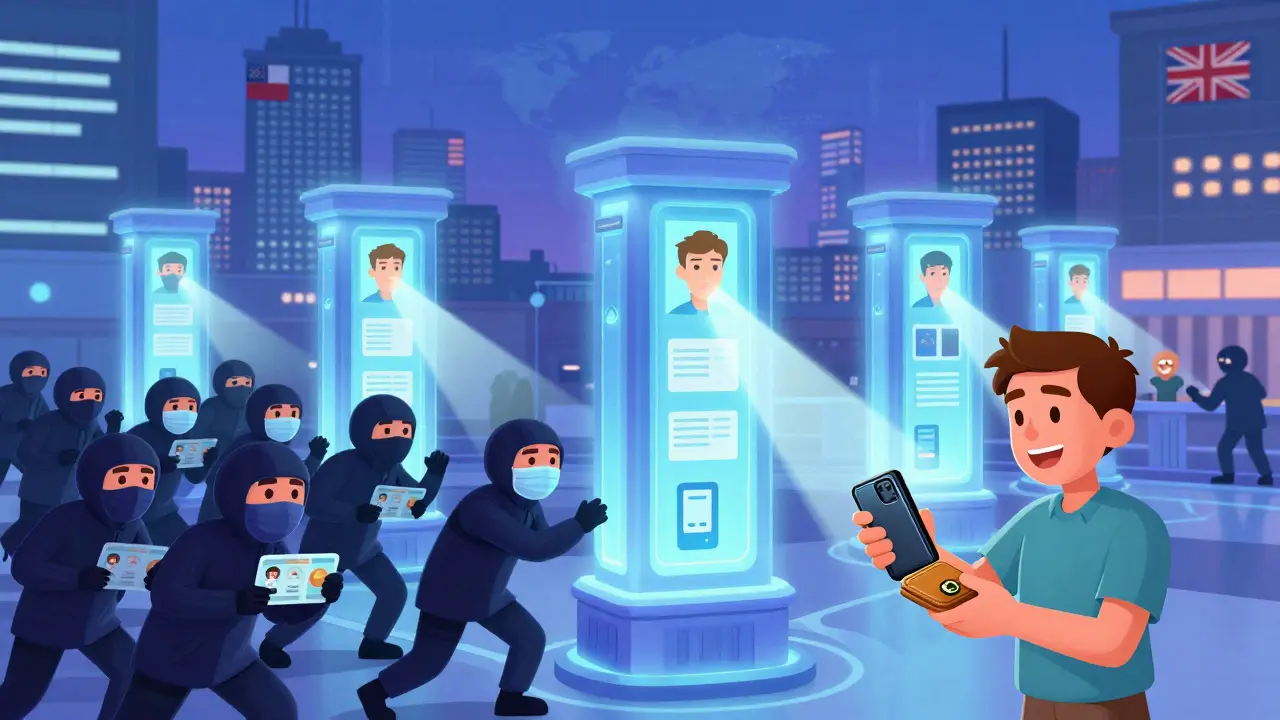

Mairead Stiùbhart
December 6, 2025 AT 09:16Oh wow, so now we’re criminalizing privacy? 🙄 Next they’ll jail you for using a pseudonym on the internet. I mean, sure, fake docs = bad, but let’s not pretend these exchanges are saints. They track your every move, sell your data, and still get hacked. If I want to trade crypto without handing over my birth certificate to a corporation that doesn’t care if I live or die, that’s my choice. The real fraud is thinking KYC = safety.
jonathan dunlow
December 7, 2025 AT 04:53Look, I get it - people think they’re being clever by using AI-generated IDs, but here’s the thing: this isn’t just about breaking rules, it’s about understanding the stakes. The system isn’t perfect, but it’s designed to stop organized crime, not punish people who want to buy Bitcoin anonymously. Think about it - if you’re using a forged document, you’re not just dodging a form, you’re potentially enabling money laundering, terrorist financing, or worse. And yeah, the penalties are brutal, but that’s because the consequences are real. These aren’t just ‘crypto bros’ - we’re talking about transnational criminal networks that use these loopholes to move billions. The fact that exchanges are now using NIST-certified AI to detect micro-expressions in deepfakes? That’s not overreach - that’s survival. We need this level of security because the financial system is now digital, and digital systems are targets. So yes, if you lie to a regulated entity, you’re playing with fire. And fire doesn’t care if you ‘just wanted privacy.’ It burns everything.
rita linda
December 8, 2025 AT 15:23Let’s be crystal clear: if you’re using fake documents to bypass U.S. financial regulations, you’re not a privacy advocate - you’re a lawbreaker. And if you think the DOJ is going to wink at this because it’s ‘crypto,’ you’re living in a fantasy. The U.S. has jurisdiction over any platform serving American users - period. Even if you’re in Lagos or Manila, if your IP connects to Coinbase, you’re under U.S. law. The idea that this is ‘overreach’ is pure delusion. The system is designed to protect the integrity of the financial infrastructure. You don’t get to opt out because you ‘don’t trust banks.’ You don’t get to bypass federal law because you think your privacy matters more than national security. This isn’t 2014 anymore. The gloves are off. And if you’re still playing around with deepfakes and dark web IDs, you’re not a hacker - you’re a walking indictment.
Uzoma Jenfrancis
December 8, 2025 AT 16:13My country has no crypto laws yet. But I read this and I understand - if you lie to a system that holds real money, you are already in danger. Even if no one catches you now, the data stays. The device. The IP. The blink pattern. One day, when your life changes, they will find you. And then you will not have a second chance. Better to use Monero. Or cash. Or nothing.
Renelle Wilson
December 9, 2025 AT 10:16It’s important to recognize that the intent behind regulation isn’t to surveil or control individuals, but to preserve the stability and legitimacy of financial systems that serve millions. Crypto exchanges operate as financial institutions - they are not social media platforms or anonymous forums. The legal frameworks governing banks, money transmitters, and securities intermediaries were not created arbitrarily; they evolved from decades of financial crises, fraud, and systemic collapse. When someone submits a forged document, they are not merely ‘bypassing a form’ - they are undermining the very mechanisms that prevent illicit capital flows, protect consumers from identity theft, and ensure market integrity. The penalties may seem severe, but they are proportionate to the scale of potential harm. Moreover, the technological advancements in detection are not tools of oppression - they are safeguards. The fact that AI can now detect a 0.3-degree hologram inconsistency isn’t dystopian; it’s responsible. We should be applauding the innovation that makes financial systems more secure, not lamenting the end of loopholes that were never meant to exist.
Elizabeth Miranda
December 10, 2025 AT 13:03I’ve seen people get caught using fake IDs on crypto platforms. Not because they stole crypto - just because they didn’t want to link their real name to an account. One guy got flagged because his utility bill was from a different county than his ID. The system didn’t even need human review. AI spotted it in 0.8 seconds. He thought he was being smart. Turns out, he was just predictable. The tech doesn’t care about your reasons. It just sees inconsistency. And once it sees it, it’s logged forever.
Chloe Hayslett
December 11, 2025 AT 01:46So let me get this straight - if I use a fake license to access a platform that’s basically a casino for billionaires, I go to prison… but the CEO who gets fined $30M for letting sanctioned Russians in? He just writes a check and calls it a day. Classic. The system doesn’t punish the powerful - it punishes the desperate.
Jonathan Sundqvist
December 12, 2025 AT 09:25Bro, I tried it once. Uploaded a fake ID. Got blocked in 12 seconds. Then my phone got flagged. Now every time I open an app, it asks for my face again. Like I’m a terrorist. Not worth it. Just buy on P2P. Less stress.
Annette LeRoux
December 13, 2025 AT 06:31It’s wild how we’ve turned identity into a commodity. We’re so scared of being tracked that we lie to get in… but then we hand over our biometrics, our location, our device fingerprint, and our entire digital footprint just to trade BTC. The irony is thick. Maybe the real question isn’t ‘why do people fake docs?’ but ‘why do we trust these systems so much in the first place?’ 🤔
Jerry Perisho
December 15, 2025 AT 00:00Document forgery detection relies on three layers: visual analysis, metadata integrity, and behavioral deviation. Most fakes fail on metadata - EXIF data from the photo, inconsistent DPI, mismatched watermark layers. AI doesn’t care if the face looks real. It checks if the PDF was created in Photoshop 2018 on a Samsung device that’s been flagged 47 times in the last month. The tech is silent. It’s precise. And it doesn’t forgive.
Manish Yadav
December 15, 2025 AT 12:13People are so stupid. You think you're smart using fake papers? You're just helping criminals. You're not cool. You're a fool. You're going to jail. Everyone knows this. Stop being dumb.
Noriko Robinson
December 16, 2025 AT 02:07I get why people do it - I really do. I’ve been in situations where I didn’t trust institutions, where I felt like I had no choice. But the thing is, once you cross that line, you’re not just risking your freedom - you’re giving power to the very systems you’re trying to escape. The more people use fake docs, the more invasive the verification gets. The more they track, the less privacy we all have. Maybe the real solution isn’t to hack the system, but to demand better ones - transparent, decentralized, user-owned. Not more surveillance. More trust. Not more lies. More options.
Madison Agado
December 16, 2025 AT 08:32If you’re willing to risk 20 years in prison to access a platform that can freeze your funds at any moment, what does that say about your understanding of power? You think you’re outsmarting the system, but you’re just performing obedience - you’re still playing by their rules, just with a different costume. The real rebellion isn’t forging a document. It’s refusing to participate at all.