DragonSwap Fee Calculator
Compare Your Transaction Costs
Calculate how much you'd save using DragonSwap v1 versus other leading DEXs
When you're trading crypto and every millisecond counts, DragonSwap v1 isn't just another decentralized exchange. It's built for speed, not just convenience. If you've ever waited 15 seconds for a trade to confirm on Uniswap while the price slipped 2%, you already know why DragonSwap exists. It doesn't just claim to be fast-it proves it. On Sei Network, transactions settle in under a second. Fees? Around $0.002 per swap. That’s not a marketing claim. That’s what Nansen and Messari measured in real-world usage.
Why DragonSwap v1 Feels Different
Most DEXs run on Ethereum or BNB Chain. They’re slow because those networks were never built for high-frequency trading. DragonSwap v1 runs on Sei Network, a blockchain designed from the ground up to handle thousands of trades per second. It uses parallelized EVM architecture, meaning multiple transactions happen at the same time instead of排队 like at a bank teller. This isn’t a tweak-it’s a rewrite of how DEXs work. The result? A swap that takes 600 milliseconds on DragonSwap versus 13,000 milliseconds on Uniswap V3. That’s 21 times faster. For traders doing arbitrage or scalping, that difference isn’t nice to have-it’s the difference between profit and loss.How It Works: Simple, But Not Simple-Minded
DragonSwap v1 uses a binary smart contract system. There’s one factory contract that creates each trading pair, and each pair has its own dedicated contract. This keeps things clean and reduces attack surface. No messy multi-purpose contracts. No bloated code. Just focused, efficient logic. The real innovation is concentrated liquidity. Unlike Uniswap V2, where you spread your funds across the whole price range, DragonSwap lets you pin your liquidity to a narrow band-say, $0.50 to $0.55 for SEI/USDC. If the price stays in that zone, you earn more fees. If it moves out? You stop earning until it comes back. It’s like setting up a shop on Main Street but only open when the foot traffic matches your product. This boosts capital efficiency by up to 400%, according to ICOholder’s analysis. Fees are fixed at 0.3%. Of that, 0.25% goes to liquidity providers. The other 0.05% goes to the protocol treasury. Simple. Transparent. No hidden fees. No surprise charges. And yes, they burn 30% of that treasury revenue to reduce the KAIA token supply-a deflationary move few DEXs even attempt.Performance Numbers That Matter
Numbers don’t lie. Here’s what DragonSwap v1 actually delivers:- Average transaction time: 400-600 milliseconds
- Average gas fee: $0.002 per transaction
- Peak throughput: 14,000 transactions per hour
- Total Value Locked (TVL): $87.3 million (as of September 2024)
- Weekly active users: ~42,000
- Trading volume since launch: $1.24 billion

Where It Falls Short
Speed and low fees are great-but they don’t mean much if you can’t trade what you want. Here’s the catch: DragonSwap v1 only works on Sei Network. No cross-chain swaps. No bridging from Ethereum or Solana. If you’re holding ETH, SOL, or even USDT on another chain, you have to bridge it to Sei first. That adds steps, risk, and time. Liquidity is another issue. 78% of DragonSwap’s $87.3 million TVL is in SEI-USD stablecoin pairs. That means if you want to trade a new, obscure token on Sei, you might not find enough depth. Slippage can spike. Or worse-you might not find a pool at all. Also, the interface doesn’t hold your hand. New users report confusion over concentrated liquidity. One in two users on Trustpilot said they didn’t understand how to set price ranges properly. That’s not the app’s fault-it’s the lack of clear education. DragonSwap assumes you know DeFi. If you don’t, you’re on your own.Wallets, Support, and Onboarding
You need a wallet that supports Sei Network. Keplr, Leap, and Front are the main ones. If you’re using MetaMask, you’ll need to manually add Sei’s RPC endpoint. That’s a 5-minute setup for experienced users. For beginners? It’s a wall. According to Reddit feedback, 63% of new users struggle with initial wallet connection. That’s a serious UX gap. DragonSwap’s interface is clean, but it doesn’t guide you through setup. No tooltips. No walkthroughs. Just a button that says “Connect Wallet.” Customer support lives on Discord. Response times are 22 minutes during business hours. On weekends? Over 3 hours. That’s acceptable for a DeFi protocol, but not great if you’re stuck during a volatile market. The API has 27 endpoints and solid documentation-but 87% uptime means 13% of webhooks fail. If you’re building a bot, you’ll need fallback logic.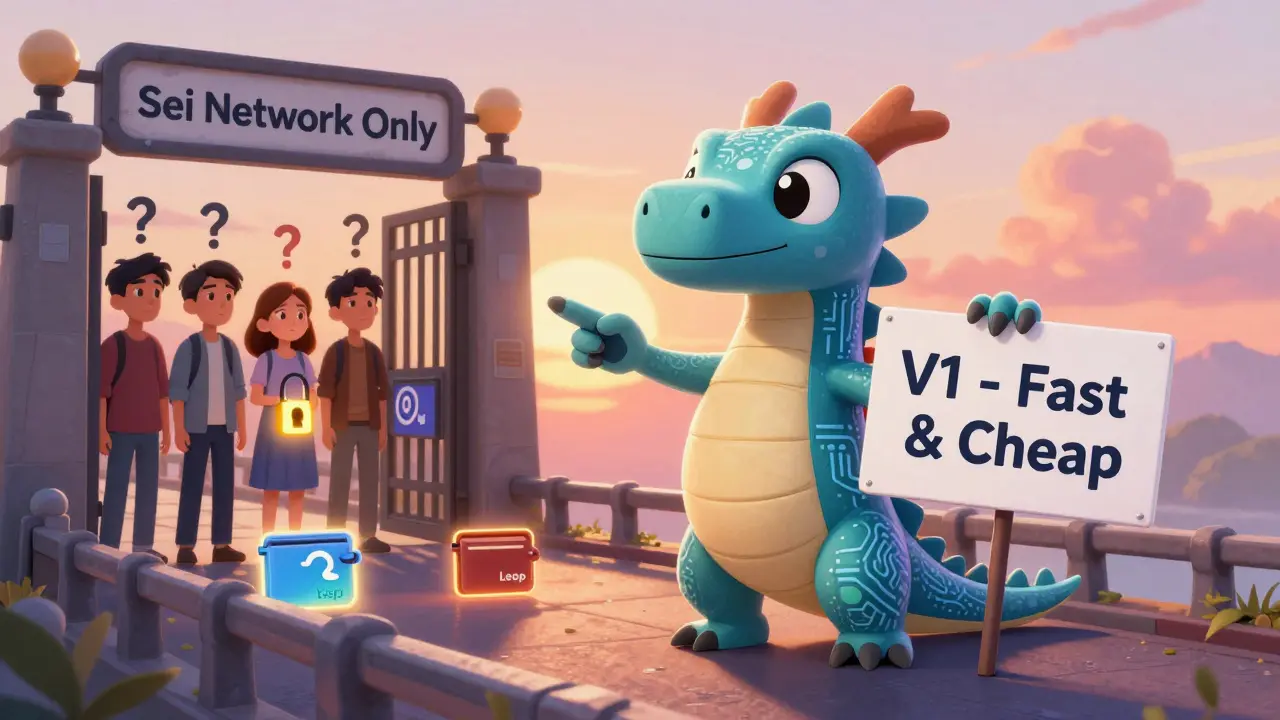
Who Is This For?
DragonSwap v1 isn’t for everyone. It’s not a place to buy your first Bitcoin. It’s not a beginner-friendly on-ramp. It’s for:- Traders who need speed: arbitrageurs, scalpers, high-frequency traders
- Liquidity providers who want maximum yield: those who understand price ranges and impermanent loss
- Sei Network users: if you’re already holding SEI or using Sei apps, this is your natural home
- Developers building on Sei: the clean architecture makes integration straightforward
The Bigger Picture: Sei Network’s Future
DragonSwap’s success is tied to Sei Network’s. Right now, Sei is the 14th-largest DeFi ecosystem with $217.5 million TVL. DragonSwap controls 43.7% of that. That’s dominance. But if Sei fails to grow, DragonSwap becomes a niche tool. Analysts like Hasu warn that if parallelized EVMs don’t become mainstream, DragonSwap’s architecture could become a dead end. That’s a real risk. But right now, Sei is gaining traction. The Kaia Foundation gave them $2.5 million in funding. They’re building cross-chain support for V2, scheduled for Q1 2025. That’s a lifeline. The team has committed to maintaining V1 through Q4 2026. So even if you’re not ready for V2, you’ve got time.Final Verdict
DragonSwap v1 is the fastest, cheapest DEX you can use today-if you’re on Sei Network. It’s not perfect. The UX is rough for newcomers. Liquidity is uneven. No cross-chain. But if you care about speed, low fees, and capital efficiency, it’s the best option in its class. It’s not the next Uniswap. It’s something more specific: the best tool for high-speed trading on a high-speed chain. If you’re trading SEI, or planning to, DragonSwap v1 isn’t just an option-it’s the default.For everyone else? Wait until V2 adds cross-chain support. Until then, stick to the networks you’re already on.
Is DragonSwap v1 safe to use?
Yes, with caveats. DragonSwap v1 was audited by CertiK in March 2024, which found three medium-severity vulnerabilities. All were patched in the V1.1 update. The contract code is minimal and focused, reducing attack surface. However, as with all DeFi protocols, you’re responsible for your own security. Never connect your wallet to unofficial sites. Use only the official DragonSwap app and verified wallet extensions like Keplr or Leap.
Can I use MetaMask with DragonSwap v1?
You can, but not directly. MetaMask doesn’t support Sei Network out of the box. You need to manually add Sei’s RPC endpoint (chain ID 1329, RPC URL, etc.) to your wallet. Many users skip this step and assume it won’t work. If you’re new to DeFi, use Keplr or Leap instead-they’re built for Sei and connect with one click.
What’s the difference between DragonSwap v1 and v2?
DragonSwap v1 is a single-chain DEX locked to Sei Network. v2, launching in Q1 2025, will add cross-chain functionality using Sei’s interchain accounts. That means you’ll be able to swap tokens from Ethereum, Solana, and other chains without bridging first. v2 will also include improved UI, better slippage controls, and deeper liquidity pools. v1 will remain active through at least late 2026.
Why is liquidity so concentrated in SEI-USD pairs?
Because SEI is the native token of the Sei Network and the most liquid asset in the ecosystem. Most users deposit SEI to earn rewards, provide liquidity, or trade against stablecoins. Newer tokens lack the user base and trading volume to sustain deep pools. As more projects launch on Sei, liquidity will diversify. But right now, SEI-USD is the backbone of DragonSwap’s trading volume.
Does DragonSwap offer staking or yield farming?
Yes, through liquid staking. You can stake SEI tokens directly on DragonSwap and receive sSEI, a tokenized version that earns yield while remaining tradable. This is different from traditional staking where your tokens are locked. Liquid staking lets you earn rewards and still trade or use your assets in other DeFi apps. It’s one of the platform’s most popular features.
How does DragonSwap compare to Uniswap?
Uniswap works across many chains and has far more liquidity and tokens. But it’s slow and expensive. DragonSwap is faster, cheaper, and more efficient for concentrated liquidity-but only on Sei Network. If you’re trading SEI or other Sei-native tokens, DragonSwap wins. If you’re trading ETH, USDC, or tokens on Ethereum, Uniswap is your only option. They’re not competitors-they serve different markets.

Annette LeRoux
December 9, 2025 AT 06:53Not just faster, but smarter. The concentrated liquidity model is like giving traders a scalpel instead of a sledgehammer. Finally, someone built for the pros.
Manish Yadav
December 9, 2025 AT 11:57Doreen Ochodo
December 10, 2025 AT 13:25DragonSwap gets it. If you’re still waiting 10 seconds to swap, you’re already behind.
Holly Cute
December 10, 2025 AT 23:19Let me guess, the team raised $2.5M and now they’re calling it ‘dominance’? Classic. TVL is inflated by SEI-USD pairs because nobody else has liquidity. And don’t get me started on that 87% uptime. That’s not ‘solid’-that’s a 1 in 7 chance your bot gets burned. This isn’t innovation. It’s a glorified beta test.
Chris Mitchell
December 12, 2025 AT 01:44That’s the future. Not hype. Not memes. Engineering.
Regina Jestrow
December 12, 2025 AT 04:46How do you even set a price range without losing your mind?
Frank Cronin
December 13, 2025 AT 12:41Meanwhile, real traders are on Hyperliquid and dYdX. This is a toy.
miriam gionfriddo
December 14, 2025 AT 03:21maybe its just me but i think if its too hard to use its not for me
Nicole Parker
December 15, 2025 AT 15:45I sat with my cousin who’s never used DeFi before-she stared at ‘Connect Wallet’ for 12 minutes. No tooltips, no help, no ‘what’s this?’ button. It’s like handing someone a Formula 1 car and saying ‘good luck’. The tech is brilliant, but the human side? Totally ignored.
michael cuevas
December 17, 2025 AT 00:45nah bro it’s laziness
you can be fast AND user friendly
stop pretending simplicity is sophistication
Elizabeth Miranda
December 17, 2025 AT 06:40My trades execute before I can blink. The fees are laughably low. And the liquid staking? Pure genius. It’s not perfect, but it’s the most honest DeFi app I’ve used in years.
Chloe Hayslett
December 18, 2025 AT 18:56Don’t act like this is the future. It’s just another distraction while real infrastructure gets built.
Vincent Cameron
December 19, 2025 AT 23:31But is a faster DEX better if it’s only useful to 0.5% of crypto users?
Maybe the real innovation isn’t in the code-it’s in asking why we need to trade so fast in the first place.
Yzak victor
December 20, 2025 AT 13:49Uniswap? Slow but safe. Pancake? Chaotic but fun. DragonSwap? Like switching from a bicycle to a jetpack.
It’s not for everyone. But if you’re in the right lane? It’s the only way to go.
nicholas forbes
December 22, 2025 AT 12:59I hold ETH, SOL, and USDC. I don’t want to bridge just to trade one token.
It’s like opening a restaurant that only serves one dish-and then charging extra for the fork.
Martin Hansen
December 23, 2025 AT 02:39They’re not building a DEX. They’re building a SEI pump engine. And the rest of us are just the fuel.
Lore Vanvliet
December 24, 2025 AT 02:51FINALLY SOMETHING THAT DOESN’T MAKE ME WANT TO THROW MY LAPTOP OUT THE WINDOW
TOO BAD YOU’RE ALL JUST HATERS WHO WANT TO STAY ON ETHEREUM AND CRY ABOUT GAS FEES
Scott Sơn
December 24, 2025 AT 08:58Some people call it reckless. I call it alive.
Meanwhile, Uniswap is a Prius with a sticker that says ‘I ❤️ ETH’.
Which one do you want to drive when the market blows up?
Stanley Wong
December 25, 2025 AT 11:52Sei’s devs are listening. They’re not just throwing code at the wall. They’re building with purpose. DragonSwap v2 with cross-chain? That’s the real play. This v1? Just the opening chapter.
And honestly? I’m glad someone’s trying something different instead of copying Uniswap for the 500th time.