It used to be that eToroX was the go-to spot for traders who wanted a professional-grade experience within the eToro ecosystem. If you are looking to open an account today as a retail investor, however, you will hit a wall. As of 2026, eToroX is no longer available for retail investors. The platform has pivoted entirely to serve institutional clients, corporate entities, and professional traders.
This shift changes everything about how we evaluate this platform. For years, eToroX sat alongside the main eToro social trading app, offering deeper liquidity tools and a more complex interface. Now, it functions as the backend infrastructure supporting eToro’s broader wallet operations. If you are a regular trader wondering if you should migrate your funds or start using eToroX, the short answer is no. But understanding why this happened-and what replaces it-is crucial for anyone managing digital assets in the current market.
The Shift from Retail to Institutional Infrastructure
To understand where eToroX stands in 2026, you have to look at its history. Launched in 2018 by eToro Group, a multi-asset investment platform regulated by CySEC, FCA, and ASIC, eToroX was designed to bridge the gap between simple social trading and high-frequency professional execution. It operated under the strict oversight of the Gibraltar Financial Services Commission (GFSC), the regulatory body that grants financial licenses in Gibraltar, achieving an "Exceeded" compliance status.
That regulatory heavy lifting made it attractive for serious players. However, the competitive landscape for retail crypto exchanges has hardened. Giants like Binance and Coinbase dominate volume, making it difficult for specialized platforms to maintain deep liquidity for everyday users. Consequently, eToro Group decided to repurpose eToroX. Instead of fighting for retail mindshare, they turned it into a B2B engine. Today, eToroX provides the operational backbone for eToro’s cryptocurrency wallet stack across various legal jurisdictions. It handles custody, settlement, and complex trading logic for large-scale participants, not individual day traders.
Who Can Actually Use eToroX Today?
If you try to sign up as an individual, you will find the doors closed. The platform now exclusively serves:
- Institutional Investors: Hedge funds, asset managers, and pension funds requiring regulated custody solutions.
- Professional Traders: Entities meeting specific high-net-worth or professional status criteria defined by financial regulators.
- Corporate Clients: Businesses needing treasury management services for digital assets.
This distinction matters because it affects the user experience you might see referenced in older reviews. Those reviews described a sleek dashboard with advanced charting and direct order book access. While those features likely still exist on the backend, they are inaccessible to the general public. For the average person holding Bitcoin or Ethereum, eToroX is effectively invisible.
Fees and Trading Mechanics: A Professional Model
Even though retail access is gone, understanding eToroX’s fee structure helps explain its appeal to institutions. The platform utilizes an inverted maker-taker model. In standard exchanges, takers (those who remove liquidity) pay higher fees than makers (those who add liquidity). eToroX flips this incentive structure to encourage liquidity provision.
| Fee Type | Rate / Detail | Notes |
|---|---|---|
| Crypto-to-Crypto Trading | 0.1% | Standard rate for conversion transactions. |
| Maker Fees | Rebate Model | Liquidity providers receive rebates rather than paying fees. |
| Taker Fees | Reduced | Lower than industry average to facilitate execution. |
| Stablecoin Trading | Platform Specific | Proprietary eToro stablecoins trade only on eToroX. |
This model works well when there is significant volume. However, one persistent critique of eToroX, even before its institutional pivot, was lower trading volume compared to top-tier competitors. Low volume can lead to slippage, where large orders move the price against you. For institutions, this risk is managed through sophisticated algorithms and off-exchange negotiations, but it highlights why the platform struggled to retain retail users who demand instant, deep liquidity.

Asset Selection and Wallet Integration
eToroX supported a robust list of assets, including over 70 cryptocurrencies and 17 unique stablecoins. Major holdings like Bitcoin (BTC), Ethereum (ETH), Solana (SOL), and Ripple (XRP) were staples. Additionally, the platform offered tokenized assets, allowing users to trade exposure to traditional markets via blockchain rails.
A key feature was the integrated wallet. Unlike many exchanges where your trading balance and withdrawal address are tightly coupled, eToroX separated these functions. The wallet acted as a secure storage solution, enabling direct purchases via processors like Simplex. While convenient, this method came with caveats. Minimum purchase thresholds often started around €112, and the fees associated with fiat-on-ramp processing were notably higher than standard P2P or bank transfer methods. For institutions, these friction points are negligible; for retail users, they were a frequent complaint.
Security and Regulatory Compliance
Security remains the primary selling point for eToroX’s current institutional client base. Operating under the Gibraltar Financial Services Commission means adhering to rigorous Anti-Money Laundering (AML) and Know Your Customer (KYC) protocols. This is not just a checkbox exercise; it involves continuous monitoring and substantial administrative overhead.
For a hedge fund or corporate treasury, this compliance framework is non-negotiable. It ensures that their digital asset holdings meet audit requirements and regulatory standards in major financial centers. eToroX implements two-factor authentication (2FA), cold storage for majority of assets, and segregated client accounts. These measures protect against both external hacks and internal insolvency risks. While retail users often complained about the tedious verification process, institutions view it as a necessary shield.
Alternatives for Retail Traders in 2026
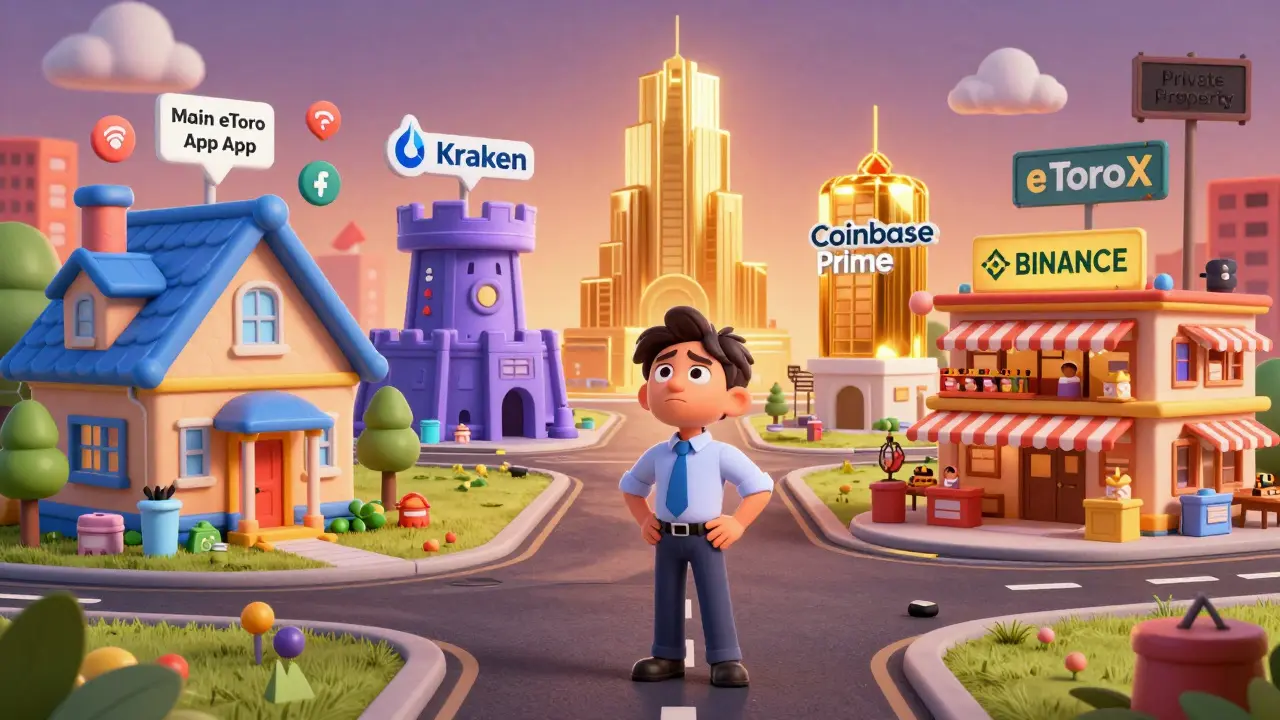
Since eToroX is off-limits, where do you go? The choice depends on what you liked about eToroX in the first place. If you valued the connection to the eToro brand, stick with the main eToro platform. It offers social trading, copy trading, and a simplified buying experience, though it lacks the deep order book mechanics of eToroX.
If you were seeking professional-grade tools and lower fees, consider these alternatives:
- Kraken: Known for strong security, transparent audits, and a pro interface (Kraken Pro) that rivals eToroX in functionality. It supports a wide range of coins and has deep liquidity.
- Coinbase Prime: The institutional arm of Coinbase, similar in positioning to eToroX. While also focused on institutions, Coinbase’s retail side remains robust and integrated.
- Binance: Offers the deepest liquidity and lowest fees for most traders, though regulatory scrutiny varies by region.
- Gemini: A highly regulated US-based exchange that appeals to those prioritizing compliance and security, much like the GFSC-regulated eToroX.
Each of these platforms caters to different needs. Kraken and Gemini align closely with eToroX’s emphasis on regulation and security. Binance aligns with the desire for low costs and high volume. The main eToro app aligns with the desire for ease of use and social features.
Conclusion: The End of an Era for Retail Users
eToroX’s transition to an institutional-only platform reflects a broader trend in the crypto industry: consolidation. The era of dozens of competing retail exchanges is fading, replaced by a few dominant players and specialized B2B infrastructure. For the average investor, this simplifies choices but removes niche options. eToroX remains a vital piece of technology for the financial sector, powering the backend of eToro’s global operations. But for you, the individual trader, it is a closed door. Focus your energy on platforms that welcome retail participation, ensuring you have access to liquidity, support, and tools that match your trading style.
Can I still open a retail account on eToroX in 2026?
No. As of 2026, eToroX is exclusively available to institutional investors, professional traders, and corporate entities. Retail investors cannot open new accounts or trade on the platform.
Where did my eToroX funds go after the transition?
Existing retail users were migrated to the main eToro platform or provided with withdrawal options. The assets remain safe within the eToro Group ecosystem, but the trading environment has shifted to the standard retail interface.
Is eToroX safer than other exchanges?
eToroX is highly regulated by the Gibraltar Financial Services Commission (GFSC), which imposes strict security and compliance standards. This makes it very secure for institutional clients. However, since retail users cannot access it, comparisons are limited to professional platforms like Kraken or Coinbase Prime.
What are the best alternatives to eToroX for professional traders?
For professional traders seeking similar regulatory rigor and toolsets, Kraken Pro, Coinbase Prime, and Gemini are strong alternatives. They offer deep liquidity, advanced charting, and institutional-grade security.
Does eToroX still support Bitcoin and Ethereum?
Yes, eToroX continues to support major cryptocurrencies like Bitcoin (BTC) and Ethereum (ETH), along with over 70 other digital assets. However, these are only accessible to eligible institutional and professional accounts.
