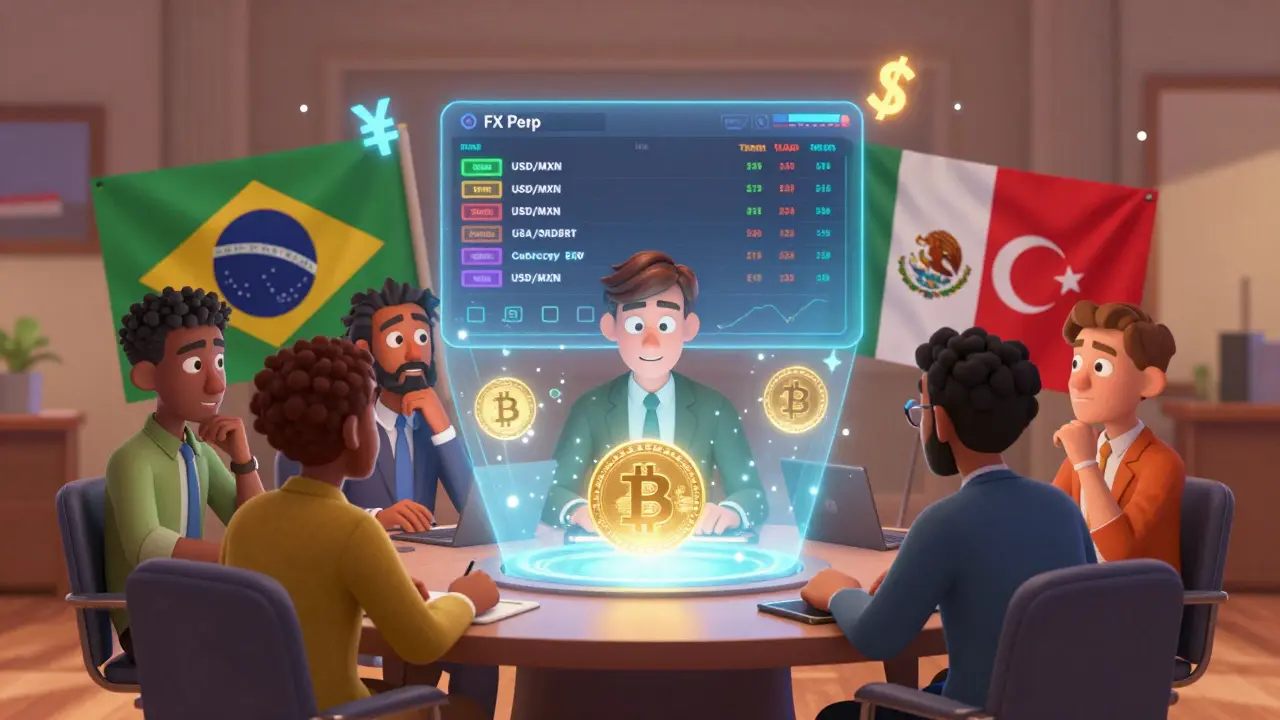
Most crypto traders think of Bitcoin, Ethereum, or Solana when they trade derivatives. But there’s a niche product quietly changing how some traders access global currency moves - without ever touching fiat. It’s called FX Swap crypto, and right now, only one exchange offers it: BitMEX.
Let’s cut through the noise. This isn’t another altcoin futures contract. It’s not a stablecoin pair. It’s something weirder - a way to bet on USD/TRY, EUR/USD, or USD/MXN using Bitcoin or USDT as your only collateral. No bank account. No wire transfer. Just crypto in, crypto out. And if you’re from Brazil, Mexico, or Turkey, this could be the only way you can hedge your local currency risk without jumping through regulatory hoops.
How FX Swap Crypto Actually Works
BitMEX launched these products on November 27, 2023, calling them "FX Perps" - short for Foreign Exchange Perpetual Swaps. The idea is simple: instead of trading BTC/USD, you trade USD/JPY. But instead of settling in dollars, you settle in Bitcoin or USDT. That’s it.
Here’s how it plays out in real life. Let’s say you believe the Mexican peso will crash against the dollar. You open a long position on the USD/MXN Perp using 0.5 BTC as margin. If USD/MXN rises 5%, your position gains 5% - but your profit is paid out in Bitcoin, not pesos. No conversion. No withdrawal delay. No KYC on a bank account.
The mechanics are built on a Central Limit Order Book (a traditional order-matching system, not an automated market maker). That means spreads are tight when liquidity is high - but during news events, slippage can spike. Unlike Uniswap or PancakeSwap, where you’re stuck with 5-10% slippage on illiquid pairs, FX Perps use real market makers. But there’s a catch: liquidity is thin. The EUR/USD Perp averages $8.7 million in daily volume. Bitcoin Perps? Over $1.2 billion.
What Pairs Are Available
BitMEX offers exactly ten currency pairs. Not 160 like traditional forex brokers. Not even 30. Just these:
- EURUSD
- USDCHF
- USDTRY
- USDINR
- USDZAR
- USDBRL
- USDMXN
- USDSEK
- NZDUSD
- USDCNH
Notice a pattern? Most of these are emerging market currencies. That’s not an accident. These are the pairs where local traders need exposure but can’t access traditional forex platforms. A trader in South Africa might use USDZAR to hedge against rand volatility. A Mexican business owner might use USDMXN to lock in rates before a payment deadline. This isn’t for Wall Street. It’s for people in places where banks won’t let them trade forex freely.
Leverage, Funding, and Settlement
You can go up to 50x leverage on EURUSD and USDCHF. But for riskier pairs like USDTRY or USDZAR, leverage drops to 20x. That’s not a bug - it’s a safety feature. In April 2023, the Turkish lira dropped 12% in four hours. Traders who went 50x long on USDTRY got liquidated hard. BitMEX responded by lowering leverage on volatile pairs.
Funding happens every 8 hours - at 4:00 UTC, 12:00 UTC, and 20:00 UTC. If the funding rate is positive, longs pay shorts. If it’s negative, shorts pay longs. The rate is calculated based on the difference between the perpetual contract price and the real-time spot FX index. It’s not random. It’s designed to keep the contract price pinned to reality.
Settlement? Always in Bitcoin (XBT) or USDT (ERC-20). No fiat. No bank. No intermediary. You open a position in crypto. You close it in crypto. Your profit or loss? Expressed in crypto. That’s the whole point.

Why This Is Different From Other Crypto Swaps
Most people think "crypto swap" means exchanging BTC for ETH on a DEX. That’s not this. FX Perps aren’t about swapping one crypto for another. They’re about trading fiat currency pairs - using crypto as collateral.
Compare it to:
- Traditional Forex (Requires bank account, fiat deposits, regulated brokers, and often limits on leverage): You need to deposit USD, EUR, or JPY. You can’t trade without it.
- Standard Crypto Perps (Like BTC/USD or ETH/USD on Binance or Bybit): You’re betting on crypto price swings, not forex.
- AMM-Based Swaps (Like Uniswap or SushiSwap): You swap tokens. Slippage is high. Liquidity is unpredictable.
FX Perps sit in the middle. You’re not trading crypto. You’re trading the dollar’s value against the rand, the peso, or the rupee. But you’re doing it in a crypto-native environment. That’s unique.
The Hidden Risks
There’s a reason this product hasn’t gone mainstream.
First, dual volatility. You’re exposed to two markets: the forex pair and Bitcoin or USDT. If the dollar strengthens against the peso, but Bitcoin crashes 15% at the same time, your profit gets eaten by your collateral’s drop. You didn’t just lose on forex - you lost on crypto too.
Second, liquidity risk. A $8.7 million daily volume on EUR/USD sounds okay - until you compare it to $1.2 billion on BTC/USD. During a Fed announcement, your 100 BTC order might get filled at 0.3% slippage. That’s $300,000 in slippage. That’s not a trade. That’s a mistake.
Third, leverage traps. One Reddit user said they lost 45% of their margin on a USDTRY trade because the pair moved 12% in four hours. They thought 50x leverage meant they could hold through volatility. It didn’t. It meant they got liquidated faster than a meme coin pump-and-dump.
And then there’s the education gap. Most crypto traders know how to read candlesticks. Few know how central bank policy affects USDINR. BitMEX has two YouTube tutorials. That’s it. No blog posts. No webinars. No community guides. You’re expected to learn forex on your own.

Who Is This For?
This isn’t for everyone. But it’s perfect for three types of traders:
- Emerging market traders who need to hedge local currency exposure but can’t use traditional forex brokers due to capital controls or lack of access.
- Algorithmic traders who spot arbitrage between crypto FX Perps and traditional FX markets. A 0.2% price difference between BitMEX’s USDZAR and a South African broker could mean a risk-free profit - if you can execute fast enough.
- Crypto-native hedgers - like a Bitcoin mining company in Brazil that gets paid in USD but has operational costs in BRL. They can use USDBRL Perps to lock in rates without ever converting to fiat.
If you’re a U.S. trader just looking to speculate on EUR/USD, this isn’t for you. Use a regulated broker. It’s cheaper, safer, and more liquid.
The Future of FX Swap Crypto
As of March 2024, no other major exchange has copied this. Binance? Focused on expanding BTC and ETH perpetuals. Coinbase? Working on regulated spot FX trading. Kraken? Still avoiding derivatives.
BitMEX hasn’t added a single new pair since January 2024. No UI upgrades. No mobile app improvements. Just the same 10 pairs, same funding schedule, same minimal documentation.
Industry analysts think this will stay niche. Kaiko’s February 2024 report showed FX Perps made up just 3.2% of total crypto derivatives volume. GSR Markets’ Maria Gomez said it’ll need a 10x liquidity boost to matter. That means either institutions start using it - or retail adoption explodes.
Right now, neither is happening. But if a major emerging market country introduces crypto-friendly forex rules - or if a stablecoin like USDT becomes widely accepted as a currency reserve - this could suddenly become critical infrastructure.
Final Verdict
FX Swap crypto isn’t a revolution. It’s a workaround. A clever hack that lets crypto users bypass traditional finance when they can’t access it. It’s risky. It’s illiquid. It’s hard to learn. But for the right person - someone in a country with capital controls, or a business that needs to hedge currency risk without touching banks - it’s one of the few tools that actually works.
If you’re curious, start small. Trade 0.01 BTC on USD/MXN. Watch the funding rate. Learn how the pair moves during local news events. Don’t go 50x. Don’t assume it’s like trading BTC. This isn’t DeFi. This is crypto-native forex. And it’s still in its infancy.
What is an FX Swap in crypto?
An FX Swap in crypto - specifically, a perpetual foreign exchange swap - is a derivative product that lets traders speculate on traditional currency pairs (like EUR/USD or USD/MXN) using Bitcoin or USDT as collateral. Unlike regular crypto swaps, it doesn’t involve exchanging one cryptocurrency for another. Instead, it tracks fiat currency movements and settles profits or losses in crypto, eliminating the need for fiat bank accounts.
Which exchange offers FX Swap crypto trading?
As of March 2024, BitMEX is the only major cryptocurrency exchange offering FX Swap products. These are called "FX Perps" and include 10 currency pairs, all settled in Bitcoin (XBT) or USDT (ERC-20). No other top-20 exchange has launched a similar product yet.
Can I trade FX Perps with fiat money?
No. FX Perps are designed to operate entirely within the crypto ecosystem. You must post margin using Bitcoin or USDT. All profits and losses are settled in crypto. There is no option to deposit or withdraw fiat currency. This is intentional - it avoids regulatory classification as traditional forex trading.
How often do funding rates change for FX Perps?
Funding rates for FX Perps occur every 8 hours at precisely 4:00 UTC, 12:00 UTC, and 20:00 UTC. The rate is calculated based on the difference between the perpetual contract price and the composite spot FX index. Traders either pay or receive funding depending on whether they’re long or short and whether the rate is positive or negative.
Is FX Swap crypto safe to use?
It’s high-risk. FX Perps combine the volatility of forex markets with the price swings of Bitcoin or USDT. High leverage (up to 50x) can lead to rapid liquidations during sudden currency moves - like Turkey’s lira crash in 2023. Liquidity is thin, spreads widen during news events, and educational resources are minimal. Only experienced traders who understand both crypto and forex should consider using it.
Why are most FX Perp pairs emerging market currencies?
These pairs - like USDZAR, USDBRL, and USDMXN - serve traders in countries with strict capital controls, unstable local banking systems, or limited access to traditional forex markets. For example, a Mexican business owner might use USDMXN to hedge against peso depreciation without needing a U.S. bank account. This makes FX Perps a practical tool for crypto-native users in emerging economies.

Gaurav Mathur
February 15, 2026 AT 06:57Beth Trittschuh
February 17, 2026 AT 02:03Benjamin Andrew
February 17, 2026 AT 16:05Holly Perkins
February 18, 2026 AT 09:33Ben Pintilie
February 18, 2026 AT 23:39Sakshi Arora
February 20, 2026 AT 08:56Ekaterina Sergeevna
February 22, 2026 AT 05:40Keturah Hudson
February 23, 2026 AT 15:24Brittany Meadows
February 23, 2026 AT 18:09Andrea Atzori
February 25, 2026 AT 07:11Joe Osowski
February 26, 2026 AT 04:40John Doyle
February 27, 2026 AT 04:10Elizabeth Choe
February 28, 2026 AT 06:48Grace Mugambi
February 28, 2026 AT 09:59Crystal McCoun
March 1, 2026 AT 09:01Donna Patters
March 1, 2026 AT 13:50Will Lum
March 3, 2026 AT 07:46Sanchita Nahar
March 4, 2026 AT 03:21bala murali
March 5, 2026 AT 12:56Desiree Foo
March 5, 2026 AT 19:58