
Smart Contract Vulnerability Impact Calculator
Estimate potential financial loss from security vulnerabilities versus audit costs. Based on 2024 data: over $2.2B stolen from un-audited contracts. Enter your contract details to see realistic risk scenarios.
Every year, billions of dollars vanish from blockchain protocols-not because of hacks on the network itself, but because of flaws in the code that runs on top of it. Smart contracts are supposed to be trustless, immutable, and secure. But if they’re poorly written, they become open doors for attackers. In 2024 alone, over $2.2 billion was stolen from smart contracts. That’s not a glitch. That’s a systemic failure in how we build and check these systems. If you’re deploying a smart contract, whether it’s for DeFi, NFTs, or a token sale, skipping an audit isn’t risky-it’s reckless.
Why Smart Contract Audits Are Non-Negotiable
Smart contracts aren’t like regular software. Once deployed, you can’t just push a patch. If there’s a bug, it’s permanent. Attackers don’t need to break into a server-they just need to find one line of flawed logic. A simple overflow in a balance check, an unchecked external call, or an unguarded function can drain millions. And these aren’t theoretical risks. In 2023, over $1.2 billion in potential losses were uncovered through penetration tests alone. The truth? Most breaches happen in contracts that were already audited. That’s not because audits don’t work. It’s because most audits aren’t deep enough.The Five-Step Audit Process
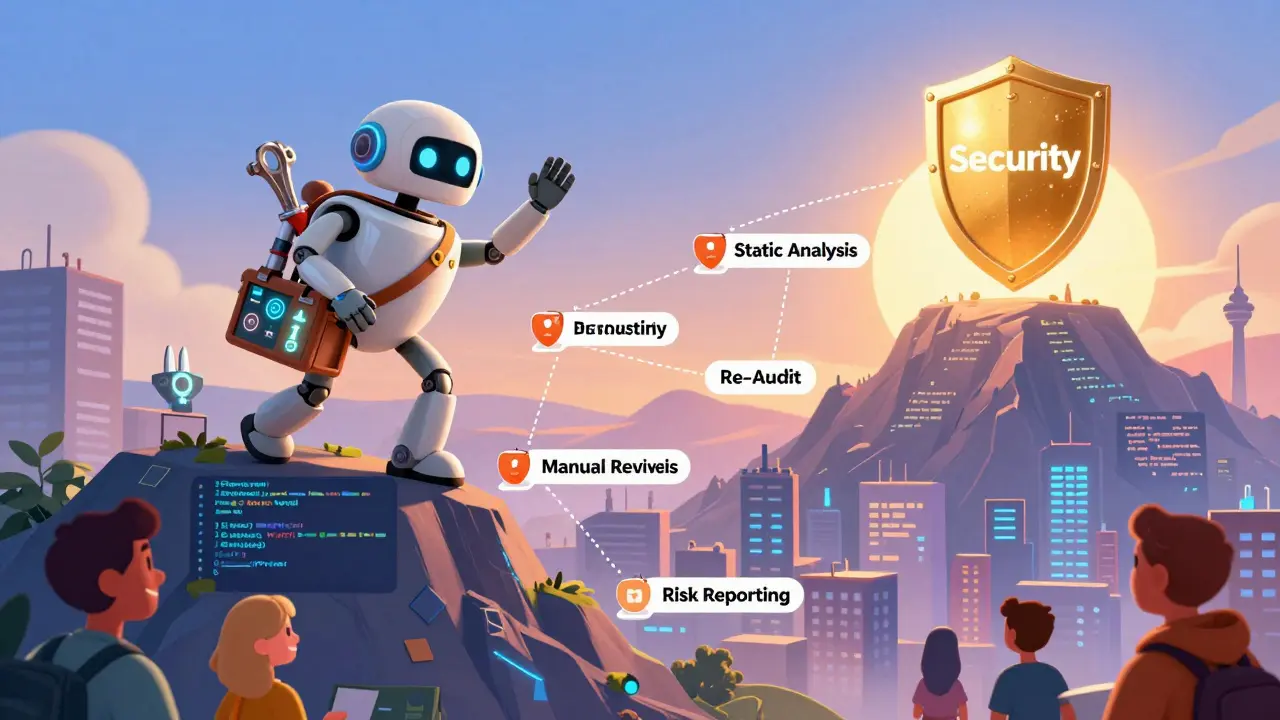
A real audit isn’t a checkbox. It’s a process. Here’s how it works in 2025:- Discovery and Scope Definition - Before any code is touched, auditors need to understand what the contract is supposed to do. This means reviewing the whitepaper, architecture diagrams, and business logic. Is this a lending protocol? A staking pool? A multi-sig wallet? Each has different risk profiles. The scope defines what’s in and what’s out-like whether third-party libraries are included or if cross-chain interactions are in scope.
- Static and Formal Analysis - Tools like Slither and MythX scan the code for known patterns: reentrancy, timestamp dependence, unchecked external calls. These tools catch about 92% of common vulnerabilities. But they miss the subtle stuff. That’s where formal verification comes in. Tools like Move Prover use mathematical proofs to show that the code behaves exactly as intended under all possible conditions. This isn’t optional for high-value contracts like Ethereum’s deposit system.
- Manual Code Review - This is where human expertise matters most. Automated tools can’t understand intent. A human auditor looks at how assets flow through the contract. Who can call what function? Can a user manipulate the price oracle? Is there a way to lock up funds indefinitely? This stage involves line-by-line review, mapping out state changes, and simulating edge cases that no test suite covers.
- Risk Reporting - A good audit doesn’t just say “there’s a bug.” It ranks issues by severity: Critical, High, Medium, Low. A critical issue means funds can be stolen right now. A high issue might let someone freeze assets. The report includes exact lines of code, how to exploit it, and how to fix it-not just “fix the code,” but “replace this function with this pattern.”
- Remediation and Re-audit - Fixing the code is only half the battle. You need to verify the fix didn’t break something else. A re-audit ensures no new vulnerabilities were introduced. Many teams skip this step, thinking they’ve fixed it. That’s how regressions happen.
Tools of the Trade
There are dozens of tools out there. Not all are created equal. Here’s what the top teams use in 2025:- Slither - Open-source static analyzer for Solidity. Fast, reliable, and free. It’s the first tool every team runs.
- MythX - A cloud-based platform combining static and dynamic analysis. Great for teams without in-house security experts.
- Move Prover - Used for Aptos and Sui contracts. It’s the only tool that can mathematically prove correctness in the Move language.
- Diligence Fuzzing - Generates random inputs to find crashes and unexpected behaviors. Finds bugs that unit tests miss.
- Hardhat and Truffle - Not auditors themselves, but essential for testing. A contract that doesn’t pass a full test suite shouldn’t even be sent for audit.
Choosing the right tool isn’t about which one has the fanciest UI. It’s about matching the tool to the language and risk level. If you’re building on Sui, Move Prover isn’t optional-it’s mandatory. If you’re on Ethereum, Slither and MythX are your baseline.
Who Should You Hire?
Not all audit firms are the same. Here’s who leads the field in 2025:- OpenZeppelin - The gold standard for Ethereum-based projects. They wrote most of the ERC standards. If you’re building an ERC-20 or ERC-721 contract, they’re your safest bet.
- Trail of Bits - For complex, high-risk systems. They’ve audited the most critical DeFi protocols and use formal methods to prove security. Their audits are expensive but worth it if you’re handling over $100 million in TVL.
- Sigma Prime - Specializes in consensus layer security. If your project interacts with Ethereum’s staking system or validator infrastructure, they’re the only ones with the right expertise.
Don’t hire someone who’s never audited your chain. Move-based chains (Aptos, Sui) require different tools and knowledge than Ethereum. A firm that’s great at Solidity might not even know how to run MoveFuzz. Ask for case studies. Look at their GitHub. Did they publish their audit reports? If not, walk away.
The Hidden Problem: Audits That Don’t Prevent Hacks
Here’s the uncomfortable truth: many hacks happen in contracts that were audited. Why? Because audits are snapshots. They happen once, before launch. But blockchain evolves. New attack patterns emerge. A contract that was secure in January might be vulnerable by March after a new DeFi protocol integrates with it. That’s why real-time monitoring is no longer optional. Platforms like CertiK and PeckShield now offer 24/7 monitoring that watches for unusual transactions, sudden fund movements, or oracle manipulation. Some even auto-freeze contracts when an attack pattern is detected.And then there’s bug bounties. Immunefi paid out $65 million in rewards in 2023 to ethical hackers. That’s not charity-it’s insurance. A well-structured bounty program catches what even the best auditors miss. It turns the community into your security team.
Costs and Timeframes
A basic audit for a simple token contract might cost $10,000 and take two weeks. A full audit for a DeFi protocol with multiple modules, oracles, and cross-chain bridges? That’s $50,000 to $200,000 and 6-10 weeks. It’s expensive. But compare that to losing $20 million because you skipped it. The cost of an audit is a fraction of the cost of a breach. And it’s not just money-it’s reputation. Users won’t trust a project that’s been hacked twice.
What You Need Before You Start
You can’t audit code you haven’t written. But you also can’t audit code that’s still changing. Before you hire an auditor:- Freeze your code. No more commits until the audit is done.
- Document everything. Whitepaper, architecture diagrams, function descriptions, expected behavior.
- Provide access to testnets and deployment scripts.
- Have your test suite running at 90%+ coverage.
If you’re missing any of this, the audit will be incomplete. And incomplete audits are worse than no audits-they give you a false sense of security.
The Future: AI, ZK, and Continuous Security
The next wave of smart contract security isn’t just better tools-it’s smarter ones. AI is now being used to understand developer intent. Instead of just matching patterns, tools can infer what a function is supposed to do and flag when it doesn’t match. Formal verification is expanding into economic modeling-checking if incentive structures encourage malicious behavior. And zero-knowledge proofs are being used to audit contracts without exposing sensitive logic.The future isn’t about one big audit. It’s about layers: automated scanning, manual review, real-time monitoring, and community bug bounties. Projects that combine all four will be the only ones that survive in 2026 and beyond.
Final Rule: Never Trust, Always Verify
Blockchain is built on trustlessness. But your code? That needs trust. And the only way to earn that trust is through rigorous, repeated, and transparent security checks. Auditing smart contracts isn’t a one-time cost. It’s an ongoing discipline. Treat it like insurance. You hope you never need it. But you’ll never sleep well without it.What happens if I skip a smart contract audit?
If you skip an audit, you’re gambling with user funds. In 2024, over $2.2 billion was stolen from un-audited or poorly audited contracts. Even small bugs-like an unchecked function call or a missing access control-can lead to total loss of funds. Once deployed, you can’t fix it. The damage is permanent, and your reputation is destroyed.
Can automated tools fully audit a smart contract?
No. Tools like Slither and MythX catch about 90% of common vulnerabilities, but they miss logic flaws, economic exploits, and complex interactions between contracts. A manual review by an expert is required to find those. Automated tools are a starting point, not the finish line.
How long does a smart contract audit take?
It depends on complexity. A simple ERC-20 token audit takes 1-2 weeks. A full DeFi protocol with lending, staking, and oracles can take 6-10 weeks. The timeline includes code freeze, analysis, reporting, and re-audit. Rushing it increases risk.
What’s the difference between an audit and a code review?
A code review is usually done internally by developers and focuses on readability and basic errors. An audit is a formal, third-party security assessment that includes automated scanning, manual analysis, formal verification, and risk reporting. Audits are designed to find exploitable vulnerabilities, not just bad code.
Are audits worth the cost?
Absolutely. A comprehensive audit costs between $50,000 and $200,000. A single exploit can cost millions-or tens of millions. Beyond money, audits build user trust. Projects with public audit reports get more liquidity, higher TVL, and better partnerships. The ROI isn’t just financial-it’s existential.
Do I need a different auditor for Sui or Aptos contracts?
Yes. Sui and Aptos use the Move programming language, which is fundamentally different from Solidity. Auditors who only know Ethereum tools won’t be able to use Move Prover or MoveFuzz effectively. Always verify the firm has audited Move-based projects before and can demonstrate that experience.
What’s the role of bug bounties in smart contract security?
Bug bounties turn the community into your security force. Platforms like Immunefi offer rewards for finding critical vulnerabilities. In 2023, over $65 million was paid out. Even the best audits miss edge cases. A bounty program catches those, especially after launch. It’s a safety net that complements formal audits.
Can a smart contract be too complex to audit?
No contract is too complex to audit-but complexity increases risk and cost. If your contract has 10+ interacting modules, cross-chain bridges, or custom oracles, you need a top-tier firm with formal verification experience. Simpler designs are easier to secure. Sometimes, breaking a complex system into smaller, auditable parts is the smartest move.

Sue Gallaher
December 10, 2025 AT 12:24People still think audits are magic bullets? Lol. I've seen contracts audited by OpenZeppelin get wiped because someone forgot to check a cross-chain oracle feed. The whole industry is built on hype and half-baked confidence.
Stop treating audits like a stamp of approval. They're a snapshot. Not a guarantee. And if you're not monitoring after deployment, you're just begging to get robbed.
Jeremy Eugene
December 11, 2025 AT 01:00While I appreciate the thorough breakdown of the audit process, I would caution against over-reliance on any single tool or firm. The security landscape evolves faster than documentation can be updated. Continuous vigilance, not just pre-launch checks, is the only sustainable approach.
Nicholas Ethan
December 12, 2025 AT 01:17Slither catches 92% of vulns? That’s statistically meaningless when the remaining 8% are the ones that drain $2B. You’re not auditing-you’re performing a compliance theater. Formal verification isn’t optional-it’s the baseline. If you’re not proving correctness mathematically, you’re not serious. And if your audit report doesn’t include state transition diagrams, it’s worthless.
Rakesh Bhamu
December 13, 2025 AT 00:45Really glad someone laid this out clearly. I’ve worked with teams that skipped audits because they were ‘moving fast.’ Then they lost everything.
What helped me was starting small-audit one core function first, get feedback, then expand. Also, always pair audits with bug bounties. The community finds things no auditor has time for.
And yes, Move needs Move experts. Don’t hire a Solidity firm for Sui. It’s like hiring a mechanic who only fixes cars to repair a jet engine.
Hari Sarasan
December 15, 2025 AT 00:27THEY’RE ALL LYING TO YOU. OpenZeppelin? They’re just a brand. Trail of Bits? They charge $200K and still miss economic exploits. The truth? No one can audit a contract that interacts with a dynamic oracle or a volatile liquidity pool. It’s impossible. You’re not securing code-you’re gambling with math. And the ‘re-audit’? A joke. The moment you deploy, the attack surface explodes. The whole system is a house of cards built on false confidence.
Stop pretending this is engineering. It’s casino capitalism with a whitepaper.
Candace Murangi
December 16, 2025 AT 00:33Been in this space since 2021. Saw the same mistakes over and over. The real issue isn’t the code-it’s the pressure to launch before it’s ready.
Teams skip audits because VCs are breathing down their necks. And then the whole thing goes up in flames. I wish more people talked about the culture problem, not just the tooling.
Also, emoji for Move Prover 🚀
Albert Chau
December 17, 2025 AT 15:44You say audits are non-negotiable? Then why are 80% of the projects on Arbitrum still deploying without one? You’re preaching to the choir. The real problem is the people who don’t care. They don’t want security-they want hype. And they’ll keep burning money until the market collapses.
Just sayin’.
Bridget Suhr
December 19, 2025 AT 04:21so like… if you’re on sui, you need move prover. got it. but what if you’re a solo dev with $500 to spend? do you just not deploy? or is there a middle ground? i’ve seen some open source move analyzers on github that seem decent. maybe start there?
Patricia Whitaker
December 20, 2025 AT 21:34Ohhh so now we need AI to understand developer intent? Like, what, your code is too dumb to speak for itself? And formal verification for incentive structures? That’s not security, that’s philosophy with a debugger.
Meanwhile, real devs are just trying to ship. This whole ‘audit industrial complex’ is just a money funnel for consultants who’ve never written a line of Solidity.
Also, I’ve never seen a re-audit actually catch anything. It’s just a line item on the invoice.
Ian Norton
December 20, 2025 AT 21:59Let’s be real. Most audits are performed by junior analysts using templated checklists. The senior folks are billing clients for ‘strategy sessions’ while the interns run Slither and call it a day. The reports are filled with boilerplate language. Critical issues are buried in appendix C. No one reads them. The client just prints the PDF and posts it on Twitter.
It’s a performance. Not a security practice.
Kathy Wood
December 22, 2025 AT 09:56YOU’RE ALL MISSING THE POINT. AUDITS DON’T SAVE YOU. BUG BOUNTIES DON’T SAVE YOU. MONITORING DON’T SAVE YOU. THE ONLY THING THAT SAVES YOU IS NOT BUILDING A CONTRACT THAT CAN BE EXPLOITED IN THE FIRST PLACE.
STOP TRYING TO FIX BAD CODE. START WRITING GOOD CODE.
IF YOU NEED AN AUDIT TO MAKE YOUR CONTRACT SAFE, YOU SHOULD’VE NEVER LAUNCHED IT.
AND YES, I’M TALKING TO YOU, DEFI STARTUP WITH 3 ENGINEERS AND A CANVAS BOARD.
Stanley Machuki
December 23, 2025 AT 16:01Big picture: audits are insurance. You don’t hope you never need it-you just know you’ll regret not having it.
My buddy’s team skipped it on a $2M token. Got hacked. Lost everything. Took them 18 months to rebuild trust.
Don’t be that guy. Spend the money. Freeze the code. Get it right.
And yes, use a bounty. It’s the best ROI you’ll ever get.
Lynne Kuper
December 25, 2025 AT 04:36Wait-so you’re telling me that if I’m building on Sui, I can’t just copy-paste a Solidity audit template and call it a day?
Wow. Mind blown. 🤯
Also, who’s the genius who thought ‘formal verification’ was a good name for something that sounds like a math PhD’s nightmare?
But seriously-this is gold. Print this. Frame it. Put it on your dev’s desk. And then go drink coffee while your test suite runs.
Kelly Burn
December 26, 2025 AT 16:36AI understanding intent? ZK audits? 🤖🧠
Feels like we’re building the Matrix version of security now. But hey-if my contract can prove it’s safe without revealing how it works? That’s next-level.
Also, I just used Move Prover for the first time. It yelled at me in 17 different ways. Felt like my code was being judged by a very stern librarian.
Still, worth it. 💪
Also, if you’re not using bug bounties, you’re leaving your wallet on a park bench. Just saying.