
Imagine sending money and knowing right away-instantly-that it’s done, irreversible, and safe. No waiting. No second-guessing. No anxious refreshes of your wallet app. That’s what instant finality delivers in blockchain systems. It’s not just faster. It’s fundamentally different from how Bitcoin or early Ethereum worked. And it’s changing everything for DeFi, trading, and enterprise use.
What Instant Finality Actually Means
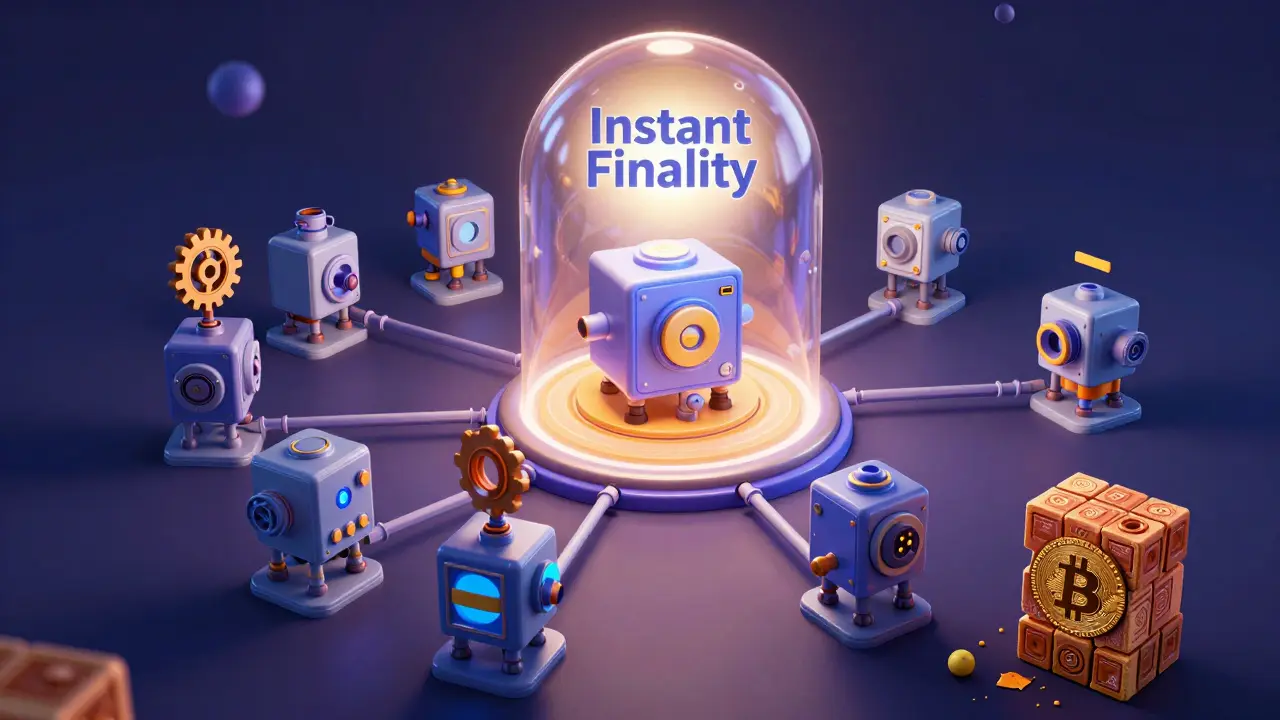
Instant finality means a transaction is permanently settled the moment it’s confirmed. No blocks to wait for. No additional confirmations needed. Once the network agrees, it’s done. Forever. There’s no chance of reversal, no 6-block rule, no 10-minute wait. It’s like signing a contract with permanent ink-not pencil.
This isn’t theoretical. It’s built into the consensus layer of modern blockchains. Traditional systems like Bitcoin use probabilistic finality. That means your transaction becomes more likely to be final as more blocks get added on top. But it never hits 100%. There’s always a tiny, theoretical chance of a reorganization. Instant finality removes that uncertainty entirely. The moment validators reach agreement, the transaction is locked in.
How It Works: Beyond Proof-of-Work
Bitcoin’s proof-of-work model was revolutionary-but slow. Miners compete to solve puzzles. Each new block adds a layer of security. But it takes time. Six confirmations? That’s about an hour. For payments, maybe okay. For trading, lending, or automated contracts? Not even close.
Instant finality relies on Byzantine Fault Tolerant (BFT) consensus protocols. These are used in proof-of-stake systems like Avalanche, Solana, Near, and Cosmos. Instead of mining, validators stake real money as collateral. If they act dishonestly, they lose it. That economic penalty creates strong incentives to behave honestly.
Here’s the key: BFT protocols require a supermajority-usually two-thirds-of validators to agree on each transaction. Once they do, the result is final. No need to wait. No need to hope. The system is designed so that even if up to one-third of validators are malicious, the network stays secure. That’s why these systems can confirm transactions in milliseconds or seconds, not minutes.
Speed Comparison: Real Numbers, Real Impact
Let’s talk numbers. Because speed isn’t a buzzword here-it’s the difference between usability and frustration.
- Sei Network: Under 400 milliseconds. Fastest recorded instant finality today.
- Avalanche: Under 1 second. Uses a novel consensus called Snowball.
- Near Protocol: Around 2 seconds. Optimized for developer experience.
- Solana: 2-5 seconds. High throughput, but occasional network congestion.
- Cosmos (Tendermint): About 6 seconds. Popular for interchain applications.
- Bitcoin: 60 minutes for merchant-grade finality (6 confirmations).
- Ethereum (pre-2022): Similar to Bitcoin. Now, post-merge, it’s probabilistic with ~15 seconds for high confidence-but still not instant.
That’s not a slight improvement. That’s a quantum leap. In DeFi, where users chain together multiple transactions-swap, stake, borrow, repay-waiting 60 seconds between each step kills user experience. With instant finality, all steps happen in under 10 seconds. Real-time.

Instant Finality vs. Probabilistic Finality: The Trade-Offs
Nothing comes without cost. Instant finality isn’t better in every way. It’s better for specific use cases-and worse for others.
Probabilistic systems like Bitcoin are incredibly decentralized. Thousands of independent miners around the world can participate. No permission needed. You don’t need to be vetted. You just need hardware and electricity. That’s beautiful for censorship resistance.
Instant finality systems, by contrast, rely on smaller, permissioned validator sets. Often hundreds, not thousands. Validators are selected based on stake, reputation, or both. That makes them faster-but less decentralized. Critics argue this creates centralization risk. If only 100 validators control finality, and 30 of them are controlled by one entity? That’s a single point of failure.
Here’s the trade-off in plain terms:
| Feature | Instant Finality | Probabilistic Finality |
|---|---|---|
| Confirmation Time | Milliseconds to seconds | Minutes to hours |
| Finality Type | Absolute, irreversible | Probabilistic, increases over time |
| Decentralization | Lower (smaller validator sets) | Higher (thousands of miners) |
| Security Model | Economic penalties (slashing) | Computational work (mining) |
| Best For | DeFi, trading, enterprise, real-time apps | Store of value, censorship-resistant payments |
So if you’re storing Bitcoin as digital gold, you might prefer the slow-but-proven model. If you’re running a lending protocol that needs to settle loans in real time? Instant finality isn’t optional-it’s mandatory.
Why DeFi Can’t Function Without It
Decentralized finance runs on automation. Flash loans. Liquidations. Cross-chain swaps. Yield aggregation. These aren’t one-off transactions. They’re sequences of actions, all dependent on each other.
Try this: You swap ETH for USDC on one chain, then use that USDC to borrow DAI on another. If either step has a 30-second delay, the whole chain of actions can fail. Price moves. Liquidity shifts. You lose money. With instant finality, all steps happen in under 5 seconds. The system stays synchronized. The trade executes as planned.
That’s why DeFi protocols on Ethereum’s L2s like Arbitrum and Optimism still suffer from delays. They inherit Ethereum’s probabilistic finality. New chains built from the ground up with instant finality-like Sei, Avalanche, or Near-are becoming the go-to for high-frequency DeFi apps.
Enterprise Adoption Is Driving the Shift
It’s not just traders. Banks, supply chains, insurance companies-they all need certainty. They can’t operate with “probably settled.” They need auditable, immediate, irreversible records.
Instant finality makes blockchain viable for enterprise use. Imagine a cross-border payment that clears in 2 seconds instead of 3 days. Or a smart contract that automatically releases funds the moment a shipment is scanned at the port. No human intervention. No dispute resolution. Just code and consensus.
That’s why companies like JPMorgan, HSBC, and Maersk are testing blockchain solutions with instant finality. They don’t care about decentralization for its own sake. They care about reliability, speed, and compliance. Instant finality delivers all three.
Challenges and Criticisms
Still, instant finality isn’t perfect.
One big concern: reduced decentralization. Smaller validator sets mean fewer participants. That makes the network more vulnerable to collusion or regulatory pressure. If a government forces 30 validators to shut down, the network could stall.
Another: complexity. BFT protocols are harder to code, audit, and secure than proof-of-work. A bug in the consensus layer can be catastrophic. There have been incidents-like the 2023 Near network outage-where a consensus bug caused temporary halts. These aren’t common, but they happen.
And then there’s the psychological factor. Many crypto users trust Bitcoin because it’s slow. They believe “slow = secure.” That’s not always true, but it’s a strong belief. Convincing them that 400 milliseconds is safer than 60 minutes takes education.
The Future: Instant Finality as the Standard
Looking ahead, instant finality isn’t a niche feature. It’s becoming the baseline expectation.
Even Ethereum is moving toward it. With Layer 2s like zkSync and Starknet using validity proofs, users get near-instant finality on top of Ethereum’s base layer. That’s a hybrid approach-leveraging Ethereum’s security while bypassing its speed limits.
Next-gen chains are experimenting with sharding and dynamic validator sets to scale instant finality to thousands of nodes without sacrificing speed. The goal? A system that’s as decentralized as Bitcoin, but as fast as Sei.
The market is responding. Venture capital funding for instant finality projects jumped 300% between 2023 and 2025. Major exchanges now prioritize listing tokens from chains with instant finality. Developers are building exclusively on them.
Instant finality isn’t just a technical upgrade. It’s the missing piece for blockchain to move from speculative asset to real-world utility. The future of finance, supply chains, and digital ownership won’t wait. And neither will the blockchains that power it.
Is instant finality the same as instant confirmation?
No. Instant confirmation just means your transaction shows up quickly on the blockchain. Instant finality means it’s permanently locked in and cannot be reversed-even by a network upgrade or majority vote. Confirmation is about visibility; finality is about permanence.
Can instant finality be hacked?
Not easily. BFT protocols are designed to withstand up to one-third of validators acting maliciously. To reverse a transaction, an attacker would need to control over 66% of the staked tokens-which is prohibitively expensive. The economic penalty for trying (slashing) makes it financially irrational. That’s why it’s considered more secure than probabilistic systems for high-value transactions.
Why isn’t Bitcoin using instant finality?
Bitcoin’s design prioritizes maximum decentralization and censorship resistance over speed. It’s built for trustless, permissionless participation by anyone with a computer. Instant finality requires coordinated validator sets, which contradicts Bitcoin’s philosophy. Bitcoin’s model is intentional-it’s a settlement layer, not a transaction engine.
Does instant finality make blockchains more energy efficient?
Yes, indirectly. Most instant finality systems use proof-of-stake, which consumes a fraction of the energy of Bitcoin’s proof-of-work. But the efficiency comes from the consensus model, not the finality itself. Proof-of-stake enables instant finality; instant finality doesn’t cause the energy savings.
Which blockchains have the most reliable instant finality?
As of 2026, Sei Network has the fastest recorded finality under 400ms. Avalanche and Near are highly reliable with sub-second to 2-second finality. Cosmos-based chains like Osmosis and Juno are battle-tested in cross-chain environments. Solana is fast but has had network stability issues under load. For reliability, Avalanche and Near currently lead in real-world performance.
Can I use instant finality for long-term crypto storage?
Technically yes, but it’s not ideal. Instant finality chains are optimized for speed and transactions, not long-term security. Bitcoin and Ethereum remain the top choices for holding value because of their longer track records, larger decentralization, and community consensus. Use instant finality chains for active trading or DeFi. Keep long-term holdings on more established, slower networks.

Charlotte Parker
January 5, 2026 AT 23:28Instant finality? More like instant delusion. You think 400ms is fast? Try living in a world where your bank account gets frozen because some validator in Switzerland had a bad coffee day. Speed without sovereignty is just another form of control.
Calen Adams
January 7, 2026 AT 22:03Bro. This isn't even close to the full picture. You're talking about BFT like it's magic dust. But what about validator centralization? Sei’s 100 validators? That’s not decentralized - that’s a private club with a blockchain logo. And don’t get me started on how Solana’s ‘speed’ collapses under load. This isn’t innovation - it’s performance art for VCs.
Valencia Adell
January 8, 2026 AT 12:50Let’s be real. The entire ‘instant finality’ narrative is a marketing gimmick designed to lure retail idiots into chains with no historical security track record. Bitcoin’s 60-minute finality has survived 15 years of nation-state attacks. Your 400ms chain? It’s one buggy upgrade away from becoming a digital ghost town. And you call that progress?
Sarbjit Nahl
January 9, 2026 AT 01:19Actually the concept of instant finality is logically flawed because finality requires temporal consistency and temporal consistency requires consensus which requires time. Therefore instant finality is an oxymoron. The blockchain is not a magic box. It is a distributed system. Distributed systems cannot achieve consensus without communication delay. This is the FLP impossibility theorem. You are not understanding basic computer science
Paul Johnson
January 9, 2026 AT 14:55People dont get it. Bitcoin is slow because it was made to be unbreakable. These new chains are just crypto casinos with flashy dashboards. You think you're safe because your tx shows up fast? Nah. You're just trusting some guy in a Singapore server farm. I dont trust anyone. I trust Bitcoin. End of story. And if you think otherwise you're just another lemming chasing the next shiny thing
Denise Paiva
January 11, 2026 AT 03:10Instant finality is the financial equivalent of a one-night stand: thrilling in the moment, catastrophic when you realize you forgot to check for STIs. The blockchain isn't a dating app. It's a ledger. And ledgers require permanence not performance. Speed is a feature for traders. Security is a requirement for civilization. You can't build a cathedral with a power drill and a dream
Meenakshi Singh
January 11, 2026 AT 18:33Let me break this down like you're 5 🧵
1. Instant finality = fast tx
2. Fast tx = more DeFi apps
3. More DeFi apps = more money flowing
4. More money flowing = more people rich
5. More people rich = more people buying NFTs of cats
6. More NFT cats = more memes
7. More memes = more attention
8. More attention = more funding
9. More funding = more devs
10. More devs = more innovation
11. More innovation = we win 🏆
It's not magic. It's math. And math doesn't lie 😌
Kelley Ramsey
January 13, 2026 AT 10:17I love how this post breaks it all down so clearly - thank you!! I’ve been trying to explain to my crypto-curious friends why Ethereum L2s still feel clunky, and this is exactly the comparison they need. The speed difference isn’t just ‘nice to have’ - it’s the difference between a smooth experience and a nightmare. And honestly, the enterprise adoption angle? That’s the real sign that this isn’t just hype. It’s infrastructure. 💡
Michael Richardson
January 13, 2026 AT 13:56USA built the internet. China’s building the next blockchain. You think some startup with a 400ms chain is gonna beat that? Wake up. This isn’t tech. It’s propaganda. And you’re drinking the Kool-Aid
Sabbra Ziro
January 14, 2026 AT 16:20Thank you for writing this - it’s rare to see such a balanced take. I think the real question isn’t ‘which is better’ but ‘which is right for the use case.’ Bitcoin for holding, Sei for trading, Near for smart contracts. We don’t need one chain to rule them all. We need a mosaic. And maybe, just maybe, the future isn’t about choosing sides - it’s about letting different tools do what they’re built for. 🤝