
When you’re trading crypto on a decentralized exchange, every fraction of a percent in fees and slippage matters. If you’ve been looking for a fast, low-cost way to swap tokens without getting stuck on Ethereum’s expensive mainnet, KyberSwap (Scroll) might be the answer you’ve been waiting for. But is it really better than the rest? Let’s cut through the hype and look at what this platform actually does - and who it’s best for.
What Is KyberSwap (Scroll)?
KyberSwap isn’t just another DEX. It’s an aggregator - meaning it doesn’t rely on just one liquidity pool. Instead, it scans dozens of decentralized exchanges at once to find the best possible price for your trade. The Scroll version is built specifically on Scroll, an Ethereum Layer 2 network designed to make transactions cheaper and faster. Unlike the main Ethereum chain, where gas fees can spike to $50 or more during peak times, KyberSwap on Scroll charges 0% maker and taker fees. That’s right - no fees at all for buying or selling tokens.
This isn’t marketing fluff. Data from FxVerify in March 2025 confirms the fee structure is live and working. Users are seeing trades settle in under 5 seconds, with gas costs roughly 90% lower than on Ethereum mainnet. If you’ve ever lost $10 in gas trying to swap a $50 token, this alone makes Scroll worth a look.
How Does It Compare to Other DEX Aggregators?
KyberSwap isn’t alone. 1inch, Matcha, and CowSwap all do similar things. But here’s where KyberSwap stands out:
- Dynamic Trade Routing: KyberSwap doesn’t just pick the cheapest route. It uses a proprietary algorithm that adjusts in real time based on liquidity depth, slippage risk, and market volatility. CoinDesk’s Senior DeFi Analyst Maria Chen found it delivers 12-15% better execution on trades over $50,000 compared to static aggregators.
- Amplified Liquidity Pools: Liquidity providers can deposit smaller amounts of tokens and still get deep liquidity. This reduces slippage by up to 70% compared to standard AMMs like Uniswap v3. That’s huge for large traders.
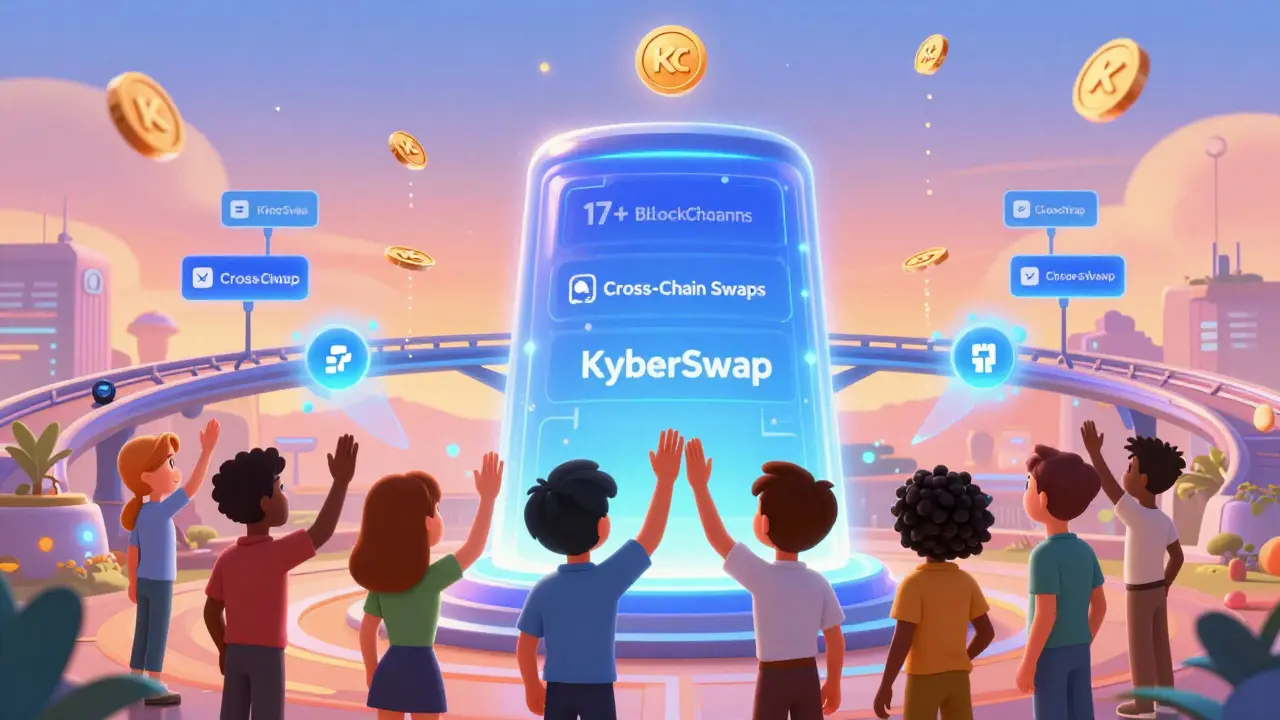
- Multi-Chain Support: KyberSwap works across 17+ blockchains, including Ethereum, Ronin, and Unichain. But Scroll is where the real savings kick in.
But it’s not perfect. In April 2025, KyberSwap reported $3.3 billion in monthly trading volume - impressive, but still behind 1inch’s $8.2 billion. And while KyberSwap’s interface is powerful, Reddit users like u/DeFi_Trader89 say it’s overwhelming for beginners. Matcha’s clean layout is easier to navigate if you just want to swap ETH for USDC.
Who Should Use KyberSwap (Scroll)?
This isn’t a platform for casual users. If you’re trading under $500 a week, you might be better off with PancakeSwap or Uniswap. But if you’re doing anything bigger - especially swaps over $1,000 - KyberSwap (Scroll) makes sense.
Here’s who benefits most:
- Active traders: Frequent traders save hundreds in fees over time. One user on Reddit reported saving $187 in gas fees over 3 months just by switching to Scroll.
- Liquidity providers: Those who deposit tokens into KyberSwap’s Amplified Pools are earning 8-9.7% APR on average, compared to 5-6% on Uniswap v3 during the same period.
- Multi-chain users: If you’re swapping between tokens on different chains (like SOL to ETH), KyberSwap’s upcoming Cross-Chain Swaps (coming May 2025) will remove the need for bridges - a major pain point right now.
It’s also a favorite among DeFi protocols. Over 24 projects, including Chainlink and Aave, use KyberSwap’s API to power their token swaps. That’s not something you see every day.

Real User Experience: What People Are Saying
There’s a catch: KyberSwap (Scroll) has zero verified reviews on FxVerify as of April 2025. That’s because it’s still relatively new on this chain. But the broader KyberSwap platform has over 317,000 active users in April 2025 - up 10% from March.
Here’s what users actually report:
- Positive: “My APR on Amplified Pools has been 9.2% for 3 months straight, even during the March dip,” said u/CryptoLiquidityProvider on Reddit.
- Neutral: “It takes 15-20 minutes to get comfortable with the interface if you’re new. But once you do, it’s faster than anything else.” - DeFi Education Project survey, March 2025.
- Negative: “During the April 10 volatility spike, the aggregator picked a bad route and I lost 1.6% more than if I’d done it manually.” - KyberSwap Community Forum, April 12, 2025.
One key tip: Always turn on Suggested Slippage. Launched in March 2025, this feature auto-adjusts your slippage tolerance based on market conditions. Users who use it report 37% fewer failed transactions.
Downsides and Risks
No platform is flawless. Here are the real drawbacks:
- KNC token utility is weak: KyberSwap’s native token, KNC, used to be central to governance and fee discounts. Now, it mostly just gives you a 5-10% discount on fees - but since Scroll has 0% fees, KNC has lost most of its purpose. Messari analyst Mira Popova called this a “missed opportunity.”
- Not beginner-friendly: The interface has too many toggles, advanced settings, and routing options. If you’re new to DeFi, you’ll feel lost. Matcha or 1inch’s simplified mode is easier.
- Volume is concentrated: According to Blockchain Research Institute, 63% of KyberSwap’s volume comes from just three partner integrations. That raises questions about whether users are truly adopting it organically.
- Support delays: Live chat is available 24/7, but response times average 8-12 minutes during peak hours. Off-hours? 25-30 minutes. If you’re stuck mid-trade, that’s a long wait.
Is KyberSwap (Scroll) Worth It?
Yes - if you’re an intermediate to advanced user who trades regularly, provides liquidity, or needs to move large amounts across chains. The 0% fees, low gas costs, and smart routing make it one of the most efficient tools in DeFi right now.
But if you’re just swapping small amounts of ETH for DAI once a month? Stick with Uniswap or PancakeSwap. The extra complexity isn’t worth it.
The bigger picture? KyberSwap is evolving fast. With Cross-Chain Swaps launching in May and Liquidity Mining in June, it’s positioning itself as a core infrastructure layer for DeFi - not just another trading interface. Whether it can sustain growth without stronger KNC utility remains the big open question.
Right now, it’s the best option for serious traders on Scroll. For everyone else? Keep an eye on it - but don’t rush in.
How to Get Started
Getting started on KyberSwap (Scroll) is simple:
- Connect your wallet (MetaMask, Rabby, or Coinbase Wallet work best).
- Switch your network to Scroll (you’ll need to add it manually if it’s not listed - use the official Scroll RPC details).
- Go to kyberswap.com and select “Scroll” from the network dropdown.
- Choose your tokens, enable “Suggested Slippage,” and hit swap.
That’s it. No KYC, no sign-up, no paperwork. Just trade.
For liquidity providers: Head to the “Liquidity” tab, pick a token pair, and deposit. Your funds will be added to Amplified Pools automatically. You’ll earn fees and rewards - no staking required.
Pro tip: Always test with a small amount first. Even with 0% fees, routing errors can happen during extreme volatility.

SUMIT RAI
December 30, 2025 AT 09:11Khaitlynn Ashworth
January 1, 2026 AT 01:23Brooklyn Servin
January 2, 2026 AT 12:16Elisabeth Rigo Andrews
January 3, 2026 AT 19:03Bruce Morrison
January 4, 2026 AT 14:50christopher charles
January 5, 2026 AT 02:21dayna prest
January 5, 2026 AT 11:35Mike Reynolds
January 5, 2026 AT 13:54Gavin Hill
January 7, 2026 AT 10:53Andy Reynolds
January 7, 2026 AT 19:40rachael deal
January 9, 2026 AT 06:48Johnny Delirious
January 10, 2026 AT 08:44Phil McGinnis
January 11, 2026 AT 22:40Alison Hall
January 12, 2026 AT 19:05Ian Koerich Maciel
January 14, 2026 AT 10:23Brandon Woodard
January 16, 2026 AT 02:38Michelle Slayden
January 16, 2026 AT 14:41Vernon Hughes
January 18, 2026 AT 00:06nayan keshari
January 18, 2026 AT 07:29