
Imagine trying to buy a house using Bitcoin in Doha or transferring Ethereum through a bank account in Riyadh. In much of the Middle East, that transaction hits a brick wall. While the global crypto market has surged past $4 trillion, the Gulf Cooperation Council (GCC) countries have built a complex maze of banking restrictions. These aren't just vague warnings; they are hard stops for financial institutions.
If you are a business owner, an investor, or simply someone holding digital assets in the region, understanding these bans is critical. One wrong move with your bank can lead to frozen accounts or legal trouble. The landscape isn't uniform-it’s a patchwork quilt where one country might be testing central bank digital currencies while its neighbor strictly prohibits any crypto-related banking activity. Let’s break down exactly how these bans work across the key markets in 2026.
The Reality of "No Legal Tender" Status
Across the entire GCC region, there is one universal rule: cryptocurrencies like Bitcoin and Ethereum are not recognized as legal tender. This means no bank is legally obligated to accept them, and most are explicitly forbidden from facilitating transactions involving them.
This distinction matters because it separates the technology from the currency. Governments here are often keen on blockchain technology for efficiency but wary of decentralized currencies that could undermine monetary policy. As a result, banks act as gatekeepers. If a bank detects funds coming from a known exchange or wallet, they may freeze the account pending investigation. This creates a chilling effect where individuals avoid linking their personal bank accounts to crypto activities altogether.
Saudi Arabia: Managed Restrictions and Strategic Caution
Saudi Arabia sits in a unique middle ground. The Saudi Arabian Monetary Authority (SAMA) does not ban cryptocurrency ownership outright, but it strictly regulates how financial institutions interact with it. Since formal warnings were issued by the Ministry of Finance in 2019, SAMA has prohibited banks from engaging in crypto transactions unless specific approval is granted.
In practice, this approval is rare for retail clients. Most Saudi banks will block transfers to and from major exchanges like Binance or Coinbase. However, the Kingdom is actively participating in the mBridge project, a multi-country pilot for Central Bank Digital Currencies (CBDCs). This signals that while private crypto banking is restricted, the state is deeply invested in blockchain infrastructure for cross-border payments. For businesses, this means relying on traditional fiat channels while keeping crypto holdings completely separate from corporate banking operations.
United Arab Emirates: Licensing Over Bans
The United Arab Emirates offers the clearest path for institutional players, but it comes with strict licensing requirements. The UAE does not impose a blanket ban on all crypto banking; instead, it operates a licensed token framework. Only approved tokens, such as Dirham Payment Tokens, are permitted for payments within regulated environments.
Banks in the UAE operate under guidelines set by the Central Bank of the UAE. They distinguish sharply between permitted activities (like trading on regulated exchanges) and restricted ones (unlicensed lending or payment services). If you are a high-net-worth individual or a firm, you can engage with crypto through Virtual Asset Service Providers (VASPs) that hold proper licenses from regulators like the Financial Services Regulatory Authority (FSRA) in Dubai. However, standard retail banks will still flag unexplained large transfers related to crypto. The key here is transparency: if your counterparty is a licensed entity, your bank is less likely to intervene.
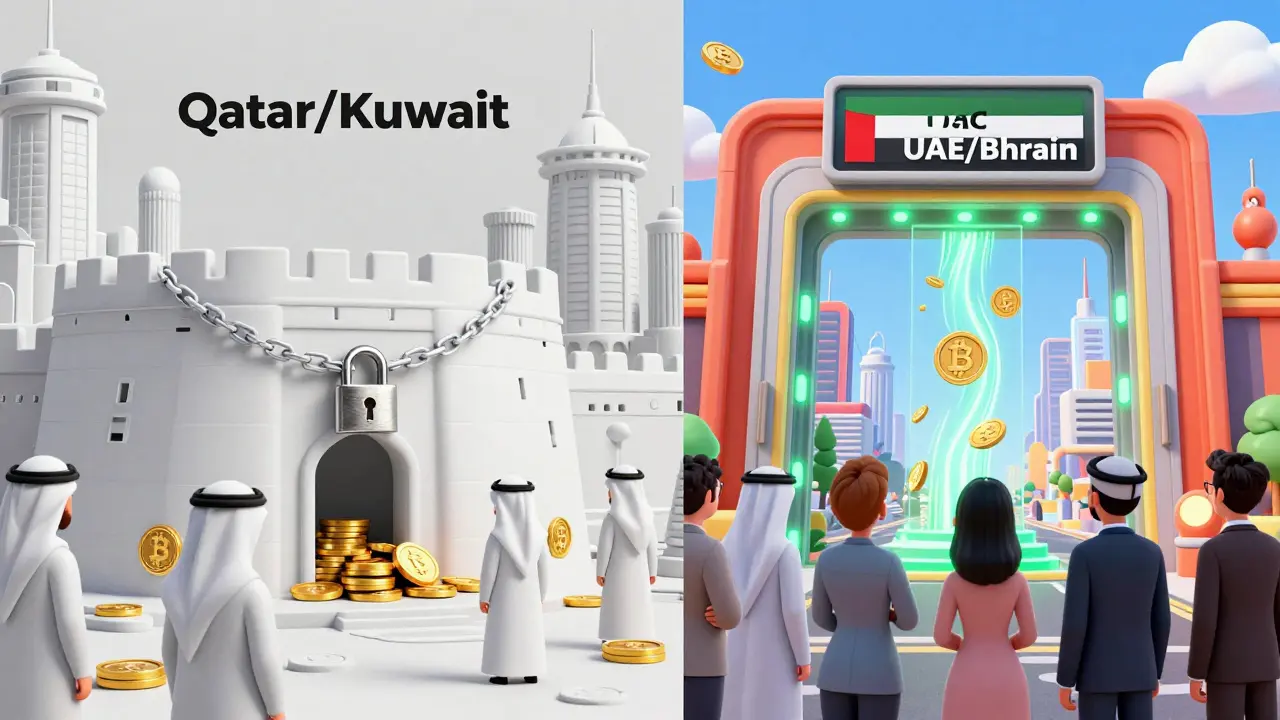
Qatar: The Strictest Prohibitions
If you are operating in Qatar, you need to tread carefully. It represents the most restrictive end of the spectrum. The Qatar Financial Centre Regulatory Authority (QFCRA) maintains comprehensive bans on cryptocurrency services for all financial institutions. This includes Bitcoin, Ethereum, and even stablecoins.
In September 2024, Qatar introduced the Digital Asset Regulations 2024. While this legalized tokenized assets like shares and bonds, it explicitly designated cryptocurrencies and stablecoins as "Excluded Tokens." This means banks cannot facilitate any transactions involving these excluded assets. Unlike other regions that might look at Anti-Money Laundering (AML) compliance as a way to open doors, Qatar’s approach is binary: if it’s crypto, it’s banned for banks. There is currently no pathway for a retail customer to link a Qatari bank account to a crypto exchange without risking account closure.
Kuwait and Bahrain: Enforcement vs. Licensing
Kuwait has taken aggressive enforcement actions, particularly against crypto mining. Following measures that resulted in a 55% reduction in local electricity usage for mining farms, Kuwait signaled its commitment to excluding itself from the crypto economy. Banks in Kuwait follow suit, maintaining strict prohibitions on any crypto-related transactions. The stance is conservative, aligning closely with Qatar’s view that digital assets pose too great a risk to financial stability.
In contrast, Bahrain operates under a clear licensing regime. The Central Bank of Bahrain uses the Crypto-Asset (CRA) module to determine which activities are permitted. This allows licensed financial institutions to engage in approved crypto activities under regulatory oversight. Bahrain has conducted interoperability tests with major global banks like JP Morgan, indicating a more permissive approach compared to its neighbors. If you are a fintech startup, Bahrain offers a sandbox environment where you can test products, provided you stay within the bounds of the license.
| Country | Regulatory Body | Banking Restriction Level | Key Mechanism |
|---|---|---|---|
| Saudi Arabia | SAMA | Moderate/Managed | Prohibited without specific approval |
| UAE | Central Bank / FSRA | Low (for licensed entities) | Licensed Token Framework |
| Qatar | QFCRA | High (Strict Ban) | Crypto classified as Excluded Tokens |
| Kuwait | Central Bank | High (Strict Ban) | Aggressive enforcement on mining/trading |
| Bahrain | Central Bank of Bahrain | Low (Licensing Regime) | CRA Module for permitted activities |

The CBDC Paradox: Why Banks Hate Crypto But Love Blockchain
You might wonder why banks are so hostile to Bitcoin when they are investing heavily in blockchain. The answer lies in Central Bank Digital Currencies (CBDCs). Countries like the UAE, Bahrain, Oman, and Saudi Arabia are active participants in CBDC pilots. These projects, such as mBridge, aim to create wholesale digital currencies for financial institutions to facilitate domestic settlements and cross-border transactions.
For regulators, CBDCs offer control, transparency, and sovereignty. Private cryptocurrencies offer none of that. This explains the paradox: banks are eager to adopt the underlying ledger technology for efficiency but vehemently oppose the decentralized assets that threaten their monopoly on money creation. When you see a "ban," understand that it is often a protectionist measure for the traditional banking sector, not necessarily a rejection of digital finance itself.
Practical Steps for Navigating the Restrictions
If you live or do business in the Middle East, here is how you navigate this landscape safely:
- Segregate Your Funds: Never mix crypto proceeds directly into your primary salary or business operating account in Qatar or Kuwait. Use dedicated wallets and peer-to-peer (P2P) networks if necessary, though be aware of local laws regarding P2P cashouts.
- Use Licensed VASPs in the UAE: If you are in the UAE, stick to exchanges that are fully licensed by the FSRA or VARA. Banks are less likely to flag transactions from these regulated entities.
- Monitor Regulatory Updates: The landscape is shifting. Qatar’s new Digital Asset Regulations 2024 created exceptions for tokenized securities. Keep an eye on announcements from SAMA and the Central Bank of Bahrain, as sandboxes often lead to broader permissions.
- Avoid Mining in Restricted Zones: Do not attempt to run mining rigs in Kuwait or Saudi Arabia without explicit industrial permits. The crackdown on electricity usage is real and carries heavy fines.
Future Outlook: Will the Bans Lift?
The trend suggests gradual liberalization, but only for compliant actors. As regional CBDC initiatives mature, regulators gain confidence in managing digital assets. We are likely to see more "restricted + managed" frameworks similar to Saudi Arabia’s current model becoming the norm. Total bans, like those in Qatar and Kuwait, may soften over time, particularly for institutional investors who can prove robust AML/KYC compliance. However, for the average retail user, direct banking integration with crypto remains unlikely in the near future. The goal for these governments is economic diversification and reducing reliance on Western financial systems, not creating a free-for-all for speculative trading.
Can I use my Saudi bank account to buy Bitcoin?
Generally, no. SAMA prohibits banks from engaging in cryptocurrency transactions without specific approval, which is rarely granted to retail customers. Transferring funds to a crypto exchange may result in your account being flagged or frozen.
Is crypto trading legal in Qatar?
Ownership is not explicitly criminalized for individuals, but financial institutions are banned from facilitating crypto services. Under the Digital Asset Regulations 2024, cryptocurrencies are classified as "Excluded Tokens," meaning banks cannot process transactions for them. Trading must occur outside the traditional banking system.
Which GCC country is most friendly to crypto businesses?
The United Arab Emirates and Bahrain are the most favorable. The UAE has established clear licensing frameworks through authorities like VARA and FSRA, allowing licensed entities to operate openly. Bahrain offers a robust licensing regime via the Central Bank's CRA module, enabling regulated crypto activities.
What is the mBridge project?
mBridge is a multi-country pilot program for Central Bank Digital Currencies (CBDCs) involving Saudi Arabia, the UAE, China, Thailand, and Hong Kong. It aims to improve cross-border payment efficiency using blockchain technology, distinct from private cryptocurrencies like Bitcoin.
Why did Kuwait crack down on crypto mining?
Kuwait enforced strict restrictions on crypto mining due to concerns over excessive electricity consumption and environmental impact. This led to a 55% reduction in local electricity usage for mining, signaling a strong government stance against unregulated crypto infrastructure.

Steven Briggs
July 18, 2026 AT 06:11it feels like they are trying to control everything instead of letting people manage their own money
Lisa Chong
July 19, 2026 AT 04:01Oh my god, this is exactly what I have been saying for years. The globalist agenda is right there in plain sight, hiding behind these so-called 'regulations'. They want to freeze your assets because they know Bitcoin is the only thing standing between you and total enslavement by the central banks. It is not about safety, it is about control. They are watching every transaction, building a profile on you, waiting for the moment to strike when you least expect it. The CBDCs are just digital shackles designed to track your every move and punish dissent. You think they care about financial stability? No, they care about power. Do not fall for their lies about efficiency or innovation. This is a trap set by the elite to strip away your privacy and your freedom. Wake up before it is too late and they take away your last shred of autonomy.
Heather Austin
July 20, 2026 AT 01:40i mean its pretty clear from the article that uae is the place to be if you actually want to do business legally. bahrain is also cool but uae has more infrastructure. just stick to licensed exchanges and dont try to sneak shit through regular banks unless you want headaches
Ran Tao
July 20, 2026 AT 16:59Please, spare me the naive optimism about UAE compliance 🙄 As if any government truly wants decentralized finance to thrive. They will license it until it becomes profitable, then squeeze it dry with taxes and regulations until it dies or moves elsewhere. The whole concept of 'licensed crypto' is an oxymoron created by bureaucrats who don't understand technology but love the sound of their own authority. Meanwhile, the rest of us are left playing whack-a-mole with frozen accounts while the elites park their billions in offshore trusts. It's a rigged game, and pretending otherwise is just embarrassing. 😒📉
Hamza k
July 21, 2026 AT 12:32The sheer audacity of these banking institutions to act as moral arbiters of our financial choices is absolutely staggering. One might almost believe they possess some divine right to dictate how we allocate our resources, yet here we are, trapped in a labyrinth of bureaucratic nonsense. It is a veritable circus of incompetence masked as prudence. To suggest that segregation of funds is merely a 'practical step' is to ignore the fundamental injustice of having one's hard-earned capital held hostage by risk-averse bankers who couldn't innovate their way out of a paper bag. We deserve better than this archaic system that treats innovation like a contagious disease.
Kim Kay
July 23, 2026 AT 06:52hey everyone i know this can be really confusing especially if you are new to the region. please remember to always check the latest rules because they change fast. if you are in qatar just avoid linking bank accounts at all costs its not worth the stress. for those in saudi maybe look into p2p options but be very careful and discreet. let us help each other stay safe and informed rather than getting angry at the system which doesnt seem to care about individual users much
Brad Semp
July 25, 2026 AT 00:39It is profoundly disappointing to observe the continued proliferation of such simplistic analyses regarding complex geopolitical financial frameworks. The author’s assertion that Qatar’s approach is merely 'strict' fails to acknowledge the sophisticated macroeconomic rationale underpinning their exclusionary policies. Furthermore, the casual dismissal of Kuwait’s enforcement actions ignores the broader implications for energy grid stability and national security. Those who advocate for unfettered access to speculative digital assets often lack the intellectual rigor required to comprehend the systemic risks involved. True financial literacy demands an appreciation for regulatory nuance, not a knee-jerk reaction against established institutions.
Korn Arrieta
July 26, 2026 AT 08:29This entire narrative is a masterclass in regulatory capture disguised as consumer protection. The GCC nations are not protecting their citizens; they are protecting their petro-dollar hegemony. By banning crypto banking, they ensure that all wealth flows through traditional channels where they can monitor, tax, and manipulate it at will. The mention of CBDCs is the smoking gun. These are not tools for financial inclusion; they are instruments of social control. Every sentence in this guide reinforces the idea that the average citizen is a liability to be managed, not a participant to be empowered. It is pathetic that anyone still believes in the benevolence of these central banks.
Jackie D
July 26, 2026 AT 16:46i was wondering why my friend in kuwait had such a hard time with his mining setup until i read this part about electricity usage. it makes sense now that they are cracking down so hard. its kinda wild how different each country is though. like uae is so open compared to qatar. i guess its good to know where the lines are drawn so we dont accidentally step over them and lose everything. thanks for breaking it down even if it sounds a bit scary sometimes
Ruth Williams
July 27, 2026 AT 16:35Let us be unequivocally clear: the restrictions outlined herein are not arbitrary impediments but necessary safeguards for economic integrity. Individuals who complain about these measures demonstrate a profound ignorance of monetary policy and the inherent volatility of unregulated digital assets. The GCC regulators are acting in the best interest of their populations by preventing the chaos that accompanies speculative bubbles. To suggest otherwise is to display a reckless disregard for financial stability. Only the most discerning investors should consider navigating these waters, and even then, only with extreme caution and full adherence to the law. Ignorance of the regulations is no excuse for non-compliance.