
Nasdaq Crypto Index Investment Calculator
Calculate your investment allocation based on the current Nasdaq Crypto Index composition and compare to direct Bitcoin investment.
Your Investment Breakdown
Based on NCI index composition
Based on NCI index composition
Based on NCI index composition
Based on NCI index composition
Cardano, Chainlink, Stellar, etc.
Fee Comparison
Total annual fee
Total annual fee
This shows the annual fee difference between investing in the Nasdaq Crypto Index ETF versus a direct Bitcoin ETF
When you hear "Nasdaq crypto exchange," you might picture a platform where you can buy Bitcoin with a credit card, trade altcoins 24/7, or use leverage like you would on Binance or Coinbase. But that’s not what Nasdaq is. It doesn’t run a crypto exchange at all. Not even close. If you’re looking to trade Ethereum or Solana directly, Nasdaq isn’t your destination. Instead, it’s quietly building the infrastructure that lets traditional finance walk into crypto - without stepping into the wild west.
What Nasdaq Actually Does in Crypto
Nasdaq doesn’t let you deposit dollars and buy Bitcoin. It doesn’t have wallets, mobile apps, or order books for spot trading. What it does offer are Nasdaq Crypto Index (NCI) and Nasdaq Crypto US Index (NCIUS). These aren’t trading platforms. They’re benchmarks - like the S&P 500, but for digital assets.
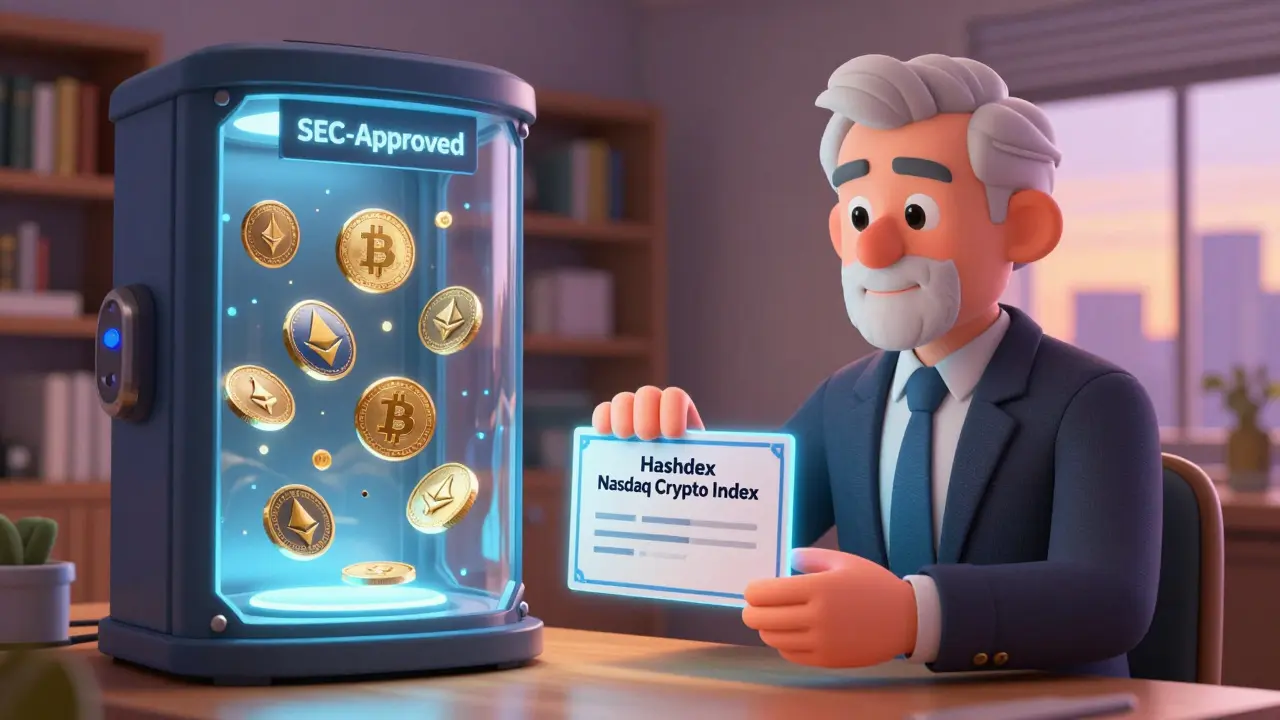
The NCI tracks the performance of the largest crypto assets by market cap, but with strict rules. To be included, a coin must be listed on regulated European exchanges like SIX Swiss Exchange or Xetra. As of December 2025, the index is dominated by Bitcoin at 74.47%, followed by Ethereum at 14.3%, XRP at 6.27%, and Solana at 3.39%. The rest are tiny slices: Cardano, Chainlink, Stellar. No meme coins. No new tokens that haven’t cleared regulatory hurdles.
This isn’t about speculation. It’s about structure. Nasdaq’s indexes are used by ETFs like the Hashdex Nasdaq Crypto Index ETF, which had $660 million in assets under management by December 2025. That’s not huge compared to Bitcoin spot ETFs that cleared $50 billion, but it’s a solid foothold for institutions.
Why Institutions Care About Nasdaq’s Crypto Index
Big money doesn’t want to touch crypto exchanges. Too many stories about hacks, frozen funds, and unregulated platforms. Fidelity, BlackRock, and JP Morgan don’t want their clients exposed to that. But they also know their clients want crypto exposure.
Nasdaq solves that by acting as a trusted third party. The NCI is audited, transparent, and built on rules that mirror traditional securities. Financial advisors can recommend it through Fidelity, Schwab, or Vanguard - no need to open a Coinbase account. One institutional investor on Seeking Alpha put it simply: "I can buy crypto through my brokerage without worrying about who’s holding the keys."
That’s the real value. You’re not buying Bitcoin. You’re buying a regulated, index-based product that holds Bitcoin - and a few other top coins - in a structure approved by regulators. It’s like owning a mutual fund that holds Apple stock, except the stock is Bitcoin.
How It Compares to Real Crypto Exchanges
Let’s be clear: Nasdaq is not competing with Coinbase, Kraken, or Binance. Those platforms moved $1.2 trillion in Q4 2025. Nasdaq’s index products are a side project.
| Feature | Nasdaq Crypto Index | Coinbase / Binance |
|---|---|---|
| Spot Trading | No | Yes |
| Margin / Leverage | No | Yes |
| DeFi Integration | No | Some |
| Regulatory Oversight | SEC-registered index | Varies by jurisdiction |
| Expense Ratio | 0.95% (Hashdex ETF) | 0.4%-0.6% trading fees |
| Primary Users | Institutional investors, advisors | Retail traders, speculators |
On Coinbase, you can buy Dogecoin, trade futures, or stake Polkadot. On Nasdaq’s index, you get a basket of the biggest, most regulated coins. No surprises. No rug pulls. But also no excitement.
The Tokenized Securities Play
In September 2025, Nasdaq filed a rule change with the SEC to allow trading of tokenized securities on its platform. This isn’t about Bitcoin. It’s about turning real-world assets - like corporate bonds, real estate funds, or private equity shares - into digital tokens that settle on blockchain.
Imagine buying a share of a Manhattan office building as a token, traded on Nasdaq, settled in seconds, with ownership recorded on a distributed ledger. That’s the goal. The SEC hasn’t approved it yet, but the framework is ready. Nasdaq’s partner, DTC, is building a system to convert traditional securities into token form and deliver them to blockchain wallets registered with DTC.
This move is strategic. It keeps Nasdaq in the center of regulated finance while opening a new revenue stream. It’s not crypto trading. It’s the future of how stocks and bonds will be issued and traded - and Nasdaq wants to own that infrastructure.
Who Should Use Nasdaq’s Crypto Products?
If you’re a retail trader looking to moonshot on Solana or short Shiba Inu, skip it. Nasdaq isn’t for you.
If you’re a financial advisor managing money for high-net-worth clients, this is your tool. The Hashdex ETF lets you add crypto exposure to a portfolio without dealing with custody, KYC on crypto exchanges, or the stigma of "crypto gambling."
If you’re an institutional investor - a pension fund, endowment, or family office - Nasdaq’s index gives you a clean, auditable way to gain exposure. It’s the equivalent of buying gold through a futures contract instead of storing bars in a safe.
But there’s a catch: the 0.95% expense ratio. That’s nearly four times higher than the 0.25% fee on Bitcoin spot ETFs. And since the index includes 7 other coins besides Bitcoin, you’re not getting pure BTC exposure. One Reddit user summed it up: "I’m paying almost 1% to get 75% Bitcoin. Why not just buy Bitcoin directly?"

What’s Missing?
Nasdaq doesn’t offer:
- Spot trading of any crypto asset
- Staking or yield products
- Decentralized finance (DeFi) access
- Mobile apps or retail trading tools
- Support for new or small-cap tokens
It also doesn’t have customer service for crypto questions. If you call Nasdaq about Ethereum price swings, they’ll refer you to their index methodology document. No live chat. No help desk. Just data and compliance.
The Bigger Picture: Crypto’s Institutional Shift
The crypto market hit $4 trillion in market cap in 2025. But only 38% of that volume came from institutions. The rest? Retail traders, speculators, and DeFi users.
Nasdaq is betting that this 38% will grow. And fast. With the GENIUS Act passing in 2025, stablecoins now operate under federal rules. The SEC’s Project Crypto clarified that tokenized securities belong under securities law - not commodity law. That’s exactly the environment Nasdaq thrives in.
TRM Labs predicts that by 2028, 15-20% of traditional securities volume will come from tokenized assets. Nasdaq isn’t just watching that trend - it’s building the rails for it.
Final Verdict: Not an Exchange. A Bridge.
Nasdaq isn’t a crypto exchange. It’s a bridge between Wall Street and blockchain.
If you want to trade crypto like a day trader - avoid it. If you want to add regulated, institutional-grade crypto exposure to your portfolio - it’s one of the cleanest options out there. The fees are high, the selection is narrow, and you can’t trade directly. But you also won’t get hacked. You won’t lose your keys. And your accountant won’t panic when you file your taxes.
For the first time, you can own crypto through your 401(k). That’s not flashy. But it’s real. And it’s the future.
Is Nasdaq a crypto exchange like Coinbase?
No, Nasdaq does not operate a crypto exchange. It doesn’t let you buy, sell, or trade Bitcoin or Ethereum directly. Instead, it provides regulated crypto indexes used by ETFs and institutional investors.
Can I buy Bitcoin through Nasdaq?
You can’t buy Bitcoin directly on Nasdaq. But you can invest in the Hashdex Nasdaq Crypto Index ETF, which holds Bitcoin and other top cryptocurrencies. This ETF is available through major brokerages like Fidelity and Schwab.
What’s the expense ratio for Nasdaq’s crypto ETF?
The Hashdex Nasdaq Crypto Index ETF has an expense ratio of 0.95% for institutional investors. This is higher than spot Bitcoin ETFs, which charge around 0.25%, because it holds a basket of multiple assets and includes regulatory compliance costs.
Why does Nasdaq’s crypto index only include 7 coins?
Nasdaq’s index only includes coins listed on regulated European exchanges like SIX Swiss Exchange and Xetra. This ensures compliance with financial regulations and reduces risk from unvetted or volatile tokens. It’s designed for institutional safety, not speculative diversity.
Is Nasdaq planning to launch a crypto trading platform?
Nasdaq is not launching a retail crypto exchange. Its focus is on tokenized securities - turning stocks, bonds, and real estate into blockchain-based assets that trade on its existing regulated platform. This is a different market entirely from spot crypto trading.
Who uses Nasdaq’s crypto indexes?
Primarily institutional investors, financial advisors, pension funds, and family offices. These users want regulated, transparent exposure to crypto without the risks of direct exchange trading. Retail traders rarely use these products directly.

Anselmo Buffet
December 12, 2025 AT 12:40Nasdaq isn't trying to be Binance. It's building the quiet backbone that lets banks sleep at night while still touching crypto.
Kathryn Flanagan
December 14, 2025 AT 04:29I've been explaining this to my clients for months now. People think crypto means buying Dogecoin on their phone. But the real story? It's about institutions getting access without touching a wallet. Nasdaq's index is like a financial safety blanket for people who want exposure but don't want to deal with the chaos. You're not trading. You're investing. Big difference. And yes, the fee is high. But when you're managing a pension fund, you pay for peace of mind. Not for memes. Not for leverage. Just clean, auditable exposure to the top assets. No one's going to lose their keys. No one's going to get hacked. That's worth something. Even if it's not flashy. Even if it doesn't make you rich overnight. It's the foundation. And foundations aren't supposed to be exciting. They're supposed to hold everything up.
Ian Norton
December 16, 2025 AT 01:070.95% fee to get 75% Bitcoin? That's a tax on ignorance. Anyone who pays this is being fleeced by financial middlemen who don't understand the technology.
JoAnne Geigner
December 17, 2025 AT 07:55I think people miss the point entirely. It's not about trading. It's about trust. For decades, Wall Street has been burned by anything that smells like crypto. Now, here's a bridge built by the most respected name in finance - with audits, rules, and regulatory backing. It's not perfect. But it's the first real step toward normalizing this. And that matters more than any moonshot.
Sarah Luttrell
December 17, 2025 AT 23:30Oh wow, so now we're supposed to be impressed that Nasdaq is charging 1% to let us own Bitcoin through a mutual fund? How quaint. I'm sure the hedge funds are weeping with joy.
Rakesh Bhamu
December 19, 2025 AT 10:45For those who think this is boring - that's the point. The wild west needs roads before it becomes a city. Nasdaq is laying asphalt while others are still selling horse carts. This isn't for gamblers. It's for the future.
Kathy Wood
December 20, 2025 AT 14:51This is exactly why crypto will never be real money. People are okay paying 1% just to avoid responsibility. Pathetic.
Steven Ellis
December 22, 2025 AT 07:21The beauty here isn't in the coins - it's in the architecture. Tokenized securities on a regulated platform? That’s the real revolution. Imagine bonds settling in seconds. Real estate shares traded like stocks. Nasdaq isn’t playing in the crypto sandbox. It’s building the entire playground - and making sure the swings are safe for everyone.
amar zeid
December 24, 2025 AT 06:25Interesting how Nasdaq avoids retail chaos but still captures institutional demand. The real win? They're not fighting the market - they're redefining it. Tokenized assets could be bigger than crypto itself.
Taylor Fallon
December 25, 2025 AT 08:28It's funny how people scream about fees when the alternative is losing everything to a scam exchange. I'd rather pay 1% and sleep than lose 100% and cry. This isn't about profit - it's about dignity. And dignity costs money.
Alex Warren
December 25, 2025 AT 19:44Correct terminology: Nasdaq provides benchmarks, not products. The Hashdex ETF is the product. Nasdaq licenses its index. Precision matters.
Claire Zapanta
December 25, 2025 AT 21:15Of course the Fed allows this. They're in bed with Wall Street. Meanwhile, ordinary people get told to "do your own research" while the elite get clean, SEC-approved exposure. This isn't innovation - it's control.
Patricia Whitaker
December 26, 2025 AT 01:27Why is everyone acting like this is genius? It's just a mutual fund with Bitcoin. No one needs this. Just buy BTC.
Nicholas Ethan
December 26, 2025 AT 12:13Expense ratio irrelevant. Liquidity and regulatory clarity are the real metrics. This is institutional-grade infrastructure. Retail doesn't belong here.
Andy Walton
December 28, 2025 AT 06:46bro… this is the future. we’re not trading coins anymore… we’re trading *ownership*. nasdaq’s not selling bitcoin… they’re selling the idea that money can be… real. 🤯
PRECIOUS EGWABOR
December 28, 2025 AT 10:11If you're still using Coinbase, you're not investing - you're participating in a crypto carnival. Nasdaq is the only adult in the room.
Ike McMahon
December 29, 2025 AT 09:32Stop comparing this to Binance. It’s not the same game. This is for portfolios. Not for memes.