
Tracing Accuracy Calculator
Tracing Method
Tracing Parameters
Estimated Accuracy
When you send Bitcoin or Ethereum, it doesn’t disappear into the void. Every transaction leaves a permanent, public record on the blockchain. That’s not a bug-it’s the feature. But this transparency is also what makes on-chain crypto transaction tracing possible. Unlike cash, where physical movement hides intent, crypto leaves a trail. And that trail is being followed-by exchanges, governments, and investigators-to track down stolen funds, ransomware payments, and money laundering schemes.
How On-Chain Tracing Actually Works
On-chain tracing isn’t magic. It’s math, patterns, and smart guesses. Blockchain explorers like Etherscan or Blockchair show every transaction: who sent what, when, and to which address. But addresses like 0x742d35Cc6634C0532925a3b844Bc454e4438f44e don’t come with names attached. That’s where tracing comes in.
Investigators don’t start with identities. They start with clusters. If five different addresses keep sending funds to one wallet, and that wallet regularly sends money to a known exchange like Coinbase or Binance, it’s safe to assume they’re controlled by the same person or group. This is called address clustering. Once one address in that cluster is linked to a real identity-say, through KYC data from an exchange-all the others in the cluster become suspect.
Another common technique is common spend analysis. If two wallets send funds to the same third wallet at the same time, they’re likely owned by the same entity. Or if someone repeatedly splits a large amount into smaller transactions to avoid detection-called a peel chain-that’s a red flag. Nansen’s 2025 analysis found these patterns are detected with 92% accuracy when properly monitored.
The Three Main Tracing Methods
There are three dominant ways to trace crypto transactions today. Each has strengths, weaknesses, and use cases.
- Heuristic-based tracing uses rules of thumb. For example, if a transaction happens right after another and the inputs match, they’re probably connected. This works well on single chains like Ethereum. TRM Labs reported 89% accuracy for tracing Ethereum transactions in 2024. But it falls apart when funds move across chains-accuracy drops to 63%.
- Rule-based tracing builds custom detection rules. If a wallet receives a token that doesn’t exist on that chain, or if funds are sent to a known mixer or privacy pool, the system flags it. This method is great for spotting known criminal patterns but needs constant updates. Criminals change tactics fast.
- Graph learning-based tracing uses machine learning. Instead of fixed rules, AI models learn from millions of past transactions. They map out how funds flow between addresses like a neural network, identifying hidden connections humans might miss. Merkle Science’s 2024 whitepaper showed these models achieve 85% accuracy on multi-chain traces. But they need massive datasets and powerful computers. Not something you run on a laptop.
Most professional tools combine all three. Chainalysis Reactor, Nansen, and TRM Labs don’t rely on one method. They layer them-clustering addresses, spotting peel chains, then feeding the data into AI models to predict next moves.
Cross-Chain Tracing: The Biggest Challenge
Here’s where it gets messy. Criminals don’t stay on one chain. They bounce between Ethereum, BSC, Tron, Solana, and even obscure networks. Why? Because each chain has different rules, tools, and visibility.
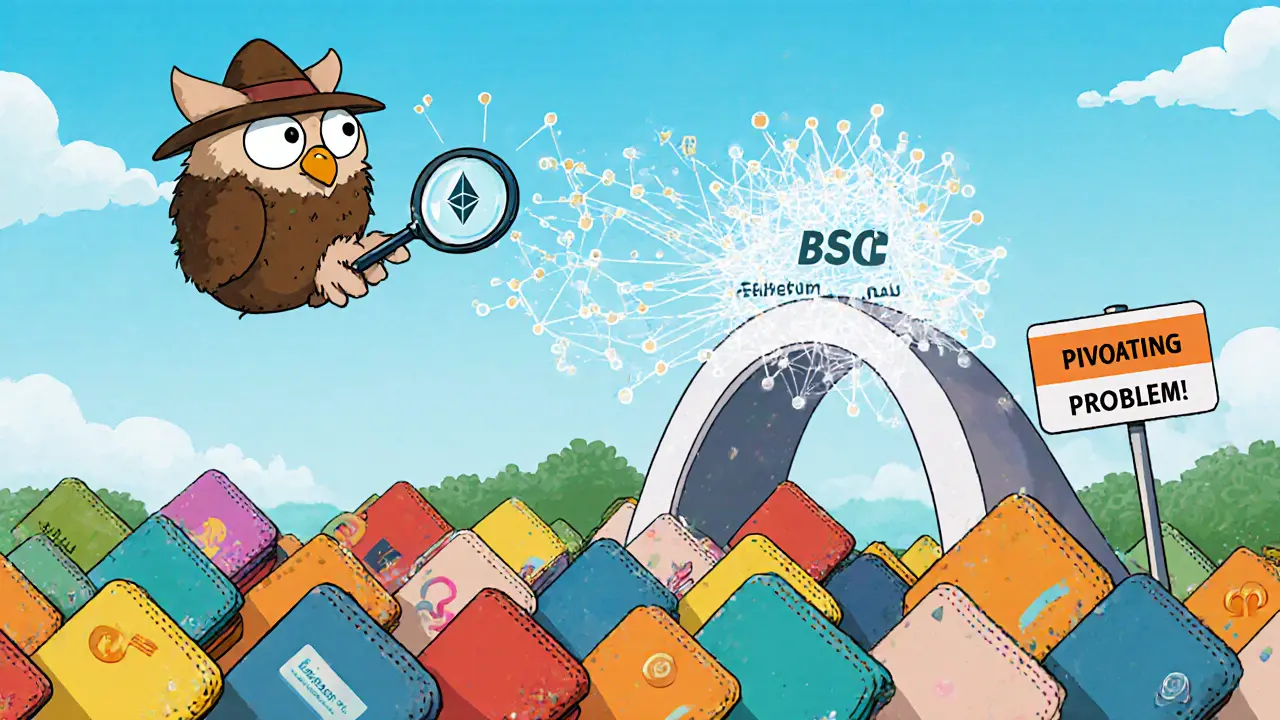
When someone moves funds from Ethereum to BSC via a bridge, the tracing process stops. The original transaction ends. A new one begins on the other chain. The investigator has to pause, switch tools, find the new address, and start over. Cryptoisac.org’s 2024 report calls this a “pivoting problem.” If a fund hops through three or four chains, the trail gets cold fast.
That’s why cross-chain tracing tools are now the most valuable-and expensive. Platforms like TRM Labs and Nansen now offer unified dashboards that follow funds across 40+ blockchains. But these cost $27,500 a year per seat. And even then, they can’t track every bridge type. Some bridges use lock-and-mint mechanisms, others use swaps or wrapped tokens. You need to understand the mechanics to trace them.
What Tracing Can’t Do
There’s a big myth: that blockchain tracing can reveal who owns a wallet. It can’t. Not by itself.
Dr. Sarah Meiklejohn from University College London put it plainly: “We can cluster addresses with high confidence, but definitive identity linkage requires non-blockchain evidence.” That means if you want to prove John Doe owns wallet X, you need his exchange login, IP address, or bank statement-not just blockchain data.
Privacy coins like Monero and Zcash make tracing nearly impossible. They use ring signatures and zero-knowledge proofs to hide sender, receiver, and amount. In 2024, they accounted for 7.2% of all illicit crypto transactions, according to CipherTrace. Mixers like Tornado Cash, which pool funds from hundreds of users to break the link, were used in 18.3% of illicit flows last year.
And then there’s dusting. Bad actors send tiny amounts of crypto-like $0.001-to thousands of wallets to see which ones respond. If a wallet sends funds out after receiving dust, it’s flagged. But this technique is increasingly useless. Most wallets now ignore dust automatically.
Who Uses These Tools-and Why
It’s not just law enforcement. The biggest buyers are financial institutions.
After the FATF’s 2019 “Travel Rule” required exchanges to share sender and receiver info for transactions over $1,000, blockchain analytics became mandatory. Today, 87% of crypto exchanges use these tools. Of the top 100 global banks, 63 now monitor crypto activity, according to Deloitte’s 2024 survey.
Insurance companies use tracing to detect fraud. Hedge funds use it to avoid tainted assets. Even legitimate traders check if a token they’re buying was previously used in a hack. One trader in Boulder told me he checks every new DeFi token’s history on Nansen before investing. “I don’t want my funds frozen because I bought from a wallet tied to a past ransomware payment,” he said.
But it’s not all clean. Privacy advocates warn of overreach. The Electronic Frontier Foundation argues that these tools can be used to surveil ordinary users. Jeremy Gillula from EFF said in a May 2024 panel: “We must ensure these tools aren’t used to surveil legitimate financial activity.”

Tools of the Trade
You don’t need to be a government agent to trace crypto. But you do need the right tools.
- Blockchain explorers (Etherscan, Solana Explorer, Bitcoin.com Explorer) - free, public, basic. Good for checking single transactions.
- Open-source tools (BlockSci, BitcoinAbuse) - for developers and researchers. Require coding skills.
- Professional platforms (Nansen, Chainalysis Reactor, TRM Labs, Elliptic) - enterprise-grade. Used by exchanges, banks, and federal agencies. Cost $15,000-$50,000 per year per seat.
Learning to use them takes time. Arkham’s 2024 guide says analysts need 3-6 months of full-time training to become proficient. You need to understand transaction formats, gas fees, smart contract interactions, and how bridges work. It’s not just clicking buttons.
The Future: AI and the Arms Race
Tracing isn’t standing still. Neither are criminals.
Researchers at MIT and Stanford are building neural networks that predict fund flows before they happen. Gartner predicts that by 2027, 70% of enterprise tools will use generative AI to spot anomalies. Imagine an AI that says: “This wallet just received funds from a mixer. It’s likely going to send them to a privacy chain in the next 48 hours.”
But criminals are adapting too. New decentralized mixers are popping up. Layer-2 solutions like zkSync and StarkNet make tracing harder by bundling hundreds of transactions into one. Some are even experimenting with AI-generated wallets that mimic normal user behavior.
David Jevans, CEO of CipherTrace, says it best: “The tracing arms race will continue indefinitely.” Every time a new tool emerges, someone builds a way around it. The cat-and-mouse game isn’t ending. It’s accelerating.
What’s clear is this: blockchain is transparent. But transparency doesn’t mean visibility. Tracing is a tool-not a crystal ball. It works best when combined with real-world evidence, human insight, and constant learning.
Can you trace Bitcoin to a person’s name?
No, not directly. Bitcoin addresses are pseudonymous, not anonymous. You can trace funds between addresses and cluster them into groups, but linking a wallet to a real person requires outside evidence-like an exchange KYC record, IP address, or bank transaction. Blockchain data alone can’t reveal identities.
Are privacy coins untraceable?
Monero and Zcash are designed to be untraceable by design. They hide sender, receiver, and amount using advanced cryptography. While some limited analysis is possible (like spotting when funds enter or exit an exchange), tracing the actual path of funds inside these networks is currently impossible with standard tools. They account for over 7% of illicit crypto flows, making them a major challenge for investigators.
How accurate is on-chain tracing?
Accuracy depends on the method and context. Heuristic tracing on a single chain like Ethereum is 89% accurate. Rule-based methods detect peel chains with 92% accuracy. Graph learning models achieve 85% accuracy on multi-chain traces. But accuracy drops sharply when funds cross more than three networks or use privacy tools. No method is perfect.
Do I need expensive tools to trace crypto?
For basic checks, free tools like Etherscan or Bitcoin Explorer work fine. But for serious tracing-like following funds across chains, clustering addresses, or detecting complex patterns-you need professional platforms like Nansen or TRM Labs. These cost $15,000-$50,000 per year. Most individuals don’t need them unless they’re investigating fraud or working in compliance.
Is on-chain tracing legal?
Yes, in most jurisdictions. Regulators require exchanges and financial institutions to use blockchain analytics to prevent money laundering. The FATF’s Travel Rule and EU’s MiCA regulation make it mandatory for businesses. However, using these tools to spy on private individuals without cause may violate privacy laws. Legality depends on intent and jurisdiction.
Can I trace my own crypto if it’s stolen?
You can track the movement of stolen funds using public explorers. But recovering them requires law enforcement or professional recovery firms with access to advanced tools and exchange cooperation. If your funds go to a centralized exchange, they can be frozen if the exchange is notified. If they go to a private wallet or mixer, recovery is extremely unlikely.
How long does it take to learn crypto tracing?
It takes 3 to 6 months of consistent study and hands-on practice to become proficient. You need to understand transaction structures, blockchain networks, wallet clustering, and common obfuscation tactics. Many analysts start with free tools and open-source projects before moving to enterprise platforms.
What’s the biggest mistake people make when tracing crypto?
Assuming that just because you can see a transaction, you know who’s behind it. Many people think tracing = identifying. It doesn’t. You can follow the money, but without external data-like KYC records or IP logs-you can’t prove who owns the wallet. Jumping to conclusions leads to false accusations and wasted effort.

Savan Prajapati
November 27, 2025 AT 01:22Blockchain doesn't reveal names. Stop acting like it does.
Michael Fitzgibbon
November 29, 2025 AT 01:11Really appreciate this breakdown. I used to think tracing = catching criminals, but now I get it-it’s more like connecting dots without knowing who holds the pencil. The part about dusting being useless now? That’s a relief. I’ve gotten tiny ETH drops before and panicked.
SHASHI SHEKHAR
November 29, 2025 AT 03:08Broooo, this is so cool 😍 I just spent 3 hours on Etherscan tracing a random wallet that got flagged for ‘suspicious activity’-turns out it was just some guy buying NFTs from 3 different mints and sending change back to himself. The clustering algo thought he was a mixer 😂 But seriously, graph learning is wild-AI can see patterns I’d miss even if I stared at 10k txs. Also, did you know some bots now auto-detect peel chains and flag them before humans even notice? 🤖💸
Susan Dugan
November 30, 2025 AT 05:57Love how this post doesn’t sugarcoat it. People think crypto is anonymous? Nah. It’s pseudonymous-and that’s a whole different beast. I work in compliance and we use Nansen daily. One time we caught a laundering ring because someone reused the same gas fee pattern across 14 wallets. It’s like fingerprinting, but with decimals. 🚨 Also-privacy coins aren’t magic. They’re just harder. And guess what? They still leave footprints at the door.
Wilma Inmenzo
November 30, 2025 AT 08:30So… you’re telling me the government, big banks, and Chainalysis are watching EVERY SINGLE TRANSACTION… and they’re using AI to PREDICT where money’s going next?? 🤔 And you call this ‘transparency’? I call it mass surveillance with a blockchain-shaped sticker on it. When did we agree to this? I didn’t sign up for a digital panopticon. Next they’ll track my coffee purchases via crypto tips. ☕👁️
Michael Labelle
December 1, 2025 AT 09:35Good summary. I’ve been using BlockSci for personal research-free, but clunky. Took me a month to stop mixing up input/output indices. One thing no one talks about: most tracing tools assume people behave rationally. But humans are messy. I’ve seen wallets send 0.0001 ETH to 200 addresses just because someone was bored. The algorithms go nuts. It’s not perfect-it’s probabilistic.
Evelyn Gu
December 3, 2025 AT 06:56I just want to say… I’ve been reading this post three times. I’m not an expert, but I’ve been trying to understand how my crypto gets flagged. The part about cross-chain pivoting? That’s terrifying. I moved some ETH to Arbitrum last week, then to Polygon, then to Solana-just to test. I have NO IDEA if anyone could follow it. And now I’m paranoid every time I bridge. I just wanted to save on gas. 😅
Sam Daily
December 5, 2025 AT 06:34Y’all are underestimating how fast this tech is evolving. I built a little script that scrapes Etherscan + Dune Analytics + Chainalysis alerts. It auto-tags wallets that match ‘tainted’ patterns. I’m not law enforcement-I’m just a guy who lost $2k to a rug pull. Now I check every token’s history before buying. If it ever touched Tornado Cash? I run. No exceptions. This isn’t fear-it’s hygiene.
SARE Homes
December 6, 2025 AT 18:30Oh please. You think this is about ‘crime’? It’s about control. The same people who told you crypto was ‘decentralized freedom’ are now the ones selling $50k/year dashboards to banks so they can freeze your wallet because you bought a token that once had a 0.0001 ETH dust drop. Wake up. This isn’t justice-it’s corporate surveillance dressed in blockchain pajamas. 🤡
Tina Detelj
December 7, 2025 AT 14:31What’s fascinating to me is the philosophical tension here: blockchain was supposed to be the ultimate ledger of truth. But now we’re layering on AI, heuristics, and clustering to *interpret* that truth… which means we’re not seeing reality-we’re seeing a model of reality. And models are always biased. Who trained the AI? Who labeled the ‘criminal’ clusters? Are we automating prejudice? I’m not against tracing-I’m against pretending it’s objective.
Vance Ashby
December 8, 2025 AT 11:28Let’s be real-most people who use these tools are just trying to avoid getting their funds frozen. I don’t care if it’s surveillance. I care that my DeFi yield farm doesn’t get blacklisted because someone else used my pool for laundering. I check every token’s history on Nansen before I deposit. It’s not paranoia. It’s FOMO with a compliance twist. 😅
Joel Christian
December 9, 2025 AT 22:32did u kno that if u send 0.000001 eth to a wallet it can get flagged as dusting?? i did that by accident and now my wallet is on some list and i cant use it on some dapps anymore 😭
Komal Choudhary
December 10, 2025 AT 04:53Bro I just tried to trace my friend’s wallet because he said he ‘lost’ his crypto. I found it in 10 mins-sent to Binance, cashed out to bank. He lied. 😏 Blockchain doesn’t lie. People do. Also, why do you think mixers are so popular? Because people are scared. Not because they’re criminals. Just… normal folks who don’t want their landlord knowing they made 50 ETH from a side gig.
Rachel Thomas
December 12, 2025 AT 01:00Wait so you’re saying we can’t trace to a person’s name? Then why do all these companies claim they can? LIES. All of it. They’re just selling fear to banks so they can charge $50k/year. I’ve seen their marketing slides-they use red arrows and skulls. It’s horror movie aesthetics. 🎃
priyanka subbaraj
December 12, 2025 AT 13:09Tracing works until it doesn’t. And when it doesn’t, it’s always the privacy coins. Monero is the real MVP. No one’s tracking that. Ever. Try it. Send 10 XMR. Watch the entire industry scratch its head. 😎
Grace Zelda
December 12, 2025 AT 20:37It’s funny how we treat blockchain like it’s this neutral god ledger. But the tools that interpret it? Built by humans. Trained on data from law enforcement. Biased toward certain patterns. What if someone’s wallet got flagged because they donated to a political cause that’s now ‘suspicious’? We’re not just tracing money-we’re tracing ideology. And that’s dangerous. Not because crypto is bad. Because power is.
Casey Meehan
December 14, 2025 AT 18:50AI predicting fund flows? That’s not tracing-that’s psychic money magic. 🧙♂️💸 I just hope they don’t start flagging wallets because ‘the model thinks you’re a bad person’. Next thing you know, your wallet gets blacklisted because you bought a token on a Tuesday. 😵💫