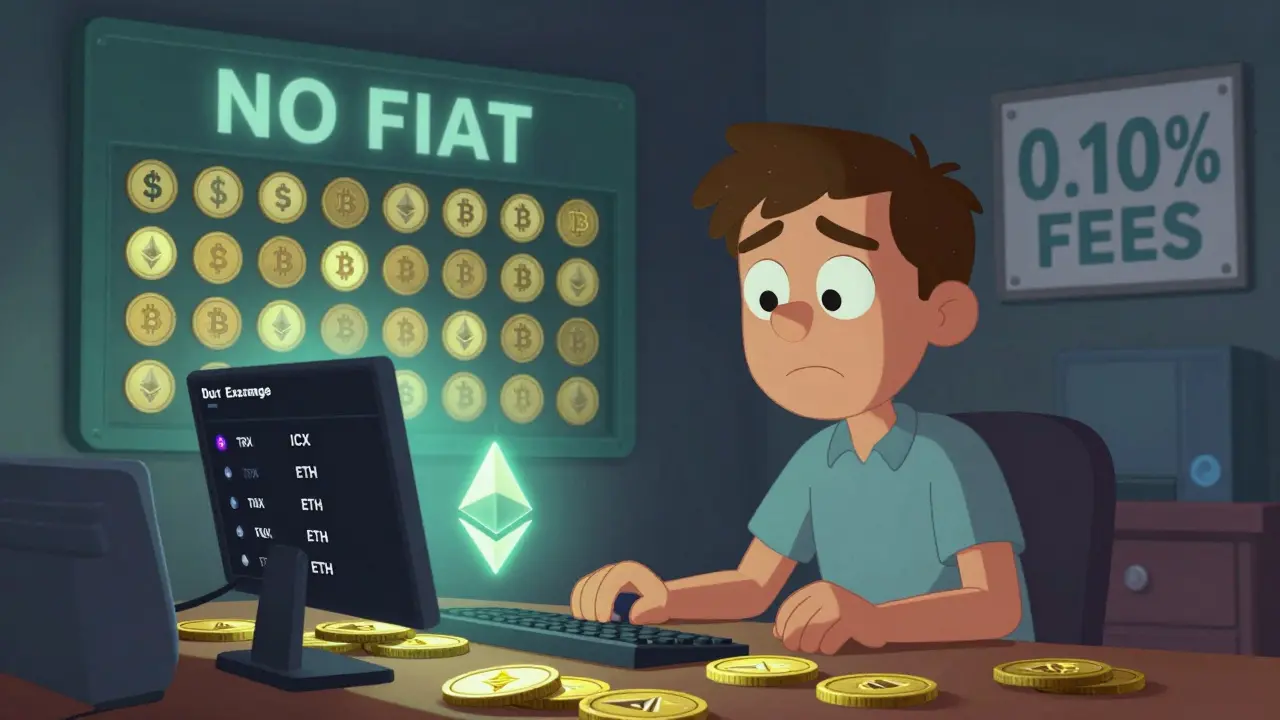
When you're looking for a crypto exchange that trades obscure altcoins, Rfinex might catch your eye. It’s been around since 2017, so it’s not new. But it doesn’t feel like a finished product. If you’re new to crypto and want to buy Bitcoin with USD, Rfinex isn’t for you. It doesn’t accept fiat at all. You need to already have ETH or another cryptocurrency before you can even log in.
Rfinex is built for one thing: trading exotic coins against Ethereum. That’s it. The full list of trading pairs is short - usually between 6 and 9, depending on what’s active. Coins like EOS, TRX, ICX, FUT, EGT, and CXTC are all available, but only if you’re trading them for ETH. No USDT. No BTC. No USD. Just ETH. That’s a big deal. Most exchanges let you trade dozens of coins against multiple pairs. Rfinex gives you a tiny selection, all tied to one asset. That’s not a feature - it’s a limitation.
The fees are where Rfinex stands out. At 0.10% per trade, it’s half the cost of most exchanges. The industry average? Around 0.25%. Even Binance and Kraken charge more. Rfinex charges the same rate whether you’re making a market order or taking one. That’s rare. Most platforms charge takers more. Here, it’s flat. If you’re trading frequently and you already hold ETH, this could save you money. But don’t get excited too fast. The withdrawal fees tell a different story.
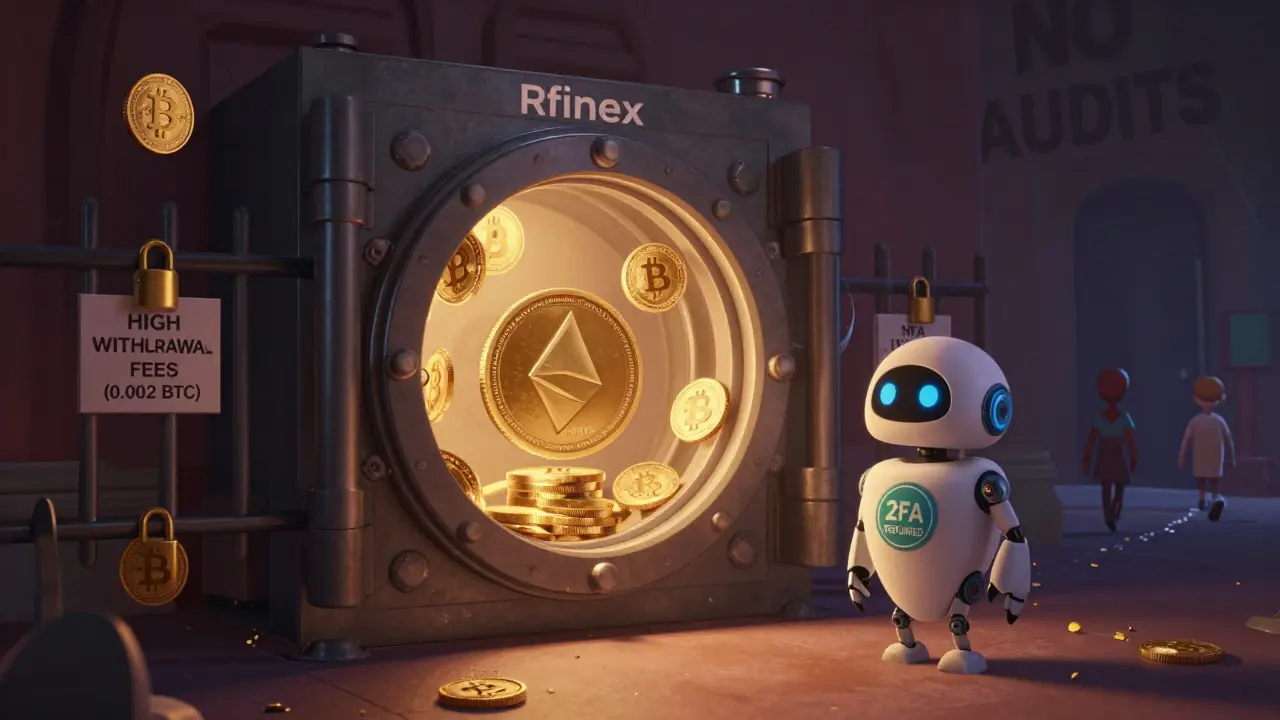
Withdraw Bitcoin? Rfinex charges 0.002 BTC. That’s about 150% higher than the global average of 0.000812 BTC. Even if Bitcoin’s price has changed since 2020, that fee still feels steep. You’re paying more to get your coins out than you would on almost any other platform. That’s not a small detail. If you’re planning to move your coins elsewhere - and you should - this adds up fast. It’s like getting a great deal on groceries, then paying $20 to carry the bags to your car.
Security is taken seriously. Rfinex requires two-factor authentication (2FA) for every login. No exceptions. That’s good. It means your account is harder to hack. But it also means you can’t trade anonymously. If you’re someone who values privacy over security, this might be a dealbreaker. The site uses SSL encryption via Let’s Encrypt, which is standard. No red flags there. But there’s no proof of cold storage, no public audit reports, and no transparency around fund reserves. That’s a problem. You can’t verify if your coins are safe.
Here’s the real issue: Rfinex feels like a work in progress. Professional reviewers say it looks unfinished. The interface is clunky. Charts work, but they’re basic. Customer support responds quickly, but there’s almost no documentation. You’ll need to figure things out on your own. And there’s no community. Zero reviews on Trustpilot, Reddit, or CoinMarketCap. No user stories. No complaints. No success tales. That’s not normal. Most exchanges, even small ones, have at least a few users talking. Rfinex has silence. That’s either because no one uses it - or because people who tried it left and never came back.
Compared to Binance, Coinbase, or Kraken, Rfinex is a ghost. Those platforms offer hundreds of coins, fiat deposits, margin trading, staking, and mobile apps. Rfinex offers none of that. It’s not trying to compete. It’s trying to survive. It’s a niche tool for traders who want to flip obscure tokens they found on Telegram or Discord. If you’re chasing the next 100x altcoin, Rfinex might be your only option. But if you want reliability, liquidity, or ease of use - look elsewhere.
There’s no roadmap. No announcements. No updates posted since 2023. The website hasn’t changed in years. That’s not a sign of stability - it’s a sign of stagnation. The crypto world moves fast. Exchanges that don’t evolve get left behind. Rfinex hasn’t added a single major feature in over five years. It still only supports ETH pairs. It still has no fiat on-ramp. It still doesn’t offer margin or futures. If this were a startup, it would’ve run out of funding by now. But it’s still here. Why? No one knows.
So who should use Rfinex? Only one kind of trader: someone who already has ETH, knows exactly which altcoins they want to trade, and doesn’t mind paying high withdrawal fees. If you’re a day trader chasing low-volume tokens, maybe it’s worth a try. But if you’re holding long-term, or you care about safety, liquidity, or ease of use - skip it. The low trading fee isn’t enough to make up for the lack of features, transparency, or community.
There’s no denying Rfinex has a unique angle. It’s one of the few exchanges that charges less than 0.15% for every trade. But that’s not enough. In crypto, you need more than cheap fees. You need trust. You need liquidity. You need updates. Rfinex gives you one thing - and it’s not enough.
What Rfinex Does Well
- Ultra-low trading fees: At 0.10%, it’s the cheapest among small exchanges.
- Mandatory 2FA: Adds a solid layer of security for account access.
- Basic charting tools: Offers candlestick charts and order book depth - enough for simple analysis.
- Responsive support: Users report quick replies from customer service via email.
What Rfinex Lacks
- No fiat support: You can’t deposit USD, EUR, or any traditional currency.
- Extremely limited trading pairs: Only ETH-based pairs. No BTC, USDT, or stablecoins.
- High withdrawal fees: Bitcoin withdrawal fee is 0.002 BTC - 150% above industry average.
- No margin or leverage: Can’t trade with borrowed funds or short positions.
- No mobile app: Only accessible via desktop browser.
- No user reviews: Zero feedback on major platforms despite being active since 2017.
- No transparency: No public audits, no proof of reserves, no clear development roadmap.
Who Should Avoid Rfinex
If you’re new to crypto and want to buy your first Bitcoin with a credit card - don’t bother. If you’re looking to stake your coins, earn interest, or trade futures - Rfinex doesn’t offer any of that. If you want to move your funds quickly and cheaply - the withdrawal fees will hurt. If you care about community trust, user feedback, or platform updates - you won’t find any of that here. Rfinex isn’t broken. It’s just not built for most people.
How to Use Rfinex (If You Still Want To)
- Buy Ethereum on a major exchange like Coinbase or Binance using fiat.
- Transfer your ETH to your Rfinex wallet using the deposit address.
- Complete registration: verify your phone number and enable 2FA.
- Start trading ETH-based altcoins like TRX, ICX, or FUT.
- When you’re ready to cash out, withdraw your ETH back to a wallet or exchange that supports fiat.
Remember: you’re not saving money on fees if you’re paying more to move your coins out. Always compare total costs - not just trading fees.

Is Rfinex Safe?
There’s no evidence of hacks or thefts on Rfinex. That’s good. But absence of news doesn’t equal safety. There’s no public proof that user funds are stored securely. No cold wallet disclosures. No third-party audits. No insurance fund. That’s risky. Most reputable exchanges publish these details. Rfinex doesn’t. If you’re depositing significant funds, you’re trusting a black box.
Final Verdict
Rfinex isn’t evil. It’s not a scam. But it’s not a full-service exchange either. It’s a tiny, underdeveloped platform for a very specific group of traders. If you’re hunting obscure altcoins and already have ETH, you might find it useful. But if you’re looking for reliability, liquidity, or growth - you’ll be disappointed. The low trading fee is tempting. But the lack of features, transparency, and user activity makes it a high-risk gamble.
Does Rfinex accept USD or other fiat currencies?
No, Rfinex does not accept any fiat currency like USD, EUR, or GBP. You must first buy cryptocurrency on another exchange and transfer it to Rfinex to trade.
What coins can I trade on Rfinex?
Rfinex only supports trading pairs against Ethereum (ETH). Common coins include EOS, TRX, ICX, FUT, EGT, CXTC, MHT, ATM, and BPT. The exact list changes occasionally, but there are never more than 9 pairs.
Is Rfinex a good exchange for beginners?
No. Rfinex is not beginner-friendly. It lacks fiat on-ramps, educational resources, and a mobile app. New users need to already understand crypto transfers and altcoin trading before they can use it.
Why does Rfinex charge such high withdrawal fees?
Rfinex charges 0.002 BTC for Bitcoin withdrawals, which is roughly 150% higher than the industry average of 0.000812 BTC. The reason isn’t explained publicly, but it likely stems from low trading volume and limited network activity, making it harder to optimize fee structures.
Does Rfinex offer margin trading or leverage?
No. Rfinex does not offer margin trading, leverage, or futures contracts. All trades are spot-only, meaning you can only buy or sell coins you already own.
Is Rfinex regulated?
There is no public information indicating Rfinex is regulated by any financial authority. It operates without a license in most jurisdictions, which increases risk for users who rely on legal protections.
Are there any user reviews for Rfinex?
As of 2025, Rfinex has zero reviews on major platforms like Trustpilot, Reddit, or CoinMarketCap. This suggests either a very small user base or widespread dissatisfaction - but without feedback, it’s impossible to know for sure.
Can I use Rfinex on my phone?
No. Rfinex has no official mobile app. The platform is only accessible via desktop browser, which limits convenience and real-time trading.

Anastasia Danavath
March 19, 2026 AT 00:47you got ETH? cool. now go trade 6 coins and pay $150 in fees to move them. 🥱
also no mobile app?? in 2025?? 😭
anshika garg
March 20, 2026 AT 20:14low fees sound nice... but when your coins are trapped in a glass box with no door, what's the point?
Bruce Doucette
March 22, 2026 AT 17:07congrats, rfinex. you've mastered the art of being irrelevant while charging more to leave than to enter. genius.
Marie Vernon
March 22, 2026 AT 23:36crypto is about connection, liquidity, community. rfinex feels like a solo hike in a blizzard - no one's coming to help you if you fall. 🤝❄️
Ross McLeod
March 24, 2026 AT 12:00rajan gupta
March 25, 2026 AT 19:32no mobile app, no fiat, no reviews... it's like a vampire that can't leave its coffin. 🧛♂️
and the 0.002 btc withdrawal fee?? that's not a fee - that's a ransom. 💸
Billy Karna
March 27, 2026 AT 03:46Cheri Farnsworth
March 27, 2026 AT 21:49Gene Inoue
March 28, 2026 AT 08:25Ricky Fairlamb
March 28, 2026 AT 23:57Arlene Miles
March 30, 2026 AT 00:52