
By 2025, if you’re still thinking about getting into crypto the old-school way-with loud GPUs and electricity bills that make your head spin-you’re already behind. The blockchain world has shifted. Staking is now the default choice for most new networks, and even giants like Ethereum have abandoned mining entirely. But what does that actually mean for you? And is mining still worth it? Let’s cut through the noise.
What Is Mining, Really?
Mining is the original way blockchains like Bitcoin confirm transactions. It’s a competition. Miners use powerful hardware to solve complex math puzzles. The first one to solve it gets to add the next block of transactions and collects a reward-in Bitcoin’s case, newly minted BTC plus transaction fees. This is called proof of work (PoW). It’s secure because it costs real money and real energy to participate. You can’t fake it. You need machines. Lots of them. Bitcoin miners today use ASICs-specialized chips designed for one thing: crunching hashes. The Bitmain Antminer S19 XP Hyd, for example, spits out 255 terahashes per second. It costs around $4,500 and eats 3,060 watts of power. That’s more than your entire home office. And it’s not even the most powerful model anymore. Mining isn’t just about buying hardware. You need cooling, stable electricity, and technical know-how. Most home miners join pools-groups that combine computing power to increase chances of earning rewards. But here’s the catch: 65% of Bitcoin’s total mining power is controlled by just 10 pools. You’re not really competing with the big guys. You’re just feeding them. And then there’s the electricity bill. To break even, you need power under $0.08 per kWh. That’s why mining clusters popped up in places like Texas, Iceland, and Kazakhstan-where energy is cheap or abundant. But even there, profitability is shrinking. Between 2021 and 2023, Bitcoin mining profitability for home miners dropped by 82%. One Reddit user with a $9,200 GPU rig spent $1,800 on electricity over 18 months and only earned $6,400 in BTC. After depreciation? He lost $4,600.What Is Staking, and How Is It Different?
Staking is proof of stake (PoS). No puzzles. No ASICs. No noise. Instead of using electricity to solve math, you lock up your crypto as collateral to help secure the network. The more you stake, the higher your chance of being chosen to validate the next block-and earn rewards. Ethereum switched to staking in September 2022. That single move cut its energy use by 99.95%. Before the change, Ethereum used more electricity than Argentina. After? It used less than a single U.S. household. To run a solo validator on Ethereum, you need 32 ETH. At $1,840 per ETH in late 2023, that’s about $59,000. Sounds steep? It is. But you don’t need to put up that much. Platforms like Lido, Coinbase, and Rocket Pool let you stake smaller amounts-even $10-and give you a token (like stETH) that represents your stake and earns rewards. These tokens can often be traded or used in DeFi, so your money isn’t completely locked away. Rewards vary. Ethereum stakers earn between 3% and 4.2% APY. Solana offers 6-8%. Some liquid staking protocols on Solana, like Marinade, have hit 10-12%. Compare that to Bitcoin mining, where hardware depreciation and rising electricity costs often eat up most of your earnings.Energy Use: The Biggest Divide
This is where staking doesn’t just win-it demolishes mining. Bitcoin mining consumes over 120 terawatt-hours per year. That’s more than Norway or Argentina. Ethereum, before staking, used nearly 79 TWh/year. After? It dropped to 0.0026 TWh/year. That’s a 99.95% reduction. You can’t argue with numbers like that. The environmental impact isn’t theoretical. It’s measurable. And it’s why regulators are stepping in. New York banned new PoW mining for two years. The EU’s MiCA regulation treats staking rewards as taxable income, but doesn’t even mention mining restrictions-because it doesn’t need to. PoS is already the future. Even Bitcoin miners are trying to go green. Companies like Riot Blockchain and Iris Energy now use excess wind and hydro power. But here’s the problem: renewable doesn’t mean zero. It still takes massive infrastructure. Staking? A Raspberry Pi 4, costing $50, can run a validator node. That’s it.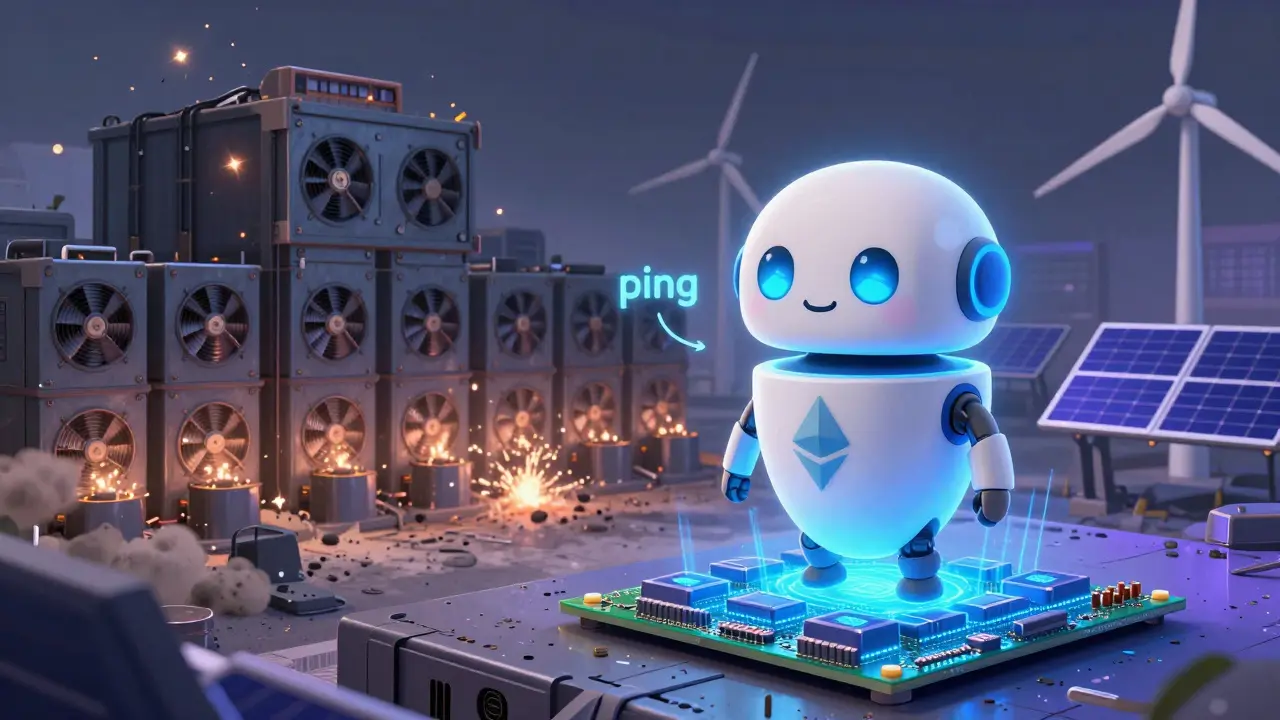
Hardware and Accessibility: Who Can Actually Participate?
Mining is becoming a corporate sport. The hardware is expensive, noisy, and outdated within 18 months. ASICs lose 50-70% of their value in a year. You need space, cooling, and technical skills. Setting up a profitable rig takes 40-60 hours for a beginner. Staking? You can do it from your laptop. Or your phone. If you use Coinbase or Binance, you click “Stake,” confirm, and you’re done. No setup. No cooling fans. No electricity bill. Even solo staking on Ethereum only takes 5-10 hours to configure, according to ConsenSys. And if you mess up? You might get slashed-meaning you lose a small portion of your stake for downtime or errors. In Q1 2023, Ethereum slashed over 1,700 ETH because of simple misconfigurations. But that’s not a dealbreaker. It’s a learning curve. And there’s tons of documentation. Ethereum’s official consensus layer docs have over 15,000 GitHub stars.Costs, Risks, and Rewards
Mining’s risks are physical: hardware failure, power outages, regulatory crackdowns. China banned mining in 2021. The hash rate dropped 50% overnight. Kazakhstan restricted mining during energy shortages. Your $10,000 rig could become a paperweight. Staking’s risks are financial and technical: slashing, exchange failures, lockup periods. Ethereum’s validator exit queue hit 16,000 people in mid-2023. If you want to unstake, you wait 15 days. And if you stake on Coinbase or Lido, you’re trusting them not to get hacked or go under. In 2023, 31% of all staked ETH was held by just three platforms: Lido, Coinbase, and Kraken. That’s centralization. But here’s the trade-off: mining’s losses are guaranteed. Staking’s risks are manageable. And rewards are steady. Coinbase paid out over $30 billion in staking rewards by mid-2023. That’s real money flowing to everyday users.
Who Should Stake? Who Should Mine?
If you’re a retail investor with a few thousand dollars and want passive income? Stake. No question. If you’re a tech enthusiast with a warehouse, cheap power, and a tolerance for hardware headaches? Maybe mine. But even then, you’re betting on Bitcoin’s price going up enough to cover your costs-and you’re competing against companies with billion-dollar budgets. For new blockchains? Almost all are building on PoS. Gartner predicts 80% of enterprise blockchain projects will use staking by 2025. Why? Because it’s cheaper, cleaner, and easier to scale. Ethereum’s upcoming “The Surge” upgrade will allow up to a million validators. That’s scalability mining could never match.The Future Is Staked
The blockchain world is moving fast. Mining isn’t dead-but it’s a niche. A relic of the early days. Bitcoin will keep running on PoW because it’s entrenched. But new projects? They’re choosing staking. Why? Because the world is watching. Investors care about ESG. Regulators care about energy. Users care about simplicity. Staking isn’t perfect. It has centralization risks. It’s not as battle-tested as Bitcoin’s PoW. But it’s the future. And if you’re starting out today, it’s the only smart way in.What’s Next?
If you want to start staking:- Choose a network: Ethereum, Solana, or Cardano are good starting points.
- Decide: Use an exchange (Coinbase, Binance) for simplicity, or a solo validator for full control.
- Never stake more than you can afford to lock up.
- Learn what slashing means-and how to avoid it.
- Run a profitability calculator with your local electricity rate.
- Factor in hardware depreciation.
- Ask yourself: Is this a hobby-or a business?
Is staking safer than mining?
Staking is safer for most people because it doesn’t require expensive hardware, high electricity bills, or technical setup. The main risks are slashing (losing a small amount of stake for downtime) and relying on exchanges. Mining risks include hardware failure, regulatory bans, and profitability loss due to rising energy costs. For non-technical users, staking is far safer.
Can I mine Ethereum anymore?
No. Ethereum fully switched to proof-of-stake in September 2022. Mining Ethereum is impossible now. Any service claiming to offer Ethereum mining is either outdated or a scam. If you want to participate in Ethereum’s network, you must stake.
How much money do I need to start staking?
You can start staking with as little as $10 using platforms like Coinbase, Kraken, or Lido. To run your own Ethereum validator, you need 32 ETH (around $59,000 as of late 2023). But most users don’t need to do that-liquid staking lets you earn rewards with smaller amounts and keeps your funds liquid.
Which is more profitable: staking or mining?
For 95% of people, staking is more profitable. Mining requires large upfront costs, high electricity, and constant maintenance. Most home miners lose money after accounting for hardware depreciation and power bills. Staking offers consistent returns with near-zero overhead. Ethereum stakers earn 3-4.2% APY. Solana stakers earn 6-12%. Mining Bitcoin rarely breaks even unless you have access to near-free power.
Is staking taxed?
Yes. In the EU, staking rewards are taxed as income when you receive them. In the U.S., the IRS treats them as taxable income at the time you receive them, based on their fair market value. Always consult a tax professional-rules vary by country and are evolving.
What happens if I stake on an exchange and it gets hacked?
If an exchange is hacked, your staked assets could be at risk. That’s why many prefer self-custody solutions like Rocket Pool or Lido. But even then, you’re trusting the protocol. Coinbase and Kraken have strong security records and insurance, but no platform is 100% immune. The trade-off is convenience vs. control.
Will Bitcoin ever switch to staking?
Almost certainly not. Bitcoin’s community values decentralization and security above all else-and proof-of-work is core to its identity. Changing to staking would require a hard fork and near-universal consensus, which is unlikely. Bitcoin will remain the last major PoW blockchain.
Can I stake multiple cryptocurrencies at once?
Yes. Platforms like Coinbase, Kraken, and Binance let you stake Bitcoin, Ethereum, Solana, Cardano, and others simultaneously. You can earn rewards from multiple chains without switching platforms. Just make sure you understand each network’s rules and risks.

SUMIT RAI
December 26, 2025 AT 15:45Andrea Stewart
December 27, 2025 AT 21:41Josh Seeto
December 27, 2025 AT 21:47surendra meena
December 29, 2025 AT 10:41Kevin Gilchrist
December 30, 2025 AT 06:11Khaitlynn Ashworth
January 1, 2026 AT 01:29Jordan Fowles
January 1, 2026 AT 23:33Steve Williams
January 3, 2026 AT 04:33Willis Shane
January 3, 2026 AT 21:46Jake West
January 5, 2026 AT 16:29