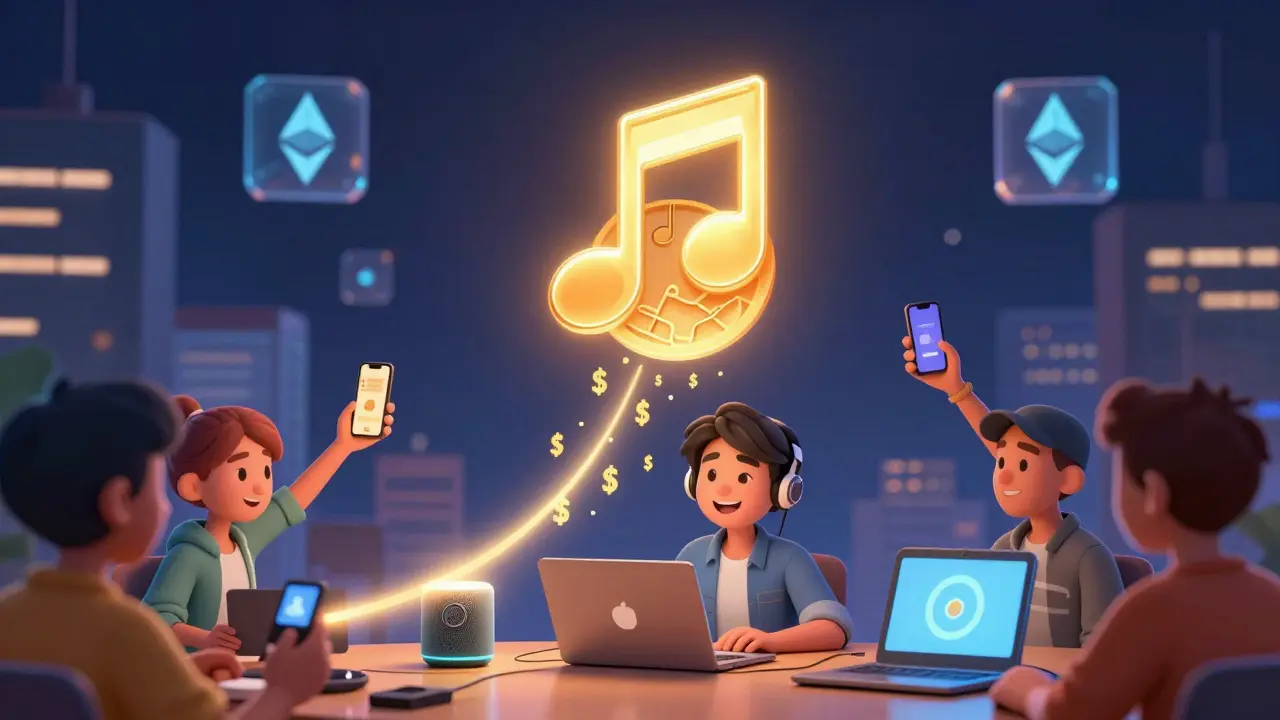
Imagine owning a piece of a song that keeps paying you every time someone streams it. Not just a share of the profits - but actual, verifiable, automatic payments built into the code. This isn’t science fiction. It’s what streaming rights as NFTs make possible today.
For years, musicians, podcasters, and indie filmmakers have watched their work get played millions of times on Spotify, YouTube, or Apple Music - and gotten pennies in return. Royalties take months, sometimes over a year, to arrive. Middlemen take cuts. Tracking who played what? Nearly impossible. Now, blockchain is stepping in with a new idea: turn access to streaming content into a digital token you can own, trade, and earn from directly.
What Exactly Are Streaming Rights as NFTs?
An NFT - or non-fungible token - is a unique digital certificate stored on a blockchain. Unlike Bitcoin or Ethereum, which are interchangeable, each NFT is one-of-a-kind. When applied to streaming, an NFT doesn’t store the video or audio file itself. Instead, it holds the right to access or redistribute that content under specific conditions.
Think of it like a backstage pass. The pass doesn’t contain the concert - but it proves you’re allowed in. Similarly, an NFT for a song might give you permission to stream it on your website, share it with friends, or even resell the access. The real magic? Every time that NFT changes hands or gets used, the original creator gets paid automatically through a smart contract.
For example, when artist 3LAU sold his album as NFTs in 2021, he earned $11.7 million. Each time someone streamed the music, a portion of that stream went straight to him - no label, no delay. That’s the core promise: creators get paid faster, fairly, and without intermediaries.
How It Works Under the Hood
At the technical level, streaming rights as NFTs rely on three key pieces:
- Smart contracts - Self-executing code on blockchains like Ethereum. These define who can stream, how often, and how much royalty gets paid.
- IPFS (InterPlanetary File System) - A decentralized storage system that holds the actual audio or video files. Unlike regular links, IPFS doesn’t break when a server shuts down.
- Blockchain tokens - The NFT itself, usually built on ERC-721 or ERC-1155 standards, which track ownership and usage history.
Here’s how a typical flow works:
- A musician uploads a track to IPFS and creates an NFT representing streaming rights.
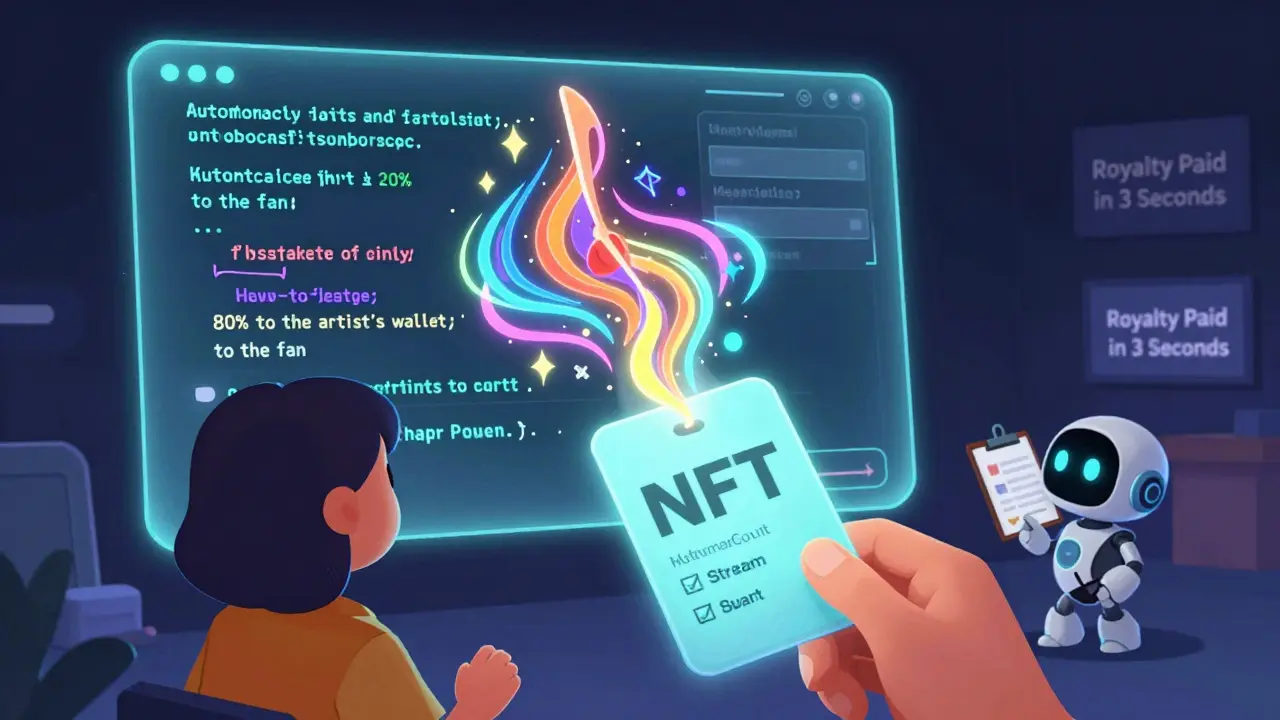
- The smart contract sets rules: “$0.02 per stream, 80% to creator, 20% to holder if resold.”
- A fan buys the NFT using crypto.
- When they stream the track, the smart contract automatically sends the royalty to the artist’s wallet - often within minutes.
This system eliminates the 6- to 18-month delays common in traditional streaming. No more waiting for ASCAP or SoundExchange to process payments. The blockchain does it instantly.
Why This Matters More Than You Think
Traditional streaming platforms pay artists based on a pro-rata model: total revenue divided by total streams. That means if you’re a niche artist with 10,000 monthly listeners, you might earn less than $10. Meanwhile, top 1% of artists get 90% of the money.
NFT-based streaming flips that. If you own the NFT that grants access to a track, you’re not just a listener - you’re a stakeholder. You can:
- Hold it as an investment
- Resell it for profit
- Use it to unlock exclusive content
- Get paid when someone else streams it
Platforms like Audius and Theta Network are already testing this. Audius, a decentralized music platform, had 6.5 million monthly users in Q2 2023. Users don’t just listen - they earn. Some artists report full royalty payouts within 24 hours, compared to the 9-month wait on Spotify.
And it’s not just music. Filmmakers are using NFTs to sell limited-edition streaming access to indie films. Podcasters are offering exclusive episodes tied to NFT membership. Even sports highlights are being tokenized - think of a viral dunk that pays the athlete every time it’s replayed.
The Real Problems - And Why It’s Not Everywhere Yet
Don’t get it twisted: this isn’t a magic fix. It’s a work in progress.
First, gas fees. On Ethereum’s main network, each transaction can cost $1-$5. That’s fine for buying a $50 NFT - but ridiculous if you’re trying to pay a creator $0.02 per stream. That’s why most platforms now use Layer 2 solutions like Polygon or Arbitrum, where fees drop to under $0.01.
Second, content storage. If the IPFS link breaks - and it does - your NFT becomes a dead key. Users on Reddit report waiting weeks just to get their stream working again after a storage provider changed addresses. Solutions like Pinata or Arweave help, but they’re not yet standard.
Third, user experience. You need a crypto wallet. You need to understand private keys. You need to know what a gas fee is. Most people don’t. That’s why NFT streaming platforms have an average Trustpilot rating of 2.8 out of 5 - with 62% of complaints about technical access issues.
And then there’s the legal gray zone. The U.S. Copyright Office made it clear in March 2023: owning an NFT doesn’t mean you own the copyright. You own the token. Not the song. Not the movie. Just the access rights - and only if the smart contract says so. If the creator didn’t clearly license the rights, you could be violating copyright law just by streaming.
Who’s Winning - And Who’s Losing
Right now, the biggest winners are independent creators. No gatekeepers. No contracts. Just direct fan support.
3LAU, as mentioned, made millions. Other artists like Grimes and Steve Aoki have used NFTs to release limited tracks, with fans paying hundreds - even thousands - for early access.
Meanwhile, major platforms are watching. Spotify launched “Artist Fundraising Links” in September 2023, letting fans buy NFT-style tokens to support creators directly. Apple filed a patent in August 2023 for a blockchain-based media system. Universal Music Group bought an NFT company. Warner Music partnered with Royal to tokenize music rights.
But here’s the catch: these companies aren’t trying to replace Spotify or Apple Music. They’re adding NFT features on top - like premium upgrades. The real disruption is happening on the edges, where creators bypass the big platforms entirely.
What’s Next? The Road Ahead
By 2026, experts predict NFT-based rights management will hit $8.2 billion in transaction volume. That’s not the whole streaming market - it’s a slice. But it’s a growing slice.
Platforms are working on fixes:
- Real-time royalties - Theta Network aims to pay creators within 10 seconds.
- Simpler wallets - Services like Fortmatic and Authereum are letting users log in with email, not crypto keys.
- Standardized licensing - The ERC-2981 royalty standard is gaining traction to make royalty splits predictable.
Will NFTs replace Netflix or YouTube? Probably not. Too many users. Too much infrastructure. But for niche content - live shows, rare albums, indie films, experimental podcasts - they’re already the better option.
The future isn’t about replacing streaming. It’s about reclaiming it. Giving creators control. Giving fans ownership. Making sure the people who make the content actually benefit from it.
It’s not perfect. It’s not easy. But for the first time in decades, the people who create the music, films, and shows are starting to get paid like they matter.
Do NFTs store the actual video or audio files?
No. NFTs only store the ownership record and access rights. The actual media files are stored on decentralized networks like IPFS or Arweave. The NFT acts like a key that unlocks the file - not the file itself.
Can I resell a streaming NFT?
Yes - if the smart contract allows it. Many NFTs for streaming rights include royalty clauses that pay the original creator a percentage every time the NFT is resold. This creates ongoing income for artists even after the initial sale.
Are streaming NFTs legal?
It depends. Owning an NFT doesn’t automatically give you copyright to the content. You only have the rights explicitly granted in the smart contract. If those rights aren’t properly licensed, you could be infringing on copyright law. Always check the terms before buying.
Do I need crypto to buy a streaming NFT?
Mostly yes - but some platforms now let you buy with credit cards through wallet-as-a-service providers like Fortmatic or Coinbase Wallet. Still, you’ll need a crypto wallet to access the content after purchase.
Why aren’t Spotify and Apple using this everywhere?
They’re experimenting, but scaling NFT streaming to hundreds of millions of users is technically hard. Gas fees, storage reliability, and user onboarding are still major hurdles. For now, they’re using NFTs as premium add-ons - not replacements.
What’s the environmental impact?
It’s much better than it used to be. Since Ethereum switched to proof-of-stake in September 2022, its energy use dropped by over 99%. Most streaming NFTs now run on low-energy blockchains like Polygon or Arbitrum, making them as green as a regular website.
