When you look at a cryptocurrency chart, it’s easy to get hooked on price swings. But if you’re serious about investing in crypto, you’re not just betting on hype-you’re betting on the tokenomics. Tokenomics isn’t just a buzzword. It’s the economic blueprint behind every coin or token. It answers the question: Why does this token have value? And more importantly, will that value last?
What Exactly Is Tokenomics?
Tokenomics is the study of how a cryptocurrency’s economic system works. It combines "token" and "economics"-and it’s not about how much the price went up last week. It’s about the rules built into the code that determine how tokens are created, distributed, used, and destroyed.Think of it like a country’s monetary policy. Central banks control money supply, interest rates, and inflation. In crypto, those rules are written into smart contracts. No human can change them overnight. That’s what makes tokenomics powerful-and dangerous if it’s poorly designed.
Projects with strong tokenomics don’t just rely on marketing. They build systems where holding, using, or staking the token creates real incentives. Weak tokenomics? That’s where you find coins that surge on a tweet and crash when the team sells their holdings.
Key Components of Tokenomics You Must Check
Not all tokens are created equal. To evaluate one properly, you need to dig into five core elements:
- Total Supply: The maximum number of tokens ever to exist. Bitcoin’s is capped at 21 million. That’s intentional scarcity. Ethereum, on the other hand, has no hard cap-its supply grows slowly, but burns more than it mints, making it effectively deflationary.
- Circulating Supply: The number of tokens actually available to the public. This matters more than total supply. For example, Solana had a total supply of 505 million tokens in late 2023, but only 56% were circulating. The rest were locked up in team or investor wallets.
- Market Cap: Price × circulating supply. Don’t be fooled by a high market cap if the token is easy to flood. Shiba Inu has a $12 billion market cap, but its price per token is $0.000007 because there are 589 trillion tokens. Compare that to Yearn.finance, with only 30,000 tokens in circulation and a $90 million market cap-each one worth about $3,000. The difference? Supply design.
- Distribution: Who holds the tokens? If 40% of a token’s supply goes to the founding team with no vesting schedule, that’s a red flag. Data from Token Terminal shows projects allocating over 25% to private investors without vesting had a 73% failure rate between 2020 and 2022.
- Utility: What can you actually do with the token? Ethereum’s ETH isn’t just a store of value-it’s required to pay for transactions on the network. In 2022, over $11.7 trillion in value flowed through Ethereum because people needed ETH to use it. Chainlink’s LINK pays node operators for delivering real-world data. If a token has no use beyond speculation, its value is fragile.
Supply Models: Fixed, Inflationary, or Deflationary?
How a token’s supply changes over time is one of the biggest drivers of its long-term value.
Fixed supply models, like Bitcoin, create scarcity. Every four years, Bitcoin’s block reward halves-from 50 BTC in 2009 to 6.25 in 2020, and down to 3.125 in April 2024. This predictable reduction in new supply has historically correlated with price increases.
Inflationary models are common in proof-of-stake networks. Cosmos, for example, has an annual inflation rate between 7% and 20%. That’s okay if staking rewards are high enough to justify the dilution. But if the network doesn’t grow usage, inflation just erodes value.
Deflationary models are becoming the gold standard. Ethereum’s "burn" mechanism, introduced after the Merge in 2022, destroys a portion of ETH every time someone sends a transaction. In 2022, it burned 1.4% of the total circulating supply. That’s not just a gimmick-it’s a direct reduction in supply. Projects like Aave and Polygon use similar burns, and they’ve outperformed inflationary tokens by over 200% since 2020.
Real-World Examples: What Works and What Doesn’t
Let’s look at three very different tokens and why their tokenomics succeeded-or failed.
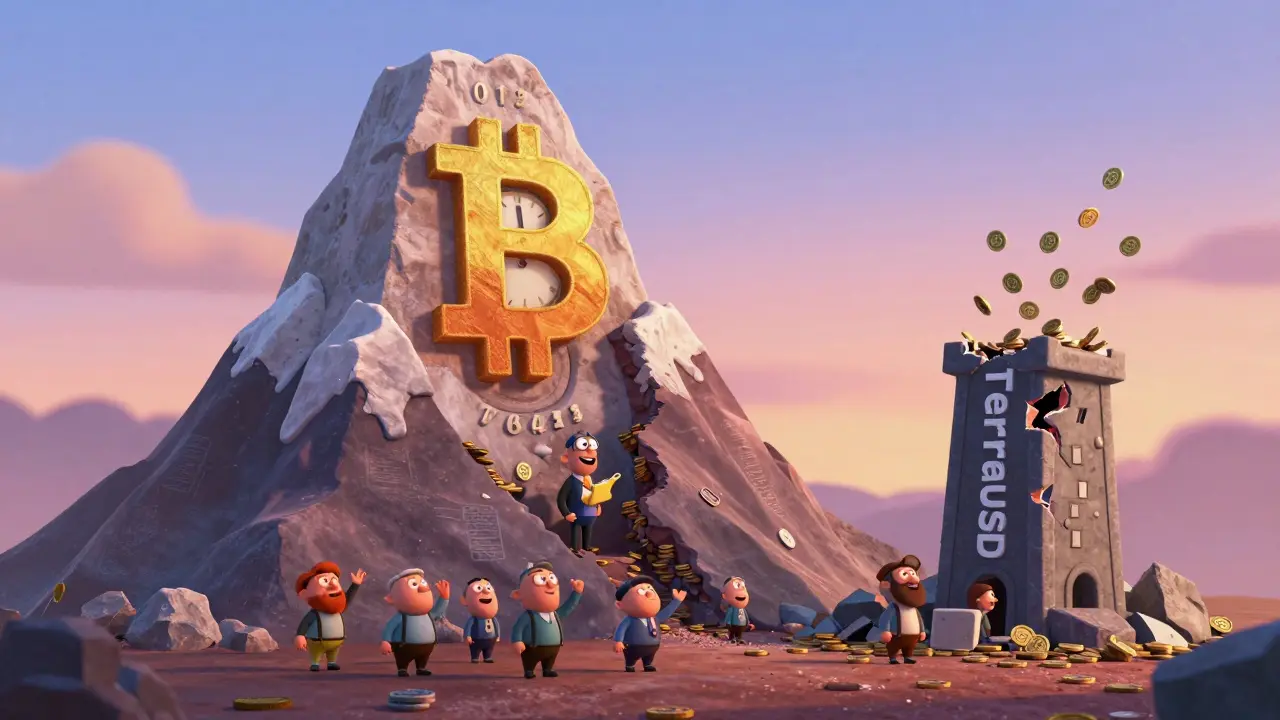
Bitcoin: Simple, clear, predictable. Fixed supply. Halving every four years. Miner rewards decrease over time, forcing scarcity. No team allocation. No central authority. That’s why it’s the most trusted digital asset.
Uniswap (UNI): This governance token gives holders voting power over the protocol. Only 15% of its supply went to the team-with a four-year vesting schedule. 43% went to the community treasury. That alignment meant users had skin in the game. By September 2023, over 117 governance proposals had been voted on. That’s not just tokenomics-it’s decentralized governance in action.
TerraUSD (UST): This was supposed to be a stablecoin pegged to the dollar. But its tokenomics relied on an algorithm that created and destroyed UST and LUNA tokens to maintain the peg. No real reserves. No transparency. When confidence dropped, the system collapsed in May 2022, wiping out $40 billion in value. The problem? No real utility. No backing. Just math that broke under pressure.
Red Flags in Tokenomics
Not every project is honest. Here are the warning signs you should never ignore:
- Team allocation over 25% with less than two years of vesting. That’s a giveaway they plan to dump.
- FDV/Circulating Supply ratio above 10x. Fully Diluted Valuation (FDV) assumes all tokens are in circulation. If FDV is 15x higher than current market cap, that means a massive amount of tokens are locked up and will hit the market soon. That’s selling pressure waiting to happen.
- No utility. If the token can’t be used to pay fees, vote, stake, or access a service, it’s just a speculative asset.
- High token unlocks in 3 months. TokenUnlocks data shows tokens with over 15% of supply unlocking in under 90 days see 62% more volatility. That’s not a feature-it’s a trap.
- Zero burn mechanism. In 2023, 72% of the top 100 tokens by market cap had some form of token burning. If a project doesn’t reduce supply, it’s betting on endless growth-and that rarely works.
How to Analyze Tokenomics Like a Pro
You don’t need a finance degree. Here’s a simple 5-step method:
- Read the whitepaper. Look for token allocation: team, investors, community, treasury. If it’s vague, walk away.
- Check CoinGecko or CoinMarketCap. Compare circulating supply to total supply. Look at FDV. Is it reasonable?
- Verify utility. Does the token actually get used? Check Etherscan for transaction volume or TokenTerminal for protocol revenue. If no one’s paying with it, it’s not real.
- Look at vesting schedules. Use TokenUnlocks or similar tools. Are big unlocks coming in the next 6 months? If yes, expect price pressure.
- Check social sentiment. Use LunarCrush to see if social volume stays steady during market drops. Tokens with strong fundamentals keep people talking-even when prices fall.
Experienced analysts say it takes 8 to 12 weeks of focused study to truly understand tokenomics. But you can start today. Pick one project you’re interested in. Run it through these five steps. You’ll know more than 90% of retail traders.
Why Institutional Investors Care About Tokenomics
Back in 2020, only 42% of crypto funds used tokenomics in their analysis. By 2023, that number jumped to 87%. Why? Because they got burned.
Institutional investors don’t gamble. They want to know: Will this token survive a bear market? A 2022 Cambridge study found that tokens with deflationary mechanics and real utility had 43% higher price stability during downturns. Coinbase’s 2023 report showed tokens with multiple utilities (staking, governance, fees) kept 68% more market cap during the 2022 crash.
Regulators are catching up too. The SEC’s 2023 enforcement actions targeted tokens with unfair distribution models. Now, smart projects limit private sales to under 20% to avoid being classified as unregistered securities.
The Future of Tokenomics
Tokenomics is evolving fast. The next wave isn’t just about supply and utility-it’s about dynamic models.
Aavegotchi’s "Tokenomics 3.0" adjusts token issuance based on real-time ecosystem activity. If usage goes up, more tokens are minted. If usage drops, supply slows. That’s like a central bank reacting to inflation-but coded into blockchain.
Real-world asset (RWA) tokenization is another frontier. BlackRock tokenized $100 million in U.S. Treasury bonds in March 2023. Now, tokens aren’t just digital assets-they’re claims on physical assets that pay interest. That’s a whole new layer of tokenomics: yield-backed value.
And with the EU’s MiCA regulation taking effect in 2024, token design will have to meet legal standards. Transparency, vesting, utility-these won’t be optional anymore.
Final Takeaway: Tokenomics Is the Foundation
Price tells you what people are paying right now. Tokenomics tells you why they should keep paying tomorrow.
Most crypto failures aren’t because of bad code. They’re because of bad economics. A team can have the best developers, the flashiest website, the biggest influencer backing-but if the tokenomics is broken, it will collapse.
Don’t chase pumps. Don’t follow memes. Look at the numbers. Ask: Is this token designed to last? Is value being created-or just redistributed?
Master tokenomics, and you stop being a trader. You become an investor.
What is the most important part of tokenomics?
The most important part is utility. A token with no real use case-even if it has a low supply or burning mechanism-will eventually lose value. ETH works because you need it to pay for transactions. LINK works because node operators earn fees for data services. Without utility, a token is just a speculative bet.
Can a token with high inflation still be valuable?
Yes-but only if the inflation is offset by strong demand. For example, Cosmos has 7-20% annual inflation, but it also offers high staking rewards (15-20% APY). If users are staking and locking up tokens, the inflation is absorbed by network growth. But if demand doesn’t grow, inflation just dilutes holders’ value.
Is Bitcoin’s tokenomics better than Ethereum’s?
They’re designed for different purposes. Bitcoin’s tokenomics is about scarcity and store of value-fixed supply, halvings, no utility beyond payments. Ethereum’s is about utility and network growth-uncapped supply, but with burning that reduces net inflation. Bitcoin wins on predictability. Ethereum wins on adaptability. Neither is "better"-it depends on what you’re investing for.
Why do some tokens have a vesting schedule?
Vesting schedules prevent insiders from dumping tokens right after launch. If the team gets 20% of tokens but can’t sell them for 2 years, they’re incentivized to build the project. Without vesting, you get quick pumps followed by crashes. Most successful projects use 2-4 year vesting for team and investors.
How do I find out when token unlocks are happening?
Use tools like TokenUnlocks, CoinMarketCap’s unlock schedule, or DappRadar. These platforms track when team, investor, and treasury tokens become tradable. If a large chunk (over 10%) is unlocking in the next 30-60 days, plan for potential price drops. Don’t buy right before a big unlock.
Are meme coins like Dogecoin doomed because of their tokenomics?
Not necessarily doomed-but they’re extremely risky. Dogecoin has no supply cap and mints 5 billion new coins every year. That’s massive inflation. Yet it still has a $10 billion market cap because of community hype and speculative demand. But history shows tokens without utility or scarcity rarely survive long-term bear markets. Dogecoin’s value is based on culture, not economics.
What’s the difference between FDV and market cap?
Market cap = current price × circulating supply. FDV = current price × total supply. FDV shows what the market cap would be if all tokens were in circulation. If FDV is 15x higher than market cap, it means 93% of tokens are still locked up. That’s a red flag-it means a huge wave of selling could hit the market later.
If you’re serious about crypto investing, stop chasing charts. Start studying tokenomics. It’s the only way to tell the difference between a project that’s building something real-and one that’s just trying to cash out.

Aaron Poole
January 27, 2026 AT 08:54Man, I wish more people would stop chasing pumps and actually read the whitepaper. Tokenomics isn't sexy, but it's the only thing keeping me from losing my shirt in this mess. I spent a week digging into Aave's burn mechanics last year and it saved me from dumping into that Terra collapse. Seriously, if you don't check supply and vesting, you're just gambling with your rent money.
Stop scrolling memes. Open CoinGecko. Look at the numbers. It's not that hard.
Ramona Langthaler
January 27, 2026 AT 19:40Andrea Demontis
January 28, 2026 AT 22:09There's something deeply human about how we assign value to abstract systems. We're wired to seek patterns, to believe in stories-even when they're encoded in smart contracts. Bitcoin’s scarcity mirrors our fear of inflation, our longing for permanence. Ethereum’s burn mechanism? It’s not just code-it’s a ritual of renewal, a digital equivalent of composting waste into fertile soil. And yet, we reduce all of this to market caps and APYs, as if economics could ever be divorced from psychology.
What if the real tokenomics isn’t in the supply curve, but in the collective belief that it matters? That’s the invisible layer no chart can capture.
Joseph Pietrasik
January 30, 2026 AT 02:13Raju Bhagat
January 30, 2026 AT 02:23laurence watson
January 31, 2026 AT 17:02I love how this post breaks it down without jargon. I showed this to my cousin who just got into crypto and she actually understood it. That’s rare. I think the biggest thing people miss is utility-it’s not about what the token can do for you, but what you can do with it. If you’re not using it, you’re just holding a speculative IOU.
Also, thank you for mentioning TokenUnlocks. I used to ignore unlock dates and got burned twice. Now I check them like a calendar. Small habits save portfolios.
Elizabeth Jones
February 2, 2026 AT 16:31Utility is indeed the cornerstone, but it must be paired with equitable distribution. A token with high utility but 40% held by a single entity is not decentralized-it’s a corporate shell with blockchain branding. The brilliance of Uniswap lies not just in its governance model, but in the deliberate dilution of control. That’s institutional-grade design disguised as community-driven chaos.
And yet, even the best tokenomics can’t survive regulatory capture. MiCA is coming. The real test won’t be whether the code works, but whether regulators let it.
Pamela Mainama
February 4, 2026 AT 12:01Rachel Stone
February 4, 2026 AT 21:38Nickole Fennell
February 5, 2026 AT 06:23I just cried reading this. After losing $20k on a token with no vesting and zero utility, I finally got it. I thought I was smart because I followed influencers. Turns out I was just emotionally addicted to the dopamine rush of price charts. This post didn’t just educate me-it saved me from repeating the same mistake.
Thank you. From the bottom of my heart. I’m reading the whitepaper now. I’m checking TokenUnlocks. I’m not buying anything until I understand the supply model. This is the first time I’ve ever felt like an investor instead of a gambler.
Edward Drawde
February 6, 2026 AT 06:48Richard Kemp
February 8, 2026 AT 03:51Biggest thing I learned? FDV isn’t just a number-it’s a warning sign. I bought a coin thinking the market cap was low, didn’t check FDV. Turns out 90% of tokens were locked. Three months later, the price dropped 70%. I’m not making that mistake again.
Also, if the team has a Discord with 50k members but zero GitHub commits? Run.
Meenal Sharma
February 8, 2026 AT 19:55One must question the underlying assumption: that tokenomics is a neutral, objective framework. In reality, it is a tool of financial colonization-designed by Western tech elites to repackage speculative capitalism as decentralized innovation. The burn mechanism? A psychological trick to simulate scarcity while centralized entities retain control of mining pools and exchange listings.
Who truly benefits? Not the retail investor. Not the global south. The same institutions that crashed the housing market now profit from crypto’s volatility under the guise of ‘economic design.’
Freddy Wiryadi
February 10, 2026 AT 14:20Man I’ve been reading this stuff for years and I still get tripped up by vesting schedules. I thought a 1-year vest was safe until I saw a project unlock 30% of supply in month 11 and crash 60% the next day 😅
Now I use TokenUnlocks like a weather app. If there’s a storm coming in 30 days, I don’t buy. I just wait. It’s boring but it works.
Also-emoji for utility: 🚀🔥💎. If you can’t point to one, walk away.
Brianne Hurley
February 10, 2026 AT 18:09How is this even considered a serious analysis? You’re glorifying a system that’s fundamentally unstable. Burning tokens doesn’t create value-it just redistributes it to early holders. And don’t get me started on Ethereum’s ‘deflationary’ label. The network is still minting 10,000 ETH per day. That’s not deflation-that’s inflation with a PR team.
Real value comes from tangible assets. Not math tricks.
christal Rodriguez
February 10, 2026 AT 23:50Tressie Trezza
February 11, 2026 AT 00:33I used to think tokenomics was boring until I started tracking unlocks. Last year I held onto a coin because I saw the team’s tokens weren’t unlocking until after the next halving. Turned out they were building something real. The price doubled.
It’s not about being smart. It’s about being patient. And checking the damn schedule.
Calvin Tucker
February 11, 2026 AT 16:47Tokenomics is the only thing separating crypto from Ponzi schemes. Without it, you’re just betting on who can shout the loudest. Bitcoin’s halving cycle is a masterpiece of predictable scarcity. Ethereum’s burn is a quiet revolution. Most projects? They’re just printing money and calling it innovation.
Read the whitepaper. If it reads like a startup pitch deck, run.
Rob Duber
February 12, 2026 AT 22:35Y’all act like tokenomics is some sacred text. Nah. It’s just the new Wall Street playbook with blockchain glitter. The only thing that matters is who’s holding the keys to the exchange, the liquidity, and the narrative. The rest? Fluff. I’ve seen projects with perfect tokenomics crash because the CEO got arrested. I’ve seen meme coins with zero utility go 100x because a billionaire posted a pic of his dog.
Don’t overthink it. Follow the money. Not the math.
Aaron Poole
February 14, 2026 AT 02:04So you’re saying the guy who studied tokenomics and avoided the Terra crash is just lucky? Or are you admitting that the people who actually understand the system are the ones who survive?
I’m not here to chase memes. I’m here to not lose everything. And yeah, I’d rather be boring than broke.