
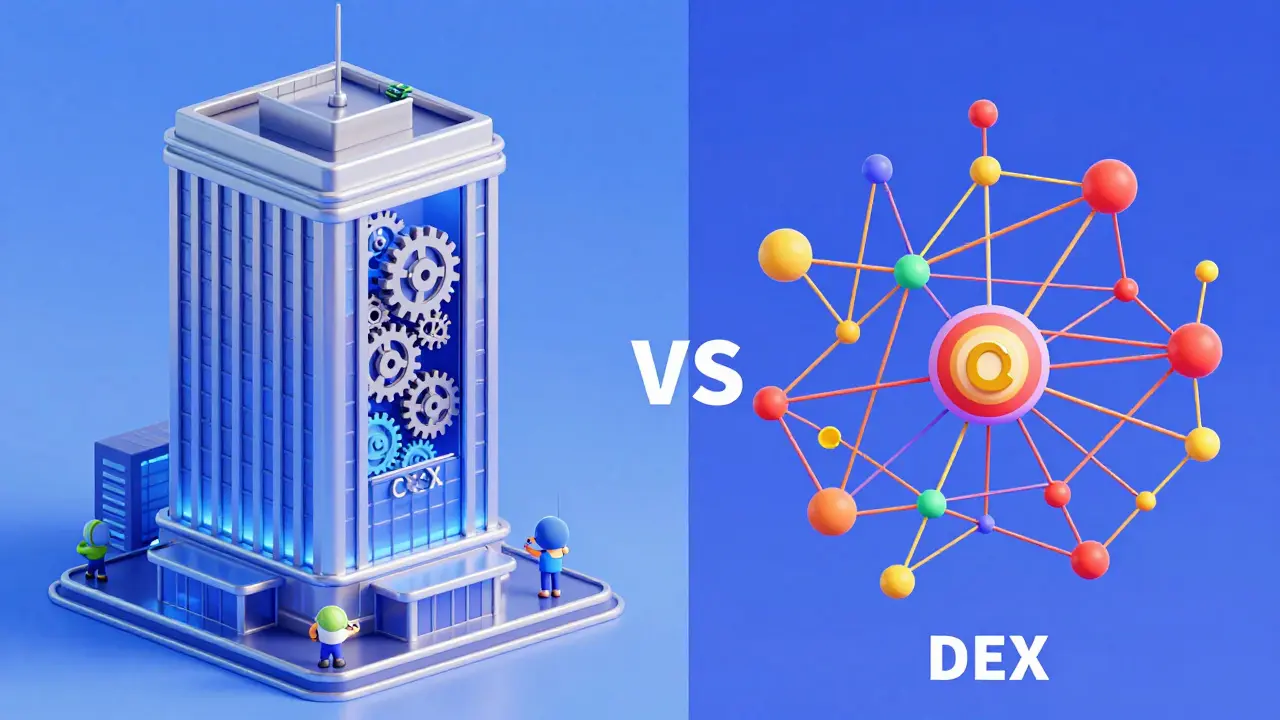
Have you ever looked at a price chart, clicked 'buy,' and then watched your profit vanish into thin air? That’s the hidden tax of trading fees. In 2026, the debate between Centralized Exchanges (CEX) is custodial platforms operated by entities like Binance or Coinbase that maintain internal order books and Decentralized Exchanges (DEX) is non-custodial smart contract systems like Uniswap that allow peer-to-peer token swaps without intermediaries isn’t just about ideology anymore. It’s about your wallet.
The landscape shifted dramatically in April 2026 when major players started slashing prices to win market share. If you’re trying to decide where to trade, you need to understand that there is no single "cheapest" option. The cost depends entirely on how much you trade, which blockchain you use, and whether you mind waiting for network congestion to clear up. Let’s break down the real math behind these fees so you can stop guessing and start saving.
The CEX Model: Predictable but Layered Costs
When you trade on a centralized exchange, you are interacting with a company’s internal database, not the blockchain directly. This architecture allows them to offer fixed percentage fees. However, "fixed" doesn’t always mean "simple." Most CEXs use a maker/taker model. A maker adds liquidity to the order book (limit orders), while a taker removes it (market orders). Takers usually pay more because they consume liquidity.
As of mid-2026, the standard spot trading fee on global giants like Binance is a leading global cryptocurrency exchange offering spot and futures trading with tiered fee structures sits at 0.10% for both makers and takers for regular users. If you hold their native token, BNB, you might get a discount down to 0.075%. But here is the catch: these rates drop significantly if you move high volumes. VIP traders moving over $1 million monthly can see fees plummet toward 0.02% or lower.
Then there is the regional competition. On April 22, 2026, Binance.US is the United States-based subsidiary of Binance that recently slashed fees to attract retail traders announced a radical shift: 0.00% maker fees and 0.02% taker fees for all spot pairs. No volume requirements. No subscriptions. Compare that to Coinbase is a popular US-based exchange known for ease of use but higher retail trading fees ranging from 0.40% to 0.60%, where retail traders often face taker fees around 0.60%. On a $1,000 trade, that’s a difference of $6 versus $0.20. That is a massive gap.
But don’t celebrate too fast yet. CEXs have other costs. Fiat deposits via credit card can range from 0.50% to nearly 5%. Withdrawals vary by asset and network. If you are trading small amounts frequently, those deposit and withdrawal fees can eat up any savings you made on the trade itself.
The DEX Model: Swap Fees Plus the Gas Tax
On a decentralized exchange, there is no company taking a cut. Instead, fees go directly to Liquidity Providers (LPs)-people who lock their crypto in pools to facilitate trades. The protocol fee is usually straightforward. For example, Uniswap v3 is a leading AMM DEX that introduced concentrated liquidity and multiple fee tiers to improve capital efficiency uses three main tiers: 0.05% for stablecoins, 0.30% for most ERC-20 tokens, and 1.00% for volatile or exotic pairs.
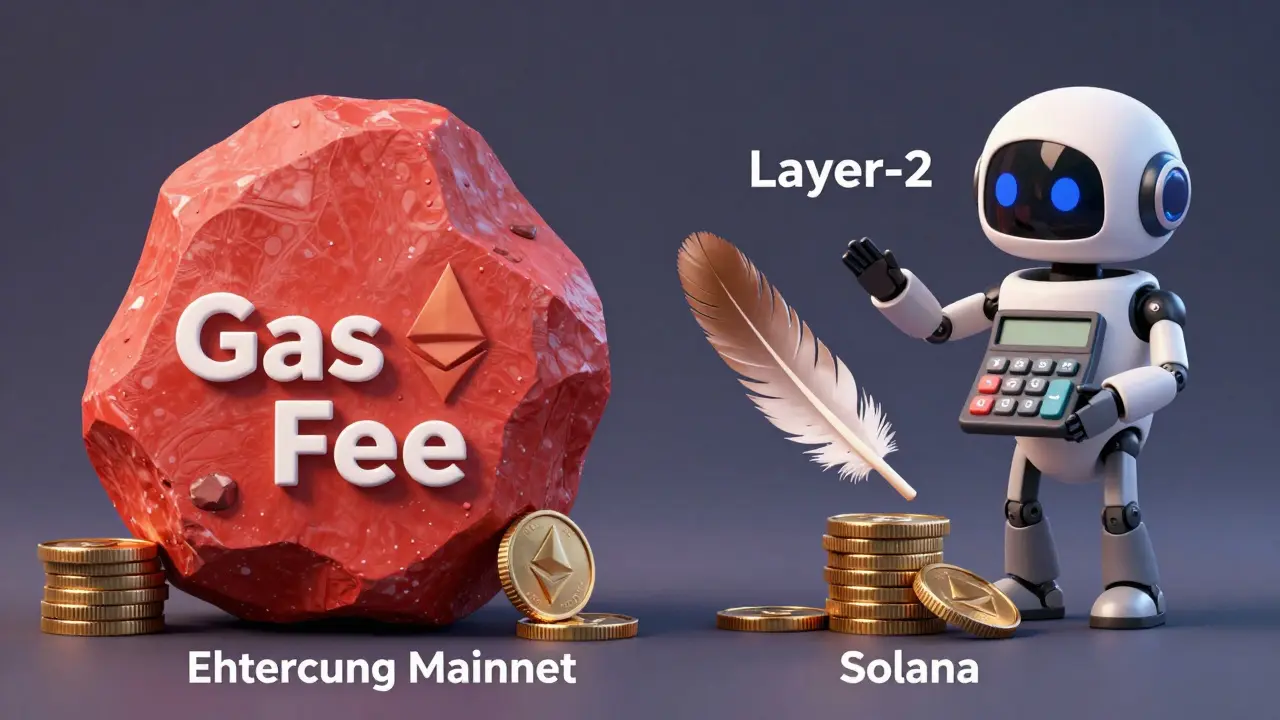
So, a 0.30% swap fee sounds expensive compared to Binance.US’s 0.02%, right? Not necessarily. You have to add the gas fee. Gas is the payment you make to the blockchain network to process your transaction. This is where DEX trading gets tricky.
If you trade on Ethereum Mainnet is the original smart contract platform that suffers from high congestion and gas fees during peak times during a busy period, gas can exceed $50. If you swap $1,000 worth of tokens, your 0.30% protocol fee is $3, but your gas is $50. Your total cost is $53, or 5.3% of your trade. That is astronomically higher than any CEX.
However, if you use a Layer-2 solution like Arbitrum is an Ethereum Layer-2 scaling solution that reduces transaction costs by approximately 95% compared to mainnet or Optimism is another Ethereum Layer-2 network offering low-cost transactions typically between $0.50 and $2.00, gas drops to roughly $0.50-$2.00. Now, your $1,000 swap costs $3 (protocol) + $1 (gas) = $4, or 0.40%. That’s competitive with many CEXs.
And if you trade on Solana is a high-throughput blockchain known for sub-cent transaction fees and fast finality? Gas is less than $0.01. Your total cost is essentially just the 0.30% swap fee. Suddenly, the DEX looks very attractive again.
Head-to-Head: Real-World Cost Scenarios
To make this concrete, let’s look at three common trading scenarios. These numbers reflect the market reality as of July 2026.
| Scenario | Platform / Network | Fee Type | Total Cost ($) | Effective % |
|---|---|---|---|---|
| Low-Fee CEX | Binance.US (Taker) | 0.02% Trading Fee | $0.20 | 0.02% |
| Standard Global CEX | Binance Global (VIP 0) | 0.10% Trading Fee | $1.00 | 0.10% |
| Retail CEX | Coinbase (Retail Tier) | ~0.60% Trading Fee | $6.00 | 0.60% |
| DEX on L2 | Uniswap on Arbitrum | 0.30% Swap + ~$1 Gas | $4.00 | 0.40% |
| DEX on Solana | Jupiter/Raydium | 0.30% Swap + <$0.01 Gas | $3.01 | 0.30% |
| DEX on Ethereum | Uniswap Mainnet (Congested) | 0.30% Swap + ~$50 Gas | $53.00 | 5.30% |
Notice the pattern? If you are trading large volumes on a major pair, the aggressive CEX fees (like Binance.US’s 0.02%) are hard to beat. But if you are trading smaller amounts on high-efficiency chains like Solana, or using Layer-2s for DeFi access, the DEX can be cheaper than traditional retail CEXs like Coinbase.
Hidden Factors: Slippage and Liquidity
Fees are only part of the story. You also need to consider slippage. Slippage is the difference between the expected price of a trade and the price at which the trade is executed. This happens when there isn’t enough liquidity in the pool or order book.
CEXs generally have deeper liquidity for major pairs like BTC/USDT or ETH/USDT. Because they aggregate orders from thousands of users off-chain, you can usually execute large trades without moving the price much. On a DEX, if you try to swap a large amount of a niche token, you might deplete the available liquidity in the pool. The protocol will charge you the 0.30% fee, but you’ll also lose value because you got a worse rate. For large institutional trades, this makes CEXs far more efficient despite similar nominal fees.
Conversely, for long-tail assets-new tokens that haven’t been listed on major CEXs yet-DEXs are your only option. Here, the fee structure matters less because you have no alternative. But be aware that some newer DEX protocols are experimenting with dynamic fees. Uniswap v4 is the next generation of Uniswap introducing hooks and dynamic fees that adjust based on volatility and gas conditions, launching in 2026, allows pools to adjust fees in real-time. This means fees could spike during high volatility to protect LPs, adding another layer of complexity to cost prediction.
Which One Should You Choose?
Your choice shouldn’t be ideological; it should be mathematical. Ask yourself these questions:
- What is your trade size? If you are trading under $500, gas fees on Ethereum will destroy your returns. Use a CEX or a low-gas chain like Solana or Base.
- Do you want custody? CEXs hold your keys. If the exchange goes bankrupt (remember FTX?), your funds are at risk. DEXs require self-custody via wallets like MetaMask. You bear the responsibility, but you also retain control.
- Are you trading mainstream or niche assets? For Bitcoin and Ethereum, CEXs often have better liquidity and lower effective costs due to fee wars. For new DeFi tokens, you must use a DEX.
- How often do you trade? High-frequency traders benefit immensely from the 0.00%/0.02% CEX models. Casual swappers might find the simplicity of a DEX on a Layer-2 sufficient.
In 2026, the lines are blurring. Hybrid solutions are emerging, and Layer-2 adoption is making DEX gas costs negligible for most users. The "best" exchange is the one that aligns with your specific trade size, asset choice, and risk tolerance. Don’t just look at the advertised percentage; calculate the all-in cost including gas, slippage, and withdrawal fees. That’s how you keep more of your money.
Are DEX fees really lower than CEX fees?
It depends on the network. On Ethereum mainnet, DEX fees are often much higher due to gas costs. However, on Layer-2 networks like Arbitrum or high-speed chains like Solana, DEX swap fees (typically 0.05%-0.30%) can be competitive with or even lower than retail CEX fees, especially if the CEX charges high spreads or deposit fees.
Why did Binance.US cut fees to 0.00% in 2026?
Binance.US implemented this strategy to compete aggressively with Coinbase and other retail-focused exchanges. By eliminating maker fees and reducing taker fees to 0.02%, they aim to capture market share from traders frustrated by higher costs elsewhere. This is a marketing lever to drive volume, which they monetize through other services like staking and lending.
What is the difference between a maker and a taker fee?
A maker adds liquidity to the order book by placing a limit order that waits to be filled. A taker removes liquidity by placing a market order that executes immediately against existing orders. Because takers provide immediacy, they typically pay higher fees than makers.
Is it safe to trade on a DEX?
DEXs remove counterparty risk associated with exchange bankruptcy, but they introduce smart contract risk. If the code has bugs, funds can be lost. Additionally, users must manage their own private keys. Losing your seed phrase means losing access to your funds forever. Always verify contract addresses and use reputable wallets.
How do gas fees affect small trades on a DEX?
Gas fees are fixed per transaction regardless of trade size. If gas is $5 and you trade $50, you are paying a 10% fee effectively. This makes DEXs inefficient for very small trades on expensive networks like Ethereum. For small trades, use low-cost chains like Solana, Polygon, or Layer-2s, or stick to a CEX.

KEITH WONG
July 4, 2026 AT 15:10bro really thought he could explain this without mentioning the hidden spread on dexes 🤡 its not just gas and swap fees. slippage eats you alive if you dont know what you are doing.
Anuj Kashyap
July 5, 2026 AT 23:25One must ponder the existential dread of watching one's capital evaporate into the ether, much like a dream upon waking 😔 The irony is palpable when we consider that both systems are merely different flavors of extraction. We chase efficiency in a market designed for inefficiency. It is a philosophical trap wrapped in a financial spreadsheet. Why do we trust code more than men? Or vice versa? The answer lies in our collective paranoia. We seek control in chaos but find only new forms of servitude. Perhaps the true cost is not monetary but spiritual. We trade freedom for convenience or security for autonomy. It is a choice between two shades of gray. And yet we argue over percentages as if they hold ultimate truth. How quaint. How human. The chart does not care about your feelings. The blockchain does not care about your soul. Only the ledger remains. And it is always balanced. In blood and bits. So let us trade. Let us lose. Let us learn. For in the end, we are all just liquidity providers to the house. Whether that house is Binance or Uniswap matters little to the architect. They watch from above. Smiling. Always smiling. 🧘♂️
Guy Davis
July 7, 2026 AT 07:03typical article ignores the fact that cexs can just freeze your account anytime. zero security.
Hamza k
July 8, 2026 AT 00:44The audacity of these centralized platforms to act as gatekeepers is nothing short of breathtakingly arrogant! They sit on their hoarded assets while we beg for access. It is a theater of power disguised as service. I refuse to participate in such a corrupt system. My keys my coins is not just a slogan it is a moral imperative. To trust another with your wealth is to invite disaster. The decentralized alternative is messy yes but it is honest. It respects the individual. It does not demand submission. Stand up against the tyranny of the order book. Embrace the chaos of the smart contract. Freedom is expensive but slavery is free. Choose wisely. 🚀
Michelle Walker
July 8, 2026 AT 01:34you are all idiots. read the table again. binance.us is clearly winning for small trades. stop whining about decentralization if you cant afford the gas.
Tracy Marshall
July 9, 2026 AT 08:40i dont trust any of this stuff they are all part of the same conspiracy to steal our money. the government wants us to use their digital currency instead. be careful out there :)
Natalie Lucas
July 10, 2026 AT 12:10omg this is so helpful!! i was so confused about why my profits were gone. thanks for breaking it down. im gonna try arbitrum now. lets gooo ✨
Steven Briggs
July 10, 2026 AT 18:07gas fees on mainnet are still too high for me. i stick to solana mostly. simpler.
Ruth Williams
July 12, 2026 AT 11:40It is truly disheartening to see the level of financial illiteracy displayed in this thread. The distinction between custodial and non-custodial solutions is elementary. One requires faith in an entity the other requires faith in mathematics. If you cannot grasp this fundamental dichotomy perhaps you should refrain from trading altogether. The market will punish your ignorance swiftly and mercilessly. Do not expect sympathy when you lose everything due to your own negligence. Education is paramount. Diligence is mandatory. Anything less is mere gambling.
Kristy Morrow
July 12, 2026 AT 13:12everyone says dex is better but have you ever tried to recover a lost private key? good luck with that. centralization has its perks like customer support. dont be a fool.
John Harman
July 12, 2026 AT 17:04look i traded back in 2017 and fees were higher then. now its pretty cheap everywhere. just pick one and move on. stop overthinking it.
Brad Semp
July 14, 2026 AT 12:08The nuances of liquidity provision are often overlooked by the masses who prefer the simplicity of a button click. However, those who understand the mechanics of automated market makers recognize the superior efficiency of concentrated liquidity. It is not merely about fee percentages; it is about capital utilization. A sophisticated trader understands that risk-adjusted returns are the only metric that matters. The rest is noise generated by amateurs chasing yield without comprehension. True expertise lies in navigating these complexities with precision and grace. Do not confuse ease of use with effectiveness. They are rarely synonymous in high finance.
Kat Barr
July 15, 2026 AT 10:50hey guys!! dont worry too much about the fees!! just focus on making gains!! if you buy low and sell high the fees wont matter so much!! stay positive!! keep learning!! you got this!! 💖✨🌈
Korn Arrieta
July 15, 2026 AT 19:56this analysis is flawed because it ignores impermanent loss for lp. most people here dont even know what that means. typical reddit crowd. useless information overall.
Curtis Johnson
July 17, 2026 AT 19:20let's just agree that everyone has their own strategy. some like safety others like control. no need to fight. peace and love traders. maybe we can all coexist in this volatile market. it is big enough for all of us. let's support each other. 🙏
Jackie D
July 18, 2026 AT 00:37i wonder if the layer 2s will eventually merge or if they will stay separate ecosystems. it feels like a fragmented landscape right now. interesting times though. lots of opportunities for those who look closely.
Logan Edmison
July 18, 2026 AT 02:55philosophy aside the math is simple. if you trade small amounts cex is cheaper. if you trade large amounts dex on l2 might be better. depends on volume. thats all.
Antony Lopez
July 18, 2026 AT 17:17american exchanges are regulated for a reason. foreign exchanges are risky. stick to coinbase or kraken if you live in the us. dont risk your money on offshore scams.
Kim Kay
July 18, 2026 AT 21:56i found this really useful thank you. i was paying way too much on coinbase. switching to binance.us seems like a no brainer for now. hope it stays stable.
Sophie Nakasako
July 19, 2026 AT 17:44What fascinates me is how the infrastructure evolves to meet demand. Layer 2s are a brilliant solution to the scalability trilemma. It shows that innovation drives competition which benefits the user. We should encourage this diversity of networks. Each has its strengths. Ethereum for security Solana for speed Arbitrum for compatibility. Together they form a robust ecosystem. Let us celebrate this progress rather than criticize the costs. The future is bright and decentralized. 🌟