
Imagine you’ve written a perfect smart contract is a self-executing agreement with terms directly written into code. It’s designed to automatically pay out insurance if it rains more than two inches in Boulder this week. The code is flawless. The logic is sound. But here’s the catch: the blockchain has no idea what the weather is doing outside. It lives in a digital vacuum, completely cut off from the physical world.
This is the fundamental limitation of every blockchain system. They are secure, transparent, and immutable, but they are also blind. They cannot natively access data that exists outside their network-like stock prices, sports scores, flight delays, or weather reports. This disconnect is known as the oracle problem is the challenge of getting real-world data securely onto a blockchain for smart contracts to use.
Enter blockchain oracles is services that act as bridges between blockchains and external data sources, enabling smart contracts to interact with real-world information. Think of them as the messengers that fetch data from the outside world, verify its accuracy, and deliver it to the blockchain so your smart contract can do its job. Without oracles, smart contracts would be locked in a box, unable to react to anything happening in reality.
How Blockchain Oracles Actually Work
To understand how an oracle functions, you have to look at its two main parts: the on-chain component and the off-chain component. These work together like a relay team.
First, the off-chain node goes out into the internet. It might query a weather API, scrape a sports website, or read data from an IoT sensor. This part of the process happens outside the blockchain because blockchains are too slow and expensive to handle raw web requests. Once the oracle node gathers the data, it doesn’t just send it blindly. It verifies the information. This verification step is crucial. It uses cryptographic proofs, reputation systems, or consensus among multiple nodes to ensure the data hasn’t been tampered with.
Once the data is verified, it is transmitted to the on-chain oracle contract. This is a piece of code living on the blockchain itself. It receives the signed data and makes it available to any smart contract that needs it. For example, if your insurance smart contract asks, “Did it rain?” the oracle contract provides the confirmed answer, triggering the payout.
This architecture solves a major efficiency problem. Processing complex data queries on-chain is incredibly costly. By moving the heavy lifting off-chain, oracles make transactions up to 100 times more efficient. This is why platforms like Ethereum is a leading public blockchain platform that supports smart contracts and decentralized applications rely heavily on oracles-they keep the network fast and affordable while still accessing rich external data.
The Oracle Problem: Why Can’t Blockchains Just Fetch Data?
You might wonder why we can’t just build a feature into Ethereum or Bitcoin that lets them check a website directly. The answer lies in the core design philosophy of blockchains: determinism.
For a blockchain to remain secure and decentralized, every single computer (node) on the network must calculate the exact same result when processing a transaction. If one node gets different data than another, the network splits, and consensus breaks. This is catastrophic for security.
If a smart contract tried to fetch live data from a central server, that server could give different answers to different nodes, or worse, be hacked to provide false data. Since blockchains cannot trust external sources by default, they refuse to accept unsolicited external input. This creates the "oracle problem": how do you get trustworthy external data onto an untrustworthy network without breaking the rules of consensus?
Oracles solve this by acting as trusted intermediaries. Instead of the blockchain fetching data, the oracle fetches it, signs it cryptographically, and presents it as a verifiable fact. The blockchain doesn’t need to trust the internet; it only needs to trust the mathematical proof provided by the oracle.
Types of Blockchain Oracles
Not all oracles are created equal. Depending on what you need to achieve, different types of oracles serve different purposes. Understanding these distinctions helps you choose the right tool for your project.
- Inbound Oracles: These bring data from the outside world into the blockchain. This is the most common type. Examples include feeding live cryptocurrency prices to a lending protocol or sending weather data to an insurance contract.
- Outbound Oracles: These do the reverse. They allow smart contracts to trigger actions in the real world. For instance, a smart contract could instruct an outbound oracle to release funds to a bank account once certain conditions are met.
- Centralized Oracles: Run by a single entity. They are easy to set up and cheap, but they create a single point of failure. If that one entity is hacked or acts maliciously, the entire system is compromised.
- Decentralized Oracle Networks (DONs): These use multiple independent nodes to gather and verify data. No single party controls the output. This is the gold standard for high-value applications because it eliminates single points of failure.
- Cross-Chain Oracles: These facilitate communication between different blockchains. As the crypto ecosystem fragments across many networks, cross-chain oracles allow data from Bitcoin to trigger events on Ethereum, for example.

Why Decentralized Oracle Networks Are the Standard
In the early days of blockchain, developers often relied on centralized oracles. It was simpler. But as the value locked in smart contracts grew into the billions, the risk became unacceptable. A single bad actor controlling the data feed could drain an entire protocol.
This led to the rise of Decentralized Oracle Networks is systems that use multiple independent nodes to retrieve and verify data, ensuring reliability and resistance to manipulation. The most prominent example is Chainlink is the leading decentralized oracle network providing reliable data feeds to smart contracts across multiple blockchains.
Chainlink operates by aggregating data from dozens of independent node operators. Each node retrieves data from different sources, processes it, and submits a result. The network then takes the median or average of these results. If one node sends fake data, it is easily identified and discarded by the others. This mechanism ensures that even if some nodes are compromised, the final data remains accurate.
As of mid-2023, Chainlink secured over $10 billion in value across more than 1,400 projects. Its dominance isn’t just about market share; it’s about security. Major financial institutions and DeFi protocols like Aave is a leading decentralized lending protocol that allows users to lend and borrow cryptocurrencies rely on Chainlink because they cannot afford the risk of centralized data failures. In fact, hybrid smart contracts-those combining on-chain logic with off-chain oracle data-now represent nearly 70% of all value-locked DeFi protocols.
| Feature | Centralized Oracle | Decentralized Oracle Network (DON) |
|---|---|---|
| Security | Low (Single point of failure) | High (Multiple nodes verify data) |
| Cost | Low | Moderate to High |
| Complexity | Simple to implement | Complex setup and maintenance |
| Trust Model | Must trust the provider | Trustless (Cryptographic verification) |
| Best Use Case | Low-value experiments | Financial apps, enterprise solutions |
Real-World Applications of Blockchain Oracles
Oracles aren’t just theoretical concepts; they power some of the most critical applications in the digital economy today. Here are three concrete examples of how they are used in practice.
1. Decentralized Finance (DeFi)
The biggest use case for oracles is price feeds. Lending platforms like Aave or borrowing protocols need to know the exact value of collateral in real-time. If someone deposits ETH as collateral, the protocol needs to know if its price drops below a certain threshold to liquidate the position. Oracles provide these price updates every few minutes, preventing massive losses due to stale data.
2. Insurance
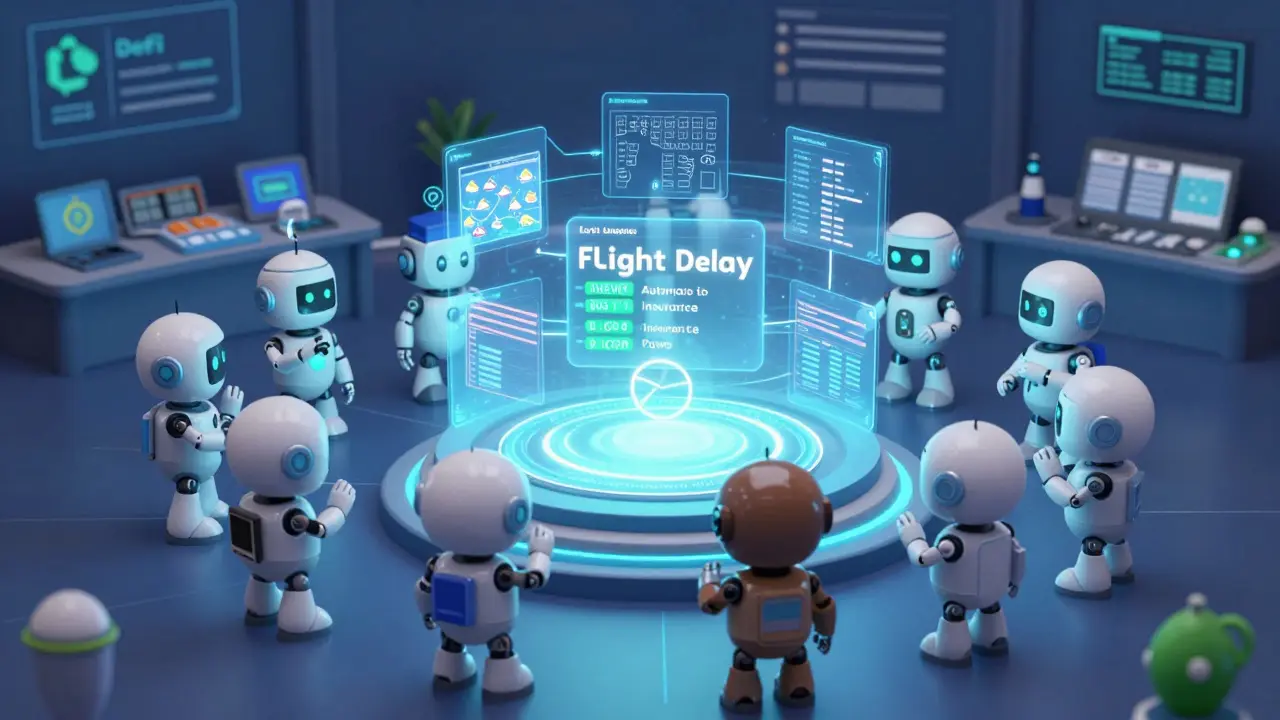
Parametric insurance is revolutionizing the industry thanks to oracles. Instead of filing claims and waiting weeks for adjusters, policies are triggered automatically. For example, a flight delay insurance policy can be linked to an oracle that monitors airline departure times. If your flight is delayed by more than four hours, the smart contract automatically pays out your compensation instantly. No paperwork, no disputes.
3. Supply Chain Management
Companies use IoT sensors combined with oracles to track goods. A temperature sensor in a shipping container sends data to an oracle. If the temperature rises above a safe level for pharmaceuticals, the smart contract can automatically flag the shipment, alert stakeholders, and even void insurance coverage for that batch. This creates an immutable record of product integrity.
Challenges and Risks
While oracles solve the connectivity problem, they introduce new risks. The most significant is the garbage in, garbage out principle. If the external data source is wrong, the oracle will faithfully transmit that error to the blockchain, and the smart contract will execute incorrectly.
Another major issue is cost. On networks like Ethereum, frequent oracle requests can become expensive. Developers often face gas fees ranging from $0.45 to $2.50 per request during peak times. This forces them to optimize their code, requesting data less frequently or using Layer 2 solutions to reduce costs.
Security exploits remain a concern. In 2022, oracle failures accounted for 12% of all DeFi exploit losses, totaling over $146 million. Most of these incidents involved attackers manipulating the price feed rather than hacking the oracle infrastructure itself. This highlights the importance of using robust, decentralized networks with strong data aggregation methods.
The Future of Oracle Technology
The oracle landscape is evolving rapidly. We are moving beyond simple data feeds toward decentralized compute networks. New protocols like Chainlink’s DECO allow for privacy-preserving computation on off-chain servers. This means sensitive data can be processed without being exposed publicly, opening doors for enterprise adoption where confidentiality is key.
Cross-chain interoperability is also becoming a priority. With dozens of blockchains competing for dominance, oracles that can seamlessly move data between them-like Chainlink’s CCIP protocol-are essential. They enable a unified digital economy where assets and data flow freely across different networks.
Regulatory frameworks are catching up too. The EU’s MiCA regulation, effective in 2024, requires specific data validation protocols for oracle networks serving financial applications. This adds a layer of compliance but also legitimizes the technology for traditional finance institutions looking to integrate blockchain solutions.
Can I build my own blockchain oracle?
Yes, you can build a centralized oracle yourself. It involves writing a script to fetch data from an API and signing it with a private key before sending it to the blockchain. However, for any application handling significant value, building your own is risky due to potential single points of failure. Most developers prefer using established Decentralized Oracle Networks like Chainlink or API3 for better security and reliability.
Are blockchain oracles secure?
Decentralized oracle networks are highly secure because they rely on multiple independent nodes to verify data. No single entity can manipulate the outcome. However, centralized oracles are vulnerable to hacks and human error. Security also depends on the quality of the underlying data sources. If the original API is compromised, the oracle may transmit incorrect data unless it has robust redundancy measures.
What is the difference between an API and an oracle?
An API (Application Programming Interface) is a method for software programs to communicate and exchange data. An oracle is a service that uses APIs to fetch data, verifies that data for authenticity, and then delivers it to a blockchain in a format that smart contracts can understand and trust. Essentially, an oracle wraps an API call in a layer of cryptographic security and consensus.
Do oracles cost money to use?
Yes, using decentralized oracle networks typically involves a fee. You usually need to pay in the network’s native token (like LINK for Chainlink) to compensate node operators for their work. Additionally, there are gas fees on the blockchain for executing the transaction. Costs vary depending on the frequency of data requests and the congestion of the underlying blockchain.
Which blockchain oracle is the best?
Chainlink is currently the industry leader, holding approximately 70% of the market share for decentralized oracle networks. It offers the widest range of supported blockchains, extensive documentation, and a large community of node operators. Other notable alternatives include API3, Pyth Network, and Band Protocol, each offering unique features like lower latency or specialized data feeds.
