Gas Fee Calculator
Calculate Your Ethereum Transaction Cost
Estimate your transaction fee based on current network conditions
How it works: Total Fee = (Base Fee + Priority Fee) × Gas Limit
1 gwei = 0.000000001 ETH
Ethereum vs Other Blockchains
Average transaction fees across popular networks (October 2023)
| Blockchain | Average Fee | Best For |
|---|---|---|
| Ethereum (Mainnet) | $0.50 – $50+ | High-security apps, DeFi, NFTs |
| Optimism (Layer 2) | $0.01 – $0.10 | DeFi swaps, NFT mints |
| Arbitrum (Layer 2) | $0.01 – $0.10 | High-volume dApps |
| Polygon | $0.001 – $0.01 | Small transactions, gaming |
| Binance Smart Chain | $0.05 – $0.10 | Low-cost trading |
| Solana | <$0.00025 | High-speed apps, microtransactions |
Ever tried sending crypto and got hit with a $50 fee for a $20 transfer? That’s a gas fee - and it’s not a glitch. It’s how blockchains like Ethereum pay the people who keep the network running. If you’ve ever wondered why your transaction takes forever or costs more than the crypto you’re sending, this is why.
What Exactly Are Gas Fees?
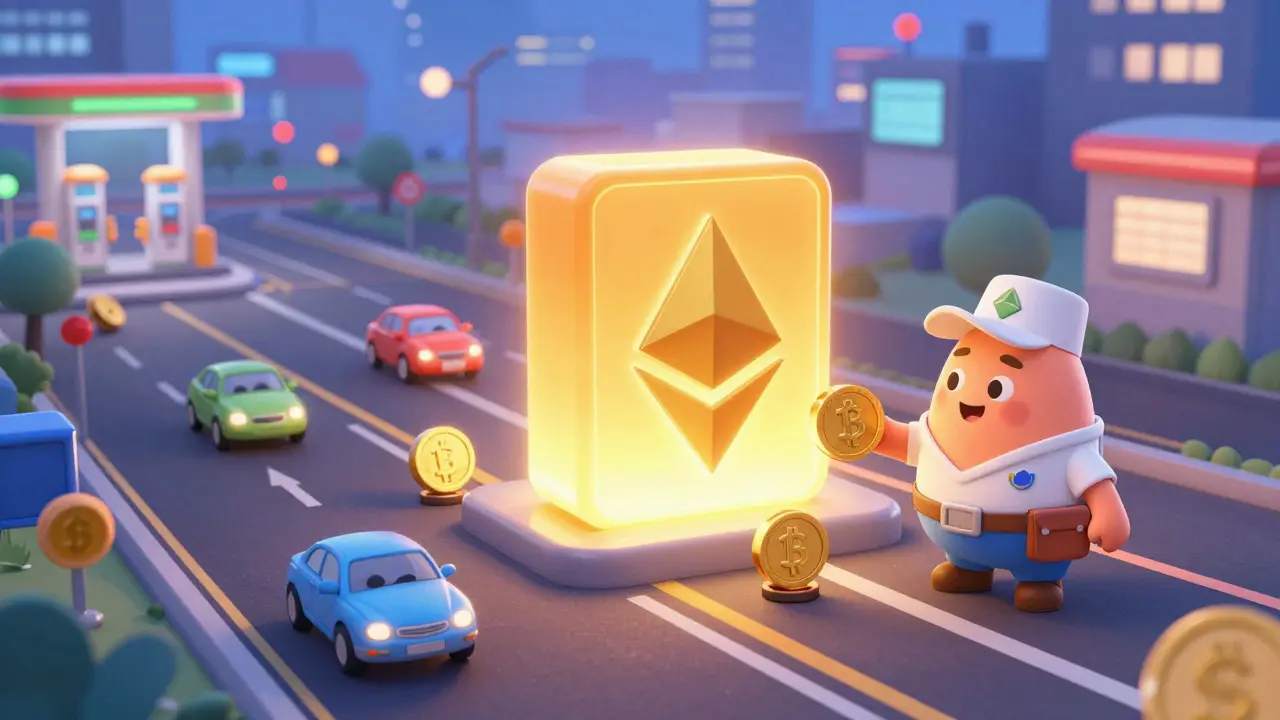
Gas fees are the cost you pay to get your transaction processed on a blockchain. Think of them like tolls on a highway - the more traffic, the higher the toll. On Ethereum, every action - sending ETH, swapping tokens, minting an NFT - needs computational work. That work is done by validators (formerly miners), and gas fees are their payment.
The term "gas" was coined by Ethereum’s creator, Vitalik Buterin, to describe the unit of computational effort. Each operation has a fixed gas cost. A simple ETH transfer uses 21,000 gas. A token swap? Around 65,000 gas. Complex smart contracts? Sometimes over 300,000 gas. The more complex the task, the more gas it needs.
Before August 2021, gas fees worked like an auction. You’d bid higher to get your transaction processed faster. That led to chaos - people paying $100 just to send $10 worth of crypto during NFT drops. That system is gone. Now, Ethereum uses a smarter model called EIP-1559.
How Gas Fees Work Today (Post-EIP-1559)
Since the London Upgrade in August 2021, Ethereum’s gas fee structure changed dramatically. Now, there are two parts:
- Base fee - automatically set by the network based on how busy it is. This part gets burned (destroyed), not paid to validators. It’s designed to be predictable and stable.
- Priority fee (tip) - optional extra you add to incentivize validators to include your transaction faster. This goes directly to them.
The formula is simple: (Base fee + Priority fee) × Gas limit = Total fee.
For example:
- Base fee: 75 gwei
- Priority fee: 5 gwei
- Gas limit: 30,000
- Total: (75 + 5) × 30,000 = 2,400,000 gwei = 0.0024 ETH
One gwei equals 0.000000001 ETH. So even though the numbers look big, the actual cost is tiny - unless the base fee spikes.
Here’s the smart part: if blocks are more than 50% full, the base fee goes up by up to 12.5% per block. If they’re underused, it drops. This keeps the network balanced without users having to guess what to pay.
Why Do Gas Fees Vary So Much?
Gas fees aren’t fixed. They’re driven by demand. When everyone’s buying NFTs, trading DeFi tokens, or minting collectibles, the network gets crowded. That pushes the base fee up.
In June 2021, during the CryptoPunks NFT mint, gas fees spiked to over 1,500 gwei. At ETH prices around $2,000, that meant $25+ per transaction. One user paid $47 in gas to swap $50 worth of tokens - a 94% fee. That’s not unusual during hype cycles.
On the flip side, during late-night hours (2-5 AM UTC), congestion drops 60-75%. Experienced users wait for these windows to save hundreds of dollars.
According to Etherscan data from October 2023, average daily Ethereum fees range from $0.50 on quiet days to over $50 during peak traffic. That’s why some people call gas fees the "tax on innovation." They’re painful - but they’re also proof the network is valuable.

How Do Gas Fees Compare Across Blockchains?
Ethereum isn’t the only game in town. Other blockchains offer much cheaper alternatives:
| Blockchain | Average Fee | Best For |
|---|---|---|
| Ethereum (Mainnet) | $0.50 - $50+ | High-security apps, DeFi, NFTs |
| Optimism (Layer 2) | $0.01 - $0.10 | DeFi swaps, NFT mints |
| Arbitrum (Layer 2) | $0.01 - $0.10 | High-volume dApps |
| Polygon | $0.001 - $0.01 | Small transactions, gaming |
| Binance Smart Chain | $0.05 - $0.10 | Low-cost trading |
| Solana | <$0.00025 | High-speed apps, microtransactions |
Layer-2 solutions like Optimism and Arbitrum are growing fast because they keep Ethereum’s security but slash fees by 10-50x. That’s why most new DeFi apps now launch on Layer 2 first.
Solana and Polygon are popular for apps where speed and low cost matter more than decentralization. But if you’re dealing with large sums or long-term value, Ethereum’s mainnet still leads in security.
How to Avoid Overpaying for Gas
You don’t have to pay more than you need to. Here’s how to save:
- Use a gas tracker - Tools like Etherscan’s Gas Tracker or ETH Gas Station show real-time base fees. Don’t guess - check.
- Wait for low-traffic times - Late night or early morning UTC (2-5 AM) is usually cheapest.
- Use MetaMask’s Advanced Gas Controls - You can manually set the base fee and priority fee. Set the priority fee to 1-5 gwei during normal times. No need to tip more.
- Set gas limits correctly - Most wallets auto-calculate this, but for complex transactions, add 10-15% buffer. Too low? Transaction fails. Too high? You pay extra.
- Batch transactions - If you’re minting 5 NFTs, do them in one batch. One transaction with higher gas can cost less than five separate ones.
- Use Layer 2 - If your wallet supports it, switch to Arbitrum or Optimism. Fees drop 90%+.
A Chainalysis study found users overpay by 22.3% on average. That’s hundreds of dollars a year wasted. Small tweaks save big.
What Happens If You Set the Fee Too Low?
Transactions can get stuck. If your priority fee is too low, validators ignore your transaction. It doesn’t fail - it just sits in the mempool (waiting room) until it times out, usually after 24-48 hours.
That’s why 78.4% of users in a CoinGecko survey said they’ve had transactions fail due to low gas. You don’t lose your crypto - it stays in your wallet. But you waste time and sometimes have to resend.
Some wallets let you "speed up" a stuck transaction by increasing the fee. Others let you "cancel" it by sending a zero-value transaction with the same nonce. Always check your wallet’s help docs before trying this.

What’s Coming Next? The Future of Gas Fees
Ethereum isn’t done improving. The Dencun upgrade, expected in early 2024, introduces proto-danksharding (EIP-4844). This will let Layer 2 networks store data cheaper, cutting their fees by 10-100x.
By 2025-2026, full danksharding could make Layer 2 transaction fees almost negligible - think pennies or less. That’s the goal: keep Ethereum secure and decentralized while making it as cheap as using a credit card.
Meanwhile, other chains are innovating too. Cardano’s Vasil upgrade will slash smart contract fees by up to 80%. Solana’s compute unit model adjusts pricing dynamically based on complexity.
But here’s the catch: if too many users move to Layer 2, Ethereum’s mainnet could lose its fee revenue. That’s a real concern for developers who rely on those fees to fund network security. The community is working on ways to keep mainnet relevant - like making it a settlement layer for Layer 2s.
Why Gas Fees Matter Beyond the Cost
Gas fees aren’t just a nuisance. They’re the economic engine of Ethereum. They pay validators, prevent spam, and create a fair market for network access. Without them, anyone could flood the network with useless transactions and crash it.
Academic research from the University of Cambridge found EIP-1559 reduced fee volatility by 37.2% - meaning users can plan better. But it also increased the average base fee by 18.5%. That trade-off is intentional: stability over low cost.
And here’s a surprising fact: in Q2 2021, Ethereum’s gas fees surpassed Bitcoin’s mining rewards for the first time. That’s huge. It means the value of using Ethereum’s network now exceeds the value of securing Bitcoin’s.
For regulators, gas fees are becoming a compliance issue. The EU’s MiCA law, effective December 2024, will force exchanges to clearly show all transaction fees - including gas - before users confirm trades. Transparency is coming.
Final Thoughts: Gas Fees Are a Feature, Not a Bug
Gas fees suck when they’re high. But they’re the price of a decentralized, censorship-resistant network. You’re not paying a bank. You’re paying a global, open system that runs without a CEO, without a server farm, without a single point of failure.
Smart users don’t fight gas fees - they work with them. They track prices. They time transactions. They use Layer 2s. They learn the tools.
If you’re new, give yourself 2-4 weeks to get comfortable. Use MetaMask. Watch Etherscan’s gas tracker. Try a small swap on Optimism. You’ll quickly see that gas fees aren’t a mystery - they’re a system. And once you understand it, you’ll never overpay again.
Why are Ethereum gas fees so high?
Ethereum gas fees are high when the network is congested - like during NFT launches or DeFi trends. More people trying to transact means higher demand for block space, which pushes the base fee up. Ethereum’s security and popularity make it the most used blockchain, so it naturally gets more traffic than others. Layer 2 solutions like Arbitrum and Optimism now handle most daily transactions to reduce this pressure.
Can I avoid paying gas fees entirely?
Not on Ethereum’s mainnet - gas fees are required to pay validators. But you can avoid them by using Layer 2 networks like Polygon, Optimism, or Arbitrum, where fees are 10-100x lower. Some apps also offer "gasless" transactions using sponsorships (where a company pays the fee for you), but these are rare and usually limited to specific use cases.
What’s the difference between gas limit and gas price?
The gas limit is the maximum amount of gas you’re willing to spend on a transaction. Think of it like setting a budget. The gas price (in gwei) is how much you’re willing to pay per unit of gas. Your total fee is gas limit × gas price. If your transaction uses less gas than the limit, you only pay for what you used.
Why does my wallet show different gas fees than Etherscan?
Wallets like MetaMask estimate fees based on current network conditions and your transaction type. Etherscan shows the actual base fee and priority fee in real time. Sometimes wallets overestimate to ensure your transaction goes through. You can adjust the fee manually in advanced settings to match Etherscan’s numbers and save money.
Do other blockchains like Bitcoin have gas fees?
Bitcoin doesn’t use "gas," but it does have transaction fees. These fees go to miners and are based on transaction size (in bytes), not complexity. Bitcoin fees are usually lower than Ethereum’s, but they’re not dynamic in the same way. Ethereum’s system adjusts automatically based on demand; Bitcoin’s doesn’t. That’s why Ethereum fees can spike faster.
Are gas fees going to disappear?
No - and they shouldn’t. Gas fees are what keep blockchains secure and spam-free. But they’re getting much cheaper. Ethereum’s upcoming upgrades will make Layer 2 transactions nearly free. For most users, gas fees will become a background cost - like the small fee you pay when using a credit card online. The goal isn’t to remove them, but to make them invisible.

Anselmo Buffet
December 13, 2025 AT 01:40Caroline Fletcher
December 14, 2025 AT 23:55Heath OBrien
December 15, 2025 AT 12:28Toni Marucco
December 16, 2025 AT 19:06Kathryn Flanagan
December 18, 2025 AT 02:01Nicholas Ethan
December 18, 2025 AT 13:27Lynne Kuper
December 18, 2025 AT 14:59Lloyd Cooke
December 19, 2025 AT 02:10Albert Chau
December 20, 2025 AT 17:00Hari Sarasan
December 22, 2025 AT 11:48Madison Surface
December 23, 2025 AT 03:40Tiffany M
December 23, 2025 AT 22:45Eunice Chook
December 25, 2025 AT 21:04Lois Glavin
December 27, 2025 AT 02:31Abhishek Bansal
December 28, 2025 AT 15:38Taylor Fallon
December 30, 2025 AT 06:56PRECIOUS EGWABOR
January 1, 2026 AT 04:32Joey Cacace
January 2, 2026 AT 14:13