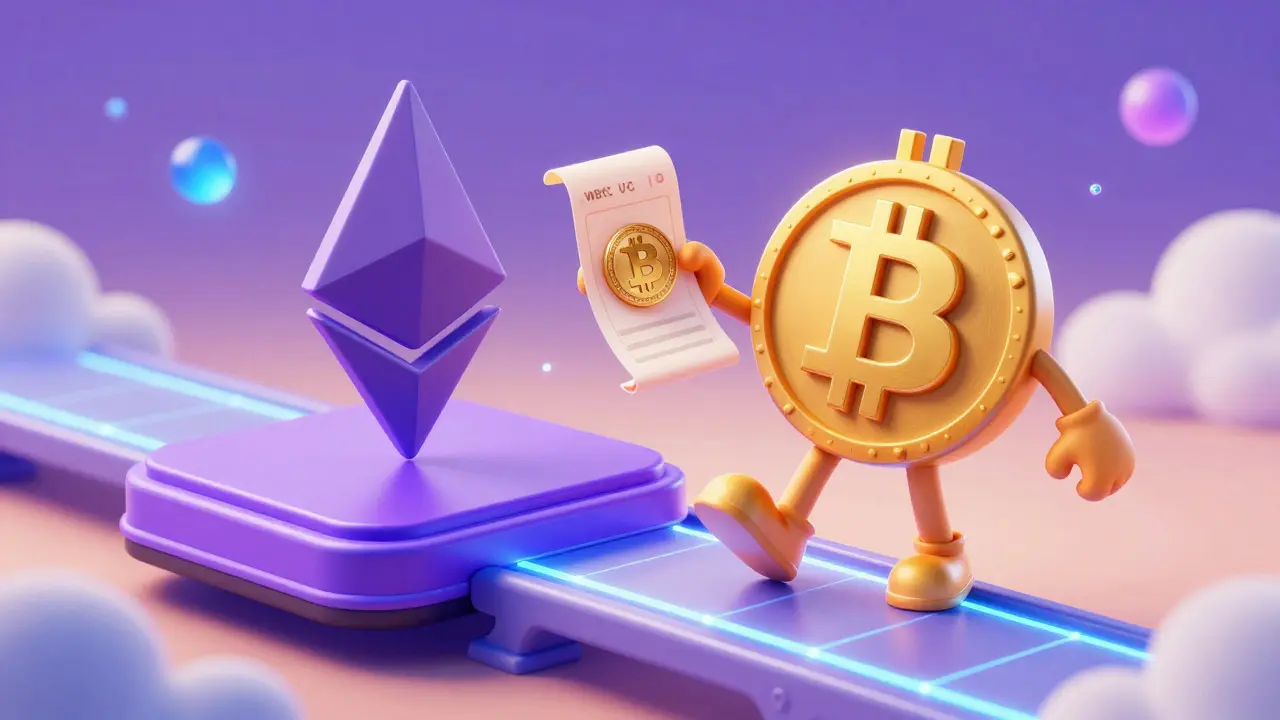
Imagine trying to spend US dollars at a shop in Tokyo that only accepts Japanese Yen. You’d need to exchange your cash first. Now picture the same problem in the world of cryptocurrency, but instead of currency exchange booths, you’re dealing with entirely different digital universes-blockchains that cannot talk to each other. This is where wrapped tokens come into play.
Wrapped tokens are essentially digital receipts. They represent a specific amount of one cryptocurrency (like Bitcoin) on a completely different blockchain (like Ethereum). If you hold Bitcoin, it lives on the Bitcoin network. It can’t interact with Ethereum’s decentralized finance (DeFi) apps directly. But if you wrap it, you get a version of Bitcoin that behaves exactly like an Ethereum token. Suddenly, your Bitcoin can earn interest, be traded on decentralized exchanges, or used as collateral for loans on the Ethereum network.
This concept solves a massive headache in crypto: interoperability. Without wrapped tokens, every blockchain would remain an isolated island. With them, assets flow freely across networks, unlocking billions in liquidity and utility. In this guide, we’ll break down how wrapping works, why it matters, the risks involved, and what you need to know before using these tools yourself.
How Wrapped Tokens Actually Work
To understand wrapped tokens, you have to look under the hood. The process isn’t magic; it’s a precise mechanical system involving locking, minting, and burning. Let’s walk through the lifecycle of a wrapped asset, using Wrapped Bitcoin (WBTC) as our primary example since it is the most widely used wrapped token in existence.
The Minting Process (Wrapping)
- Deposit: You send your native Bitcoin to a custodian service. Think of the custodian as a secure vault operator. For WBTC, this consortium includes companies like BitGo, Kyber Network, and Ren.
- Locking: The custodian locks your Bitcoin in a multi-signature wallet. Your original coins are now frozen in place. You no longer control them directly.
- Minting: Once the Bitcoin is confirmed as locked, a smart contract on the Ethereum network mints an equivalent amount of WBTC. One BTC equals one WBTC. This new token is sent to your Ethereum wallet address.
The Burning Process (Unwrapping)
- Submission: When you want your original Bitcoin back, you send the WBTC back to the official smart contract.
- Burning: The smart contract destroys (burns) the WBTC. These tokens are removed from circulation forever.
- Release: The custodian verifies the burn and releases the original Bitcoin from their vault, sending it back to your Bitcoin wallet address.
This mechanism relies heavily on trust. You are trusting the custodians not to steal your Bitcoin and the smart contracts not to fail. While efficient, this centralization point is the biggest criticism of wrapped tokens. Unlike native assets, which are secured by the blockchain’s own code, wrapped tokens require third-party intermediaries.
Why Do We Need Wrapped Tokens?
If blockchains could communicate natively, wrapped tokens wouldn’t exist. Unfortunately, Bitcoin and Ethereum were built with different coding languages and consensus mechanisms. Bitcoin uses Proof-of-Work and simple transaction scripts. Ethereum uses Proof-of-Stake (as of its Merge upgrade) and complex smart contracts. They speak different technical dialects.
Without a bridge, Bitcoin holders miss out on the entire DeFi ecosystem. They can’t lend their BTC on Aave, trade it on Uniswap, or use it in yield farming strategies. Wrapped tokens act as translators. By converting Bitcoin into an ERC-20 token (the standard format for Ethereum assets), WBTC becomes compatible with thousands of existing applications.
The impact is staggering. As of late 2023, over $10 billion worth of Bitcoin was wrapped as WBTC. This represented nearly 80% of all Bitcoin liquidity in the DeFi space. Without wrapped tokens, Bitcoin would largely remain a "store of value" sitting in cold storage. With them, it becomes active capital working in financial markets.
| Feature | Native Asset (e.g., BTC) | Wrapped Asset (e.g., WBTC) |
|---|---|---|
| Blockchain Home | Bitcoin Network | Ethereum Network |
| Smart Contract Support | Limited/None | Fully Compatible (ERC-20) |
| Custody | Self-Custody (Non-Custodial) | Third-Party Custodian Required |
| Transaction Speed | ~10 minutes per block | ~12 seconds per block (on Ethereum) |
| Primary Use Case | Store of Value / Payments | DeFi, Lending, Trading |
The Risks Involved in Using Wrapped Tokens
Convenience comes with a price tag: risk. Because wrapped tokens introduce centralized elements into a decentralized system, they create new vulnerabilities that don’t exist with native assets. Understanding these risks is crucial before you wrap any significant portion of your portfolio.
Counterparty Risk
When you wrap your Bitcoin, you give up direct control. The custodian holds the keys. If the custodian is hacked, goes bankrupt, or acts maliciously, your underlying asset is at risk. Although major providers like the WBTC consortium use multi-signature wallets (requiring multiple parties to approve transactions), history shows that centralized entities are frequent targets for attackers.
Smart Contract Vulnerabilities
The minting and burning processes rely on smart contracts. Code is only as good as its audit. Bugs in these contracts can lead to catastrophic failures. In November 2022, a bug in the RenBridge protocol temporarily stranded $96 million in wrapped tokens. Users couldn’t unwrap their assets for 72 hours until developers patched the issue. While resolved, such incidents highlight the fragility of automated systems.
Depegging Events
Wrapped tokens are supposed to maintain a strict 1:1 peg with the underlying asset. However, market panic or technical glitches can cause temporary depegging. If WBTC trades at $29,000 while BTC is at $30,000, you lose value simply by holding the wrapped version. This usually corrects quickly, but during high volatility, it can result in real losses.
Regulatory Uncertainty
Regulators are still figuring out how to classify wrapped tokens. In September 2023, the U.S. SEC hinted that some wrapped tokens might be classified as securities if the custodians exert too much control. Similarly, the EU’s MiCA regulation treats them as "asset-referenced tokens," requiring strict proof-of-reserve audits. Changes in regulation could restrict access to certain wrapping services or impose heavy compliance costs passed down to users.
Major Players in the Wrapped Token Space
Not all wrapped tokens are created equal. Some dominate the market due to early adoption and deep liquidity, while others offer alternative security models. Here are the key players you should know.
WBTC (Wrapped Bitcoin)
Launched in January 2019, WBTC is the undisputed leader. Backed by a consortium including BitGo, Kyber Network, and Ren, it accounts for over 80% of the wrapped Bitcoin market. Its dominance provides unmatched liquidity, meaning you can easily buy or sell large amounts without slippage. However, its centralized structure remains a point of contention among purists.
renBTC
Created by the Ren Project, renBTC aims to be more decentralized than WBTC. It uses a network of independent nodes called "Ren VM" to lock and release Bitcoin. This reduces reliance on a single corporate custodian. However, renBTC has faced significant hurdles, including the aforementioned bridge hack and lower overall liquidity compared to WBTC.
tBTC (Threshold Bitcoin)
tBTC takes a fully decentralized approach using threshold cryptography. Instead of a single custodian or even a small group, tBTC distributes the private key shares among many operators. No single entity can move the funds alone. This model minimizes counterparty risk but is technically complex and currently holds a smaller market share (~3.7%).
wETH (Wrapped Ether)
While less discussed than Bitcoin wrappers, wETH is essential within the Ethereum ecosystem itself. Many DeFi protocols require ERC-20 tokens for compatibility reasons. Native ETH doesn’t fit that mold perfectly. Wrapping ETH into wETH allows it to function seamlessly in lending protocols and automated market makers (AMMs).
Alternatives to Wrapped Tokens
As the industry matures, developers are exploring ways to achieve cross-chain interoperability without relying on wrapped tokens. These alternatives aim to reduce centralization and improve security.
Cross-Chain Bridges
Protocols like Wormhole and Multichain attempt to move assets directly between chains. Instead of locking an asset and minting a wrapper, some bridges lock the asset on Chain A and release the native asset on Chain B. Others use message-passing systems. While promising, bridges have been notoriously insecure. The Wormhole hack in February 2022 resulted in a $325 million loss, demonstrating that bridging technology is still evolving.
Atomic Swaps
Atomic swaps allow two parties to trade different cryptocurrencies directly without a trusted third party. They rely on hash-time-locked contracts (HTLCs). While theoretically perfect and trustless, atomic swaps are currently impractical for mainstream use due to low throughput and complexity. They handle fewer than 100 daily transactions across major networks, making them unsuitable for large-scale liquidity needs.
Sidechains and Layer 2 Solutions
Networks like Polygon and Arbitrum offer sidechains or rollups that connect to main blockchains. While not strictly "wrapped tokens," they provide environments where assets can move more freely. Projects are increasingly building native interoperability layers, such as Chainlink’s CCIP (Cross-Chain Interoperability Protocol), which facilitates secure communication between chains without necessarily creating wrapped assets.
Practical Guide: How to Wrap Your First Token
If you decide to take the plunge, here is a step-by-step overview of how to wrap Bitcoin into WBTC. Note that this process requires technical familiarity and carries inherent risks. Always start with a small amount.
- Set Up Wallets: You need two wallets. One for Bitcoin (e.g., Ledger, Trezor, or Electrum) and one for Ethereum (e.g., MetaMask). Ensure both are secure and backed up.
- Acquire Gas Fees: To wrap BTC, you need to pay fees on the Ethereum network. Buy enough ETH to cover gas costs (typically 0.005-0.02 ETH depending on network congestion).
- Choose a Portal: Visit an official wrapping portal like the WBTC website or a reputable DEX that supports wrapping (like Uniswap or SushiSwap). Never use unofficial links found in search results.
- Initiate the Wrap: Connect your Ethereum wallet. Enter the amount of BTC you wish to wrap. The platform will generate a unique Bitcoin deposit address for you.
- Send BTC: From your Bitcoin wallet, send the exact amount of BTC to the generated address. Double-check the address. There are no refunds for wrong addresses.
- Wait for Confirmation: The custodian must confirm receipt. This usually takes 15-60 minutes depending on Bitcoin network speed and custodian processing times.
- Receive WBTC: Once confirmed, the WBTC tokens will appear in your Ethereum wallet. You can now use them in DeFi apps.
Pro Tip: Check the current fee structure before wrapping. Major platforms charge between 0.1% and 0.3% for wrapping/unwrapping. During periods of high Ethereum gas prices, the cost of interacting with smart contracts can exceed the wrapping fee itself.
The Future of Wrapped Tokens
The landscape of wrapped tokens is shifting. Industry leaders acknowledge that centralized custodians are a "necessary evil" for now, but the goal is decentralization. Vitalik Buterin, co-founder of Ethereum, has stated that wrapped assets will remain critical for 3-5 years while next-generation interoperability solutions mature.
We are seeing a transition toward DAO-governed wrapping. The WBTC consortium announced plans to move toward a decentralized autonomous organization model by mid-2024, reducing the role of individual corporations like BitGo. Additionally, upgrades like Ethereum’s Cancun-Deneb update include optimizations for bridge security, potentially lowering costs by 40-60%.
Despite the rise of native cross-chain protocols, wrapped tokens aren’t disappearing anytime soon. They provide immediate liquidity and compatibility that newer solutions struggle to match. For the foreseeable future, they remain the backbone of cross-chain finance, enabling Bitcoin and other legacy assets to participate in the modern DeFi economy.
Is WBTC safe to hold?
WBTC is relatively safe compared to lesser-known wrapped tokens because it is backed by a reputable consortium including BitGo and Kyber Network. However, it is not risk-free. You are exposed to counterparty risk (if the custodians fail) and smart contract risk (if the code has bugs). It is generally safer than holding altcoins on unknown bridges, but less safe than holding native Bitcoin in your own hardware wallet.
Can I convert WBTC back to BTC instantly?
No, the process is not instant. After you submit your WBTC for burning, the custodians must verify the transaction and release the Bitcoin from their vault. This typically takes 15 to 60 minutes, but can be longer during periods of high network congestion or if manual verification is required.
What happens if the custodian goes bankrupt?
If the custodian managing the wrapped token goes bankrupt, your underlying asset could be frozen or seized by creditors. This is the primary downside of wrapped tokens versus native assets. To mitigate this, major projects like WBTC use multi-signature wallets and regular proof-of-reserve audits, but legal recourse in bankruptcy scenarios is complex and uncertain.
Do I pay taxes when I wrap my crypto?
Tax laws vary by jurisdiction. In the United States, the IRS has not issued definitive guidance specifically on wrapped tokens. Some tax professionals argue that swapping BTC for WBTC is a taxable event (a disposal of BTC and acquisition of WBTC), while others view it as a non-taxable conversion since the value remains identical. Always consult a qualified tax advisor familiar with cryptocurrency regulations in your country.
Are there cheaper alternatives to WBTC?
Yes, options like renBTC and tBTC exist. However, they often suffer from lower liquidity, which can lead to higher slippage when trading. Additionally, unwrapping fees and gas costs on alternative networks can sometimes outweigh the savings. WBTC remains the most cost-effective option for large transactions due to its deep liquidity pools on major decentralized exchanges.
Will wrapped tokens become obsolete?
Eventually, yes. As native cross-chain communication protocols (like Chainlink CCIP or LayerZero) mature, the need for wrapped tokens may decrease. Experts predict a gradual decline in wrapped token usage starting around 2025-2028. However, they will likely remain relevant for several years as legacy infrastructure continues to support the majority of DeFi liquidity.
What is the difference between wETH and ETH?
ETH is the native currency of the Ethereum network. wETH is an ERC-20 token that represents ETH on a 1:1 basis. Most DeFi protocols require assets to follow the ERC-20 standard to function properly within their smart contracts. Therefore, you must wrap your ETH into wETH to use it in many lending platforms, automated market makers, and yield farming strategies.
