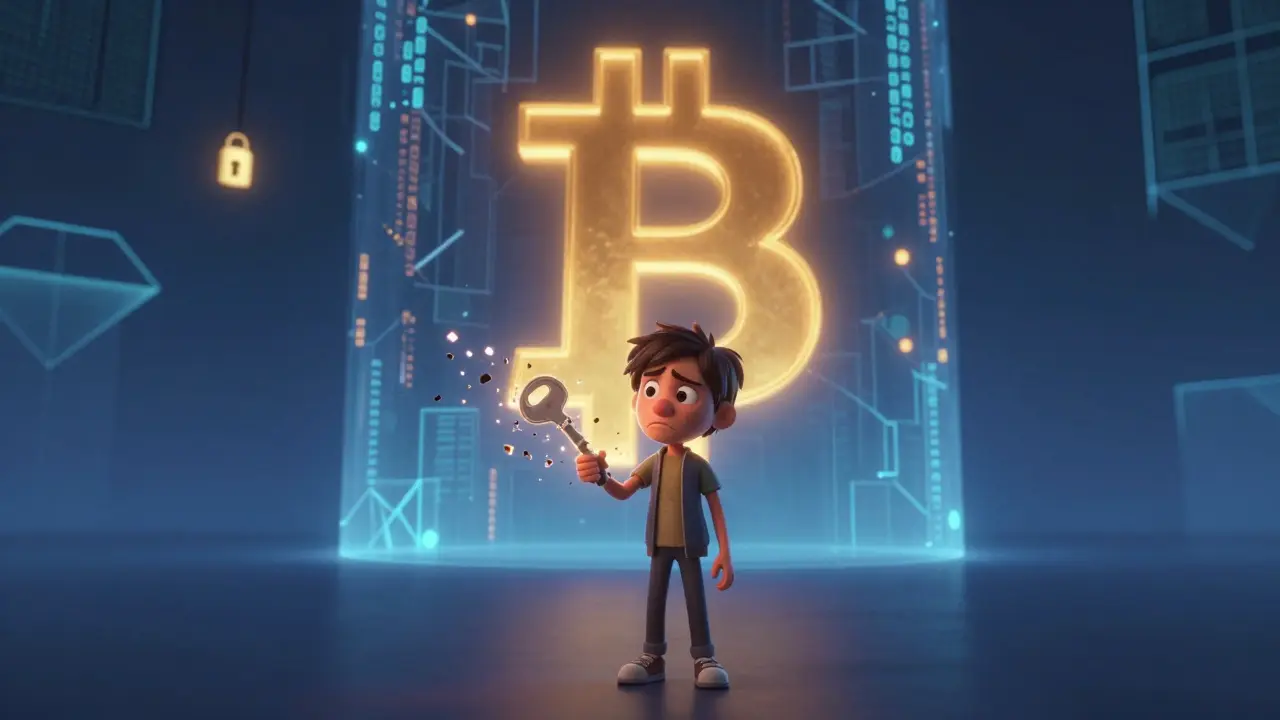
Imagine walking into your bank and realizing you forgot your PIN. You’d panic, sure, but the teller would ask for your ID, verify your identity, and reset access in minutes. Now imagine doing that with your Bitcoin is a decentralized digital currency that operates on a peer-to-peer network without central authority. There is no teller. There is no customer service line. And there is absolutely no way to reset your access.
If you lose your private key, you don’t just lose a password-you lose permanent control over your assets. The coins are still sitting on the blockchain, visible to everyone, but they are mathematically locked behind a door for which you threw away the only key. According to Chainalysis, approximately 3.7 million BTC-worth roughly $248 billion as of early 2026-is permanently inaccessible because users lost their keys. That isn’t a glitch; it’s by design.
The Hard Truth: No Backdoors Exist
You need to understand one core concept before anything else: blockchains are designed to be unforgiving. When Satoshi Nakamoto launched Bitcoin in 2009, the goal was to create a system where no government or corporation could freeze or seize your funds. To achieve that, the system had to remove any possibility of third-party intervention. This means there is no "Forgot Password" button.
Private Key is a cryptographic code consisting of 256-bit numbers that proves ownership and authorizes transactions for digital assets. It is typically represented as a 64-character hexadecimal string or, more commonly for users, a Seed Phrase is a set of 12-24 standardized words used to regenerate a private key according to BIP-39 protocol containing 12 to 24 words. These phrases follow the BIP-39 standard, finalized in 2013. The mathematical space of possible keys is so vast-$1.15 \times 10^{77}$ combinations-that guessing a lost key is statistically impossible. It is harder than finding a specific atom in the observable universe.
As AnchorWatch stated clearly in January 2025: "If you lose the private keys that control your Bitcoin, no one else can access it. And no one can help you recover it." This applies whether you use a software wallet on your phone or a hardware device like a Ledger Nano X. If the data is gone, the money is gone.
Lost vs. Stolen: A Critical Distinction
People often confuse losing a key with having their wallet hacked. They are completely different scenarios with different outcomes.
| Scenario | Asset Status | Recovery Possibility | Primary Risk |
|---|---|---|---|
| Lost Private Key | Funds remain on blockchain, untouched | Zero (unless backup exists) | User error, poor backup habits |
| Stolen/Hacked Wallet | Funds moved to attacker's address | Low (depends on exchange cooperation) | Phishing, malware, weak security |
When funds are stolen, blockchain analysis firms like Elliptic can trace the movement of coins. In their 2025 Transparency Report, they noted a 92.7% accuracy rate in tracing illicit flows. Sometimes, if the hacker tries to cash out at a regulated exchange, the exchange might freeze those funds. But when you simply lose your key, the transaction never happens. The coins sit there, dormant. As Andreas Antonopoulos wrote in *Mastering Bitcoin*, "There is no such thing as a lost bitcoin, only lost private keys." The value hasn’t disappeared from the global ledger; it has disappeared from your life.

Can You Recover a Lost Key?
The short answer is no. The long answer is also no, unless you have a backup. Let’s look at why people get hopelessly stuck.
A study by the University of Cambridge Centre for Alternative Finance found that 68.7% of users who lost access did so by forgetting passwords or recovery phrases. Another 22.4% suffered from hardware failure. Here is the trap many fall into: thinking their computer remembers the key. It doesn’t. Your wallet app stores an encrypted version of the key locally. If you reinstall the app, format your drive, or buy a new phone, that local file is gone. Without the original seed phrase or private key file, the new installation creates a *new* wallet with *new* keys. Your old coins are still on the blockchain, but your new wallet has no link to them.
Some users try "recovery services" online. Be extremely cautious. Most are scams. Legitimate cryptography does not allow for remote unlocking. If a company claims they can hack the blockchain to retrieve your funds, they are lying. The only exception is if you have partial backups-for example, you remember 11 of 12 words in your seed phrase. In that case, specialized tools can brute-force the missing word, but this requires technical skill and significant computing power.
Real Stories: Devastation and Rare Wins
To understand the stakes, look at real user experiences. On Reddit’s r/CryptoCurrency, a user named 'CryptoWidow2024' shared her story in March 2025. Her husband passed away without telling her the recovery phrase for their joint crypto holdings. She estimated the loss at $1.2 million. "The exchange told me they could do nothing," she wrote. "It felt like watching money evaporate." This highlights a major legal and personal gap: inheritance planning for crypto is nearly non-existent for most families.
On the flip side, success stories exist but rely entirely on preparation. GitHub user 'KeySaver' documented recovering $85,000 in January 2026 after losing his primary laptop. He succeeded because he followed the "3-2-1 backup rule": three copies of his seed phrase, on two different media types (paper and metal), with one stored offsite in a safety deposit box. Meanwhile, on Bitcointalk, user 'WalletWarrior' lost 25 BTC ($1.66 million) after deleting his Electrum wallet file without a backup. One moment of carelessness versus years of discipline-the difference is everything.
How to Never Lose Access Again
You cannot change the past, but you can secure your future. The industry is moving toward better solutions, but until then, you must take responsibility. Here is how experts recommend protecting your keys:
- Write It Down Physically: Do not store your seed phrase digitally. Screenshots, text files, and cloud notes are vulnerable to hackers and ransomware. Use pen and paper, or better yet, steel plates designed to resist fire and water damage.
- Use Multiple Locations: Keep one copy at home, one in a safe deposit box, and perhaps give one to a trusted family member. This protects against house fires, theft, or natural disasters.
- Test Your Backup: Before you move large amounts of money, test your recovery process. Create a small test wallet, write down its seed phrase, delete the app, and restore it using the phrase. If it works, you’re ready.
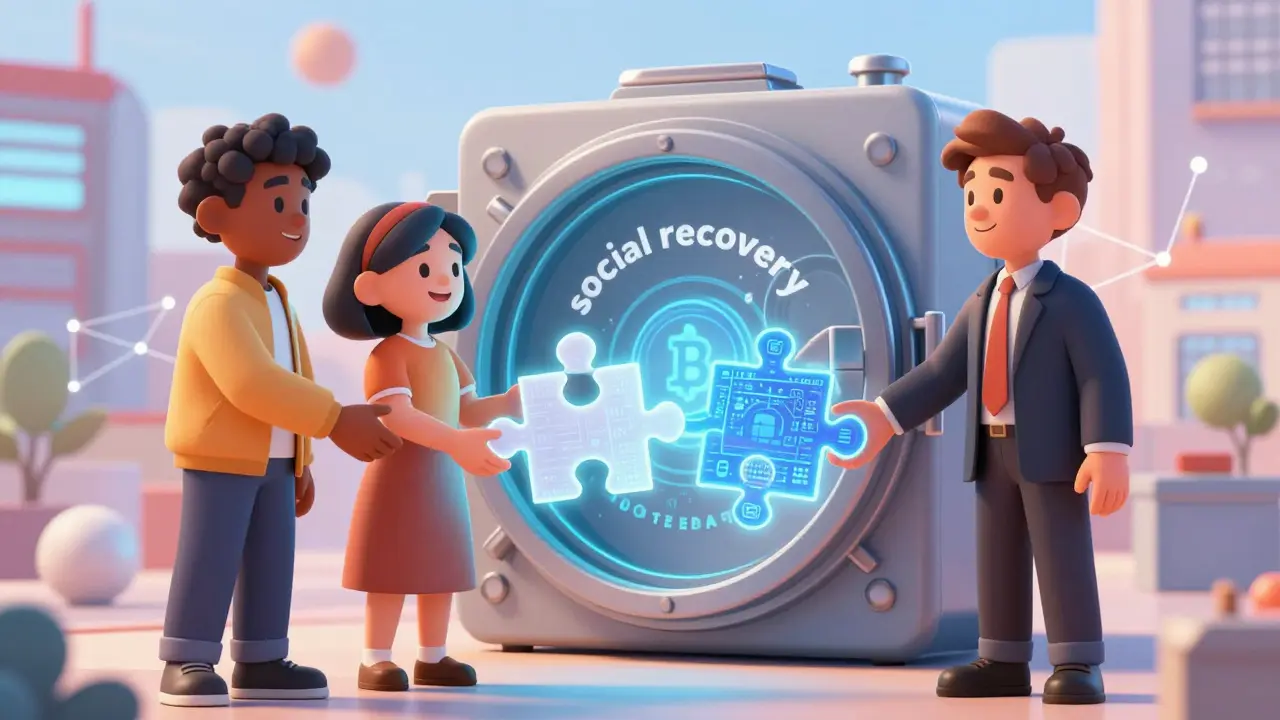
- Consider Social Recovery: Newer wallets like Argent (which had 1.2 million users by Jan 2026) offer "social recovery." This allows you to designate trusted contacts (friends, family, lawyers) who can collectively approve a key reset if you lose yours. It adds complexity but reduces the risk of total loss.
- Hardware Wallets: Devices like Ledger or Trezor keep your private key offline. Even if your computer is infected with malware, the key never leaves the device. However, remember: the hardware wallet is just a tool. The seed phrase written on the card inside is what truly matters.
The Future: Will Things Get Easier?
The landscape is shifting slightly. Regulatory bodies are pushing for transparency. The EU’s MiCA regulation, effective January 2025, mandates that exchanges clearly disclose the risks of irreversible loss. New York’s 2024 Digital Asset Custody Rules require exchanges to verify user backup procedures. These steps help consumers understand the gravity of self-custody.
Technologically, we are seeing the rise of Multi-Party Computation (MPC) wallets used by institutions via platforms like Fireblocks. MPC splits the key into shards distributed among parties, so no single entity holds the full key. For retail users, Ethereum co-founder Vitalik Buterin proposed "social recovery" mechanisms in EIP-86 (2025), aiming to balance security with usability. Gartner predicts that by 2030, 95% of consumer wallets will incorporate some form of recovery mechanism. But note this carefully: these are wallet-level innovations. The underlying blockchain protocols remain unchanged. You still need possession of cryptographic proof to move funds.
Until universal social recovery becomes standard, the rule remains simple: Not your keys, not your coins. And if you have the keys but lose them, not your coins either.
Is it possible to recover Bitcoin if I lost my private key and seed phrase?
No. Without the private key or the 12-24 word seed phrase, it is mathematically impossible to regain access to your Bitcoin. The blockchain has no central authority to reset passwords. The funds remain on the network but are permanently inaccessible to you.
Can I find my private key if I deleted my wallet app?
Only if you backed up the seed phrase or private key file before deletion. Deleting the app removes the local encrypted storage of the key. If you did not save the seed phrase elsewhere, the key is gone forever. Reinstalling the app generates a new, empty wallet.
What is the safest way to store a seed phrase?
The safest method is writing the seed phrase on physical paper or engraving it on a metal plate, then storing it in a secure location like a fireproof safe or safety deposit box. Avoid digital storage methods like photos, email, or cloud drives, as these are vulnerable to hacking and ransomware.
Do hardware wallets protect me if I lose the device?
Yes, provided you have the seed phrase. Hardware wallets like Ledger or Trezor are merely interfaces. The actual key is derived from the seed phrase. If you lose the device, you can plug a new one in, enter your seed phrase, and restore all your funds. If you lose both the device AND the seed phrase, your funds are lost.
Are there any legitimate recovery services for lost crypto keys?
Most online "recovery services" are scams. Legitimate cryptography does not allow remote unlocking. The only exception is if you have partial information (e.g., 11 of 12 seed words), in which case specialized technical tools may help guess the missing word. However, for complete loss, no service can recover your funds.
What happens to crypto assets when the owner dies?
If heirs do not have the private keys or seed phrases, the assets become permanently inaccessible. Unlike traditional bank accounts, exchanges cannot release funds to next of kin without the correct cryptographic credentials. Proper estate planning involving secure sharing of seed phrases is essential.

Scott Miller
July 1, 2026 AT 00:38Listen up, you absolute morons. The post is crystal clear and if you are still holding your keys on a cloud drive, you deserve to lose every penny. I see people crying about lost coins in the comments like it's some tragic accident when it is purely user error. You want freedom? You take responsibility. If you can't handle writing down twelve words on a piece of paper without losing it, then go back to your bank account where the government can freeze your assets whenever they feel like it. Stop whining and start securing your stack properly or get out of crypto entirely because you are just dragging down the rest of us who actually know what we are doing.
Carl Belgrave
July 2, 2026 AT 20:30This entire narrative is designed to scare the average American into thinking they need to become cryptographers overnight. It is nonsense. We built this country on trust and institutions for a reason. Why should I trust a piece of code written by an anonymous ghost over the Federal Reserve? The idea that there is no customer service is not a feature, it is a bug that preys on the uneducated. Real wealth is held in tangible assets and regulated accounts, not digital air that vanishes if you sneeze on your hard drive. This 'self-custody' cult is just another way to separate fools from their money.
Carl Hanzel
July 2, 2026 AT 21:10You are all missing the point completely. The loss isn't the tragedy; the tragedy is that you believed you owned anything in the first place. Money is a social construct, and by removing the social layer, you have created a void where greed meets incompetence. I watch these people brag about their 'financial independence' while storing their life savings on a USB stick they left in a coffee shop. It is pathetic. The system works exactly as intended: it filters out the weak-minded. If you cannot memorize a phrase, you do not deserve the privilege of decentralized finance. Keep your hands off the blockchain until you learn basic discipline.
Daniel J. Cox
July 4, 2026 AT 07:48I've been watching this space from the sidelines for years, mostly observing how culture shifts around technology. In Japan, we have a concept called 'mottainai,' which expresses regret over waste. Seeing millions of dollars locked forever feels incredibly wasteful, doesn't it? But at the same time, it highlights a beautiful human trait: the desire for total autonomy. Even if we fail, the attempt to own ourselves is noble. I just hope everyone takes a breath and remembers that technology serves humanity, not the other way around. Stay calm, folks.
Emma Rémond
July 5, 2026 AT 05:54The epistemological framework underlying self-custody is fundamentally flawed for the layperson. To suggest that a BIP-39 mnemonic sequence is a viable security protocol for non-technical actors is intellectually dishonest. The entropy required to secure assets against brute-force attacks necessitates a level of cryptographic literacy that simply does not exist in the general populace. When one discusses 'loss,' one must consider the systemic risk of key management failures versus the theoretical benefits of decentralization. It is pretentious to claim that anyone can safely manage their own private keys without understanding the underlying elliptic curve cryptography. Most users are merely interacting with a black box, hoping for the best, which is statistically akin to gambling rather than investing.
ELNORA JEFFERSON
July 6, 2026 AT 14:44Ugh, why do I even bother reading this stuff? It's always the same doom and gloom. First, you tell me I'm going to be rich, then you tell me I'll lose everything if I blink wrong. It's exhausting. I just want my money to sit there and grow, not require me to act like a paranoid spy. This whole thing is a drama factory. I'm done trying to keep up with these ridiculous rules. Just give me a password reset button already.
Carol @minaszilda
July 8, 2026 AT 14:30Let's breathe. It is okay to feel overwhelmed. The technology is complex, but our minds are capable of learning. Think of your seed phrase as a sacred promise to your future self. Write it down slowly. Carefully. Trust yourself. You are enough to handle this responsibility. Take small steps. Test with a tiny amount first. Be kind to yourself during the process. Growth happens in patience.
Fiona Ellis
July 9, 2026 AT 23:57Oh darling, let’s talk about the real horror story here 😱. It’s not losing the key; it’s dying and leaving your poor family clueless! 🤦♀️ I had a friend who didn’t tell her kids where the hardware wallet was hidden. They spent months tearing apart the house looking for a ‘metal plate’ she mentioned in passing. It was a nightmare! 😭 So please, for the love of all that is holy, write it down and put it in a safe place! Don’t make your loved ones play detective after you’re gone! 💀📝
Abby Martin
July 10, 2026 AT 15:12Look, I’m not saying banks are perfect, but at least when you forget your PIN, you don’t lose your life savings instantly. That’s just cruel design. People are moral beings, not computers. We make mistakes. Punishing someone for a simple error by locking away their livelihood is ethically bankrupt. There has to be a middle ground where security doesn’t mean total abandonment of user safety. It’s selfish to build systems that assume everyone is a tech genius. We need empathy in code, not just math.
Mélanie Boulay
July 12, 2026 AT 07:25It is important to consider the broader implications of these technological advancements on our daily lives and how they intersect with our personal responsibilities and societal expectations regarding financial security and privacy. While the immediate reaction might be one of fear or frustration due to the potential for irreversible loss, we must also acknowledge the profound shift in power dynamics that occurs when individuals take control of their own assets without intermediary oversight, which ultimately fosters a greater sense of autonomy and accountability among users who are willing to engage with the necessary precautions and educational resources available to them today.
Maurice Flynn
July 14, 2026 AT 05:55Hey Scott, I hear your passion, but maybe dial back the aggression? Everyone starts somewhere. Carl, you're right that it's tough, but that's what makes the victory sweet when you get it right. Let's encourage each other instead of tearing people down. We're all in this together, building something new. Stay positive and keep learning!