
Imagine building a wireless network not by a giant telecom company, but by thousands of everyday people using small devices in their homes. Or rendering 3D graphics not on a server farm owned by Amazon, but on GPUs from gamers and artists around the world. This isn’t science fiction. It’s DePIN - Decentralized Physical Infrastructure Networks - and it’s changing how real-world services are built and paid for using cryptocurrency.
What Exactly Is DePIN?
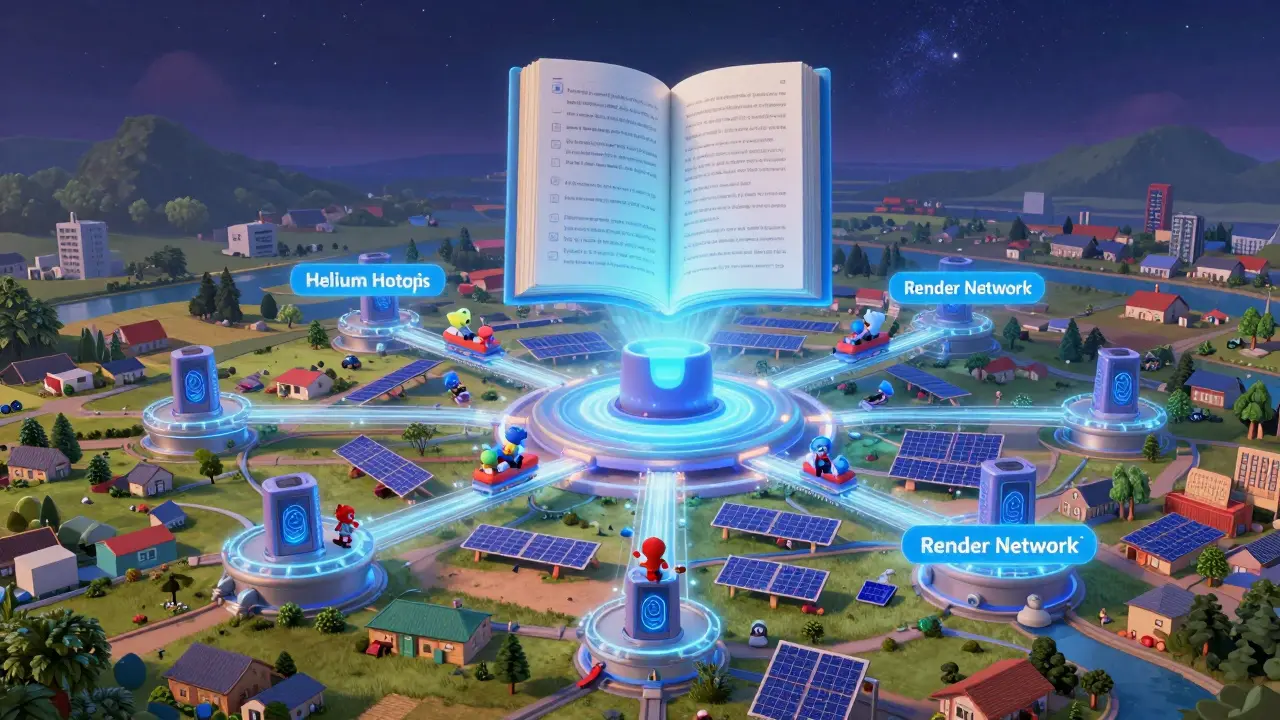
DePIN stands for Decentralized Physical Infrastructure Networks. At its core, it’s a way to use blockchain and cryptocurrency to reward people for contributing real, physical resources to a shared network. Instead of one company owning and controlling infrastructure like cell towers, internet routers, or computer servers, DePIN lets anyone with the right hardware join in and earn crypto for their contribution.
Think of it like Uber or Airbnb, but for infrastructure. You’re not just renting out your car or spare room - you’re renting out your Wi-Fi hotspot, your extra GPU power, or even your solar panel. In return, you get paid in cryptocurrency. The blockchain keeps a transparent, tamper-proof record of who did what, and smart contracts automatically send payments when conditions are met.
It’s not about trading coins or speculating on prices. It’s about turning everyday hardware into valuable network nodes. The first big example? The Helium Network. Launched in 2019, it let people set up small LoRaWAN hotspots in their homes. These devices provided low-power wireless coverage for IoT devices like smart meters and trackers. In exchange, hotspot owners earned HNT tokens. By 2023, over 950,000 of these hotspots were active worldwide - more than most telecom companies had.
How Does DePIN Work?
DePIN isn’t one single system. It’s a model with three key parts working together:
- The off-chain network - This is where real life happens. People plug in devices: hotspots, GPUs, solar panels, or sensors.
- The blockchain - This acts like a public ledger. Every time someone provides a service - say, a hotspot connects a device - the transaction gets recorded on-chain. No one can delete or alter it.
- The protocol - These are the rules coded into smart contracts. They decide how rewards are calculated, who qualifies, and how data is verified. For example, Helium uses a “proof-of-coverage” system that checks if a hotspot is really providing wireless signal where it claims to be.
Here’s how it plays out in real life: You buy a Helium hotspot for $400, plug it in, and it starts connecting IoT devices. Every time it successfully transmits data, the blockchain records it. A smart contract checks the proof-of-coverage, confirms you’re not cheating, and sends you HNT tokens. You can hold them, trade them, or use them to pay for more services on the network.
There are two main types of DePIN networks:
- Physical Resource Networks (PRNs) - These are tied to location. Think Wi-Fi, cellular coverage, EV charging stations, or solar energy. The hardware is fixed. You can’t move it and expect the same rewards.
- Digital Resource Networks (DRNs) - These are location-independent. Render Network lets you rent out your GPU power for 3D rendering. Filecoin lets you rent out unused hard drive space. These services can be accessed from anywhere.
Why DePIN Is Different From Traditional Infrastructure
Traditional infrastructure is expensive, slow, and centralized. Building a single cell tower can cost $1-2 million. It takes months to get permits. And once built, it’s owned by one company - often with little incentive to serve rural or low-income areas.
DePIN flips that. A single Helium hotspot costs $300-$500. You can set it up in a weekend. No permits. No corporate bureaucracy. And because thousands of people are doing it, coverage grows organically - even in places no telecom wants to touch.
The numbers speak for themselves:
- DePIN networks cut infrastructure costs by 35-50% compared to traditional models.
- Deployment speed increases by 60-75% - especially in underserved areas.
- Uptime is 99.9% or higher because there’s no single point of failure. If one hotspot goes down, ten others pick up the slack.
Compare that to AWS, which controls about one-third of the cloud market. Render Network offers similar GPU computing power at 40-60% lower prices. And unlike AWS, you’re not locked into a contract. You can join or leave anytime.

Who’s Using DePIN - And How?
DePIN isn’t just for crypto fans. Real people are using it to solve real problems.
In Detroit, the People’s Broadband Project used Helium hotspots to give free internet access to over 5,000 residents in neighborhoods without reliable service. In rural Texas, users report earning $45-$120 a month from their hotspots after electricity costs. One Reddit user, u/WirelessWarrior, said they made $75/month - enough to cover their internet bill.
On the compute side, artists and small studios use Render Network to render animations without paying $500/hour for cloud services. A filmmaker in Berlin told CoinDesk they saved $8,000 on a single project by using decentralized GPUs.
Even solar energy is getting in on it. Projects like SolarDePIN let homeowners earn tokens for excess solar power they feed into the grid. One user in Arizona said their monthly electricity bill dropped 30% - and they made extra crypto on top.
Challenges and Risks
DePIN isn’t perfect. There are real hurdles.
Regulation - Most governments haven’t figured out how to classify DePIN. Is a hotspot a telecom device? A utility? A financial instrument? In 78% of countries, the legal status is unclear. That creates risk. If regulators decide DePIN networks violate telecom laws, they could shut them down.
Technical complexity - Setting up a Helium hotspot is easy. Setting up a Render Network GPU rig? Not so much. You need to know about drivers, cooling, network settings, and blockchain wallets. A 2023 survey found 65% of potential users gave up because it was too confusing.
Token volatility - Rewards are paid in crypto. If the token price crashes, your earnings drop. That happened in Puerto Rico in 2022. A DePIN energy project collapsed when token values fell 82%. Participants were left with hardware they couldn’t sell and no income.
Scalability - A DePIN network needs enough participants to be useful. One hotspot doesn’t make a network. You need hundreds or thousands. Early adopters often wait months before seeing real value. That’s why many projects fail before they gain traction.
What’s Next for DePIN?
Despite the risks, DePIN is growing fast. In January 2023, the total market value of all DePIN projects was $470 million. By September 2023, it hit $3.2 billion. Gartner predicts it’ll hit $12.7 billion by 2025.
Major upgrades are happening:
- Helium moved to Solana in 2023, increasing transaction speed from 5 per second to 65,000 per second.
- Render Network launched “Proof of Render” - a new consensus mechanism that cuts verification time by 70%.
- The DePIN Alliance, formed in mid-2023, now includes Chainlink, Filecoin, and Render. They’re creating standards so networks can work together.
Looking ahead, we’ll see:
- Decentralized EV charging networks launching in early 2024.
- Satellite-based internet from SpaceMesh by 2025 - think Starlink, but owned by users.
- More partnerships with utilities and telecoms. Deloitte found 37% of Fortune 500 infrastructure companies are testing DePIN pilots.
Experts are split. MIT’s Dr. Jane Smith calls DePIN “the most promising blockchain application for real-world impact.” But Vitalik Buterin warns that token incentives alone aren’t enough - better governance is needed to keep networks fair and sustainable.
Should You Get Involved?
If you’re curious, here’s how to start:
- For beginners - Buy a Helium hotspot. Plug it in. Wait. You’ll earn HNT over time. No coding needed. Just make sure you’re in a decent coverage area.
- For tech-savvy users - Try Render Network. Rent out your GPU. You’ll need an NVIDIA RTX 3080 or better. Set up takes 15-20 hours, but earnings can be high.
- For investors - Look at projects with real usage, not just hype. Check how many active users they have, not just token price.
Avoid projects that promise guaranteed returns. DePIN isn’t a get-rich-quick scheme. It’s a new way to build infrastructure - slowly, collectively, and transparently.
DePIN doesn’t replace traditional networks. It competes with them. And in places where they’ve failed - rural towns, developing countries, underserved neighborhoods - it’s already working. That’s the real promise: infrastructure built by the people, for the people.
Is DePIN the same as Web3?
DePIN is a subset of Web3. Web3 is the broad idea of decentralized internet services. DePIN specifically applies that idea to physical infrastructure - things like internet, computing power, energy, and transportation. So all DePIN projects are Web3, but not all Web3 projects are DePIN.
Do I need to be a crypto expert to use DePIN?
No. For basic participation - like running a Helium hotspot - you just need to plug in a device and use a simple app. You don’t need to understand wallets, private keys, or blockchain. But if you want to set up a GPU provider or build a DePIN app, then yes - you’ll need some technical knowledge.
Can I make money with DePIN?
Yes, but not guaranteed. Many users earn $45-$120/month from Helium hotspots after electricity costs. GPU providers can earn more - sometimes $200-$500/month - depending on demand. But earnings depend on location, network demand, and crypto prices. It’s passive income, not a job.
What hardware do I need for DePIN?
It depends on the network. For Helium, you need a LoRaWAN hotspot ($300-$500). For Render Network, you need a powerful NVIDIA GPU (RTX 3080 or better). For Filecoin, you need spare hard drive space - 10TB or more. Always check the project’s official requirements before buying anything.
Is DePIN safe? Can I lose money?
You can lose money if the crypto token crashes, or if your hardware becomes worthless. There’s also regulatory risk - governments might restrict DePIN in the future. But your hardware isn’t stolen or locked in. You can always sell it or repurpose it. The biggest risk is investing more than you can afford to lose.

Heather James
March 16, 2026 AT 05:54Sarah Hammon
March 17, 2026 AT 11:13iam jacob
March 19, 2026 AT 09:31Sahithi Reddy
March 20, 2026 AT 18:27George Hutchings
March 22, 2026 AT 15:27Henrique Lyma
March 23, 2026 AT 16:54Bruce Doucette
March 24, 2026 AT 11:01Marie Vernon
March 26, 2026 AT 09:44Ross McLeod
March 27, 2026 AT 04:53rajan gupta
March 27, 2026 AT 12:26Steph Andrews
March 28, 2026 AT 13:18Prakash Patel
March 29, 2026 AT 08:31Zachary N
March 29, 2026 AT 14:05Elizabeth Kurtz
March 30, 2026 AT 11:49