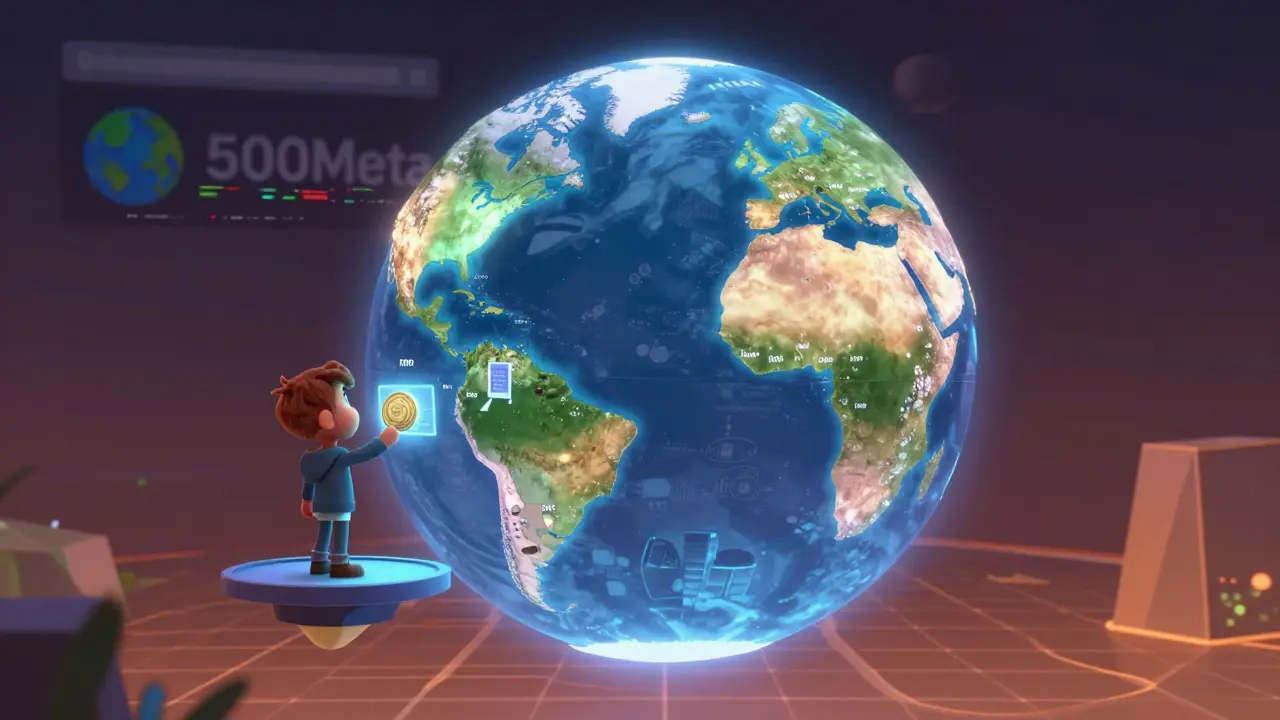
EarthMeta (EMT) isn't another meme coin. It claims to be something bigger: a digital twin of Earth, where every street, park, and building has a blockchain-backed version you can own. Sounds like science fiction? Maybe. But if you’ve ever wondered what owning a piece of real-world geography online would look like, EarthMeta is trying to make it real. Here’s the full story - the promises, the tech, the risks, and why most experts think it’s not going anywhere.
What EarthMeta Actually Does
EarthMeta (EMT) is a cryptocurrency launched in 2024 that runs on the Polygon blockchain. Its whole purpose? To let users buy, sell, and manage virtual land that matches real locations on Earth. Think of it like Google Earth, but instead of just viewing, you own it. Each parcel of virtual land is an NFT tied to actual GPS coordinates. A plot in downtown Tokyo, a patch of desert in Nevada, a corner of Paris - all can be tokenized and traded using the EMT coin.
The token isn’t just for buying land. It’s used for everything inside the ecosystem: paying for upgrades, staking to earn rewards, voting on governance decisions, and even collecting taxes from other users who build on your land. The project calls this the "Governor and President" system - if you manage land well, you get a cut of transaction fees from others using it. It’s like being a landlord in a digital world.
The Tech Behind It - Polygon, NFTs, and Digital Twins
EarthMeta doesn’t run on Ethereum. It’s built on Polygon, which is a big deal. Polygon offers faster, cheaper transactions than Ethereum’s mainnet. That matters because if you’re buying virtual land, you don’t want to pay $50 in gas fees every time you transfer it. With Polygon, fees are cents, not dollars.
Each piece of land is an NFT - a unique, non-fungible token. That means no two parcels are the same. One might be a 100x100 meter square in Times Square. Another could be a 500-meter stretch along the Amazon River. These NFTs come with metadata: names, historical info, zoning rules (if any), and even 3D models if developers ever build them.
The whole thing is called a "digital twin" - a real-time, blockchain-powered copy of Earth. The idea is that someday, you could walk through your virtual property in VR, host events on it, or rent it out to businesses. Right now? That’s all theoretical.
Market Stats: A Tiny Fish in a Huge Ocean
As of September 2025, EarthMeta had a circulating supply of about 1.44 billion EMT tokens out of a total supply of 2.1 billion. The price hovered around $0.0105, giving it a market cap of roughly $15 million. That sounds like a lot - until you compare it.
- Decentraland (MANA): $1.1 billion market cap
- The Sandbox (SAND): $800 million market cap
- CityDAO (a similar geospatial project): $28 million market cap
EarthMeta is smaller than most of its peers. Even smaller projects are doing better. And liquidity? Forget it. The 24-hour trading volume was under $4,300. That means if you bought $10,000 worth of EMT, you’d have a hard time selling it without crashing the price. There are only two exchanges that list it: BitMart and XT. No Binance. No Coinbase. No Kraken. That’s a red flag.
Why It’s Not Working - The Broken Platform
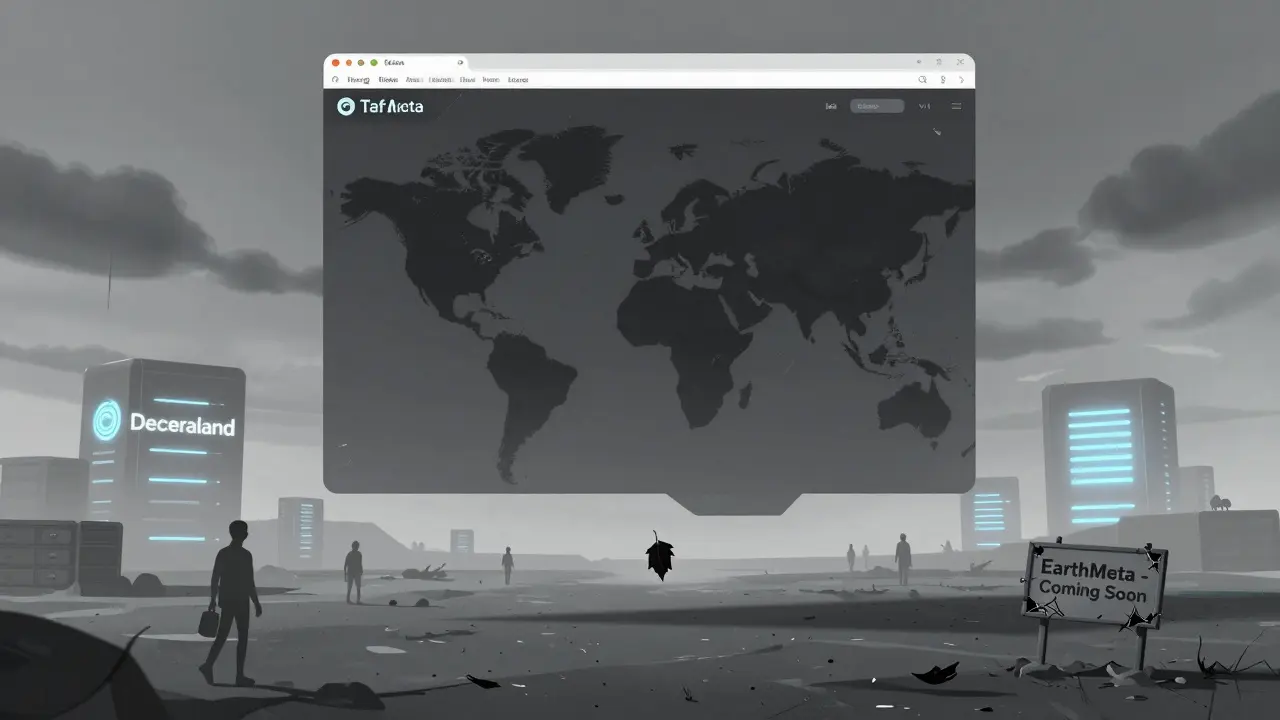
The biggest problem with EarthMeta? The website doesn’t work.
As of late 2025, earthmeta.ai returns a 500 Internal Server Error. That’s not a slow site. That’s a dead site. No dashboard. No map. No way to buy land. No guide. No support. If you can’t access the platform, you can’t use it. And if you can’t use it, the token has no real utility.
There’s no GitHub repo. No active Discord. No developer updates. No blog. No roadmap. The project vanished after its initial marketing push. Reddit threads about it have fewer than 20 posts. Trustpilot has zero reviews. Even the people who bought the token on BitMart don’t talk about using the platform - they only talk about price.
One user on Reddit summed it up: "Tried to navigate the supposed digital twin but the main site keeps giving 500 errors - smells like vaporware."
Is It a Scam? The Red Flags
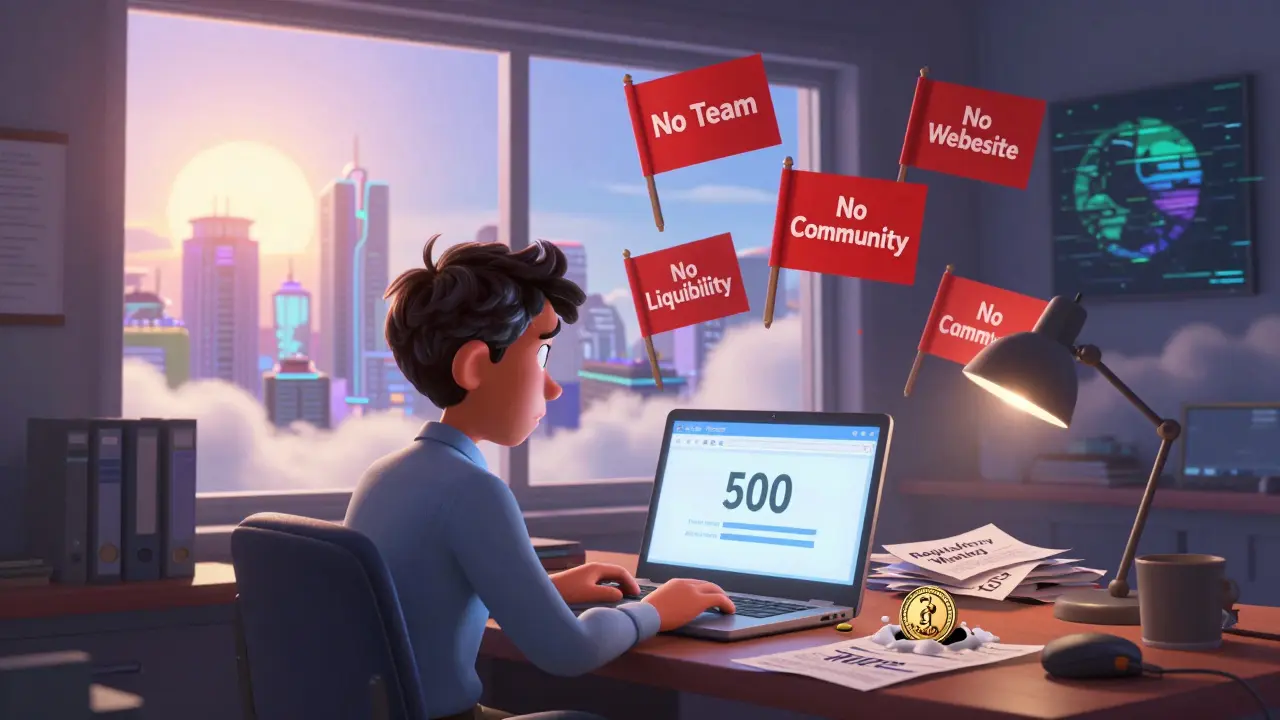
It’s not a scam in the classic sense - no one’s been arrested, no one’s admitted to fraud. But it ticks almost every box for a high-risk, low-utility token:
- Zero transparency: No team names, no company registration, no legal entity listed.
- Non-functional product: The core platform is offline.
- Extremely low liquidity: Hard to buy, harder to sell.
- Minimal community: Only 1,842 wallets hold EMT. That’s less than a small apartment building’s residents.
- High volatility: 8.85% daily swing. That’s wild for a token with no active users.
On top of that, the "tax rewards" system could get it flagged as a security by regulators. If you’re earning income from managing land you don’t even own in real life, that looks a lot like selling shares in a company. The SEC has been cracking down on metaverse projects that promise passive income. EarthMeta could be next.
Price Predictions: A Bear Market Nightmare
CoinCodex’s analysis from September 2025 shows EarthMeta’s 14-day RSI at 16.86 - deeply oversold, but still falling. The price is below both its 50-day and 200-day moving averages. That’s technical death. The model predicts a 25% drop to $0.0055 by December 2025. Even the most optimistic forecasts only see it hitting $0.022 by 2026 - still below its all-time high.
Here’s the math: if you bought $1,000 of EMT at $0.0105, you’d need it to hit $0.022 to double your money. That’s a 110% gain. But with zero development, zero traffic, and zero exchange support? That’s not a prediction - it’s a fantasy.
Who Should Even Care?
Only one type of person might find EarthMeta interesting: a crypto speculator looking for a micro-cap gamble. You’re not buying a product. You’re betting that someone will revive the site, attract developers, and bring in millions of users - all from a dead project with no team.
For everyone else - investors, metaverse enthusiasts, real estate NFT buyers - EarthMeta offers nothing. No utility. No access. No future. It’s a ghost coin.
What You Need to Know Before Buying
If you’re still thinking about it, here’s what you need:
- You need a Polygon-compatible wallet (MetaMask configured for Polygon network).
- You can only trade on BitMart or XT - no other exchanges.
- You’ll face high slippage - the price can swing 5-10% just from a small trade.
- You won’t find any tutorials, guides, or help docs - the website is broken.
- You’re risking your money on a project that hasn’t shipped its product in over a year.
There’s no way around it: EarthMeta is a failed experiment. The idea had potential. The tech was sound. But without a working platform, a team, or a community, the token is just a number on a chart.
It’s not the future of virtual land. It’s a cautionary tale.
Is EarthMeta (EMT) a good investment?
No, not for most people. EarthMeta has no working platform, minimal liquidity, and no development activity. Its price is driven entirely by speculation, not utility. With a market cap under $15 million and a broken website, it’s a high-risk gamble with little chance of recovery. Only experienced traders looking for extreme volatility should consider it - and even then, treat it as a lottery ticket, not an investment.
Can I buy EarthMeta on Coinbase or Binance?
No. EarthMeta (EMT) is only listed on two small exchanges: BitMart and XT. It’s not available on Coinbase, Binance, Kraken, or any major platform. This limits liquidity and makes it harder to buy or sell without affecting the price. The lack of listing on top exchanges is a major red flag for any project claiming long-term value.
What is EMT used for?
According to its whitepaper, EMT is meant to be used to buy virtual land NFTs, stake for rewards, pay for land upgrades, and vote in governance. But in practice, none of this works. The EarthMeta website is down, so you can’t access the platform. Without a working interface, the token has no real use - it’s just a digital asset with no ecosystem behind it.
Why is the EarthMeta website down?
As of late 2025, earthmeta.ai returns a 500 Internal Server Error - meaning the server can’t process requests. This has been ongoing for months. No updates, no announcements, no fixes. This strongly suggests the project has been abandoned. A functioning project would have a team actively maintaining its site. A dead site means no users, no developers, and no future.
How many people own EarthMeta tokens?
As of September 2025, only 1,842 unique wallet addresses hold EMT tokens. That’s fewer than the population of a small town. For comparison, Decentraland has over 1.2 million active wallets. This tiny holder base confirms EarthMeta has almost no user adoption. Without users, the token has no value beyond speculation.
Is EarthMeta at risk of being shut down by regulators?
Yes. The "tax rewards" system - where users earn passive income from managing virtual land - could classify EMT as a security under U.S. and international regulations. The SEC has already targeted similar metaverse projects that promise returns based on others’ activity. With no team or legal structure, EarthMeta has no defense against regulatory action. If regulators step in, the token could be frozen or delisted entirely.

Brittany Meadows
February 11, 2026 AT 16:37So let me get this straight… we’re betting our life savings on a website that 500s when you click it? 🤔💀 I’m not saying it’s a scam… I’m just saying the devs probably got abducted by aliens and left the server running on a toaster in their basement. EarthMeta? More like EarthMistake. 🌍❌
SAKTHIVEL A
February 13, 2026 AT 13:04It is imperative to underscore the ontological dissonance inherent in the purported value proposition of EarthMeta. The tokenization of geospatial entities sans functional infrastructure constitutes a structural anomaly within the decentralized ledger paradigm. One is compelled to interrogate the epistemological foundations of such a venture, particularly in the absence of demonstrable utility or operational transparency. The market cap, whilst nominally elevated, is rendered functionally inert by the complete absence of a viable user interface. This is not merely a failed project-it is an epistemic failure.
krista muzer
February 15, 2026 AT 00:02i mean… i get it. the idea is kinda cool? like, imagine owning a piece of the amazon or a corner of tokyo in vr? but… the site is just… gone? like, poof? no updates, no team, no nothing. it feels like someone built a really fancy house… then moved out and forgot to leave the keys. i still kinda wanna believe in it? but… also… i don’t? 😅
Tammy Chew
February 16, 2026 AT 01:18How tragically predictable. A project with the ambition of digitizing the planet… reduced to a 500 error and a whisper in the void. The audacity of attempting to tokenize reality without even securing domain stability is… almost poetic. A monument to hubris. The only thing more haunting than the dead site is the silence of the whitepaper’s promises. This isn’t crypto. This is digital necromancy.
Lindsey Elliott
February 17, 2026 AT 12:05lol so the whole thing is just a chart? no website, no app, no devs, just people buying and selling a number because they think someone else will pay more later? 🙄 i’m not even mad. i’m impressed. this is peak crypto. pure chaos theory in token form.
Claire Sannen
February 18, 2026 AT 13:37If you’re considering investing, please take a moment to reflect on whether you’re investing in technology-or in hope. The lack of a functional platform is not a minor setback. It’s a complete absence of the core product. Without access, there is no utility. Without utility, there is no value. Please prioritize projects with transparency, activity, and a working interface. You deserve more than a ghost.
blake blackner
February 19, 2026 AT 03:29you people are acting like this is a surprise? 🤡 the site’s been down since january. no github. no discord. no blog. just a bunch of bots on bitmart buying and selling the same 1.44 billion tokens like it’s a bingo game. if you bought this, congrats-you just paid to fund someone’s vacation. now go check your wallet. it’s probably worth less than your coffee this morning.
kelvin joseph-kanyin
February 19, 2026 AT 22:39LOOK-I know it’s rough seeing a dream die. But here’s the thing: EarthMeta didn’t fail because the tech was bad. It failed because no one showed up. No builders. No passion. No hustle. That’s the real lesson here. Crypto isn’t about the idea-it’s about the people who grind to make it real. This? This was a PowerPoint. 🚫
Grace Mugambi
February 20, 2026 AT 10:19I think there’s something beautiful in the idea of owning a piece of Earth digitally-like a modern-day land deed for the digital age. But beauty without function is just a painting on a wall. And if the gallery burned down? The painting doesn’t matter anymore. Maybe this was a noble experiment… but noble doesn’t pay bills. Maybe next time, they build the house before they sell the blueprints.
Crystal McCoun
February 21, 2026 AT 21:05Just to be clear: if the website is down, and there are no updates, and no team, and no GitHub, and no Discord-then yes, this is dead. Dead. Dead. I’m saying this gently, because I care about people losing money-but please, don’t throw good money after bad. This isn’t a ‘long-term play.’ It’s a tombstone with a ticker symbol. Please, take a step back. Breathe. Look at safer options. You’re worth more than this gamble.
Elijah Young
February 21, 2026 AT 21:23It’s ironic. The concept of digital twins is actually promising. Polygon’s infrastructure is solid. The NFT model makes sense. But without a functioning UI, it’s like having a Ferrari with no engine. You can admire the paint job, but you’ll never get anywhere. The team either vanished or never existed. Either way, the product is fiction. And fiction doesn’t pay dividends.
Desiree Foo
February 22, 2026 AT 05:32People are still buying this? Really? You’re risking your future on a site that says ‘500 ERROR’ when you try to log in? This isn’t crypto. This is just a digital version of handing cash to a stranger on the street who says, ‘Trust me, I’ll double it tomorrow.’ I’m not judging. I’m just… confused. And sad. For you.
Kaz Selbie
February 22, 2026 AT 14:59Let me break this down for the emotionally attached: 1,842 wallets. That’s less than a single apartment complex. The 24hr volume is under $4,300. That’s not a market. That’s a backyard garage sale. The RSI is 16.86? That’s not oversold-it’s clinically dead. The ‘tax rewards’ system? That’s a pyramid with no pyramid. The SEC will eat this for breakfast. You’re not investing. You’re donating to a ghost.
Robbi Hess
February 24, 2026 AT 03:12It’s not even about the money anymore. It’s about the principle. You don’t launch a ‘digital twin of Earth’ and then vanish. That’s not negligence. That’s betrayal. You’re playing with people’s hopes. You’re turning dreams into ticker symbols. And now? You leave them with a 500 error and a shrug. That’s not innovation. That’s cruelty.
Keturah Hudson
February 25, 2026 AT 21:17As someone who grew up in Nairobi, I find the idea of owning a digital slice of the Maasai Mara… hauntingly beautiful. But beauty without access is just memory. And memory fades. This project had soul. But soul needs hands to build. And hands need a platform. Without both? It’s just a poem written on sand.
Ace Crystal
February 27, 2026 AT 10:21Don’t give up on the idea. The tech is real. The need is real. People want to own a piece of Earth. But they need a website. A Discord. A dev team. A roadmap. This isn’t a token failure. It’s a leadership failure. If someone else picks up the pieces? I’ll be first in line. But until then? Don’t throw money at a ghost.