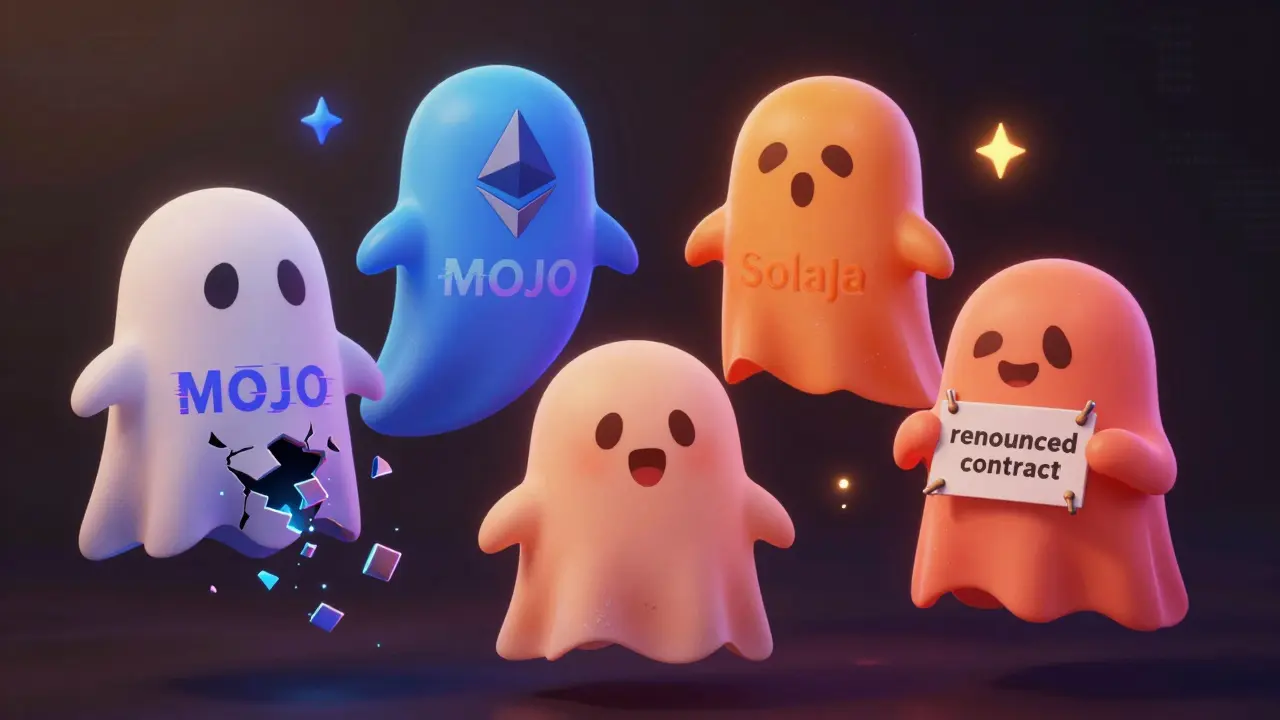
The name Mojo (MOJO) shows up in crypto forums, price trackers, and meme pages - but what you’re seeing might not be one coin at all. In fact, there are at least four different tokens using the MOJO ticker, each on a different blockchain, with wildly different values, supplies, and stories. If you’re wondering whether Mojo is a serious investment or just another crypto ghost, the answer is simpler than you think: Mojo isn’t a project - it’s a collection of abandoned experiments.
There’s More Than One Mojo
You might have heard about Mojo from a YouTube video or a Telegram group promising 1000x returns. But here’s the catch: the MOJO token you’re looking at could be one of four completely separate coins. The most talked-about version is the Ethereum-based MOJO, with a total supply of 420.69 trillion tokens. That’s not a typo. It’s 420,690,000,000,000 coins. Each one is worth about $0.0000000001483 as of March 2026. Sounds tiny? It is. But because there are so many of them, the total market value looks bigger than it is - $78,000 at current prices. That’s less than the cost of a used smartphone.
Then there’s MojoCoin, a completely different token that’s been around since 2017. It has only about 12 million coins in circulation and trades at $0.0059. It’s not dead - but it hasn’t moved in months. Zero trading volume. No updates. No community. Just a website that hasn’t changed in years.
On Solana, another MOJO token exists. It’s faster and cheaper to trade, but no one’s using it. And then there’s Planet Mojo - a gaming project that barely has players, let alone a working game. All four share the same name, but none share the same code, team, or purpose.
How Did Mojo Even Get Created?
The Ethereum MOJO token didn’t launch with a press release, a whitepaper, or even a Twitter account. It was dropped quietly - a stealth presale with no announcement. The developers took the liquidity (the money locked up to let people buy and sell), burned it, and then walked away. That’s called a renounced contract. It means no one can change the rules, add more coins, or pull out funds. Sounds noble? Maybe. But it also means no one can fix bugs, update the system, or respond to problems.
Compare that to Bitcoin or Ethereum, where teams still work on upgrades, security patches, and new features. Mojo’s contract is frozen. Like a car with no keys left in the ignition. It runs - but no one’s driving it.
Why Is the Price So Low?
Think of Mojo like a lottery ticket printed in quadrillions. Each ticket costs a fraction of a penny. If you bought one, you’d need to own billions just to make $1. And even then, you’d struggle to sell it.
The entire market for Ethereum MOJO trades less than $10 a day. That’s not a typo. $10. On Uniswap V2, the only exchange where it trades, the bid-ask spread is 0.61%. That means if you try to buy $100 worth, you might end up paying $100.61 - and even then, the order might not go through because there’s not enough liquidity. You can’t buy a coffee with Mojo. You can’t pay rent. You can’t even buy a meme NFT with it.
The math doesn’t add up. For Mojo to reach $0.01 per token - still pennies - the total market cap would need to hit $4.2 billion. That’s more than 100 times its current value. And for that to happen, thousands of new users would need to discover it, start trading it, and believe in it. No one is. No one is even looking.
What About the Solana and MojoCoin Versions?
The Solana version of MOJO has the same supply issues but runs on a faster, cheaper network. That’s a technical advantage - if anyone was using it. But the daily volume? Zero. The MojoCoin version has been around longer. It hit $0.34 in 2018. Today? $0.0059. It’s been stuck there for years. No development. No marketing. No updates. It’s not a coin. It’s a relic.
Neither has a team, roadmap, or community. No Discord. No GitHub. No blog. Just a token address on a blockchain and a listing on CoinSwitch or Uniswap. That’s not innovation. That’s digital graffiti.
Who’s Buying Mojo - and Why?
Not institutions. Not hedge funds. Not even serious retail traders. The buyers are people who saw a meme: "Buy MOJO and become a millionaire!" They’re chasing a ghost. They think low price = high potential. But price per token doesn’t matter. What matters is utility, adoption, and demand.
Bitcoin trades at $70,000 because millions use it. Ethereum trades at $3,000 because thousands of apps run on it. Mojo? No one uses it. No one builds on it. No one needs it.
Some claim the burnt liquidity and renounced contract make it "trustless" or "decentralized." But decentralization isn’t about deleting keys - it’s about active, ongoing participation. A coin with no team, no updates, and no users isn’t decentralized. It’s dead.

Is Mojo a Scam?
It’s not technically a scam. No one stole money. No one promised returns. The developers vanished, but they didn’t drain the treasury - they burned it. That’s rare. But it’s not a feature. It’s a sign of abandonment.
Real projects don’t disappear after launch. They grow. They fix issues. They respond to users. Mojo didn’t. It’s like a startup that launched an app, then shut down the servers and left the domain to rot.
What’s the Bottom Line?
Mojo (MOJO) isn’t a cryptocurrency you invest in. It’s a crypto curiosity. A statistical anomaly. A token that exists because blockchain technology lets anyone create a coin with any supply, any name, and no oversight.
If you’re holding Mojo, you’re holding a digital artifact - not an asset. Its value isn’t based on use, demand, or innovation. It’s based on hope. And hope doesn’t pay bills.
There are thousands of tokens like Mojo. Most die within a year. A few linger, forgotten, on price charts. Mojo is one of them. It’s not going to moon. It’s not going to revolutionize anything. It’s just there - a ghost in the machine.
If you’re thinking of buying it: don’t. If you already own it: consider it a learning experience. The lesson isn’t about Mojo. It’s about how easily crypto can fool people into believing that low price means high potential. It doesn’t. Not unless someone is actually using it.
Is Mojo (MOJO) a real cryptocurrency?
Mojo exists as multiple tokens - primarily on Ethereum and Solana - but none have real utility, development, or adoption. It’s not a project with a team or roadmap. It’s a collection of abandoned tokens with no active community or purpose.
Can I make money trading Mojo?
Technically, yes - if you buy at a low price and someone else buys higher. But with less than $10 in daily trading volume, it’s nearly impossible to buy or sell more than a few dollars without extreme slippage. Most trades don’t go through. The risk of getting stuck with worthless tokens is extremely high.
Why is the supply so high - 420.69 trillion?
The massive supply is a tactic to make the price per token look tiny, which tricks people into thinking it’s "cheap" and has room to grow. But with no demand, the value doesn’t increase. A trillion coins at $0.0000000001 each still equals less than $100 in total value.
Is Mojo available on Coinbase or Binance?
No. Mojo is only listed on decentralized exchanges like Uniswap V2. It’s not on any major centralized exchange. That means you need a crypto wallet, Ethereum, and knowledge of how to use DeFi platforms to even buy it - which most retail investors can’t do safely.
Does Mojo have a whitepaper or official website?
No. The Ethereum MOJO token has no official website, documentation, or team. The MojoCoin version has a website (mojocoin.org), but it hasn’t been updated in years. No whitepapers, roadmaps, or developer updates exist for any major variant.
What happened to the developers of Mojo?
They disappeared after launch. The Ethereum version had a renounced contract - meaning the developers gave up control permanently. The Solana and MojoCoin versions show no signs of ongoing activity. No announcements, no updates, no communication. They’re gone.
Is Mojo a good long-term investment?
No. With zero adoption, no utility, and no development, Mojo has no path to growth. Its value is based purely on speculation and meme-driven hype. Most tokens like this lose all value within months. Mojo is already years past its peak.
How is Mojo different from Bitcoin or Ethereum?
Bitcoin and Ethereum have millions of users, active developers, real-world use cases, and institutional backing. Mojo has none of that. Bitcoin moves billions daily. Mojo moves less than $10. Bitcoin has a global community. Mojo has a handful of traders on Uniswap. The difference isn’t size - it’s legitimacy.
Can Mojo’s price go up in the future?
It’s mathematically possible - but astronomically unlikely. For Mojo to reach $0.01, its market cap would need to jump from $78,000 to $4.2 billion. That would require thousands of new users, major exchange listings, and real adoption - none of which are happening. The odds are far lower than winning the lottery.
Should I avoid Mojo entirely?
Yes. Unless you’re speculating with money you can afford to lose completely - and understand that this isn’t investing, it’s gambling - avoid Mojo. It offers no utility, no security, no growth, and no community. It’s a digital ghost.

Grace van Gent-Korver
March 13, 2026 AT 07:28Zephora Zonum
March 14, 2026 AT 02:38Douglas Anderson
March 15, 2026 AT 10:21Brandon Kaufman
March 16, 2026 AT 23:44Craig Gregory
March 18, 2026 AT 15:36Anshita Koul
March 20, 2026 AT 09:42PIYUSH KOTANGALE
March 21, 2026 AT 11:37vishnu mr
March 22, 2026 AT 00:21Anthony Marshall
March 22, 2026 AT 01:51Lindsay Girvan
March 23, 2026 AT 11:56Mara Alves Mariano
March 24, 2026 AT 07:51Allison Davis
March 25, 2026 AT 07:49Tom Jewell
March 25, 2026 AT 14:41karan narware
March 26, 2026 AT 07:29