
Remember the game of POG? Those little cardboard discs that ruled schoolyards in the 1990s? Now imagine trying to buy them with a cryptocurrency that promises to blend childhood nostalgia with decentralized finance. That’s the pitch for POG, often traded under the ticker POGS. But here’s the kicker: while the name sparks instant recognition, the actual project behind it feels more like a mystery box than a transparent tech venture.
If you’re seeing ads or social media posts hyping POG as the next big thing, you might be wondering if it’s worth your time-or your wallet. This article breaks down what POG actually is, why its claims raise eyebrows, and what you should know before jumping in. We’ll look at the facts, the missing pieces, and the warning signs that separate legitimate projects from hype trains.
The Concept: Milk Caps Meet Blockchain
At its core, POG is a cryptocurrency project positioning itself as a nostalgic DeFi token. It aims to merge the physical collectible culture of the original POG game with digital assets. The idea sounds charming: use blockchain technology to create an ecosystem where digital and physical POG collectibles interact. Think NFTs, but with a retro twist.
The project claims to offer an "innovative ecosystem" powered by its own coin. However, when you dig into the details, the picture gets blurry. Unlike established projects like Ethereum or Solana, which publish detailed whitepapers and code repositories, POG lacks verifiable technical documentation. There’s no clear GitHub link, no smart contract audit from firms like CertiK or OpenZeppelin, and no transparent roadmap. This opacity is unusual for a serious DeFi initiative.
Price Predictions vs. Reality
Crypto markets thrive on speculation, and POG is no exception. Some sources claim the token has seen massive gains. For instance, an article from Gate.com suggested POG surged from under $0.002 to $1.00. Sounds impressive, right? But hold on. That article was dated November 5, 2025-a date in the future relative to recent data snapshots. This discrepancy alone raises credibility concerns.
Meanwhile, price prediction sites like Swapspace.co listed POGS at roughly $0.0085 in mid-2023. These figures conflict sharply with the "$1 surge" narrative. WalletInvestor projected modest growth to around $0.016 by 2025, which contradicts the idea of the token already hitting a dollar. When predictions vary this wildly, it’s usually a sign that the asset lacks stable market fundamentals or consistent trading volume.
| Source/Claim | Stated Value/Date | Context/Issue |
|---|---|---|
| Gate.com Article | $1.00 (Nov 2025) | Dated in the future; unsubstantiated surge claim. |
| Swapspace.co | ~$0.0085 (July 2023) | Specific decimal precision suggests algorithmic pricing, not real-time market data. |
| WalletInvestor | ~$0.0164 (2025 Projection) | Contradicts the $1.00 claim; typical of automated forecasting tools. |
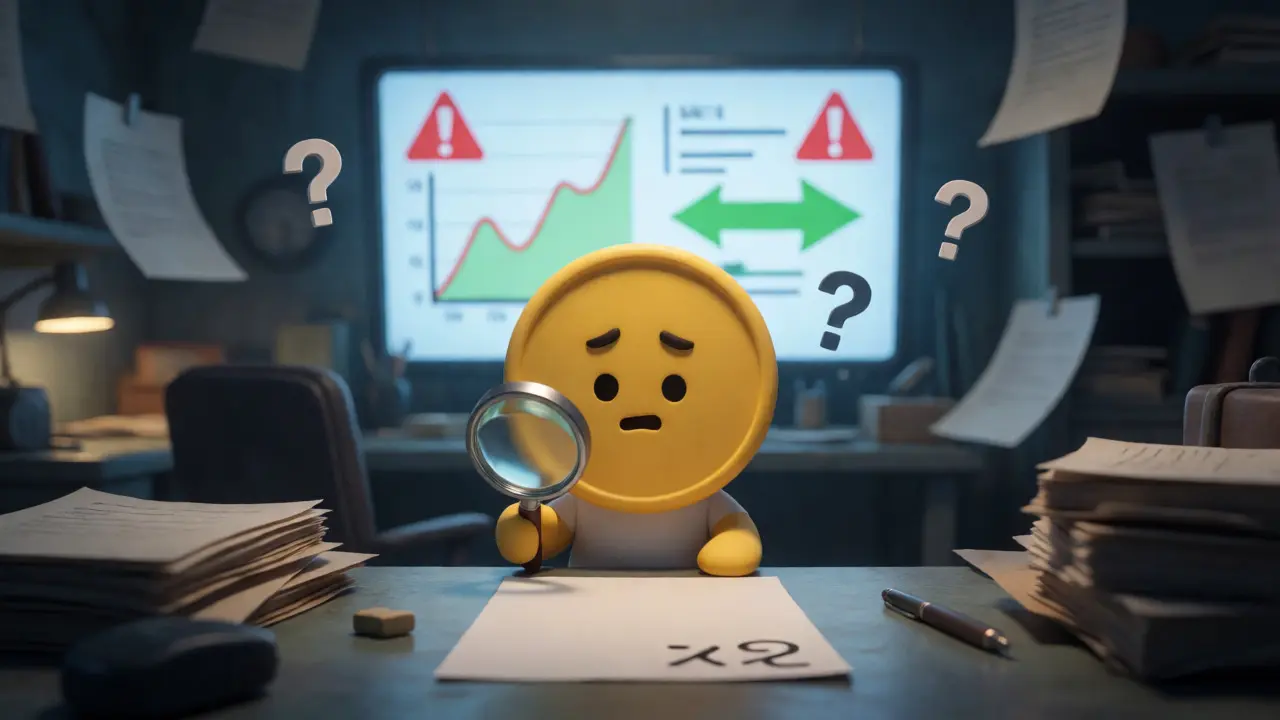
Technical Transparency: Where’s the Code?
Legitimate cryptocurrencies operate on public blockchains. You can verify transactions, check supply caps, and review smart contracts on explorers like Etherscan or BscScan. With POG, these details are scarce. Binance lists a guide on how to buy POGS using their Web3 Wallet, implying it runs on an Ethereum-compatible chain (likely Ethereum or Binance Smart Chain). But without a verified contract address or explorer link, users can’t independently confirm ownership or transaction history.
Another claim involves staking. Gate.com mentioned a competitive Annual Percentage Yield (APY) of up to 12%. For context, established networks like Ethereum currently offer around 3.8% staking yield, while Cardano hovers near 3.3%. A 12% APY would make POG highly attractive-if it were real. Yet, there’s no documentation on lock-up periods, reward schedules, or minimum stake requirements. High yields without clear mechanics often signal unsustainable models or potential rug pulls.
Community and Market Presence
A healthy crypto project buzzes with community activity. Check Reddit, Twitter, or Telegram for DOGE or SHIB, and you’ll find thousands of daily discussions about memes, partnerships, and price action. Now search for POG. The silence is deafening. Major crypto news outlets like Cointelegraph, Decrypt, or The Block rarely cover it. No significant threads appear on r/cryptocurrency discussing user experiences or technical issues.
This lack of organic discourse is a major red flag. If a token is experiencing a "surge," you’d expect chatter about exchange listings, wallet integration problems, or community events. Instead, POG seems to exist mostly in isolated marketing materials. The absence of a dedicated developer team profile or corporate structure further weakens its case. Who is building this? Where are they based? Without answers, trust remains low.
Nostalgia Coins: A Crowded Space
POG isn’t the first token to ride the nostalgia wave. Projects like Tamagotchi (TAMA) and various Pokémon-inspired tokens have tried similar angles. Most failed to gain lasting traction because nostalgia alone doesn’t drive utility. Successful meme coins usually rely on strong communities, viral marketing, or specific functional niches. POG attempts to combine physical collectibles with digital assets, but without a functioning marketplace or app to prove this concept, it remains theoretical.
Moreover, the broader crypto market is skeptical of unverified projects. In 2023, the SEC took enforcement actions against several unregistered token offerings. Regulatory scrutiny demands transparency-something POG hasn’t provided. Investors today prefer projects with audited code, known teams, and clear roadmaps over vague promises of "ecosystems."
Should You Buy POG?
Buying any cryptocurrency carries risk, but POG presents specific hazards. First, verify the contract address. If you can’t find it on a reputable explorer, don’t buy. Second, check liquidity. Low trading volume means you might struggle to sell your tokens later. Third, assess the source of your information. Be wary of articles with future dates or exaggerated claims lacking evidence.
If you’re drawn to the nostalgia factor, treat POG as a speculative gamble rather than a long-term investment. Keep expectations realistic. Don’t invest money you can’t afford to lose. And always do your own research beyond the initial pitch.
Frequently Asked Questions
Is POG (POGS) a legitimate cryptocurrency?
It exists as a tradable token, likely on an EVM-compatible chain, but lacks the transparency of established projects. Key issues include missing whitepapers, unverified smart contracts, and conflicting price data. Treat it with caution due to these red flags.
Where can I buy POGS?
Binance provides a guide suggesting purchases via their Web3 Wallet through decentralized exchanges (DEXs). Always verify the correct contract address before swapping to avoid fake tokens.
Does POG have real utility?
The project claims to integrate digital and physical POG collectibles, suggesting NFT-like functionality. However, no active marketplace or app demonstrating this utility has been widely documented or verified.
Why are there conflicting price predictions for POG?
Sources like Gate.com and Swapspace.co provide vastly different figures. Some articles even carry future dates, indicating potential content fabrication or SEO manipulation. Rely on real-time exchange data rather than predictive articles.
Is POG safe to stake?
Claims of 12% APY exist, but without verified staking contracts or clear terms, safety is uncertain. Unaudited staking mechanisms carry higher risks of bugs or scams compared to established protocols.
Next Steps for Investors
- Verify the Contract: Before buying, find the official smart contract address on CoinMarketCap or CoinGecko. Cross-reference it with blockchain explorers.
- Check Liquidity: Ensure there’s enough trading volume to enter and exit positions without significant slippage.
- Ignore Hype: Disregard articles with future dates or exaggerated claims. Look for independent audits and active development updates.
- Start Small: If you decide to invest, use only disposable income. Nostalgia coins are volatile and unpredictable.

Stephen McElreavy
September 9, 2026 AT 23:03Look, I get the appeal of the nostalgia play here. It's a classic cultural ambassador move to leverage childhood memories for DeFi utility. But let's be real about the technical jargon: without a verified smart contract audit from a reputable firm like CertiK or OpenZeppelin, this is basically vaporware wrapped in cardboard aesthetics.
The lack of a transparent GitHub repository is a massive red flag in my book. We're talking about decentralized finance, not just a meme coin pump-and-dump scheme. If the code isn't public and verifiable on-chain, how can we trust the supply mechanics? It feels like they are hiding something behind the 'mystery box' narrative. I'd say proceed with extreme caution because the opacity here is frankly unacceptable for any serious blockchain initiative.
sri harni
September 10, 2026 AT 19:01simple idea but no app yet
Rishi Mehta
September 12, 2026 AT 14:14This whole thing smells like a scam waiting to happen
I saw people buying this stuff thinking it was going to moon
But look at the data it makes zero sense
Why would anyone trust a token with no team info?
It’s just greed blinding everyone again
They will lose everything when the rug pull comes
I told you so already
These influencers are lying to your face
Don’t believe the hype train
Wake up people
It’s all fake
No transparency means no trust
End of story
Eugene McGrath
September 13, 2026 AT 05:52Typical American over-hype garbage trying to sell us milk caps as blockchain tech. The APY claims are absolute nonsense-12% yield on an unaudited contract? Yeah right. That’s not innovation, that’s a Ponzi structure disguised by SEO spam articles dated in the future. Who wrote that Gate.com piece, a time traveler? This project has zero liquidity depth and the community is non-existent outside of paid bots. Don’t buy into this junk unless you want to light your money on fire while watching a slideshow of 90s cartoons. Absolute trash tier asset.
Courtney Parker
September 14, 2026 AT 17:22Wait, hold on 😳 Are we sure there isn't some hidden alpha here? Just because it's quiet doesn't mean it's dead! Sometimes the best gems fly under the radar before the big exchanges list them. Maybe the silence is strategic? 🤔 I feel like everyone is too quick to judge based on Reddit threads that might be biased anyway. What if the dev team is just super focused on building and not tweeting? We should probably give them the benefit of the doubt before calling it a rug. 😬
Finlay Samms
September 15, 2026 AT 00:31Hard to say mate 😐 On one hand, the lack of docs is worrying 📉 but on the other, maybe they’re still in stealth mode? 🕵️♂️ Nostalgia tokens do have their moments though ✨. I’d wait for a proper audit before putting any serious capital in 👀. Better safe than sorry innit? 🤷♂️
Dominic Jones
September 16, 2026 AT 07:33Let us consider the philosophical implications of value in this context...; when a token lacks intrinsic utility...; and relies solely on the collective belief of its holders...; does it truly possess value...; or is it merely a reflection of our own desires for validation...; In the case of POG...; the absence of a whitepaper suggests a fundamental disconnect between promise and reality...; which is troubling for any rational investor...; We must ask ourselves...; if the community is silent...; who exactly is driving the price action...; Is it organic interest...; or artificial manipulation...; These questions remain unanswered...; until more data emerges...;
Sheryl Nelsen Hutton
September 17, 2026 AT 21:21I think it is important to recognize that the intersection of physical collectibles and digital assets represents a fascinating frontier in the evolution of decentralized economies, particularly when considering the potential for bridging generational gaps through shared nostalgic experiences, although the current implementation details provided in the article seem somewhat vague regarding the actual technological infrastructure required to support such a hybrid model effectively, especially given the historical precedents of similar projects that failed due to a lack of sustained community engagement and clear utility pathways beyond mere speculation.
John Lewis
September 18, 2026 AT 00:42From a technical standpoint, verifying the contract address is step one. If you can't find it on Etherscan or BscScan with a verified source code, you're essentially trading blind. The conflicting price predictions mentioned in the article highlight the danger of relying on automated forecasting tools that don't account for low market cap volatility. I recommend checking DEXTools or DexScreener for real-time liquidity pools rather than trusting static articles. Always cross-reference multiple sources before executing a swap.
Sophie Fitzgerald
September 18, 2026 AT 14:39Agreed on the caution points. It seems risky given the missing info.
Ritchie Grogg
September 18, 2026 AT 15:57Man, this hurts my soul 💔 seeing these old-school vibes get turned into such a shady crypto venture. It used to be so pure playing POG in the playground, now it's all about charts and scams. I feel like I'm losing a part of my childhood every time I see one of these hype posts. It’s just sad really, like watching a puppy try to drive a car. Hopeless and dangerous. 😢
Alexander James
September 19, 2026 AT 13:46We have a moral obligation to protect the vulnerable from predatory financial schemes! 🛑 When a project hides behind 'nostalgia' while lacking basic transparency, it is exploiting emotional connections for profit. 🎭 The audacity to claim 12% APY without a locked smart contract is nothing short of criminal negligence in my eyes. ⚖️ We must stand firm against these unverified entities. ✊ Do not let them pollute the space with their lies!
Mary Burnett
September 19, 2026 AT 17:40I appreciate the detailed breakdown provided in the original post. It is evident that many investors are feeling uncertain about the legitimacy of this new token. The concerns raised regarding the lack of a verifiable whitepaper and the inconsistent pricing data are valid and should be taken seriously by those considering entry into this market. It appears that patience and thorough due diligence are currently the most prudent strategies available.
Ferdinand Friday
September 21, 2026 AT 02:11Imagine, if you will, a tapestry woven from the threads of memory and silicon, where the clatter of milk caps echoes through the digital void. 🧵✨ This token attempts to stitch together two disparate worlds, yet the needlework is clumsy, frayed at the edges, and lacking in pattern. 🪡 The vibrant hues of our youth are being dyed in shades of gray uncertainty, washed out by the harsh light of speculative frenzy. 🌫️ Without a loom of solid code to hold the design, the fabric tears easily, unraveling into loose ends that catch on the fingers of the unsuspecting buyer. 🕸️ One cannot build a cathedral on a foundation of sand, nor can one mint trust from a vacuum of information. 🏗️ The whispers of the blockchain should sing with clarity, not murmur in the shadows of anonymity. 🎶 Until the veil is lifted and the gears of the machine are visible to the naked eye, this remains a ghost ship sailing on a sea of fog. 🚢🌫️
Gabriela Gonzalez
September 23, 2026 AT 00:05Hey guys! 🌟 Don't let the negativity bring you down! Every big project started somewhere small! 🚀 Even if it looks sketchy now, imagine the upside if they actually deliver! 💪 Keep your eyes open and stay positive! You never know what's around the corner! 🔮💰 Let's keep dreaming big! ✨
John Martin
September 24, 2026 AT 16:48Listen, I’m not saying it’s definitely a scam, but the risk-to-reward ratio here is terrible. 📉 If you absolutely must trade it, use limit orders to avoid slippage. 🛑 And please, for the love of god, check the liquidity lock status. 🔒 If it’s unlocked, you’re gambling, not investing. 🎲 Stay safe out there. 🙏
Abid Bhatti
September 26, 2026 AT 00:40You are all sheep following the herd off a cliff. They created the problem (no transparency) and now they offer the solution (buy more). It is a closed loop of control. The media outlets citing future dates are not making mistakes; they are testing compliance. If you accept the date error, you accept the narrative. It is psychological warfare. Do not participate in the experiment.
Jess Emmerson
September 27, 2026 AT 11:57Just chilling here observing the chaos. 😎 Honestly, the vibe is weird. No devs, no chats, just ads. Feels like a mall kiosk selling magic beans. I'll watch from the sidelines. 🍿
Paige Ray
September 29, 2026 AT 10:57I hear the frustration in these comments. It is exhausting to sift through so much noise just to find a signal. For those who are anxious about missing out, remember that staying in cash is also a position. There is no shame in waiting for clarity.
Indu Nair
September 30, 2026 AT 17:32STOP BEING SO NEGATIVE! 😤 Yes, it has risks, but look at the opportunity cost of doing NOTHING! 📉 People are afraid of failure so they choose stagnation! 🛑 This is how progress happens! Through bold moves! 🚀 Even if it fails, the lesson is valuable! 🧠 So stop whining about audits and start thinking about the vision! 🌈 We need believers, not critics! 💥 Join the movement or get left behind! 🏃♀️💨