
You’ve probably seen the ticker QI flash across your screen on a crypto exchange or in a DeFi dashboard. It’s not just another random coin with a catchy name. The QI token is the heartbeat of the QiDAO protocol, a system that lets you borrow money against your crypto without paying interest. If you are wondering what this actually means for your portfolio, or why this specific token matters in the broader world of decentralized finance, you are asking the right questions.
The short answer is that QI is a governance and fee-sharing token. But the longer answer involves a fascinating mechanism called Collateralized Debt Positions (CDPs), a stablecoin named MAI, and a community that votes on how millions of dollars in treasury funds are spent. Let’s break down exactly how this works, who it helps, and what you need to know before interacting with the protocol.
Understanding the QiDAO Protocol
To understand the QI token, you first have to understand the machine it powers: QiDAO is a decentralized financial protocol established in 2021 to oversee Mai Finance, functioning as a self-sustaining, community-governed collateralized debt positions platform.
Think of traditional lending. You go to a bank, put up collateral like a house, and get a loan. You pay interest every month. Now imagine a system where you lock up your cryptocurrency-like Ethereum or Chainlink-as collateral, and mint a stablecoin against it. You don’t pay monthly interest. Instead, you pay a one-time fee when you close the loan. That is the core promise of QiDAO.
The protocol originated on Polygon PoS is a layer-2 scaling solution for Ethereum that QiDAO used as its initial launchpad., making it one of the first native stablecoin protocols on that network. Since then, it has expanded to zkEVM is a zero-knowledge Ethereum Virtual Machine chain where QiDAO deployed new smart contracts for improved efficiency.. This multi-chain approach allows users to access liquidity wherever their assets are located, reducing the friction of moving funds between different blockchains.
The Role of the MAI Stablecoin
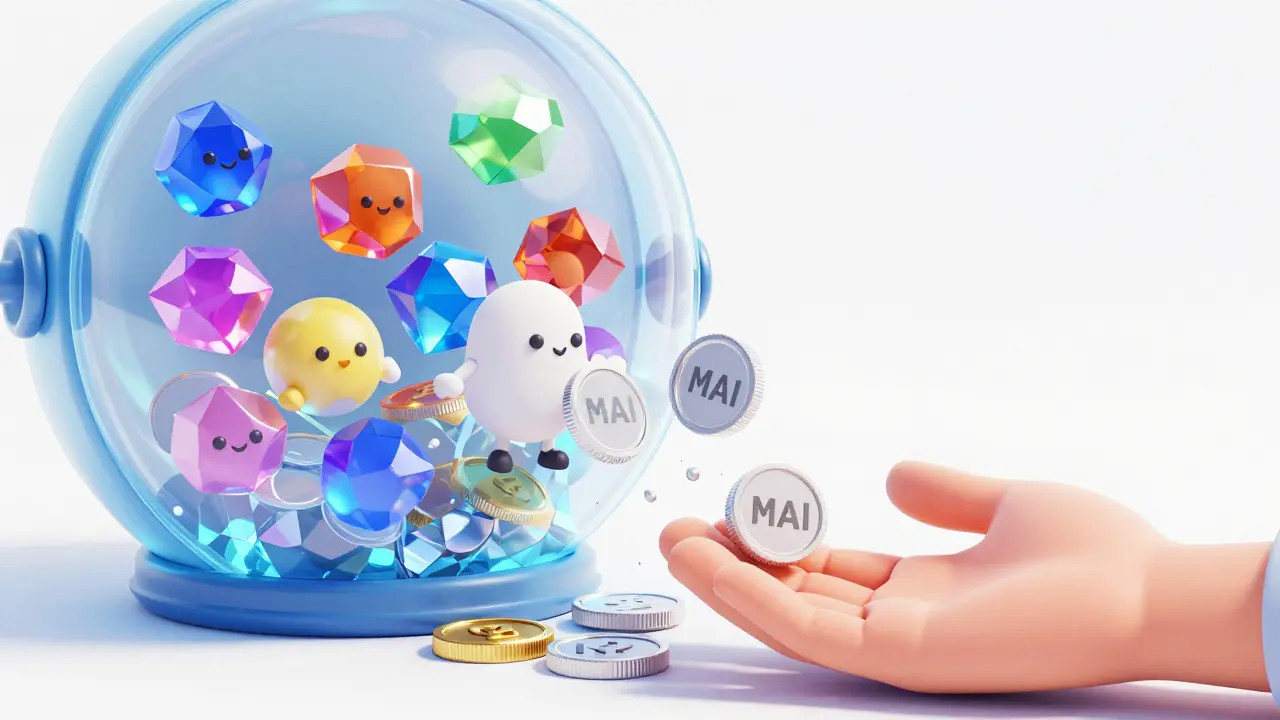
You can’t talk about QiDAO without talking about MAI is the debt-backed stablecoin collateralized by locked collateral tokens within the QiDAO ecosystem.. MAI is the product you get when you use the protocol. It is softly pegged to the U.S. Dollar, meaning its value aims to stay at $1.00, but it is maintained through market mechanisms rather than holding cash reserves in a bank account.
Here is how the borrowing process works:
- Deposit Collateral: You deposit approved assets into a vault. These can be static tokens like LINK or CRV, or yield-generating assets like Aave’s aTokens.
- Mint MAI: The protocol mints new MAI tokens and sends them to your wallet. You now have liquid cash (in the form of stablecoins) while still owning the underlying crypto.
- Maintain Ratio: You must keep your collateral value above a certain threshold relative to your debt. If the price of your collateral drops too low, your position risks liquidation.
- Repay and Close: When you want your collateral back, you repay the MAI plus a small closing fee. Your collateral is unlocked.
The beauty of this system is capital efficiency. Because you can use yield-bearing assets as collateral, you might earn interest on your deposited tokens while simultaneously using the borrowed MAI for other investments. It turns idle crypto into active working capital.
What Does the QI Token Actually Do?
So, if MAI is the product, what is QI? The QI Token is the governance and fee-sharing token of the QiDAO Protocol with a maximum supply of 200 million tokens. serves two primary functions: control and reward.
1. Governance Power Anyone can submit a proposal to change the protocol, but only QI holders can vote. However, simply holding QI isn’t enough to maximize your influence. Holders can lock their QI tokens for periods up to four years. In return, they receive eQI tokens. The longer you lock, the more voting power you get. This "Qi Powah" determines how decisions are made regarding protocol parameters, such as which new collaterals to accept or how to adjust risk models.
2. Fee Sharing The protocol generates revenue from closing fees and other income streams. This money goes into the Treasury. QI holders, particularly those with locked eQI, share in these revenues. It creates an incentive alignment: if the protocol is healthy and widely used, the Treasury grows, and token holders benefit.
Treasury Management and Community Control
One of the most unique aspects of QiDAO is its self-sustaining model. Unlike some projects that rely on venture capital injections, QiDAO relies on its own Treasury. As of recent data, the Treasury holds approximately $2.69 million, distributed among major cryptocurrencies, stablecoins, and other assets.
The community decides how to spend this money. Need to upgrade security audits? Pay for developer grants? Boost liquidity on a new chain? These are all voted on by the QI holders. This decentralization ensures that the protocol evolves based on user needs rather than the whims of a central team. It also means the protocol is resilient; even after significant challenges, the community has continued to govern and improve the system.
Security and Risk Factors
No discussion of DeFi is complete without addressing risk. QiDAO has faced hurdles. Early in its history, the protocol experienced a security incident involving stolen funds, including team-vested tokens. This led to a sharp drop in the QI token price, falling by roughly 65% at the time. While the price eventually recovered, it serves as a reminder of the volatility inherent in crypto governance tokens.
Beyond external hacks, there are operational risks:
- Liquidation Risk: If the market crashes and your collateral value drops below the required ratio, your assets can be sold off to cover your debt. You lose your collateral and potentially some profit.
- Peg Deviation: MAI is a "soft" peg. While mechanisms like the Peg Stability Module (PSM) help keep it near $1.00, extreme market stress could cause temporary deviations.
- Smart Contract Risk: Like any code running on a blockchain, there is always a non-zero chance of bugs or exploits, though QiDAO employs rigorous auditing and upgrades like the permit2 standard to mitigate this.
Recent Developments: The Peg Stability Module
In March 2024, QiDAO introduced a major infrastructure update: the Peg Stability Module (PSM) is a vault accepting USD-pegged assets as collateral to mint and redeem MAI stablecoins at a 1:1 ratio..
Why does this matter? Before the PSM, maintaining the peg relied heavily on market makers and arbitrageurs. The PSM allows users to directly swap other stablecoins (like USDbC) for MAI at a 1:1 ratio. This increases liquidity and makes the peg more robust. It essentially gives the protocol a direct valve to adjust the supply of MAI based on real-world demand, enhancing stability for everyone using the system.
How to Interact with QI
If you are interested in participating, here are the practical steps:
- Acquire QI: You can buy QI on exchanges like LBank or Binance. Be aware of price discrepancies between platforms; always check multiple sources for the best rate.
- Lock for Governance: To participate in voting, you’ll need to stake your QI to generate eQI. This is done through the official QiDAO interface.
- Vote: Review QiDAO Improvement Proposals (QIPs). Your vote weight depends on your locked balance. Engage in discussions to understand the implications of each proposal.
- Earn Yield: Some platforms offer ways to lend QI or provide liquidity to earn additional returns, though this introduces counterparty risk.
| Component | Function | User Benefit |
|---|---|---|
| MAI Stablecoin | Debt-backed stablecoin | Access liquidity without selling crypto |
| QI Token | Governance & Fee Share | Voting power & revenue distribution |
| eQI Token | Locked QI representation | Increased voting weight & rewards |
| PSM | Stablecoin redemption/minting | Enhanced peg stability & liquidity |
Is QiDAO Right for You?
QiDAO appeals to users who want to maintain exposure to their crypto assets while accessing cash. It is ideal for those who believe in decentralized governance and want a say in how a protocol evolves. However, it requires active management. You cannot set and forget a loan in QiDAO; you must monitor collateral ratios and stay informed about governance votes.
For casual investors looking for passive income with zero risk, this might be too complex. But for DeFi enthusiasts who understand the mechanics of collateralized debt and want to participate in a community-driven financial system, QI offers a meaningful role. It is not just a speculative asset; it is a key to unlocking a suite of financial tools designed for the modern crypto economy.
What is the difference between QI and MAI?
MAI is the stablecoin you borrow against your collateral. It is pegged to the US Dollar. QI is the governance token that controls the protocol. You use QI to vote on changes and share in the protocol's fees. They serve completely different purposes within the ecosystem.
Do I have to pay interest to borrow MAI?
No. QiDAO loans are interest-free. You only pay a one-time closing fee when you repay your debt and unlock your collateral. This makes it cost-effective for long-term holdings compared to traditional lending platforms.
What happens if my collateral value drops?
If the value of your collateral falls below a specific Loan-to-Value (LTV) threshold, your position becomes undercollateralized. This triggers a liquidation risk, where your assets may be sold to cover the debt. You should monitor your position closely and add more collateral if necessary.
How do I get voting power in QiDAO?
You need to hold QI tokens and lock them up. Locking QI generates eQI tokens. The longer you lock your tokens (up to 4 years), the more eQI you receive, and the greater your voting weight in protocol decisions.
Is MAI fully backed by cash?
No. MAI is a decentralized stablecoin backed by overcollateralized crypto assets, not fiat currency held in a bank. Its stability is maintained through economic incentives, overcollateralization requirements, and mechanisms like the Peg Stability Module.
Which blockchains does QiDAO support?
QiDAO was originally launched on Polygon PoS. It has since expanded to zkEVM. This multi-chain presence allows users to interact with the protocol on networks that offer lower transaction costs and faster speeds.
What is the Peg Stability Module (PSM)?
The PSM is a feature that allows users to mint and redeem MAI using other USD-pegged stablecoins like USDbC at a 1:1 ratio. This helps maintain the price stability of MAI by allowing direct arbitrage between stablecoins.
Can anyone submit a proposal to QiDAO?
Yes, anyone can submit a proposal. However, only holders of staked QI (eQI) can vote on these proposals. This open submission process encourages community participation and innovation.
What types of collateral can I use?
You can use static tokens like LINK and CRV, as well as yield-generating assets like Aave aTokens and Yearn vault tokens. Using yield-bearing assets allows you to earn interest on your collateral while it is locked.
How much QI is in circulation?
The maximum supply of QI is 200 million tokens. The distribution includes allocations for strategic partners, keepers, and the majority for the community. Specific circulating supply figures vary based on vesting schedules and market activity.
