
Revolotto (RVL) isn’t just another cryptocurrency. It’s a high-risk, high-reward experiment built on a bold promise: automatic wealth generation through transaction fees, token burns, and rewards - all without you lifting a finger. But behind the flashy claims and $100,000 price targets lies a coin with almost no trading volume, a 20% fee on every trade, and a market cap so small it barely registers on the radar. So what exactly is Revolotto, and should you even care?
How Revolotto (RVL) Works: The Four-Dimensional Tokenomics System
Revolotto operates on the Binance Smart Chain (BSC) and claims to have a unique four-dimensional tokenomics model. Unlike most tokens that simply reward holders or burn supply, RVL layers multiple mechanisms on top of each other - and every single transaction triggers them all.
Here’s how it breaks down on every trade:
- 80% to the investor - This is the portion that goes to the person making the transaction. It’s not a reward; it’s just the remaining balance after fees.
- 6% to all holders - Every RVL wallet automatically gets 6% of the total transaction volume as a reward. No staking. No locking. Just holding.
- 5% burned - This portion is permanently removed from circulation. With every trade, the total supply shrinks. That’s the deflationary engine.
- 9% added to liquidity - This money goes into a locked pool to ensure there’s always some buying power in the market.
So if you buy $100 worth of RVL, $20 goes to fees. Of that $20, $12 goes back to you, $6 gets split among all holders, $5 disappears forever, and $9 is used to strengthen the trading pair. The project calls this an “auto-staking” system. But it’s really just a fee tax with side benefits.
Supply Mechanics: The Deflationary Engine
Revolotto’s total supply is capped at 210 million tokens. As of February 2026, 209,914,200 RVL are already in circulation. That means less than 86,000 tokens remain unissued - and even those might not ever be released.
The burning mechanism is relentless. Every time someone trades RVL - whether they’re buying or selling - 5% of the transaction value is burned. That’s not a one-time event. It happens on every single trade. Over time, this reduces the total supply. The project calls these “coin circulation cycles.” When the total volume of trades equals the total supply, one cycle completes, and another 5% of the remaining supply is burned. This creates a feedback loop: fewer coins → higher scarcity → (theoretically) higher price.
But here’s the catch: if nobody’s trading, the burn stops. And right now, trading volume is dangerously low.
The Price Projections: $100,000 Per Token?
Revolotto’s whitepaper doesn’t just talk about growth - it dreams in zeros. The “Hard Target: 100 Cycles” roadmap claims that if the burn and trading mechanisms hold up, RVL could hit:
- Cycle 1: $1,000 per token
- Cycle 10: $10,000 per token
- Cycle 25: $50,000 per token
- Cycle 50: $100,000 per token
These numbers aren’t guesses. They’re math. Based on the burning curve, if supply drops to 1.2 million tokens, and demand stays constant, the math adds up. But demand doesn’t stay constant. It vanishes.
Right now, RVL trades at around $0.023-$0.03. Its all-time high was $4.16. That’s a 99% drop. The price projections assume millions of people will start trading RVL consistently - and that’s not happening. The 24-hour volume ranges from $33 to $496. That’s not a market. That’s a garage sale.
The Lock-Ups: You Can’t Sell for Three Months
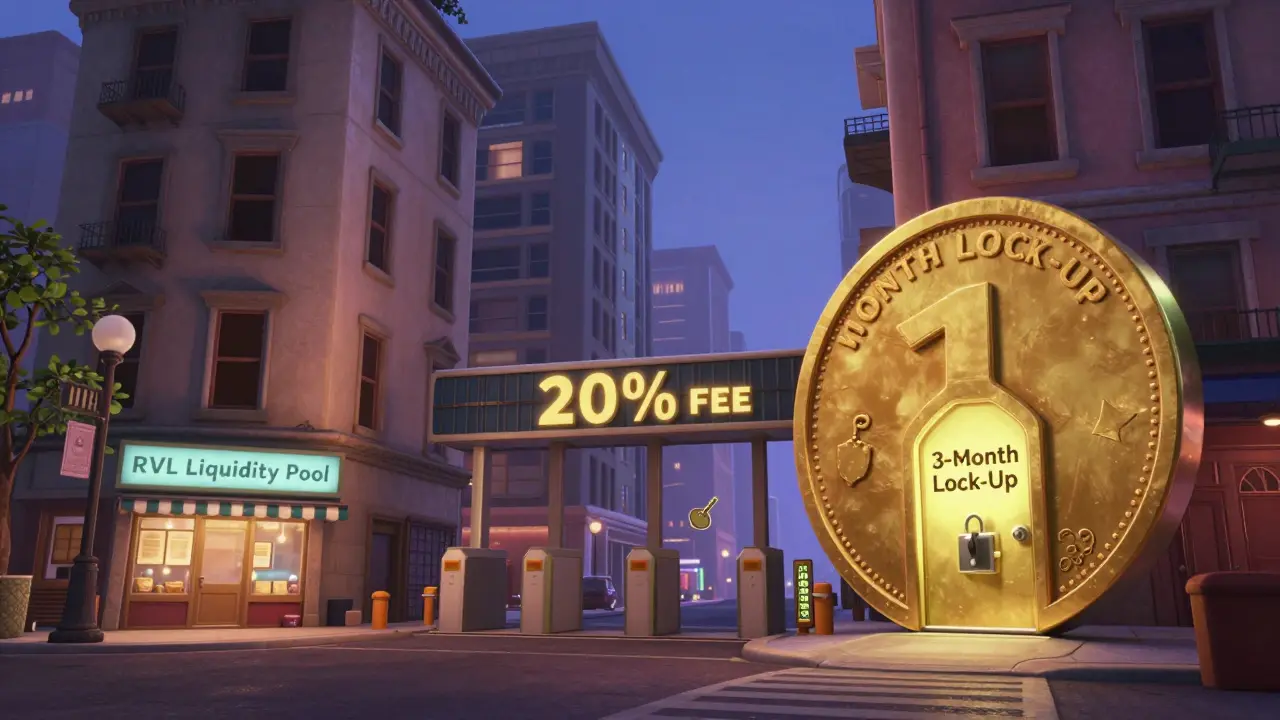
Here’s where Revolotto gets really tricky. If you buy RVL today, you can’t sell it for three months. Your tokens are locked. The project says this prevents “whales” from dumping and crashing the price. In theory, it sounds smart. In practice, it’s a trap.
Imagine buying $1,000 worth of RVL. You’re told, “Great! You’ll earn 6% rewards and the price will skyrocket!” But three months later, the price is $0.01. You can’t sell. You’re stuck. And if the project dies before the lock-up ends? You lose everything.
Even worse - the 20% transaction fee makes every trade expensive. If you want to move your RVL to another wallet or exchange, you pay $20 in fees for every $100 you trade. That’s not a feature. That’s a tax.
Market Reality: A Micro-Cap Ghost
Revolotto is ranked #11,538 by market cap. That’s not just low - it’s invisible. For comparison, Bitcoin trades at over $1 trillion. Even obscure tokens like Shiba Inu or Dogecoin have market caps in the billions. RVL’s fully diluted valuation is around $6.9 million. That’s less than the cost of a single Tesla Model Y.
There’s no media coverage. No analyst reports. No Reddit threads. No Twitter buzz. No YouTube breakdowns. The only people talking about RVL are the project’s own channels - and they’re pushing the $100,000 dream.
The liquidity pool is locked for five years. The team wallet is locked for one year. That sounds reassuring - until you realize nobody knows who the team is. No names. No LinkedIn profiles. No public history. Just a contract address: 0x6dc3d0d6ec970bf5522611d8eff127145d02b675.
Security Claims: Audited, But Not Verified
The project says the smart contract has been audited. That’s good. But no audit report is publicly available. No firm name. No findings. No GitHub link. Just a claim. In crypto, that’s not enough. Real audits are published openly. They’re pinned to GitHub. They’re discussed in Telegram groups. RVL’s audit? Silent.
The KYC and QC claims are equally vague. KYC means the team had to prove their identity. But again - no names. No documents. No proof. If the team is anonymous, the audit is meaningless. And if the team walks away tomorrow? The locked liquidity doesn’t matter. The coin dies.
Why This Isn’t a “Get Rich Quick” Scheme
Revolotto markets itself as a passive income tool. “Hold and earn 6% on every trade!” sounds amazing. But here’s what they don’t tell you: you only earn if someone else is trading.
If you’re the only person holding RVL? You get zero rewards. If no one buys or sells? The burn stops. The liquidity doesn’t grow. The price doesn’t move. You’re just sitting on a token with no market.
And the rewards? They’re paid in RVL. So if the price crashes 90%, your 6% reward is worth 90% less. You’re not earning dollars. You’re earning a coin that might be worthless tomorrow.
Who Is Revolotto For?
Revolotto isn’t for investors. It’s for speculators - the kind who chase moonshots, ignore red flags, and believe in magic math. It’s for people who saw a 100x return on some meme coin years ago and think the same thing can happen again.
It’s not for long-term holders. You can’t sell for three months. You’re forced to ride the rollercoaster.
It’s not for traders. The 20% fee makes every trade a loss.
It’s not for the cautious. No transparency. No team. No volume. No history.
It’s only for those who believe the math will somehow override reality.
The Bottom Line
Revolotto (RVL) is a high-risk, low-liquidity token with a speculative roadmap and zero real-world adoption. It has a cleverly designed tokenomics model - but models don’t matter if no one uses them. The 6% rewards sound great. The 5% burn sounds smart. The $100,000 price target sounds magical.
But none of that matters if the market doesn’t exist.
As of March 2026, RVL is a ghost coin. It’s alive on paper. Dead in practice. The only thing growing is the number of people who lost money chasing it.
If you’re thinking about buying RVL - don’t. If you already own it? Consider it a loss. And move on.
Is Revolotto (RVL) a scam?
Revolotto isn’t technically a scam - it doesn’t steal funds or fake ownership. But it’s built on misleading promises. The team is anonymous, the audit isn’t public, the trading volume is near zero, and the price projections are mathematically possible but practically impossible. It’s more accurately described as a high-risk speculation with no foundation.
Can I really earn 6% on every trade just by holding RVL?
Yes - technically. Every time someone buys or sells RVL, 6% of the transaction value is distributed to all holders. But if no one is trading, you earn nothing. And if the price crashes, your 6% reward is worth far less than what you paid. The reward is real, but its value is entirely dependent on someone else’s activity.
Why is the trading volume so low?
The trading volume is low because there’s no demand. The coin has no media coverage, no community, no exchange listings beyond a few obscure platforms, and a 20% transaction fee that discourages trading. Most people who bought RVL at its peak have already sold or lost interest. The few remaining holders are either waiting for a miracle or can’t sell due to the 3-month lock-up.
What happens if the Revolotto team abandons the project?
If the team disappears, the locked liquidity and wallets won’t matter. The smart contract will keep running - but no one will update it. No marketing. No new features. No fixes. The token will continue to burn on trades, but without any new buyers, the price will collapse. The 3-month lock-up will expire, and holders will be stuck with a worthless asset.
Is Revolotto worth investing in?
No. Revolotto has none of the qualities that make a cryptocurrency a viable investment: transparency, liquidity, team credibility, community support, or real-world use. The price projections are fantasy math. The tokenomics are designed to extract fees, not create value. The only people who profit from RVL are those who sold early. Everyone else is just waiting for the lights to go out.

William Montgomery
March 10, 2026 AT 20:19This isn't investing. It's gambling with extra steps. That 20% fee? That's not a feature - it's a robbery tax. If you're still holding RVL, you're not a believer. You're a sucker who got played.
Mara Alves Mariano
March 12, 2026 AT 00:56Oh honey, this isn't crypto - it's a performance art piece called 'How to Drain 100 People's Life Savings While Saying 'Passive Income' With a Straight Face.' I love it. The audacity? Chef's kiss. 🤡💸
Adam Ashworth
March 13, 2026 AT 16:43Look, the math on the burn rate is technically sound - if volume existed. But volume doesn't exist. And without volume, it's just a spreadsheet fantasy. The 6% rewards are meaningless if the token's value keeps cratering. This isn't DeFi - it's a ghost town with a smart contract.
Tom Jewell
March 14, 2026 AT 00:22There's something almost poetic about Revolotto - a token built on the idea that scarcity alone can create value, even when no one wants it. It's like a silent film about a revolution that never happened. We watch it, we nod, we wonder why we're still here. The burn cycle is beautiful. The liquidity lock? Tragic. And the $100,000 dream? A monument to human hope in the face of cold, hard math.
Craig Gregory
March 15, 2026 AT 13:01The audit claim is the most dishonest part. No public report? No firm name? That’s not negligence - it’s fraud by omission. If you’re going to scam people, at least have the decency to make the contract look legit. This is amateur hour with a whitepaper.
Anthony Marshall
March 16, 2026 AT 14:58Don’t let haters fool you. This is the next Bitcoin. The volume is low because the whales are hoarding. The lock-up? That’s genius - it forces long-term thinking. The 20% fee? That’s what fuels the burn. The math checks out. If you’re not in yet, you’re already behind. The moon is coming. Buckle up.
Lindsay Girvan
March 18, 2026 AT 02:08Let me get this straight - you buy a coin, pay 20% to trade it, can’t sell for 90 days, and ‘earn’ rewards in the same worthless token? That’s not passive income. That’s a pyramid where the only thing you’re building is debt. I’m not shocked. I’m disappointed in humanity.
Douglas Anderson
March 18, 2026 AT 10:58For anyone still holding: if you bought at $4, you’re already down 99%. If you bought at $0.03, you’re gambling. The 6% rewards sound nice, but they’re paid in RVL - which means if the price drops, your ‘earnings’ drop too. It’s a trap wrapped in a spreadsheet. Don’t chase the dream. Cut your losses. Walk away.
Tina Keller
March 18, 2026 AT 22:36It’s funny how we romanticize ‘math’ in crypto while ignoring human behavior. The burn cycle looks elegant on paper - until you realize no one’s trading. No one’s buying. No one’s even looking. The project isn’t dead. It’s been forgotten. And in crypto, being forgotten is worse than being hacked.
vasantharaj Rajagopal
March 20, 2026 AT 16:58From a technical standpoint, the tokenomics are structurally flawed due to the absence of liquidity incentives beyond fee redistribution. The 9% liquidity addition is insufficient to offset the 20% fee burden, creating a negative feedback loop where trading velocity collapses. Additionally, the 3-month lock-up violates the principle of fungibility, rendering the asset illiquid and non-compliant with DeFi norms. This is not innovation - it’s systemic failure.
Allison Davis
March 21, 2026 AT 14:20People keep saying ‘the math adds up.’ But math doesn’t care about trust. Or community. Or whether people are still alive to trade it. RVL isn’t a coin. It’s a thought experiment. And the experiment is over. The data’s in. It failed.
karan narware
March 23, 2026 AT 05:37Oh, so the ‘auto-staking’ is just a tax… and the ‘$100,000 target’ is just… a dream? And the team? Anonymous? And the audit? Invisible? And the volume? A whisper? And the lock-up? A prison? And the rewards? Paid in the same trash? ...I’m not mad. I’m impressed. Someone spent months designing this. And they did it… on purpose.
Michael Suttle
March 23, 2026 AT 08:19They’re not just hiding the team - they’re hiding the fact that this is a honeypot. The 20% fee? That’s the exit scam. The 3-month lock? That’s the trapdoor. The ‘burn’? That’s the smoke. They want you to think it’s math. It’s not. It’s a front. I’ve seen this before. This isn’t crypto. It’s a digital Ponzi with a whitepaper.
Jenni James
March 24, 2026 AT 01:22While I acknowledge the structural deficiencies of the Revolotto tokenomics framework - particularly the non-transparent audit, illiquid market, and coercive lock-up mechanisms - I must emphasize that your characterization of this asset as ‘worthless’ is both empirically inaccurate and philosophically reductive. Value is not solely determined by market volume. It is also shaped by narrative, belief, and emergent utility. To dismiss RVL is to dismiss the very essence of speculative innovation.