XUSD Cross-Border Payment Calculator
Calculate Your Savings
Payment Comparison
Traditional Banking
Estimated Fees: $50.00
Estimated Time: 3-5 days
XUSD Stablecoin
Estimated Fees: $0.50
Estimated Time: Under 4 seconds
$49.50
Savings on fees
3-5 days faster
Time saved
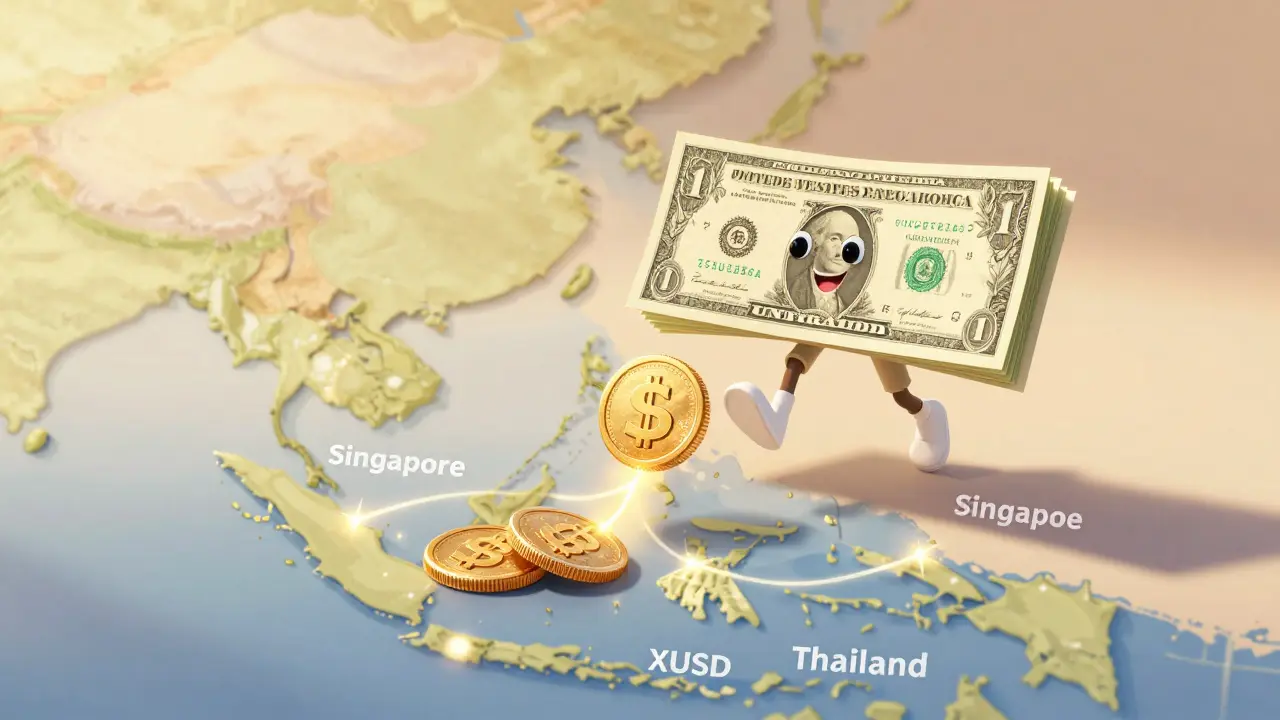
When you think of stablecoins, you probably think of USDT or USDC. But there’s another player quietly making waves in Southeast Asia-StraitsX USD, or XUSD. It’s not trying to beat Bitcoin or compete with Tether. Instead, it’s built for one purpose: to move money quickly, safely, and legally across ASEAN countries using the stability of the U.S. dollar.
What Exactly Is XUSD?
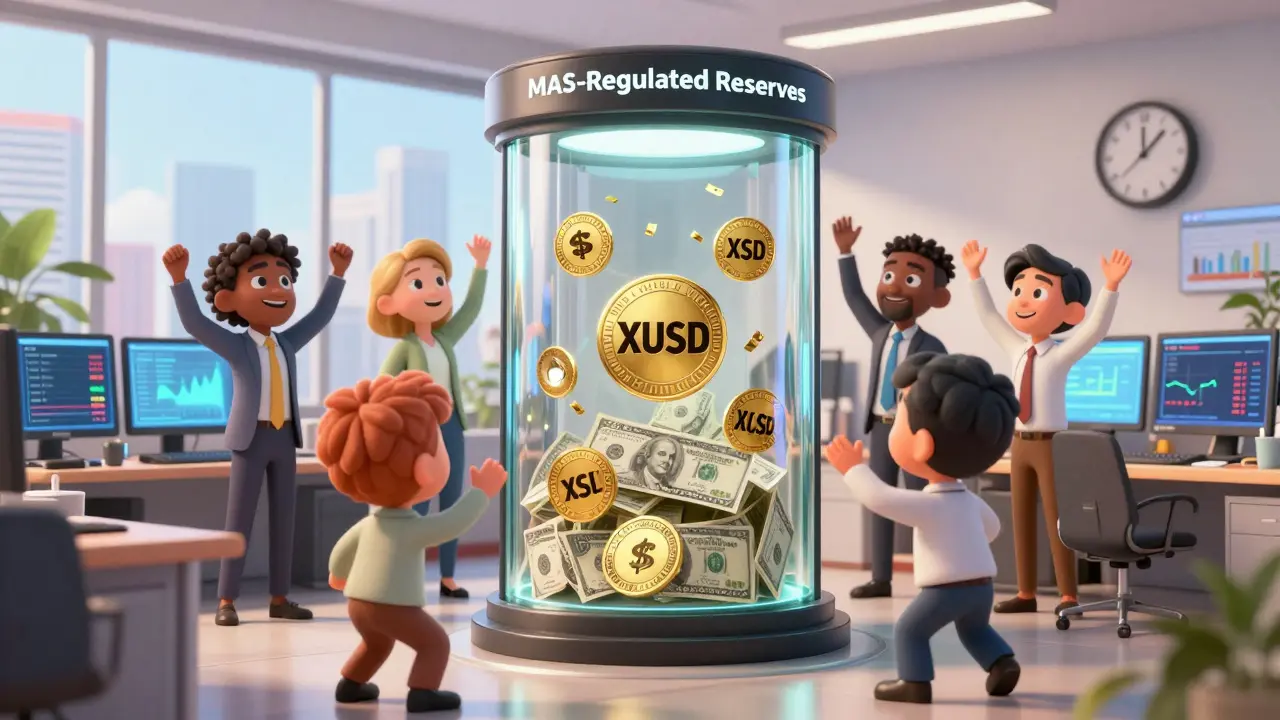
StraitsX USD (XUSD) is a digital token that’s always worth $1.00 USD. It’s not a speculative crypto like Ethereum or Solana. You don’t buy it hoping it’ll go up 10x. You buy it because you need a reliable digital dollar that works 24/7, even when banks are closed. It’s issued by StraitsX, a company based in Singapore and regulated by the Monetary Authority of Singapore (MAS). That’s a big deal. Most stablecoins operate in legal gray zones. XUSD doesn’t. Every XUSD token is backed by a real U.S. dollar held in regulated banks in Singapore. If you have 100 XUSD, there are $100 in cash sitting in a vault somewhere, ready to be exchanged back to you anytime. Unlike algorithmic stablecoins that use complex math to stay pegged to $1, XUSD doesn’t guess or adjust. It’s simple: deposit $1, get 1 XUSD. Burn 1 XUSD, get $1 back. No tricks. No risks from market swings. Just direct 1:1 backing.How Does XUSD Work?
XUSD runs on two major blockchains: Ethereum (as an ERC-20 token) and BNB Smart Chain (as a BEP-20 token). That means you can send it anywhere those networks work-like to wallets on MetaMask, Trust Wallet, or exchanges like Bybit and Bitget. Transactions settle fast. On Ethereum, it takes about 12 seconds. On BSC, it’s under 4 seconds. That’s faster than most bank transfers, especially across borders. And fees? Much lower than wire transfers or SWIFT payments. You can’t mine XUSD. You can’t earn interest on it through staking. That’s intentional. It’s not a yield farm. It’s a payment tool. New tokens are only created when someone deposits real U.S. dollars into StraitsX’s reserve account. When someone redeems XUSD for USD, the tokens are destroyed. The supply is always exactly equal to the cash on hand.Who Uses XUSD-and Why?
Most users aren’t retail crypto traders. They’re businesses. According to StraitsX’s own reports, 78% of XUSD transactions are B2B payments. Think of a Thai manufacturer paying a supplier in Indonesia. Without XUSD, they’d use a bank wire. That could take 3-5 days, cost $30-$50, and get stuck in compliance delays. With XUSD, they send it in seconds. The recipient gets it in their digital wallet. They can cash out to local currency through a partner bank. No middlemen. No hidden fees. And because it’s MAS-regulated, both sides trust it. One user in Singapore told Coinbase: “Used XUSD to transfer funds during the Maybank outage in September 2024-settled in 15 seconds when traditional banking took 3 days.” That’s the kind of real-world problem it solves.Where Can You Get XUSD?
You won’t find XUSD on Coinbase, Kraken, or Binance US. That’s not an accident. It’s not designed for U.S. users. It’s built for ASEAN. As of late 2024, you can buy or trade XUSD on:- Bitget
- Bybit
- Crypto.com (limited regions)
- Some Singapore-based exchanges
How Does XUSD Compare to USDT and USDC?
Here’s the reality: XUSD is tiny compared to the giants.| Feature | XUSD | USDT (Tether) | USDC (Circle) |
|---|---|---|---|
| Market Cap (Nov 2024) | $58.46 million | $112 billion | $34 billion |
| 24-Hour Volume | $46.24 million | $50+ billion | $18 billion |
| Regulation | MAS-approved (Singapore) | Controversial; CFTC fined in 2023 | U.S.-regulated, but not MAS-approved |
| Primary Use Case | ASEAN cross-border payments | Global trading, DeFi | Global trading, DeFi, institutional |
| Available in U.S.? | No | Yes | Yes |
| Blockchain Support | Ethereum, BSC | 10+ chains | 10+ chains |
Why Singapore’s Regulation Matters
Singapore isn’t just another crypto hub. It’s one of the few places in the world with clear, practical rules for stablecoins. In 2023, MAS released guidelines requiring full reserve backing, monthly audits, and transparency. XUSD was the first to meet them. Independent auditors (from the ISCA list) check StraitsX’s reserves every month. The reports are public. You can see exactly how much USD is held against XUSD. That’s more than you can say for Tether, which spent years denying full backing. This isn’t just about trust. It’s about access. Banks in Malaysia and Indonesia are more willing to partner with XUSD because they know it’s not going to get shut down next week. That’s why 17 financial institutions in ASEAN now integrate XUSD into their systems-including DBS Bank’s digital exchange.What’s Next for XUSD?
The roadmap is focused, not flashy. In October 2024, XUSD connected to Singapore’s PayNow system. Now you can instantly convert XUSD to SGD (Singapore dollars) with a tap. That’s huge for everyday users who need to pay bills or send money to family. In early 2025, XUSD plans to launch on Polygon and Solana. That’ll make it cheaper and faster for DeFi apps in ASEAN to use it. Also, 12 more ASEAN banks are expected to integrate XUSD by mid-2025. But here’s the catch: central bank digital currencies (CBDCs) are coming. Seven ASEAN countries are testing their own digital currencies. If Thailand launches a digital baht, will businesses still use XUSD? Maybe. But if XUSD is already embedded in payment systems, it could become the bridge between CBDCs and global trade.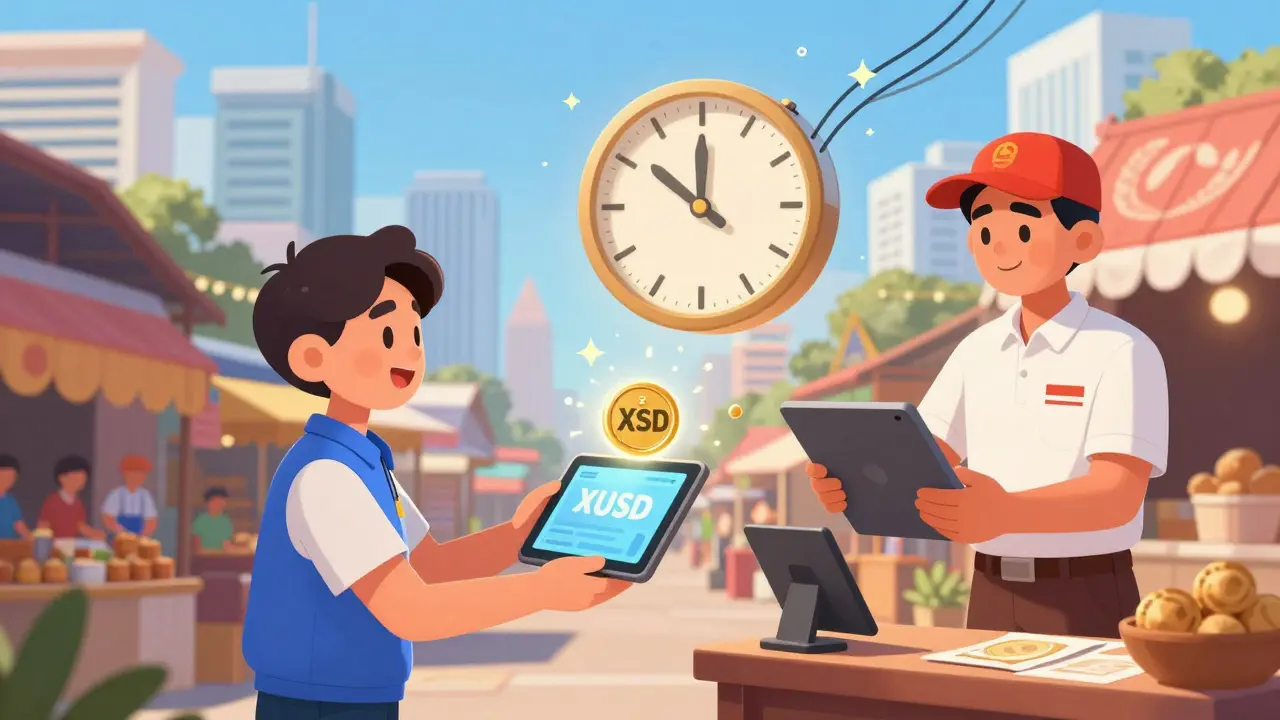
Who Should Use XUSD?
You should consider XUSD if:- You’re based in Singapore, Malaysia, Indonesia, Thailand, or another approved ASEAN country
- You need to send money across borders quickly and cheaply
- You work with businesses that deal with ASEAN suppliers or customers
- You trust regulated financial institutions over anonymous crypto projects
- You live in the U.S., EU, or UK and can’t access it
- You want to trade it for profit-its price barely moves
- You need to use it on major U.S. exchanges
Is XUSD Safe?
Yes-within its scope. It’s not risky like a meme coin. But it’s not risk-free either. The biggest risk? It’s tied to Singapore’s regulatory stance. If MAS changes its rules, or if global regulators start pressuring Singapore to restrict cross-border stablecoins, XUSD’s growth could stall. Also, it’s centralized. StraitsX controls the minting and burning. If their systems go down, you can’t create or redeem tokens. But that’s the trade-off for speed and compliance. Decentralization isn’t the goal here. Legal clarity is.Final Thoughts
XUSD isn’t trying to be the next Bitcoin. It’s trying to be the next digital dollar for Southeast Asia. And for businesses moving money across ASEAN, it’s already doing that. It’s not flashy. It doesn’t promise riches. But in a region where banking systems are slow and unreliable, having a stable, fast, regulated digital dollar is a game-changer. If you’re in the right geography and need to move money without friction, XUSD isn’t just another crypto-it’s a practical tool you can rely on.Is XUSD the same as USDC or USDT?
No. XUSD is a regional stablecoin issued by a Singapore-regulated company, while USDC and USDT are global stablecoins with much larger market caps and broader exchange availability. XUSD is designed specifically for ASEAN compliance and cross-border payments, whereas USDC and USDT are used globally for trading and DeFi.
Can I buy XUSD in the United States?
No. XUSD is not available on U.S. exchanges due to regulatory restrictions. It’s only accessible to users in 18 approved countries, primarily in Southeast Asia and parts of the Middle East and Asia-Pacific. U.S. residents cannot directly purchase or redeem XUSD through official channels.
Is XUSD backed by real U.S. dollars?
Yes. Every XUSD token is fully backed by U.S. dollars held in regulated financial institutions in Singapore. The issuer, StraitsX USD Issuance Pte. Ltd., publishes monthly attestation reports from an independent auditor to prove the 1:1 reserve ratio.
How fast are XUSD transactions?
On Ethereum, XUSD transactions settle in about 12 seconds. On BNB Smart Chain, they settle in under 4 seconds. This makes it significantly faster than traditional bank transfers, especially for cross-border payments in ASEAN.
Can I earn interest on XUSD?
No. XUSD is not designed as a yield-generating asset. It doesn’t support staking, mining, or lending natively. Its purpose is to act as a stable digital dollar for payments, not investment. Any interest earned would come from third-party DeFi platforms that accept XUSD as collateral, not from the issuer.
What happens if StraitsX goes bankrupt?
The USD reserves backing XUSD are held separately from StraitsX’s operating funds in regulated financial institutions. In theory, those funds should remain protected and available for redemption even if the company faces financial trouble. However, legal processes would determine how and when users could access those funds, which introduces some counterparty risk.
Is XUSD regulated by the SEC?
No. XUSD is regulated solely by Singapore’s Monetary Authority of Singapore (MAS). It is not registered with or subject to oversight by the U.S. Securities and Exchange Commission (SEC) or any other U.S. financial regulator.
What to Do Next
If you’re in an approved country and need to send money across ASEAN borders:- Visit straitsx.com and check if your country is supported.
- Complete KYC verification (ID + proof of address).
- Deposit USD via bank transfer.
- Mint XUSD instantly.
- Send it to a recipient’s wallet or exchange it for local currency through a partner bank.

Nicholas Ethan
December 16, 2025 AT 02:02Real stablecoin adoption requires interoperability, not regional gatekeeping.
Hari Sarasan
December 17, 2025 AT 07:20Jessica Eacker
December 18, 2025 AT 13:36Andy Walton
December 18, 2025 AT 23:19Tiffany M
December 20, 2025 AT 03:25Eunice Chook
December 21, 2025 AT 10:58Jessica Petry
December 21, 2025 AT 13:09Scot Sorenson
December 23, 2025 AT 06:27Heath OBrien
December 24, 2025 AT 05:28Taylor Farano
December 25, 2025 AT 05:11Kathryn Flanagan
December 26, 2025 AT 05:30Ian Norton
December 27, 2025 AT 18:05