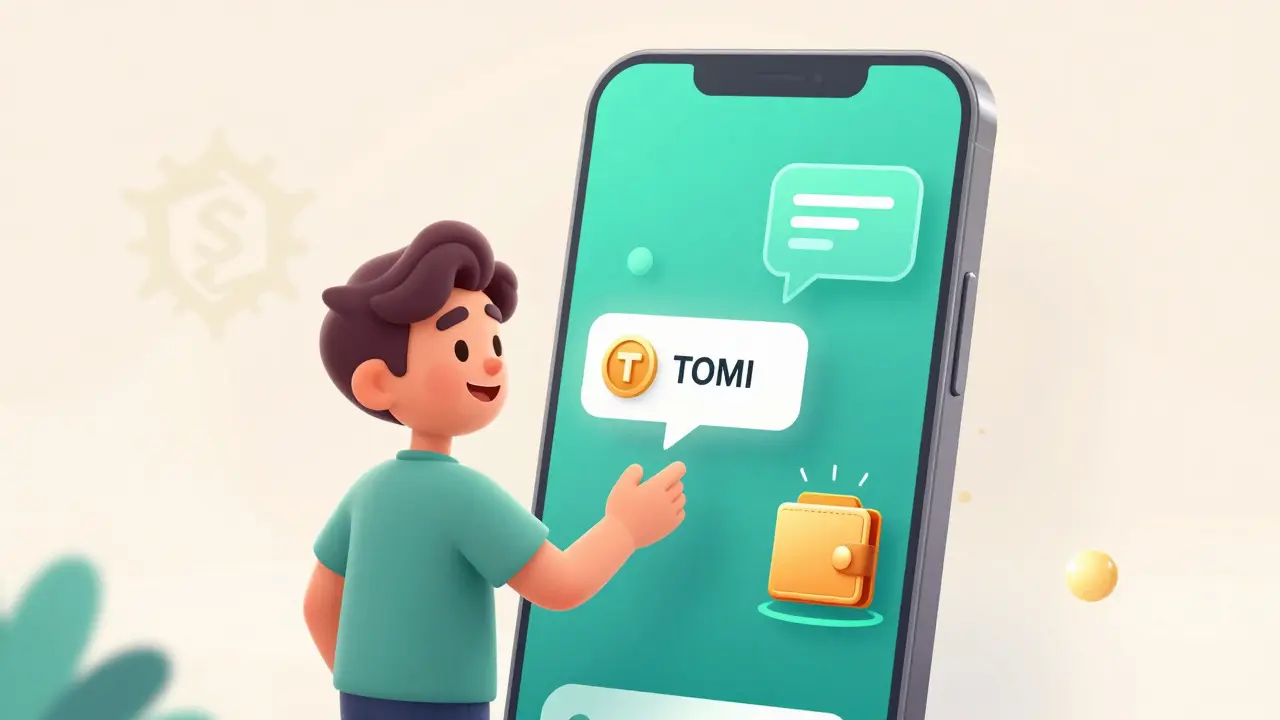
The TOMI crypto coin isn't just another altcoin. It’s a full-blown Web3 app wrapped in a token. Think of it as a mix between encrypted messaging, a crypto wallet, and a creator paywall - all running on the Solana blockchain. You don’t just hold TOMI. You use it to chat, send money, prove who you are online, and even get paid for your content - all without handing control to a company.
What TOMI Actually Does
TOMI isn’t a currency you buy and hope goes up. It’s the engine behind a platform that combines four key functions:
- Encrypted messaging: Private, end-to-end chats that can’t be snooped on - no third-party servers storing your messages.
- Crypto payments: Send and receive TOMI or other tokens instantly using an embedded wallet. No need to switch apps.
- Decentralized identity: Your Username DID (Decentralized Identifier) acts like your digital passport. It stays with you across apps, not locked to one platform.
- Creator monetization: Build a community, set up gated content, and earn directly from followers. No middlemen taking 30%.
This isn’t theoretical. Real users are already doing this. A musician on TOMI can send a private demo to a fan, get paid in TOMI, and lock future tracks behind a paywall - all within the same app. No PayPal, no Patreon, no bank account needed.
Built on Solana - Why That Matters
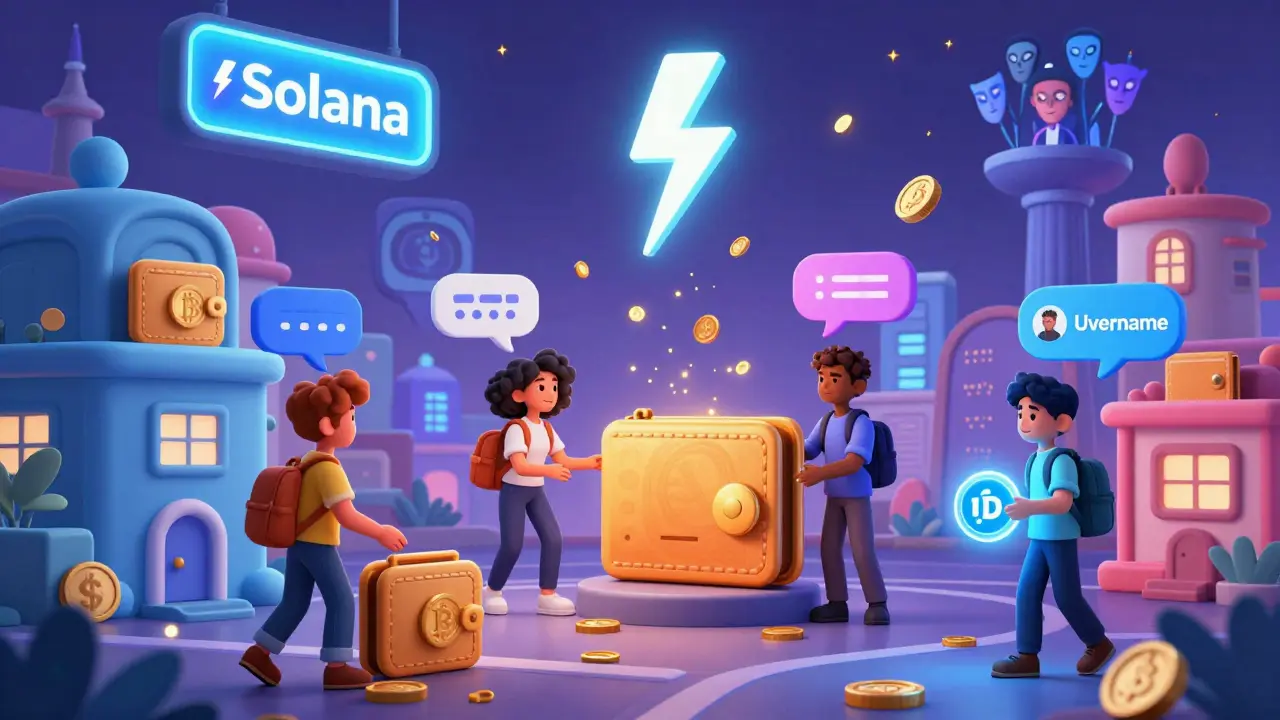
TOMI runs on Solana, and that choice changes everything. Most crypto apps feel slow. Transactions take seconds, sometimes minutes. Fees can be a dollar or more. Solana fixes that.
Solana handles about 65,000 transactions per second. That’s faster than Visa. Block times are under half a second. For TOMI, this means messages load instantly, payments settle in real time, and users don’t get frustrated waiting. Transaction fees? Usually less than a penny. That’s critical when you’re trying to make Web3 feel as simple as texting a friend.
Compare that to Ethereum-based apps, where gas fees can spike to $5 or more during busy times. TOMI’s Solana foundation isn’t a technical footnote - it’s the reason the whole thing works for everyday people.
Market Data - The Numbers Don’t Add Up
Here’s the messy part: nobody agrees on TOMI’s value.
On February 14, 2026:
- TradingView says the price is $0.000040292, up 14% in 24 hours.
- CoinMarketCap reports a $5.34 market cap and 26% surge.
- Investing.com claims a $3.96 million market cap with 2.19 billion tokens in circulation.
- TradingView also shows a $506,370 market cap and $4.97 million in daily volume - a number that doesn’t match the other reports.
Why the chaos? Three reasons:
- Low liquidity: Few exchanges list TOMI. Most trading happens on one or two small platforms. A single large buy or sell can swing the price wildly.
- Data delays: Smaller tokens often don’t get updated fast. One site might show yesterday’s price while another is live.
- Volume manipulation: Some trading pairs are fake. Pump-and-dump groups inflate volume to trick new buyers.
The 52-week price range tells the real story: $0.00117 to $1.39900. That’s a 1,190x swing. One day you wake up with a coin worth 10 cents. The next, it’s worth 1/100th of a cent. This isn’t normal volatility. This is extreme risk.

Who Holds TOMI? And Who Runs It?
About 19,000 wallets hold TOMI. That’s tiny. Bitcoin has millions of holders. Ethereum has tens of millions. TOMI’s user base is still in the early adopter phase.
It’s governed by the TOMI DAO. That means token holders vote on changes - upgrades, fee structures, new features. No CEO. No corporate board. If the community votes to add a new payment method, it happens. If they vote to cut a feature, it gets removed.
This is a double-edged sword. It’s democratic. But it’s also slow. Getting 51% of holders to agree on anything is hard. And if the core team leaves? The DAO has to keep things running alone. No one knows if it can.
How TOMI Compares to Other Web3 Apps
TOMI isn’t alone. It’s trying to do what several other projects do - but all in one place.
| Feature | TOMI | Signal | MetaMask | Len Protocol |
|---|---|---|---|---|
| Encrypted Messaging | Yes | Yes | No | No |
| Non-Custodial Wallet | Yes | No | Yes | No |
| Decentralized Identity | Yes (Username DID) | No | Partial | Yes |
| Creator Monetization | Yes | No | No | Yes |
| Blockchain | Solana | Centralized | Ethereum | Ethereum |
Signal gives you privacy. MetaMask gives you a wallet. Lens Protocol lets creators earn. But none of them do all four together. TOMI’s big bet is that users want one app for everything - not five.
Price Predictions - Take Them With a Grain of Salt
Some sites claim TOMI will hit $0.000000001169 by 2027. Others say it’ll be worth $0.000000000041205. Both are written in the same tone - confident, precise, fake.
Here’s the truth: no one can predict a coin like TOMI. Its market cap is under $6 million. It trades on a handful of exchanges. It has no major partnerships, no institutional backing, and no clear roadmap. Those price forecasts? They’re math models built on zero real data. They’re noise.
If you’re thinking of investing, ask yourself: Would you put money into a startup with no revenue, no team bio, and a website that doesn’t explain how the app works? That’s TOMI right now.
Is TOMI Worth Your Time?
Here’s who should care:
- Web3 builders: If you’re creating a community app, TOMI’s tools could save you months of development.
- Privacy-focused users: If you hate being tracked, and want to send crypto without leaving a trail, this is a rare combo.
- Creators on the edge: If you’re tired of Patreon taking half your earnings, and want to keep 100%, TOMI’s monetization is worth testing.
Here’s who should stay away:
- Investors chasing gains: The price swings are too wild. You could lose 99% of your stake in a week.
- People who want stability: This isn’t Bitcoin. It’s not even Ethereum. It’s a prototype with a token.
- Those who need support: No customer service. No help desk. If the app breaks, you’re on your own.
TOMI isn’t a coin. It’s a bet on whether people want one app to do everything Web3-related. Right now, that bet is still being placed. The platform is real. The tech works. But the market? It’s a gamble.
Is TOMI a good investment?
TOMI is not a good investment for most people. Its market cap is under $6 million, it trades on only a few exchanges, and its price swings wildly - from under a penny to over a dollar in less than a year. Price predictions are speculative and often based on flawed data. If you’re looking to make money, this is far too risky. Only consider it if you’re comfortable losing everything you put in.
Can I use TOMI to send crypto to friends?
Yes. TOMI includes a non-custodial wallet built into the app. You can send TOMI or other tokens directly to another user’s Username DID without needing their wallet address. The transaction is fast and costs less than a penny thanks to Solana’s low fees.
Where can I buy TOMI?
As of early 2026, TOMI is listed on a few smaller exchanges like BingX and some decentralized platforms. It’s not available on major exchanges like Coinbase or Binance. Always double-check the trading pair before buying - many fake listings exist. Use only verified contracts.
What is a Username DID?
A Username DID (Decentralized Identifier) is your permanent, self-owned identity on the TOMI platform. Instead of using a long wallet address like 0x9f3...a7b, you can use a simple username like @jenny42. This DID links to your wallet, messages, and content - and stays with you even if you switch devices or apps that support the same standard.
Does TOMI have a whitepaper or official team?
Public documentation is extremely limited. There’s no clear whitepaper, no detailed technical roadmap, and no verifiable team members listed on the website. This lack of transparency is a major red flag for any project claiming to be decentralized. Community governance through the DAO is the only governance structure, but without clear leadership, progress is slow and uncertain.
Final Thoughts
TOMI is one of the most ambitious Web3 experiments out there. It’s not trying to be money. It’s trying to be the next messaging app - but with crypto built in from day one. If it works, it could change how people interact online. If it fails, it’ll be another footnote in crypto history.
Right now, it’s not a coin. It’s a prototype. And prototypes are for tinkerers - not traders.
