
When you hear the name TOMI, you might think of a forgotten meme coin or a random crypto project. But TOMI isn't just another token. It's a full-blown Web3 platform built on Solana that tries to do something no other crypto project has attempted at this scale: replace your phone's messaging app, your wallet, your identity manager, and even your internet browser-with one private, community-run system.
Launched on June 6, 2023, TOMI hit an all-time high of $7.13. Today, as of February 14, 2026, it trades around $0.000003. That’s a 99.95% drop. So why does anyone still care? Because behind the price crash, there’s real tech. And it’s not going away.
What TOMI Actually Does (Beyond the Price)
TOMI isn’t just a currency. It’s the fuel for a platform called TOMI Network. Think of it like a Swiss Army knife for digital life-but built on blockchain instead of plastic and metal. Here’s what it actually offers:
- Encrypted messaging: Like Signal or Telegram, but no one-not even TOMI’s team-can see your messages. Zero-knowledge proofs keep everything private.
- Multi-chain crypto payments: Send Bitcoin, Ethereum, Solana, or stablecoins in one app. No switching wallets. No swapping exchanges.
- Decentralized identity (DID): Your username isn’t tied to your phone number or email. It’s a unique digital ID you own. You can have multiple identities. You can change them. No one can lock you out.
- Creator monetization: Content creators can charge for posts, videos, or access using TOMI tokens. No middlemen. No platform fees. Just direct payments from fans.
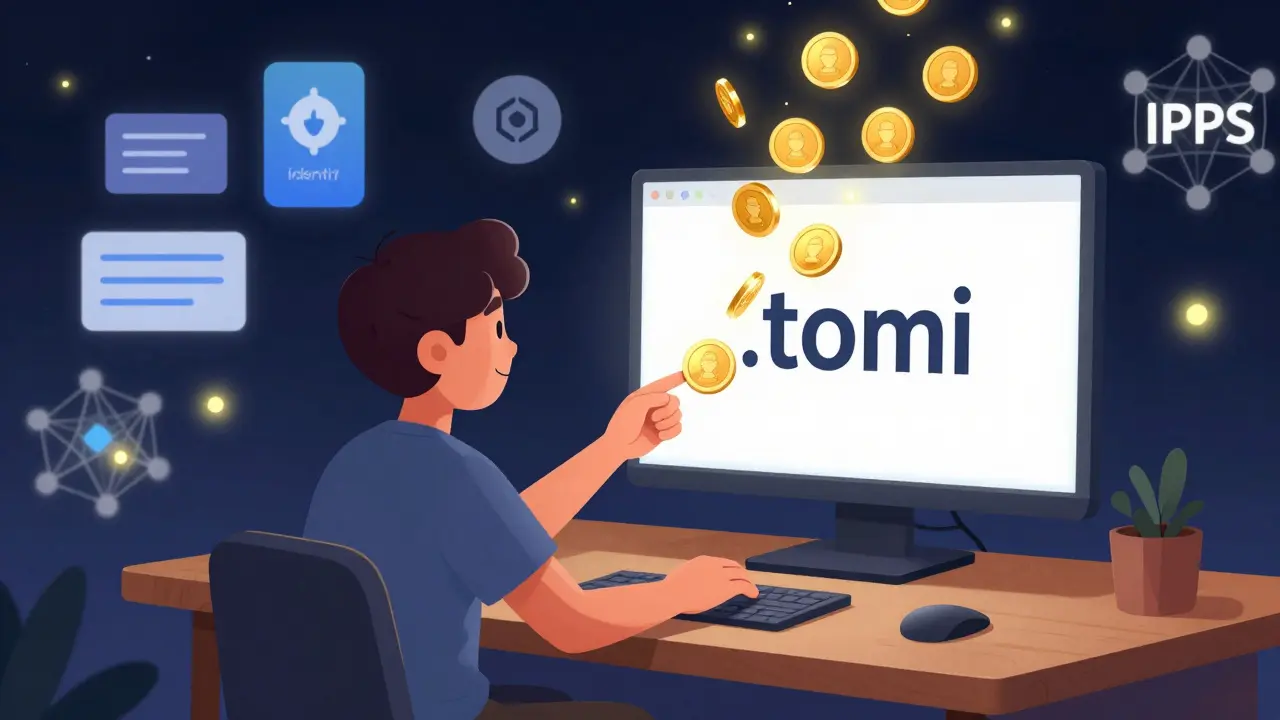
- Decentralized DNS (TDNS): This is the wild part. You can buy a .tomi domain-like yourname.tomi or even amazon.tomi-and host websites that can’t be shut down by governments or corporations. It’s powered by IPFS and built to survive censorship.
These aren’t ideas on a whitepaper. People are using them. In 2025, users minted domains like aaron.tomi, altcoindaily.tomi, and metamask.tomi. That’s not a coincidence. That’s adoption.
How TOMI Works Under the Hood
TOMI runs on Solana because Solana is fast and cheap. Transactions cost pennies. That matters when you’re sending crypto for messaging or paying a creator $0.10 for a newsletter.
The app itself? It’s a fork of Brave Browser. That means it blocks ads, trackers, and scripts by default. But TOMI adds more: a built-in non-custodial wallet, encrypted chat, and a private network called TOMInet. This isn’t just another browser extension. It’s a whole alternative internet layer.
Privacy isn’t an add-on. It’s baked in. TOMI uses SNARK proofs-same tech Zcash uses-to prove you sent money without revealing who you sent it to or how much. It’s advanced cryptography, not marketing fluff.
And unlike apps like Telegram or PayPal, TOMI doesn’t hold your keys. You do. If you lose your seed phrase, your money and identity are gone. That’s the trade-off for true self-custody.
Market Data: The Price Crash and the Recovery
Let’s get real about the numbers. TOMI’s all-time high was $7.13. Today? $0.000003. That’s not a typo. The market cap is under $13,000. Some exchanges say $5, others say $8 million. Why the chaos? Because there’s no consensus on supply. One tracker counts 4.27 billion tokens in circulation. Another says 4.28 billion. Tiny differences like that cause wild swings in valuation.
Trading volume? It’s all over the map. Binance reports $505K in 24 hours. CoinMarketCap says $187K. CoinGecko says $2.3 million. That’s not just volatility-it’s fragmentation. The token is traded on a handful of small exchanges. No Coinbase. No Kraken. No institutional buyers.
But here’s the twist: on January 29, 2026, TOMI hit an all-time low of $0.000001. Just 12 days later, it bounced back to $0.000003-a 1,685% surge. Why? No one knows. Was it a whale? A bot? A community push? No official statement. But the fact that it recovered at all suggests there’s still life in the project.
Who Holds TOMI? And Why?
There are 19,170 wallet addresses holding TOMI. That’s not a lot. Bitcoin has millions. Ethereum has tens of millions. But for a niche Web3 platform? It’s not tiny. It’s a tight-knit group of believers.
Most holders aren’t day traders. They’re builders. Creators. Privacy advocates. People who care about owning their data. You won’t find TOMI on Reddit hype threads. You’ll find it on Discord channels where users discuss domain minting, wallet security, and how to run a TOMI node.
The project doesn’t need 10 million users. It needs 10,000 dedicated ones. Because every person who mints a .tomi domain, sends a message, or pays a creator with TOMI is strengthening the network. It’s not about volume. It’s about utility.
The DAO: Who Really Runs TOMI?
TOMI has no CEO. No board. No venture capital firm calling the shots. It’s governed by a DAO-Decentralized Autonomous Organization. That means every TOMI holder can vote on changes:
- Should the token supply increase?
- Should new blockchains be added to TOMIPay?
- Should domain auctions last 6 months instead of a year?
Each vote is weighted by how many TOMI tokens you hold. So if you own 10,000 TOMI, you have 10,000 votes. If you own 10, you have 10.
It’s not perfect. Voter turnout is low. Many holders don’t even know how to vote. But the structure is there. And that’s rare. Most crypto projects claim to be decentralized. TOMI actually lets you change it.

Is TOMI a Good Investment?
Here’s the truth: if you’re looking for a quick flip, walk away. The price is too volatile. The liquidity is too thin. The market cap is smaller than some meme coins.
But if you’re asking: “Could this become the foundation for a private, censorship-resistant internet?”-then the answer is different.
TOMI isn’t trying to beat Bitcoin. It’s trying to replace your phone. And that’s a much harder job. It needs adoption, not speculation. It needs users, not traders.
The fact that it’s still alive after a 99.95% crash suggests one thing: the tech is too useful to die. The price may crash again. But the network? It’s still being built.
What’s Next for TOMI?
The roadmap is ambitious-and vague. But here’s what’s planned:
- Full DAO governance (voting on everything, not just some things)
- TOMMey Access (a privacy layer for DeFi-think lending and borrowing without KYC)
- More apps built on TOMI Network (think Twitter clone, YouTube clone, all with zero tracking)
- Physical hardware devices (yes, real devices that run TOMI offline-rumored to cost $150-$300, but no official price yet)
None of this is guaranteed. But if even half of it ships, TOMI could become the first Web3 platform that actually replaces mainstream apps-not just adds to them.
Final Thoughts: A Project That Shouldn’t Exist-But Does
TOMI is the kind of project that gets mocked by crypto influencers. It’s too complex. Too niche. Too early. Too risky.
But look at what it’s trying to do: give people back control over their messages, money, identity, and data. No middlemen. No ads. No surveillance.
It’s not perfect. The price is a mess. The ecosystem is small. The tech is unproven at scale.
But it’s real. And in a world where every app sells your data, that’s worth something.

Beth Trittschuh
February 15, 2026 AT 17:43Benjamin Andrew
February 17, 2026 AT 14:54Donna Patters
February 18, 2026 AT 02:21Michelle Cochran
February 19, 2026 AT 19:13Peggi shabaaz
February 20, 2026 AT 18:12Kaz Selbie
February 21, 2026 AT 17:30Robbi Hess
February 22, 2026 AT 00:15Keturah Hudson
February 23, 2026 AT 20:17Ace Crystal
February 24, 2026 AT 00:51Brittany Meadows
February 25, 2026 AT 01:51krista muzer
February 26, 2026 AT 02:43Tammy Chew
February 26, 2026 AT 07:52Lindsey Elliott
February 26, 2026 AT 23:40blake blackner
February 27, 2026 AT 21:53Andrea Atzori
March 1, 2026 AT 09:32Joe Osowski
March 1, 2026 AT 18:09Gaurav Mathur
March 2, 2026 AT 02:29Jeremy Lim
March 2, 2026 AT 10:48